CCSD Code B2710: Radical mastectomy including block dissection
CCSD Code B2710: Definition and clinical scope CCSD Code B2710 is the UK private...

Last Updated: Nov 13, 2026
P9034 is the HCPCS Level II code for platelets, pheresis, each unit. It covers one single-donor apheresis platelet unit with no leukocyte reduction, irradiation or pathogen reduction in its descriptor.
Most P9034 denials trace back to code selection. A leukocyte-reduced unit belongs under P9035, an irradiated one under P9036 or P9037, and a pathogen-reduced one under P9073. Read the product label in the blood bank issue record before you pick the code.
Let Pabau's smart automation suggest the right codes, reduce claim denials, and keep your practice compliant—effortlessly.
Automate repetitive tasks and focus on what matters most—your patients.
Reduce coding errors and ensure compliance with the latest regulations.
Clean claims, fewer denials, and faster reimbursements.
Powerful insights and reporting to help your practice thrive.
HIPAA compliant SOC 2 certified GDPR-compliant Trusted by 4,000+ clinics worldwide

HCPCS Code P9034 covers one unit of apheresis (pheresis) platelets, with no leukocyte reduction, irradiation or pathogen reduction in its descriptor.
Each added processing step moves the unit to another code: P9035 for leukocytes reduced, P9036 for irradiated, P9037 for both, and P9073 for pathogen-reduced.
Each unit billed must match one apheresis platelet unit in the blood bank issue record, or the claim will deny.
Pabau, the practice management platform we build, sends US claims through Claim.MD and brings ERA remittances back, so denied P9034 lines surface early.
HCPCS Code P9034 is the Level II HCPCS code for platelets, pheresis, each unit, in the P0000-P9999 Pathology and laboratory services series. The code is maintained by the Centers for Medicare and Medicaid Services (CMS), and CMS’s quarterly HCPCS release file lists it under that descriptor. It sits in the blood products block (P9010-P9100). The code has been active since January 1, 2001, and one billed unit equals one apheresis platelet product administered to the patient.
The “each unit” wording in the descriptor is the billing rule. Every unit on the claim corresponds to one apheresis platelet product. Pheresis platelets are single-donor products collected by apheresis (also called pheresis), as opposed to pooled platelets derived from multiple whole-blood donations.
Pheresis platelets come from a single donor via an apheresis machine that separates platelets from other blood components and returns the remainder to the donor. One apheresis collection typically yields a therapeutic platelet dose equivalent to four to six pooled random-donor units. It is still billed as one unit, even though its platelet count is higher than a single whole-blood-derived unit.
The P9034 descriptor carries no processing qualifier. It describes an apheresis platelet unit that has not been leukocyte-reduced, irradiated or pathogen-reduced. That makes the product label the deciding document, because each of these steps points to a different code:
Many US blood centers leukocyte-reduce apheresis platelets during collection, so check the label before you default to P9034. The matrix below shows which processing step each neighboring code names.
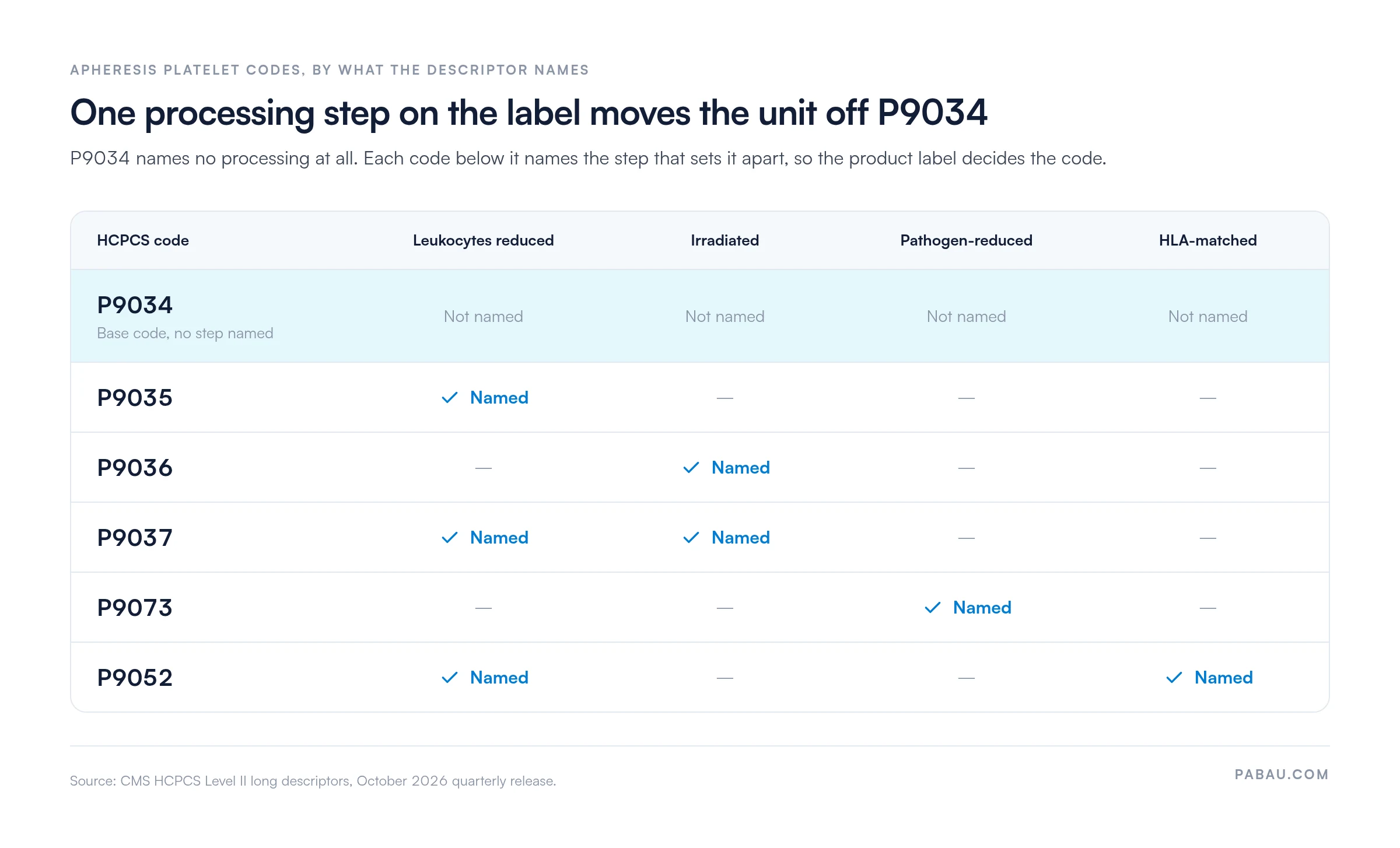
P9034 applies to one specific product: a single-donor apheresis platelet unit with no leukocyte reduction, irradiation, pathogen reduction or HLA matching. Any of those processing steps moves the product to a different code.
The administration service is never bundled into P9034. The blood product and the transfusion service go on separate claim lines, with the transfusion itself reported under 36430.
Always check the blood bank issue record before selecting a code. If the product label shows leukocyte reduction, irradiation or pathogen reduction, P9034 is the wrong code. Record the unit number and the label’s processing attributes in the medical record. That lets anyone trace the claim’s code back to the product.
The P9034 through P9037 family, P9073 and P9052 describe the same starting product — a single-donor apheresis platelet — processed in different ways. The table below maps each code to its official descriptor and the processing attribute that separates it from P9034.
The P9034 versus P9035 pair deserves a closer look. Their descriptors differ by two words, “leukocytes reduced”, and that is the attribute billers most often miss. If the unit label shows leukocyte reduction, the code is P9035. Verify the current-year descriptors in the CMS HCPCS release file or the AAPC HCPCS code lookup before you bill.
Payers require a linked diagnosis code establishing medical necessity on every P9034 claim. The claim needs a valid ICD-10-CM code that supports the clinical indication for a platelet transfusion. Without one, it will deny however accurately the HCPCS code was selected.
The physician order must specify the clinical indication. “Thrombocytopenia” on the order and “D69.6” on the claim align. “Pre-operative platelet support” on the order does not align when the same claim carries no surgical procedure code. Mismatches between the order language and the diagnosis code are a common audit trigger.
Medicare covers platelet transfusion products including P9034 as part of the medically necessary treatment of a covered condition. Coverage rules differ by billing setting, and understanding those differences prevents avoidable denials.
CMS does not publish a specific reimbursement dollar amount for P9034 that holds across all settings and years. Rates are updated through annual OPPS final rules. Never cite a specific dollar figure without year-specific sourcing from the current CMS OPPS Addendum B.
Clean claims for P9034 depend on a documentation chain. It runs from the physician order through the blood bank issue record to the transfusion administration record. If one of those records is missing or disagrees with the claim, expect a denial or an audit finding. The guide to submitting a clean claim covers the payer edits a claim has to pass first.
The product label is the strongest evidence for P9034. Its ISBT 128 product code identifies the collection method and each processing attribute, so record it in the issue log. If the label shows any added processing, recode the line before the claim goes out.
P9034 is reported per unit. One unit equals one apheresis-derived platelet product. That definition sounds simple but generates billing errors in three specific scenarios.
The claim’s quantity field must match the blood bank issue record for the same date. If the blood bank shows two units issued on Monday and one on Wednesday, the claim reflects that split. It should not show three units on one date.
Most P9034 denials fall into six categories. Effective denial management starts with finding which of these drives your team’s denial rate. From there, fix the upstream process instead of only resubmitting the claim. For the CARC and RARC codes that accompany these denials, see the guide to denial codes in medical billing.
The HCPCS blood product code set changed when pathogen reduction technology (PRT) for platelets reached US blood centers. This change has practical consequences for billers who previously used P9034 or P9035 for all pheresis platelets.
CMS added P9073 (Platelets, pheresis, pathogen-reduced, each unit) to the HCPCS Level II code set. It captures pheresis platelets treated with an FDA-approved pathogen reduction system, such as the INTERCEPT Blood System. These products were previously coded inconsistently — some billers used P9034 or P9035, treating pathogen reduction as a secondary step. That approach is incorrect. Pathogen-reduced pheresis platelets require P9073, whether or not the unit was also leukocyte-reduced.
The practical effect: Your blood center may have adopted PRT before your billing team updated the code. If so, you may have P9034 claims on file that belonged under P9073. The same audit applies to leukocyte reduction. If P9034 has been your default for every apheresis unit, check how many were labeled leukocyte-reduced and belonged under P9035. CMS releases the annual HCPCS update files each fall for the following year. Verify P9034’s active status and check for any descriptor revisions each year before billing resumes.
Run a targeted audit of P9034 claims from periods when your blood center transitioned to pathogen reduction technology. Cross-reference the blood bank product records against the codes billed. If pathogen-reduced products were billed as P9034, those claims may need correcting and refiling as P9073. Your payer’s correction and timely filing policies apply.
In many billing offices, a biller copies the code and unit count from the blood bank issue log into the claim. The remittance is then checked against a spreadsheet, line by line, and a denied unit can sit unnoticed for weeks.
Pabau’s claims management software sends US claims through the Claim.MD clearinghouse as CMS-1500/837P claims. Eligibility checks run before the visit, and ERA remittances come back to the same patient record as the claim.
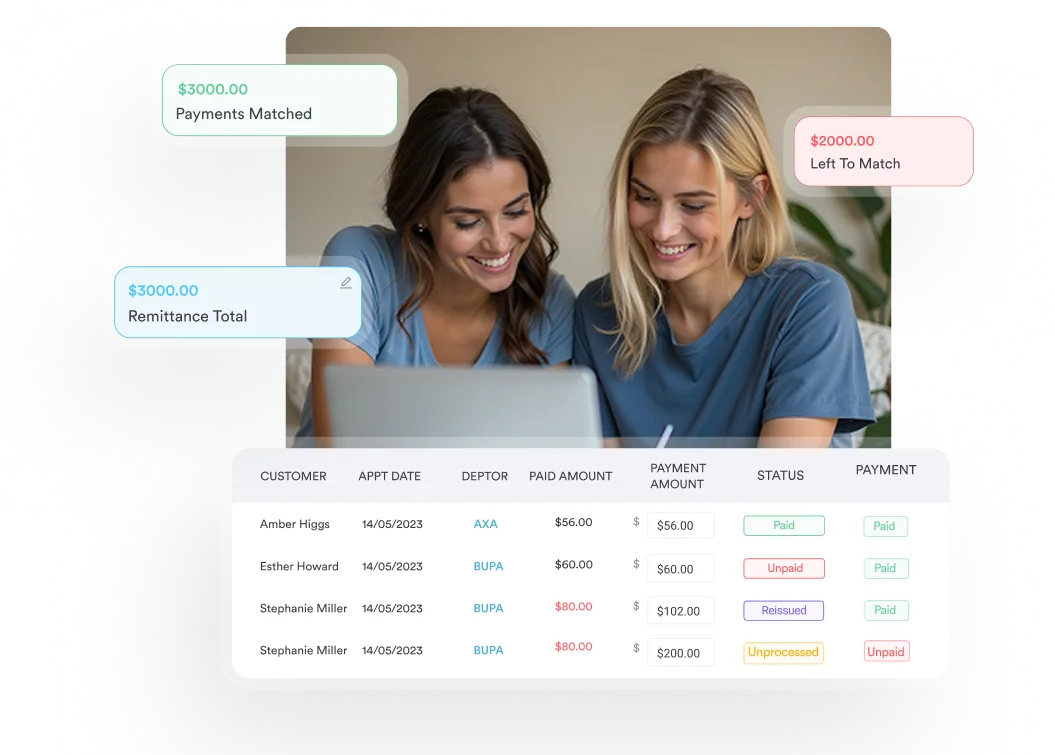
Prior authorization codes, dates and sessions sit on the patient’s case, with a warning when one is missing. That matters for commercial plans that require authorization above a platelet unit threshold. A rejected P9034 line gets corrected and resubmitted while it is still inside the filing window.

Pabau’s claims management tools send US claims through Claim.MD and bring ERA remittances back to the same record. Denied HCPCS lines surface while there is still time to correct them.

Start every P9034 claim at the blood bank issue record. HCPCS Code P9034 fits only an apheresis unit whose label shows no leukocyte reduction, irradiation or pathogen reduction. Many US units carry at least one of those steps, so confirm P9034 against the label on every claim.
The trade-off is a minute of label checking per unit against a denial, a refiling and possibly a post-payment audit. If your blood center adopted pathogen reduction recently, audit past P9034 claims before a payer does.
Book a demo to see how Pabau tracks claim lines and remittances for practices billing blood products.

Need a full reference on HCPCS denial codes? Denial codes in medical billing covers CARC and RARC codes that accompany common blood product claim rejections.
Building a denial prevention workflow? Denial management in healthcare outlines the upstream processes that reduce denial rates across code sets.
New to HCPCS billing overall? Medical billing workflows explains how HCPCS claims flow from code selection through payer adjudication.
Is the unit leukocyte-reduced? HCPCS code P9035 covers leukocyte-reduced apheresis platelets, the code most often confused with P9034.
Was an HLA-matched unit ordered? HCPCS code P9052 explains how HLA-matched, leukocyte-reduced apheresis platelets are billed.
HCPCS Code P9034 describes platelets, pheresis, each unit — one single-donor apheresis platelet unit with no leukocyte reduction, irradiation or pathogen reduction in its descriptor. It covers the blood product itself, not the transfusion administration service, which is billed separately.
P9034 describes platelets, pheresis, each unit, with no processing qualifier. P9035 describes platelets, pheresis, leukocytes reduced, each unit. If the product label shows leukocyte reduction, bill P9035. Verify both descriptors in the current-year CMS HCPCS release file before you bill.
CMS sets no universal per-encounter unit cap for P9034. Units billed must match the apheresis platelet units transfused and documented in the blood bank issue record for that date. Some payers apply medically unlikely edits (MUEs) or prior authorization above a unit threshold. Check your MAC’s policies and any applicable LCD for unit limits.
Yes, Medicare covers P9034 for medically necessary platelet transfusions when billed in an eligible setting by a CMS-enrolled, FDA-authorized provider. Outpatient hospital claims are reimbursed under OPPS APC rates, which change annually. Inpatient claims are generally bundled into the DRG payment. Verify the current APC assignment and any applicable LCD in your MAC region before billing.
Six reasons drive most denials. The most common is the wrong code: the unit was leukocyte-reduced, irradiated or pathogen-reduced and needed P9035, P9036, P9037 or P9073. The others are a missing or mismatched ICD-10 code, units above the blood bank record, missing product documentation, a billing setting mismatch, and late filing. Reconciling the blood bank record against the claim before submission prevents most of them.
P9034 covers pheresis platelets with no processing qualifier. P9073 covers pheresis platelets treated with an FDA-approved pathogen reduction system, such as INTERCEPT. A pathogen-reduced unit is billed as P9073 even if it was also leukocyte-reduced. Billing it as P9034 is a coding error that can trigger post-payment audits.
Leukocyte-reduced apheresis platelets are billed as P9035 (platelets, pheresis, leukocytes reduced, each unit), not P9034. If the unit is also irradiated, use P9037. An HLA-matched, leukocyte-reduced apheresis unit is P9052.