HCPCS Code K0900: Customized DME billing and coding guide
HCPCS Code K0900: Official descriptor and code overview HCPCS Code K0900 is a CM...

Last Updated: Nov 18, 2026
P9032 is the HCPCS Level II code for platelets, irradiated, each unit.
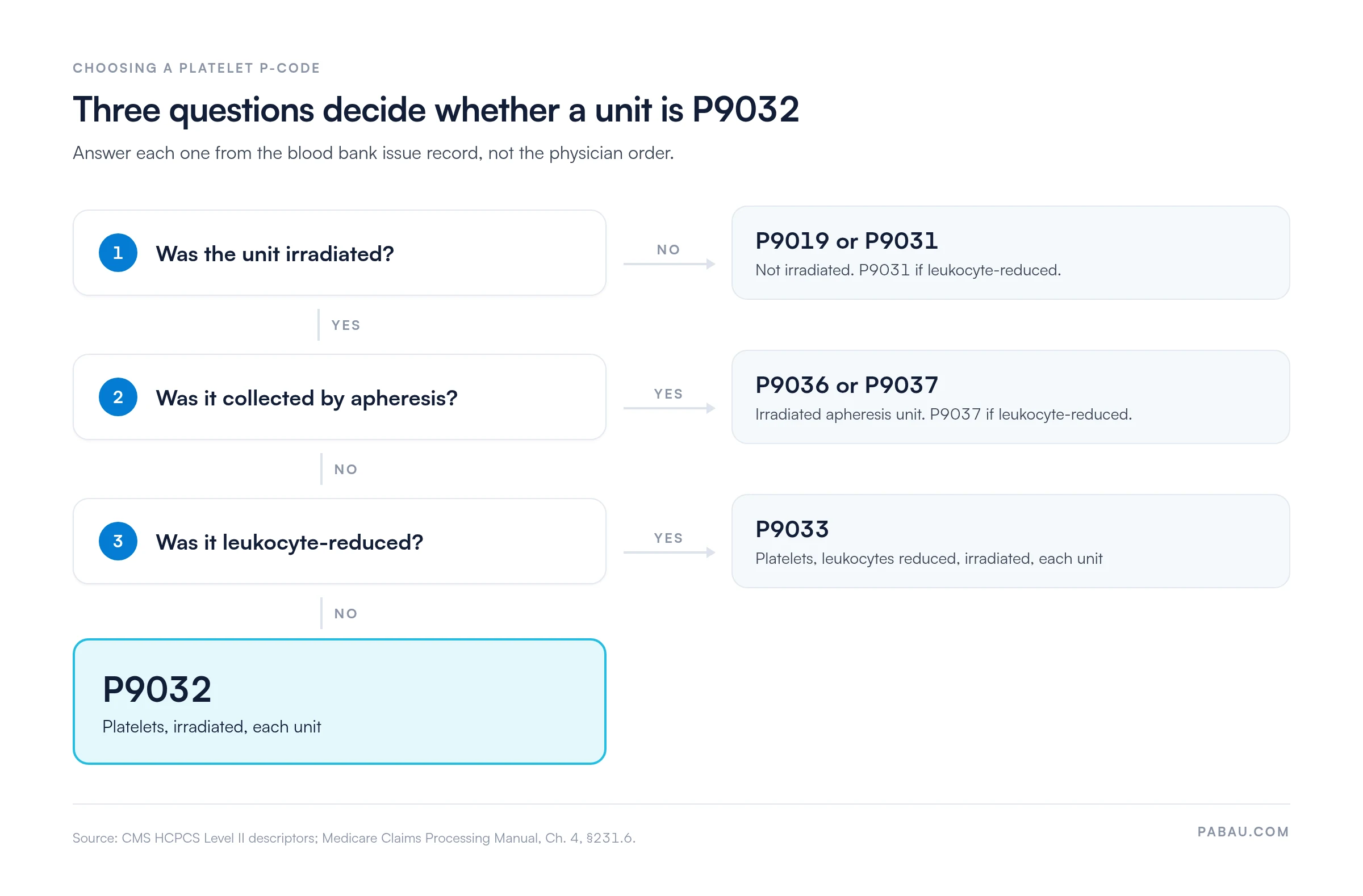
Coders use P9032 when the blood bank issue record shows an irradiated platelet unit that was not collected by apheresis. If the same unit was also leukocyte-reduced, the correct code is P9033 instead. An irradiated apheresis unit moves to P9036, or to P9037 when it is leukoreduced too.
Let Pabau's smart automation suggest the right codes, reduce claim denials, and keep your practice compliant—effortlessly.
Automate repetitive tasks and focus on what matters most—your patients.
Reduce coding errors and ensure compliance with the latest regulations.
Clean claims, fewer denials, and faster reimbursements.
Powerful insights and reporting to help your practice thrive.
HIPAA compliant SOC 2 certified GDPR-compliant Trusted by 4,000+ clinics worldwide

HCPCS Code P9032 covers one unit of irradiated platelets that were not collected by apheresis — the descriptor carries no pheresis or leukoreduction term.
If the issue record shows the unit was also leukocyte-reduced, bill P9033; if it was collected by apheresis, bill P9036 or P9037.
P9032 is billed per unit, and the claim quantity must match the units the blood bank issued and the patient received.
Irradiation prevents transfusion-associated graft-versus-host disease, so the diagnosis codes on the claim should show the patient’s risk, not only thrombocytopenia.
Claims software such as Pabau catches code and unit mismatches before blood product claims reach the payer.
HCPCS Code P9032 is a Level II HCPCS code for irradiated platelets, and its official descriptor is Platelets, irradiated, each unit. It appears as “Platelets, irradiated” in the blood product chart of the Medicare Claims Processing Manual, Chapter 4. The code has been in the set, unchanged, since January 1, 2001.
P9032 sits among the HCPCS Level II codes that the Centers for Medicare & Medicaid Services (CMS) maintains. Its descriptor names one processing step, irradiation, and does not mention apheresis collection or leukocyte reduction. Those two features are what separate P9032 from its neighbors in the platelet family.
P9032 covers a platelet unit that has been irradiated with gamma rays or X-rays. Irradiation stops donor lymphocytes from dividing, which is how it prevents transfusion-associated graft-versus-host disease (TA-GvHD).
The descriptor has no “pheresis” term. P9032 therefore describes a platelet unit prepared from donated whole blood, not one collected from a single donor by apheresis. The blood bank issue record should confirm both points — the unit was irradiated, and it was not an apheresis product.
Covered by P9032:
Not covered by P9032:
Platelet P-codes are built from three yes-or-no questions. Was the unit collected by apheresis? Was it leukocyte-reduced? Was it irradiated? Each combination has its own code. P9032 answers “no” to the first two questions and “yes” to the third. The diagram below asks the irradiation question first, since a “no” there rules P9032 out at once.
Many blood suppliers now leukoreduce most platelets as standard practice. That makes P9033 a common alternative to P9032 for irradiated whole-blood-derived units. Code from what the issue record shows, not from a facility habit or the supplier’s usual process.
The same caution applies to apheresis. Hospitals that transfuse mostly apheresis platelets may see an irradiated unit and assume P9036. If the label shows a whole-blood-derived unit, P9032 or P9033 is correct instead.
Irradiated platelets are ordered for patients at risk of TA-GvHD. It is a rare complication, but it is usually fatal, and it happens when donor lymphocytes engraft in a recipient who cannot reject them.
Medicare coverage for platelet transfusions falls under NCD 110.8 Blood Platelet Transfusions (Medicare Coverage Database ID 44). Irradiation is a product choice inside that coverage, so the record should show why the patient needed it.
Patients commonly given irradiated platelets include:
The table below sets P9032 beside the platelet codes it is most often confused with. Read across the three processing columns, then match the row to the issue record.
The selection rule is short. Use P9032 only when the unit was irradiated, was not collected by apheresis and is not recorded as leukocyte-reduced. A “yes” in either of the other columns moves the claim to a different code.
P9032 is billed per unit. If a patient receives three irradiated platelet units in one episode, the claim line reads P9032 with a quantity of 3. The quantity must match the blood bank issue record, which is an easy target for claim edits.
How the line is paid depends on the setting:
Hospital outpatient claims report blood products under revenue code 038X for the product and 039X for processing and storage. That rule comes from the Medicare Claims Processing Manual, Chapter 4, §231. The transfusion itself is a separate service, reported with its own administration code where the payer allows it.
Because P9032 already describes an irradiated product, an OPPS provider bills P9032 itself and does not add CPT 86945 for the irradiation (Chapter 4, §231.5).
Read the product code on the blood bank issue record, not the physician order. An order for “irradiated platelets” can be filled with a leukoreduced or apheresis unit, and each of those changes the HCPCS code.
Most P9032 claims need no modifier. Under OPPS, a hospital that buys the unit and reports it under revenue code 038X appends modifier BL (Chapter 4, §231.2). The same modifier goes on the matching 039X processing and storage line.
Modifier 22 (increased procedural services) is rarely applicable to blood product codes, because it describes extra physician work rather than a supply.
Payers may ask for other modifiers in specific cases, such as a repeat unit on the same day. Check your Medicare Administrative Contractor (MAC) guidance and payer contracts before adding one.
A P9032 claim needs to show two things. The product given matches the code descriptor, and the patient had a clinical reason for that product. Reviewers look for:
Complete transfusion records support both billing compliance and patient safety. Pabau’s guide to medical billing compliance explains how structured documentation lowers audit exposure.
Medicare does not generally require prior authorization for P9032. Coverage rests on NCD 110.8 and any local guidance from your MAC, so medical necessity is shown in the record rather than approved in advance.
Commercial and Medicaid managed care plans vary. Some require authorization for planned, non-emergency transfusions, especially during a scheduled treatment course. Others follow Medicare policy as their baseline.
Use the CMS Physician Fee Schedule search tool and the OPPS addenda to check current payment rates. Blood product rates change every year, so never carry last year’s figure forward.
Most P9032 denials happen when the code on the claim and the product on the issue record disagree. These are the patterns to watch for.
Tracking denials by code shows which pattern costs your facility the most. Tagging each denial with its HCPCS code makes blood product errors visible before they repeat.
The diagnosis codes on a P9032 claim should explain why the patient needed irradiated platelets. These codes often appear alongside it:
Pair the risk diagnosis with a thrombocytopenia or bleeding code where the record supports it. Together they explain both the transfusion and the irradiation.
Most blood product billing still depends on someone reading an issue record and picking the right code by hand. With six platelet codes that differ by one word, a tired coder can easily bill P9032 for a unit that was also leukoreduced.
Pabau checks each claim line before it goes out. Pabau’s claims management software flags code and quantity mismatches, attaches the documents a payer will ask for and tracks every denial by code.
The result is fewer rework cycles on blood product claims, and a clear view of which errors keep coming back.

Pabau’s claims management tools help billing teams capture blood product charges accurately and track denials by code. P9032 errors stop recurring.

P9032 is the narrowest of the irradiated platelet codes — one irradiated, non-apheresis unit with nothing else named. That narrowness makes it easy to misuse, because many irradiated units a blood bank issues are also leukoreduced or collected by apheresis.
Treat the blood bank issue record as the deciding document, and P9032 becomes a quick, defensible choice. Pabau’s clean claim checks keep those decisions consistent across your team. Book a demo to see how it works on your blood product claims.

Need a deeper look at denial patterns across your blood product claims? Denial codes in medical billing explains common remark codes and how to respond to each.
Looking for a primer on the full billing workflow? What is revenue cycle management covers the end-to-end process from charge capture through payment posting.
Billing a platelet unit that was not irradiated? HCPCS code P9019 covers platelets with no irradiation or leukocyte reduction, billed per unit.
HCPCS Code P9032 covers one unit of irradiated platelets, billed per unit. The official descriptor is “Platelets, irradiated, each unit.” It applies to non-apheresis units that are not recorded as leukocyte-reduced.
Both codes describe irradiated platelets. P9036 is for platelets collected by apheresis, while P9032 is for non-apheresis units. Check the collection method on the blood bank issue record to choose between them.
P9033 covers irradiated platelets that were also leukocyte-reduced. P9032 names irradiation only. If the issue record shows leukoreduction, bill P9033 instead of P9032.
No. P9037 covers apheresis platelets that are both leukocyte-reduced and irradiated. P9032 covers non-apheresis platelets with irradiation as the only processing step named.
Bill one P9032 unit for each irradiated platelet unit the patient received, as shown on the blood bank issue record. If three units were issued and given, the quantity is 3.
Most P9032 claims need no modifier. Under OPPS, a hospital that buys the unit and bills it under revenue code 038X appends modifier BL. Modifier 22 rarely applies, so check your MAC and payer contracts for other rules.
Yes. Under Medicare Part B, hospital outpatient blood products are paid through the OPPS. For inpatient Part A claims, blood product costs are bundled into the DRG payment.