CPT code 21011: Excision of soft tissue tumor of the face
CPT code 21011: Official descriptor and procedure overview CPT code 21011, as pu...

Last Updated: Oct 8, 2026
P9033 is the HCPCS Level II code for platelets, leukocytes reduced, irradiated, each unit.
Let Pabau's smart automation suggest the right codes, reduce claim denials, and keep your practice compliant—effortlessly.
Automate repetitive tasks and focus on what matters most—your patients.
Reduce coding errors and ensure compliance with the latest regulations.
Clean claims, fewer denials, and faster reimbursements.
Powerful insights and reporting to help your practice thrive.
HIPAA compliant SOC 2 certified GDPR-compliant Trusted by 4,000+ clinics worldwide

HCPCS Code P9033 covers one unit of platelets that has been both leukocyte reduced and irradiated before transfusion.
Bill P9033 per unit administered, with a claim line for each individual platelet unit transfused rather than per transfusion episode.
Modifier 77 is the most frequently misapplied modifier on P9033 claims, so document the ordering and administering providers separately.
Practice management software like Pabau supports HCPCS P-series billing workflows and cuts manual keying errors on blood product claims.
HCPCS Code P9033 carries the official descriptor Platelets, leukocytes reduced, irradiated, each unit. It belongs to the HCPCS Level II P-series, the range CMS maintains for blood, blood products, and pathology services.
P-series codes are updated annually. P9033 has stayed active through the 2026 code year, with no change to the descriptor or its status.
Both processing steps in the descriptor matter clinically and for billing. Leukocyte reduction and irradiation must each be documented in the transfusion record before the claim is submitted. A platelet unit that has undergone only one of the two processes does not meet the P9033 descriptor.
Leukoreduced irradiated platelets go to patients whose immune systems cannot safely handle a standard unit. According to the AAPC’s HCPCS code reference, P9033 is indicated for immunocompromised recipients, where an unmodified platelet product carries an elevated risk of transfusion complications. Two specific risks drive the double-processing requirement.
Clinicians typically order P9033 products for four patient groups.
Indications still vary by institution and payer. Frame the documentation around the specific diagnosis and the ordering physician’s rationale rather than assuming universal coverage.
P9033 is billed per unit. Each individual platelet unit transfused generates its own claim line, so four units transfused during one encounter means four units of P9033. Submit one claim line with a quantity of four, or four separate lines of one each. Payer preference varies, so check your MAC’s submission instructions.
Tracking unit counts across a multi-unit transfusion session is where manual entry slips. Software built for cleaner claims management keeps the quantity on the claim tied to the units recorded against the encounter.

Documentation requirements are strict. The transfusion record must confirm that both processing steps occurred, and both must be attributable to the specific unit being billed. Four records carry that proof.
Assemble those four records before a single code is entered. The same discipline sits behind the clean claim standards that apply to every other submission your practice sends.
Payer rules diverge at the commercial level. Medicare generally covers P9033 when an appropriate diagnosis establishes medical necessity.
Commercial payers may require prior authorization for processed blood products in elective transfusion settings. Verify coverage with the specific plan before the transfusion whenever the clinical situation allows.
Modifier selection is where billing errors on P9033 claims cluster. The modifiers below apply in specific clinical and administrative circumstances. Applying the wrong one, or omitting a required one, triggers edits that delay or deny payment.
Modifier 76 versus modifier 77 is the most common point of confusion. Modifier 76 applies when the same physician performs a repeat procedure, and modifier 77 when a different physician performs it.
Take a transfusion where a hospitalist orders the first unit and an on-call hematologist orders later units the same day. Modifier 77 is correct on the second provider’s claim, and both providers must appear in the medical record.
Modifier rules vary between CMS and commercial payers. Verify your MAC’s local guidance before applying them across high-volume claim scenarios.
CMS sets Medicare fee schedule amounts for blood product codes, and regional Medicare Administrative Contractors (MACs) administer them. Rates vary by MAC locality and are updated in the annual CMS Physician Fee Schedule.
Locality-specific rates shift every January 1, so verify the current allowed amount against your MAC’s published schedule before quoting expected reimbursement.
Several factors move the payment amount on a P9033 claim. Medicare’s methodology for blood products accounts for acquisition cost, processing, and overhead. Crossover claims, where Medicare pays primary and a commercial plan pays secondary, may see different allowed amounts at each level.
The claim’s setting decides which methodology governs it. Hospital outpatient claims bill on the facility side under the Outpatient Prospective Payment System (OPPS), which uses APC-based payment logic for blood products.
Physician office claims follow the Physician Fee Schedule. Knowing which one applies prevents underbilling and reduces overpayment risk.
For current locality-specific rates, query your MAC’s online portal directly rather than a third-party lookup. Check the rate at least once a year, ideally before January claims go out.
P9033 sits in a family of platelet codes whose descriptors look similar at a glance. Picking the wrong one is a common audit trigger. Two facts settle the choice. The first is how the platelets were collected, the second is which processing steps were performed.
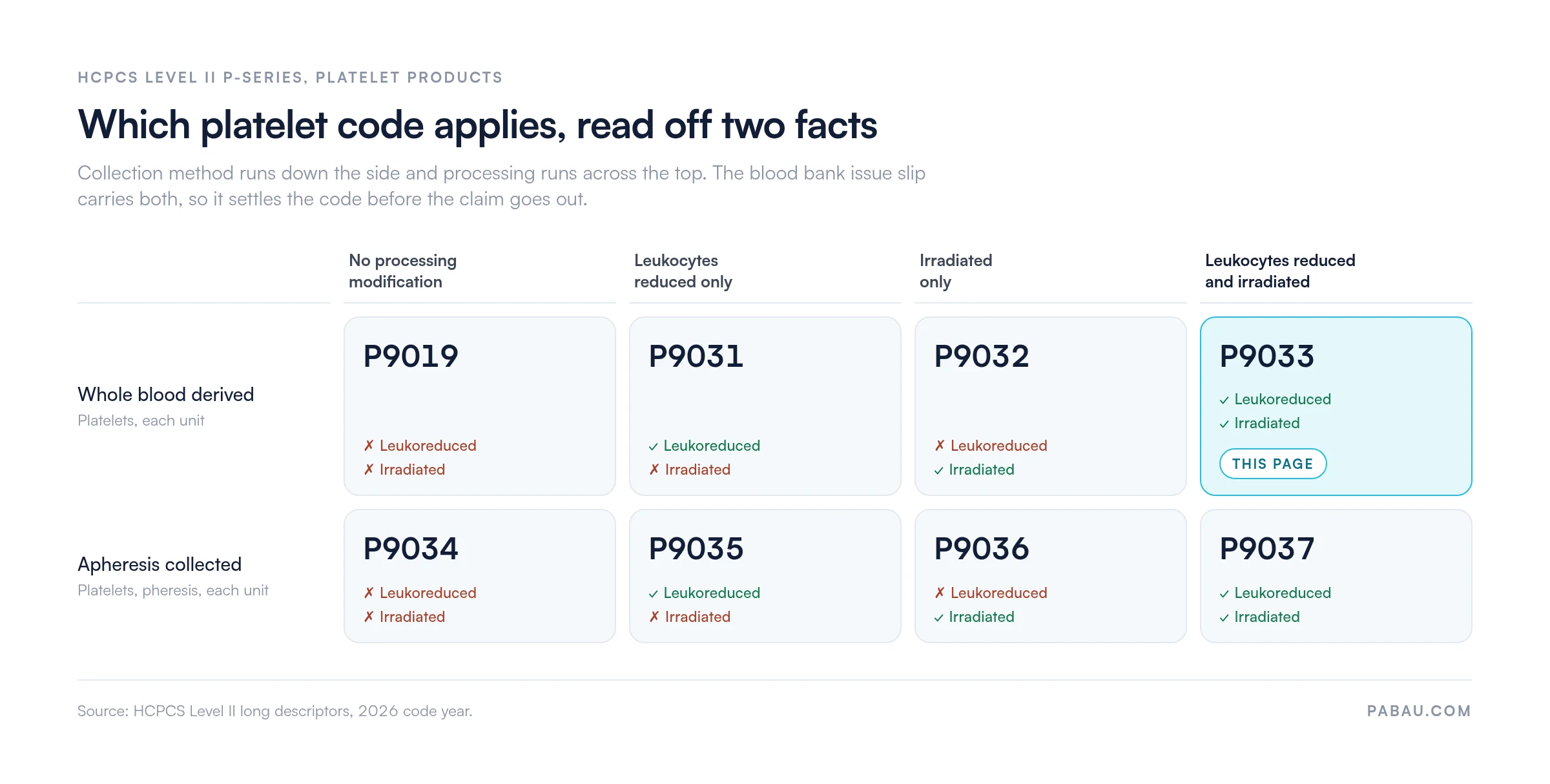
The table below spells out each descriptor and how it differs from P9033.
The P9031, P9032 and P9033 trio is where most coding errors happen. Selecting P9033 when only one processing step was performed is upcoding. Selecting P9031 or P9032 when both steps occurred leaves legitimate reimbursement uncaptured.
The blood bank issue slip is the primary audit document, so it should name both processes explicitly and the code must match it.
Before submitting any P9033 claim, pull the blood bank issue slip. Confirm two distinct processing entries, one for leukocyte reduction and one for irradiation. If only one entry appears, the correct code is P9031 or P9032. This single check prevents the most common upcoding denial on blood product claims.
Medicare covers leukoreduced irradiated platelet transfusions when the patient’s diagnosis establishes medical necessity. No national coverage determination (NCD) mandates prior authorization specifically for P9033. Individual MACs may still issue local coverage determinations (LCDs) that set diagnosis-based criteria.
Review your MAC’s LCDs for blood product transfusions before you submit for a patient whose diagnosis falls outside the common hematology-oncology conditions.
The HCPCS series a code sits in decides Medicare eligibility before any medical necessity review. P-series blood product codes are payable, while temporary S-codes like HCPCS code S0164 are rejected by a MAC on system logic.
Commercial payers vary considerably. Some require prior authorization for processed platelet products regardless of setting. Others cover them automatically when the transfusion happens in a hospital.
Outpatient infusion center billing needs the most careful plan-by-plan verification, since criteria often differ from inpatient rules inside the same insurer.
Facility and professional billing split here too. The hospital bills P9033 on the UB-04 institutional claim under the outpatient or inpatient facility revenue code.
The administering physician bills the transfusion administration CPT code separately on the CMS-1500. Both claims must carry consistent dates, quantities, and diagnoses, or automated edits will flag the discrepancy.
Denials on blood product claims cluster around three failure points. Those are wrong code selection, missing documentation, and modifier errors. The checklist below addresses each one for the double-processed platelet product specifically.
Denial management matters as much as prevention. When a P9033 claim is denied, first identify whether it is a coding denial, a documentation denial, or a coverage denial. Each has a different appeal pathway, and routing them by type cuts the time to resolution on blood product claims.
Tracking P9033 denial patterns over 90-day periods usually points at a documentation problem that training can fix. Our reference on denial codes breaks down the remittance adjustment reason codes you will see most often.
Run a 90-day audit of your P9033 claims before and after any transfusion protocol change. Filter by denial reason code. If most cluster around CO-4 (inconsistent modifier) or CO-11 (diagnosis inconsistent with procedure), you have a training problem rather than a documentation problem. Fix the process at the front end instead of managing denials one at a time.
Practices billing blood products often run the code selection in one place and the claim in another. A coder reads the blood bank issue slip, writes P9033 on a worksheet, and someone else keys the unit count into the billing system. Every hand-off is a chance for the quantity or the modifier to drift from the record.
Practice management software like Pabau keeps the two together. The encounter that records the transfusion is the same record the claim is built from. The unit count on the claim comes from what was administered, not from a re-keyed worksheet. Modifiers and diagnoses sit on the same line.
Every Pabau subscription includes the full billing and claims toolset, so no part of it sits behind a higher tier. For a billing team handling regular multi-unit transfusion sessions, that means fewer corrected claims and less time spent reconciling unit counts after a denial.

Pabau supports HCPCS P-series submissions, tracks unit counts across a transfusion encounter, and flags missing documentation before the claim goes out.

The code itself is the easy part of P9033. The work sits upstream. The blood bank issue slip has to prove both processing steps happened, and the unit count has to match what was administered.
So build the check into the workflow instead of the appeal. A practice that confirms two processing entries before the claim leaves rarely argues about upcoding later. One that keys unit counts by hand will keep paying for it in reworked claims.
The trade-off worth remembering is that the most processed product carries the heaviest documentation load. Book a demo to see how Pabau ties P-series unit counts to the transfusion record before the claim goes out.

Need to understand how medical billing workflows connect to documentation? What is medical billing walks through the full revenue cycle from charge capture to remittance.
Seeing repeated P9033 denials and not sure why? Denial management in healthcare covers how to build a systematic denial categorization and appeal process.
Want a clean-claim checklist for every blood product submission? What makes a clean claim outlines the documentation and billing standards that prevent edits before the claim leaves your system.
HCPCS Code P9033 is used to bill for a platelet unit that has undergone both leukocyte reduction and irradiation before transfusion. It is submitted once per individual platelet unit administered. The code is typically associated with immunocompromised patients, where standard platelets would carry elevated transfusion risk.
Bill P9033 per unit transfused. Submit one unit of P9033 for each individual leukoreduced irradiated platelet unit administered during the encounter. The blood bank issue slip must confirm both processing steps for each unit. Document the ordering diagnosis, the treating physician, and the administration date for each claim line.
Six modifiers apply to P9033 under the right circumstances. They are 52 for a reduced service, 76 and 77 for repeat procedures, 78 and 79 for postoperative situations, and 99 for multiple modifiers. Modifier 76 versus 77 is the most common selection error. Use 76 when the same physician repeats the transfusion, and 77 when a different physician does.
P9031 covers platelets that are leukoreduced only, with no irradiation. P9032 covers platelets that are irradiated only, with no leukoreduction. P9033 requires both leukoreduction and irradiation. Selecting P9033 when only one processing step occurred is upcoding. Selecting P9031 or P9032 when both steps occurred results in underbilling. The blood bank issue slip is the definitive document for code selection.
Diagnoses commonly linked to P9033 include bone marrow or stem cell transplant status, chemotherapy-induced immunosuppression, congenital immune deficiencies, and neonatal transfusion indications. Coverage criteria vary by MAC and commercial payer. Always verify your payer’s local coverage determination for blood products, and document the clinical rationale in the ordering physician’s notes.
Medicare fee schedule rates for P9033 vary by MAC locality and are updated annually. Rates differ by region, so a single dollar figure would mislead. Check the CMS Physician Fee Schedule search tool, or your MAC’s published schedule, for the allowed amount in your locality. Rates effective January 1, 2026 apply to dates of service in the 2026 calendar year.