CPT code 36468: Injection sclerotherapy of telangiectasia billing guide
CPT code 36468 covers spider veins on a limb or the trunk CPT code 36468 reports...

Last Updated: Nov 13, 2026
P9053 is the HCPCS Level II code for platelets, pheresis, leukocytes reduced, CMV-negative, irradiated, each unit.
It applies to a single-donor apheresis platelet unit that carries all three processing attributes: leukoreduced, CMV-negative and irradiated. Without irradiation, the same unit bills as P9055. An irradiated, leukoreduced apheresis unit without CMV-negative status bills as P9037, and HLA-matched platelets have their own code, P9052.
Let Pabau's smart automation suggest the right codes, reduce claim denials, and keep your practice compliant—effortlessly.
Automate repetitive tasks and focus on what matters most—your patients.
Reduce coding errors and ensure compliance with the latest regulations.
Clean claims, fewer denials, and faster reimbursements.
Powerful insights and reporting to help your practice thrive.
HIPAA compliant SOC 2 certified GDPR-compliant Trusted by 4,000+ clinics worldwide

HCPCS Code P9053 covers one apheresis platelet unit that is leukoreduced, CMV-negative and irradiated, billed per unit transfused.
P9055 is the same product without irradiation, P9037 is irradiated and leukoreduced without CMV-negative status, and P9052 covers HLA-matched platelets.
Irradiation prevents transfusion-associated graft-versus-host disease, so the order and record should name the patient’s irradiation indication.
Most hospitals report P9053 under revenue code 0390 because the blood supplier charges only for processing, and never add CPT 86945 for the irradiation.
Medicare pays P9053 separately under OPPS with status indicator R, so check the current Addendum B for the national rate.
HCPCS Code P9053 is a Level II code that the Centers for Medicare and Medicaid Services (CMS) maintains in its Healthcare Common Procedure Coding System. The official long descriptor reads: Platelets, pheresis, leukocytes reduced, CMV-negative, irradiated, each unit.
Every term in that descriptor is a coding condition. Pheresis means a single-donor collection. Leukocytes reduced means the white cells were filtered out. CMV-negative means the donor tested seronegative for cytomegalovirus, and irradiated means the unit was treated to inactivate donor lymphocytes.
P9053 requires all three attributes at once. A unit missing any one of them belongs to a different code, which the comparison section below maps out. Code descriptors here follow the AABB billing guide for blood products and the CMS HCPCS file.
Irradiation exists to prevent transfusion-associated graft-versus-host disease (TA-GvHD). Donor T-lymphocytes in an unirradiated unit can engraft in a recipient who cannot reject them. The British Society for Haematology (BSH) describes TA-GvHD as rare but usually fatal.
The BSH 2020 guidelines on the use of irradiated blood components list the patient groups that need irradiated cellular components. The main indications are:
CMV-negative status addresses a separate risk: cytomegalovirus transmission to a seronegative, immunocompromised recipient. Many blood services treat leukoreduction as CMV-safe, so the CMV-negative specification follows local transfusion policy. When the order asks for it and the label confirms it, the unit qualifies for P9053.
P9053 pays for the platelet product itself. The transfusion procedure and some related laboratory services carry their own codes.
Irradiation is already built into P9053. The AABB billing guide states that billing irradiation CPT code 86945 alongside an irradiated P-code is never appropriate. If an irradiated unit is prepared but not transfused, the hospital may bill 86945 for the irradiation, but not the P-code.
The apheresis platelet codes differ by one or two processing attributes. Picking the right one means reading the unit label against each descriptor.
The one-attribute pair is P9053 and P9055. Both describe leukoreduced, CMV-negative apheresis platelets, and only irradiation separates them. P9037 is the other close neighbor. It is irradiated and leukoreduced, but its descriptor carries no CMV-negative specification.
The order logic runs in a fixed sequence. Irradiated, leukoreduced, CMV-negative apheresis platelets are P9053. Leukoreduced, CMV-negative apheresis platelets without irradiation are P9055. HLA-matched leukoreduced apheresis platelets are P9052. P9035 covers leukoreduced apheresis platelets with neither attribute specified. Apheresis platelets with no leukoreduction, irradiation or CMV-negative label are HCPCS P9034. P9032 describes irradiated platelets without the apheresis or leukoreduction terms.
For leukoreduced apheresis units that are not HLA-matched, two label checks settle the code, as the matrix below shows.
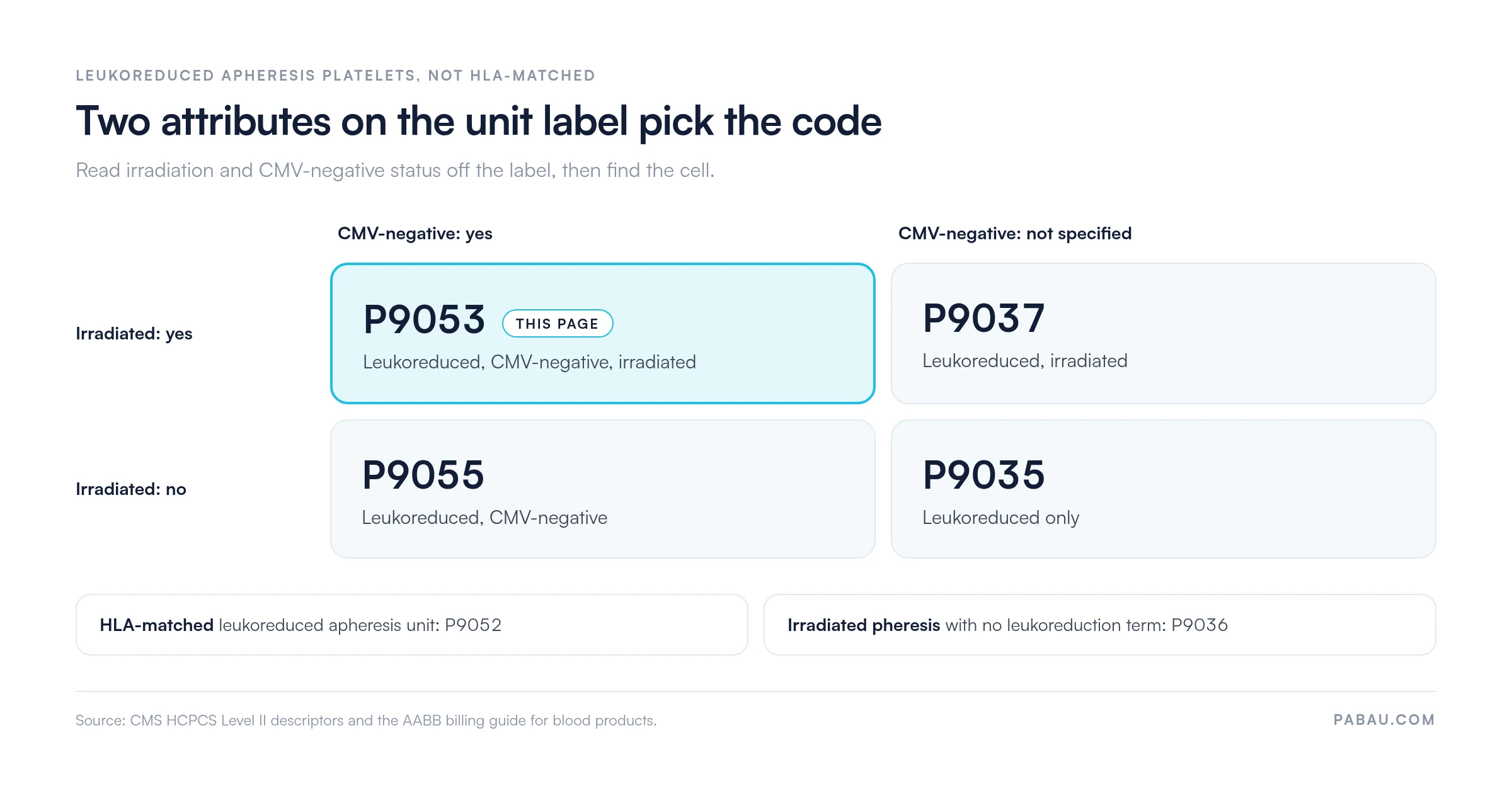
Read the unit label for three attributes before you code the line: leukoreduced, CMV-negative and irradiated. All three present means P9053. No irradiation means P9055, and no CMV-negative status on an irradiated unit means P9037. If the label and the order disagree, get the order clarified first.
Accurate P9053 billing matches the blood bank issue record to the claim line, unit by unit. The steps below take a unit from the order to the submitted claim.
Revenue code choice depends on what the hospital paid for. According to the AABB billing guide, most hospitals get blood from community blood centers that charge only for processing and storage. Those hospitals report the P9053 line under revenue code 0390.
Revenue code series 038X, modifier BL and blood-related value codes apply only when the hospital bills for the blood itself. A processing-only claim uses none of them. Hospital outpatient claims go on the UB-04, with P9053 in form locator 44.
Medicare does not require an NDC on a P-coded blood component line. Blood components carry ISBT 128 product codes on their labels rather than NDCs. Some state Medicaid programs and commercial payers set their own drug-reporting rules, so check each payer’s policy.
Most processing-only P9053 claims need no modifier. Modifier BL (special acquisition of blood and blood products) applies only when the hospital bills the cost of the blood under revenue code 038X. The JW and JZ discarded-drug modifiers apply to single-dose drug containers, and P-series blood codes are outside that policy.
NCCI edits also govern which blood codes can share a claim. Per the AABB guide, certain non-irradiated platelet P-codes are not paid when billed with an irradiated P-code on the same outpatient claim and date. Review the current NCCI edits before you report P9053 next to another platelet code.
Medicare pays hospital outpatient claims for P9053 under the Outpatient Prospective Payment System (OPPS). Blood product P-codes carry status indicator R and sit in their own Ambulatory Payment Classifications (APCs). The national rate changes with each annual OPPS final rule and quarterly update, so check the CMS OPPS Addendum B for the date of service.
Track P9053 payments against what your blood supplier charges each year. Effective revenue cycle management for blood products means spotting a rate change before it erodes the margin on every unit.
A P9053 claim stands on a complete chain from order to transfusion. Payers check both the product attributes and the reason for them. Building that chain before submission is core to medical billing compliance.
No Medicare national or local coverage determination sets a diagnosis list for P9053. The codes below are diagnoses that commonly document the need for irradiated components, based on the BSH 2020 indication list. They are examples, not a payer-accepted list.
Use the most specific code the record supports, rather than an unspecified variant. Confirm current code status in the CDC ICD-10-CM browser before you submit.
Most P9053 problems start when the order, the unit label and the claim line disagree. A front-end check catches them before submission, which is the core of denial management in healthcare.
Read the CARC and RARC on the remittance before you rework the claim. CARC 50 signals a medical necessity dispute, while CARC 16 points to missing information or a billing error. The denial codes in medical billing guide maps each code to its fix.
Add two hard stops to your blood product charge rules. Block any claim that pairs CPT 86945 with an irradiated P-code for the same unit. Hold any P9053 line whose unit number has no matching transfusion record.
A P9053 claim depends on records that often live in separate places. The order sits in the chart, the unit label sits with the blood bank, and the charge sits in billing. A mismatch between them stays hidden until the remittance arrives.
Pabau, the practice management and billing platform we build, keeps the order, scanned unit labels and the invoice on one patient record. For US payers, Pabau’s claims management software pre-fills claims from data already on the record and submits them through Claim.MD. Your team then tracks each claim’s status and denial reason in one place.
When a payer asks for records on a P9053 line, staff pull the order and label from the same record as the invoice. That turns an audit request into a document pull rather than a search across systems.

Pabau keeps the order, unit records and invoice on one patient record. Your team matches each P9053 charge to its records and tracks every denial reason in one place.

P9053 is the code for one specific product: an apheresis platelet unit that is leukoreduced, CMV-negative and irradiated. Treat the unit label as the source of truth, and code from all three attributes. Drop irradiation and the line becomes P9055, while dropping CMV-negative status makes it P9037.
Two checks carry most of the risk. Confirm the order states the irradiation indication, and keep CPT 86945 off any unit already billed as P9053. Running both on every platelet line keeps audits short.
Book a demo to see how Pabau keeps orders, unit records and invoices together for every transfusion claim.

Need a full denial management framework? Denial management in healthcare covers root-cause analysis, appeal workflows, and denial prevention strategies for outpatient billing teams.
Unfamiliar with clean claim requirements? What makes a clean claim explains the data elements payers check on submission and how to prevent common edit failures.
Looking to understand the broader billing picture? What is medical billing covers the end-to-end revenue cycle from charge capture through payment posting.
HCPCS Code P9053 describes platelets, pheresis, leukocytes reduced, CMV-negative, irradiated, each unit. It is one single-donor apheresis platelet unit with white cells filtered out, from a CMV-seronegative donor, and irradiated to inactivate donor lymphocytes. All three attributes must be present.
Irradiation is the only difference. Both codes describe leukoreduced, CMV-negative apheresis platelets. P9053 is the irradiated unit and P9055 is the same unit without irradiation. P9052 is a separate code for HLA-matched leukoreduced apheresis platelets.
Report one unit of P9053 for each apheresis platelet unit transfused. Three units transfused in one session means a quantity of three, matched to three issue-log entries. The transfusion itself goes on a separate line, usually CPT 36430, reported once per session.
Keep a signed order naming irradiated, CMV-negative, leukoreduced apheresis platelets and the reason for irradiation. Add the unit label, the blood bank issue record and the transfusion administration note. A disposition record should confirm each billed unit was transfused.
A denial follows when a unit lacks one of the three required attributes. CPT 86945 billed on top of P9053 and NCCI conflicts with non-irradiated platelet codes also trigger denials. So do unit counts that differ from the issue log and orders without an irradiation indication.