CCSD Code H3320: Abdominoperineal resection of rectum
CCSD code H3320: Definition and clinical scope CCSD code H3320 is the UK private...

Last Updated: Oct 20, 2026
L0456 is the HCPCS Level II code for a flexible thoracic-lumbar-sacral orthosis (TLSO) with a rigid posterior panel and soft anterior apron. It extends from the sacrococcygeal junction to just below the scapular spine and restricts gross trunk motion in the sagittal plane. The brace is prefabricated, then trimmed, bent, molded or otherwise customized to the patient by an individual with expertise.
Its off-the-shelf counterpart is L0457. Neighboring codes across the entire L0450-L0492 range differ by construction, anatomical extent, and whether the device is off-the-shelf, custom-fitted or custom-fabricated. L0456 denials most often trace back to a device descriptor mismatch or a diagnosis that does not meet CMS Policy Article A52500.
Let Pabau's smart automation suggest the right codes, reduce claim denials, and keep your practice compliant—effortlessly.
Automate repetitive tasks and focus on what matters most—your patients.
Reduce coding errors and ensure compliance with the latest regulations.
Clean claims, fewer denials, and faster reimbursements.
Powerful insights and reporting to help your practice thrive.
HIPAA compliant SOC 2 certified GDPR-compliant Trusted by 4,000+ clinics worldwide

HCPCS Code L0456 covers a prefabricated flexible TLSO with a rigid posterior panel and soft anterior apron. An individual with expertise customizes it to the patient.
The brace must run from the sacrococcygeal junction to just below the scapular spine. A flexible brace that stops above T-9 codes to L0454 or L0455 instead.
The same brace dispensed off-the-shelf codes to L0457, so who fitted the device decides between the two codes.
Medicare covers L0456 under the DMEPOS benefit when the order, clinical notes and proof of delivery support medical necessity under CMS Policy Article A52500.
Pabau’s claims management pairs documentation checklists with claim-status tracking, so the paperwork for each claim stays in one place.
HCPCS Code L0456 describes a flexible thoracic-lumbar-sacral orthosis (TLSO) that provides trunk support to the thoracic region. It has a rigid posterior panel and a soft anterior apron. The brace extends from the sacrococcygeal junction and ends just inferior to the scapular spine.
It restricts gross trunk motion in the sagittal plane and produces intracavitary pressure to reduce load on the intervertebral disks. It is a prefabricated item that an individual with expertise has trimmed, bent, molded, assembled, or otherwise customized to fit the patient. Each of those attributes is a separate denial risk if the dispensed device doesn’t match.
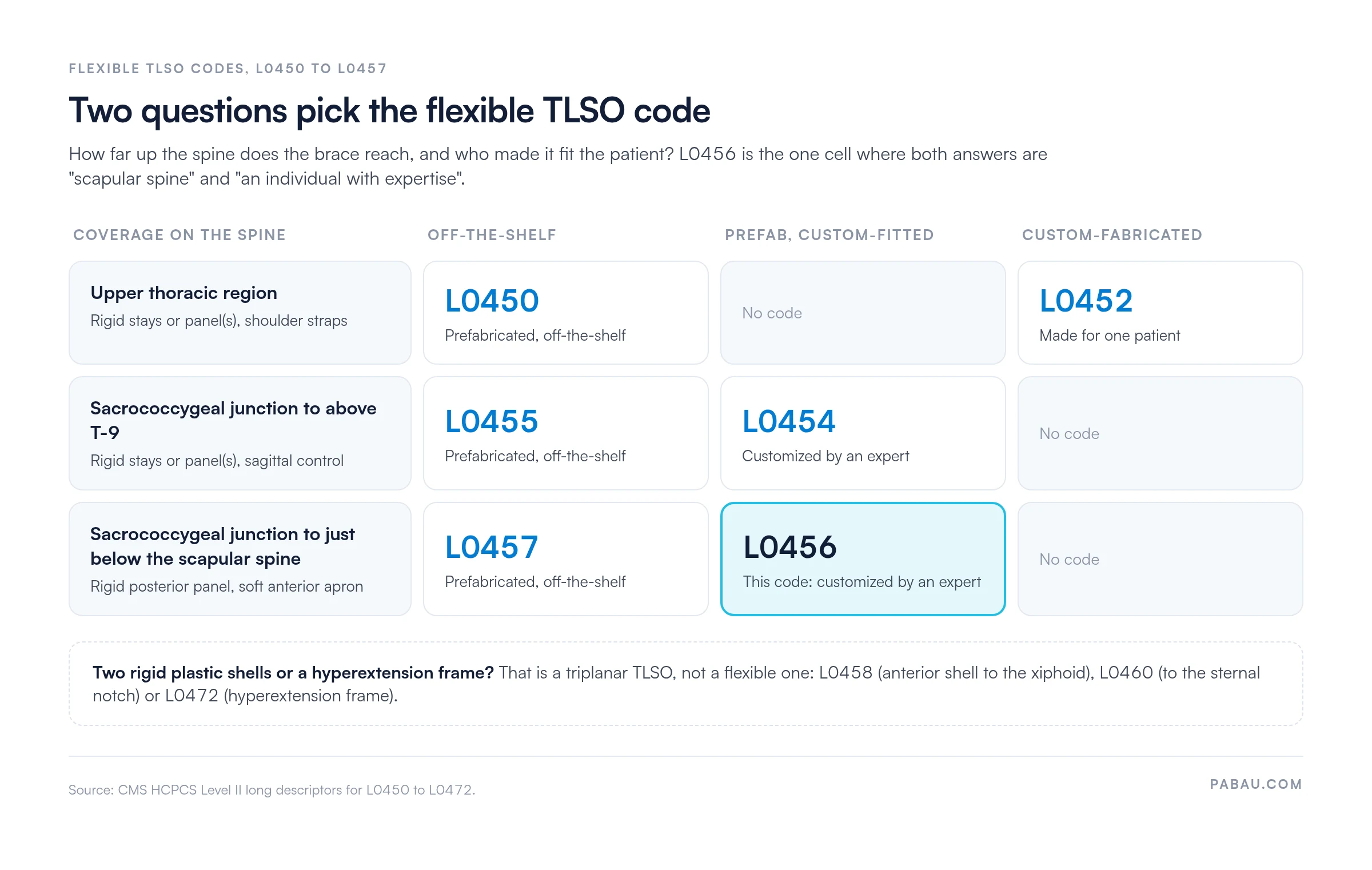
Coders most often slip on two attributes: how far up the spine the brace reaches, and whether an expert customized it. The table below compares L0456 with its neighbors across the L0450-L0472 range.
L0454 and L0456 are both custom-fitted flexible TLSOs, but they differ in height and construction. L0454 stops above the T-9 vertebra and uses rigid stays or panels. L0456 runs to just below the scapular spine with a rigid posterior panel and a soft anterior apron.
The fitting question splits L0456 from L0457, its off-the-shelf twin. If the brace needed only minimal adjustment, with no expert trimming or molding, it is off-the-shelf. Two-shell systems such as L0460 belong to the triplanar family, which controls motion in all three planes. The grid below lays the flexible codes out by those two questions.
Medicare covers HCPCS Code L0456 under the Part B DMEPOS benefit when the beneficiary meets the indications in CMS Policy Article A52500. That article governs spinal orthoses, including the full TLSO code range.
A diagnosis alone never guarantees coverage, because the claim also needs complete supporting documentation. Rigorous medical billing compliance workflows reduce the risk of retrospective denials on audit.
General indications include spinal fractures requiring stabilization, post-surgical lumbar or thoracic fusion support, and severe osteoporotic vertebral compression fractures.
Degenerative disc disease and spondylolisthesis qualify when the treating physician documents that an orthosis is medically necessary to reduce pain and restore function. A flexible TLSO like L0456 suits patients who need sagittal-plane support rather than full three-plane immobilization.
Request the physician’s clinical notes before submitting the claim, not after. CMS auditors consistently find suppliers holding the order and the delivery receipt but missing the narrative. That narrative explains why the patient needs spinal stabilization rather than physical therapy alone. The medical reviewer reads it first.
The ICD-10 codes below reflect diagnoses that commonly support medical necessity for a flexible TLSO under CMS Policy Article A52500. The list isn’t exhaustive, so check the current policy article before relying on it.
Non-specific pain codes, and unspecified fracture codes without documentation of mechanism and severity, routinely trigger medical necessity denials. Code each diagnosis to the highest level of specificity before submitting. Lumbar disc degeneration without radiculopathy belongs in the M51.36- subcategory, not M51.16.
Thorough documentation sits at the center of the medical billing process for a DMEPOS supplier, and it’s the strongest protection against a post-payment audit. CMS contractors can recoup payment years after a claim is paid if the file is incomplete. Assemble the following before dispensing the device.
Not at the federal level today. HCPCS Code L0456 is not on the CMS DMEPOS required prior authorization list as a standalone item. The program expands periodically, though, and MAC requirements vary by jurisdiction. Check your MAC’s local coverage determination and policy articles before every claim cycle.
Commercial payers often require prior authorization (PA) for every TLSO code, whatever CMS requires. Many Medicaid managed care plans require it too. Assuming one payer’s rules apply to the next causes costly delays. Build a per-payer PA checklist into the pre-dispensing workflow instead of checking after the fact.
The Medicare allowable amount for HCPCS Code L0456 varies by year and by geography. In non-competitive bidding areas (non-CBAs), the DMEPOS fee schedule amount for your state applies.
In competitive bidding areas (CBAs), the contracted rate from the DMEPOS Competitive Bidding Program applies where a contract is in effect. Use the CMS DMEPOS fee schedule files to confirm the current allowable for your ZIP code and claim year.
Denial patterns for L0456 are predictable. Most trace to three root causes: the wrong code for the device dispensed, missing documentation, and a diagnosis that doesn’t meet policy criteria. Structured denial management workflows that log each denial reason and its correction cut repeat denials on the same account.
Each code in the table is a claim adjustment reason code from the remittance advice. Our guide to medical billing denial codes lists the full set, with the fix for each one.
Upcoding and downcoding in the L-code range are both compliance risks. A clean claim for a flexible TLSO needs every attribute in the descriptor to match the device dispensed. Audit these common errors before submission:
A useful pre-submission audit: pull the manufacturer’s specification sheet and map each attribute (panel material, coverage extent, fitting) to the L0456 descriptor. If any attribute doesn’t match, choose a different code before submitting.
Coders verify HCPCS Code L0456 in several reference tools. The AAPC Codify HCPCS lookup and the CGS Medicare coding verification tool both display the official descriptor and active status.
Some claim systems show only the short descriptor, “TLSO flex trnk SJ-SS pre cst.” That compressed text captures the sacrococcygeal junction-to-scapular spine coverage and the prefabricated, customized status.
When a claim system shows the short descriptor, confirm it against the full descriptor before assuming the code is correct. Short descriptors sometimes truncate the details that separate adjacent codes.
Many DME billing teams track L0456 paperwork across email, shared drives and payer portals. The written order sits in one place, the delivery receipt in another, and claim status lives in a spreadsheet.
Pabau, the practice management platform we build, includes claims management for orthotists and DME billing teams. Documentation checklists keep the order, clinical notes, fitting record and proof of delivery together against each patient record. Claims go out electronically through Claim.MD, and Pabau tracks and reconciles them as payments arrive.
Your team sees which L0456 claims are pending, paid or rejected in one view. A missing document gets fixed while the claim can still be corrected, instead of surfacing months later in an audit.

Pabau gives DMEPOS suppliers and orthotic practices documentation checklists and claim-status tracking in one place. See how the claims workflow fits your orthotic billing team.

Coding L0456 correctly comes down to two checks at the point of dispensing. Does the brace reach just below the scapular spine with a rigid posterior panel, and did an expert customize it? Answer both and the choice between L0454, L0456 and L0457 settles itself.
The trade-off is paperwork. Expert fitting is the attribute that separates L0456 from L0457, so a fitting record naming who customized the brace belongs in every file.
If your team still chases orders and delivery receipts after the claim goes out, there’s a simpler setup. Book a demo to see how Pabau keeps orthotic claim documentation and status tracking together.

Need a clean claim checklist for orthotic billing? Clean claim submission covers every field and documentation element required to pass first-pass adjudication.
Want the wider billing compliance picture for DMEPOS? Medical billing compliance covers the documentation, supplier credentialing, and audit-readiness requirements that apply to HCPCS billing.
Is the brace a two-shell triplanar system? HCPCS Code L0458 covers the modular TLSO whose anterior shell reaches the xiphoid.
Was the upper thoracic brace made for one patient? HCPCS Code L0452 covers the custom-fabricated flexible TLSO for the upper thoracic region.
HCPCS Code L0456 covers a prefabricated flexible thoracic-lumbar-sacral orthosis (TLSO) with a rigid posterior panel and soft anterior apron. It spans from the sacrococcygeal junction to just inferior to the scapular spine and restricts gross trunk motion in the sagittal plane. An individual with expertise must customize it to fit the patient.
L0450 is an off-the-shelf flexible TLSO for the upper thoracic region, with rigid stays or panels and shoulder straps. L0456 extends from the sacrococcygeal junction to just below the scapular spine. It uses a rigid posterior panel and soft anterior apron, and an expert customizes it to the patient.
Yes. Medicare covers HCPCS Code L0456 under Part B when the beneficiary has a qualifying diagnosis under CMS Policy Article A52500. The physician’s notes must establish medical necessity, and an accredited DMEPOS supplier must dispense the device against a signed written order.
Billing L0456 requires a signed written order, physician clinical notes establishing medical necessity, a beneficiary-signed proof of delivery, and active DMEPOS supplier accreditation. Keep a record of who customized the brace, too. Some MACs and commercial payers also require a completed Certificate of Medical Necessity.
L0456 is a prefabricated code for a brace that an individual with expertise customizes to the patient. The same brace dispensed off-the-shelf codes to L0457. L0472 is not a custom version of L0456. It covers a prefabricated hyperextension brace with a rigid anterior and lateral frame.
Not at the federal level today. L0456 is not on the CMS DMEPOS required prior authorization list, but individual MACs and commercial payers may require it. Verify with each payer before dispensing, because the program’s scope changes periodically.