

CCSD code XR940: Foreign body retrieval billing guide
CCSD code XR940 is the UK private healthcare code for retrieval of a foreign bod...

Last Updated: Nov 26, 2026
L0466 is the HCPCS Level II code for a prefabricated thoracic lumbar sacral orthosis (TLSO) with sagittal control. It pairs a rigid posterior frame with a flexible soft anterior apron. An individual with expertise trims, bends, molds or otherwise customizes it to fit the patient.
That makes L0466 a custom-fitted code. Fully custom-fabricated TLSOs have separate codes. The off-the-shelf version of the same brace is L0467, and Medicare tells the two apart by the fitting done at delivery. Bill L0466 only when more than minimal self-adjustment was needed and performed, and keep a note of what was changed and why.
Let Pabau's smart automation suggest the right codes, reduce claim denials, and keep your practice compliant—effortlessly.
Automate repetitive tasks and focus on what matters most—your patients.
Reduce coding errors and ensure compliance with the latest regulations.
Clean claims, fewer denials, and faster reimbursements.
Powerful insights and reporting to help your practice thrive.
HIPAA compliant SOC 2 certified GDPR-compliant Trusted by 4,000+ clinics worldwide

L0466 is a prefabricated TLSO with sagittal control that someone with expertise customizes at delivery, so Medicare classes it as custom fitted. Fully custom-fabricated TLSOs have their own codes.
L0467 is the same brace delivered off the shelf, and the fitting performed at delivery decides which of the two codes you bill.
Medicare covers it under LCD L33790 for four indications, and the treating practitioner’s records must show one of them.
A standard written order, a detailed fitting note and signed proof of delivery belong in the file before the claim goes out.
The TLSO policy doesn’t call for KX on L0466, and L0466 isn’t on CMS’s prior authorization list.
HCPCS code L0466 is a prefabricated thoracic lumbar sacral orthosis (TLSO) with sagittal control, customized to the patient at delivery by someone with expertise.
The Medicare policy article for spinal orthoses classes that as custom fitted. It pairs L0466 with L0467, the off-the-shelf version of the same brace.
That pairing is where most of the money is won or lost. Older billing guides describe L0466 as a brace built from a cast or scan. Teams that believe them get the code, the paperwork and the audit trail wrong. A brace made from a model of the patient bills under a custom-fabricated code such as L0482 instead.
Here’s the official descriptor CMS publishes for the code:
TLSO, sagittal control, rigid posterior frame and flexible soft anterior apron with straps, closures and padding, restricts gross trunk motion in sagittal plane, produces intracavitary pressure to reduce load on intervertebral disks, prefabricated item that has been trimmed, bent, molded, assembled, or otherwise customized to fit a specific patient by an individual with expertise.
CMS HCPCS Level II long descriptor for L0466
Three phrases in it do the work. “Sagittal control” means the brace limits forward and backward bending. “Rigid posterior frame and flexible soft anterior apron” describes the build. The closing clause, “customized to fit a specific patient by an individual with expertise,” is what separates L0466 from L0467.
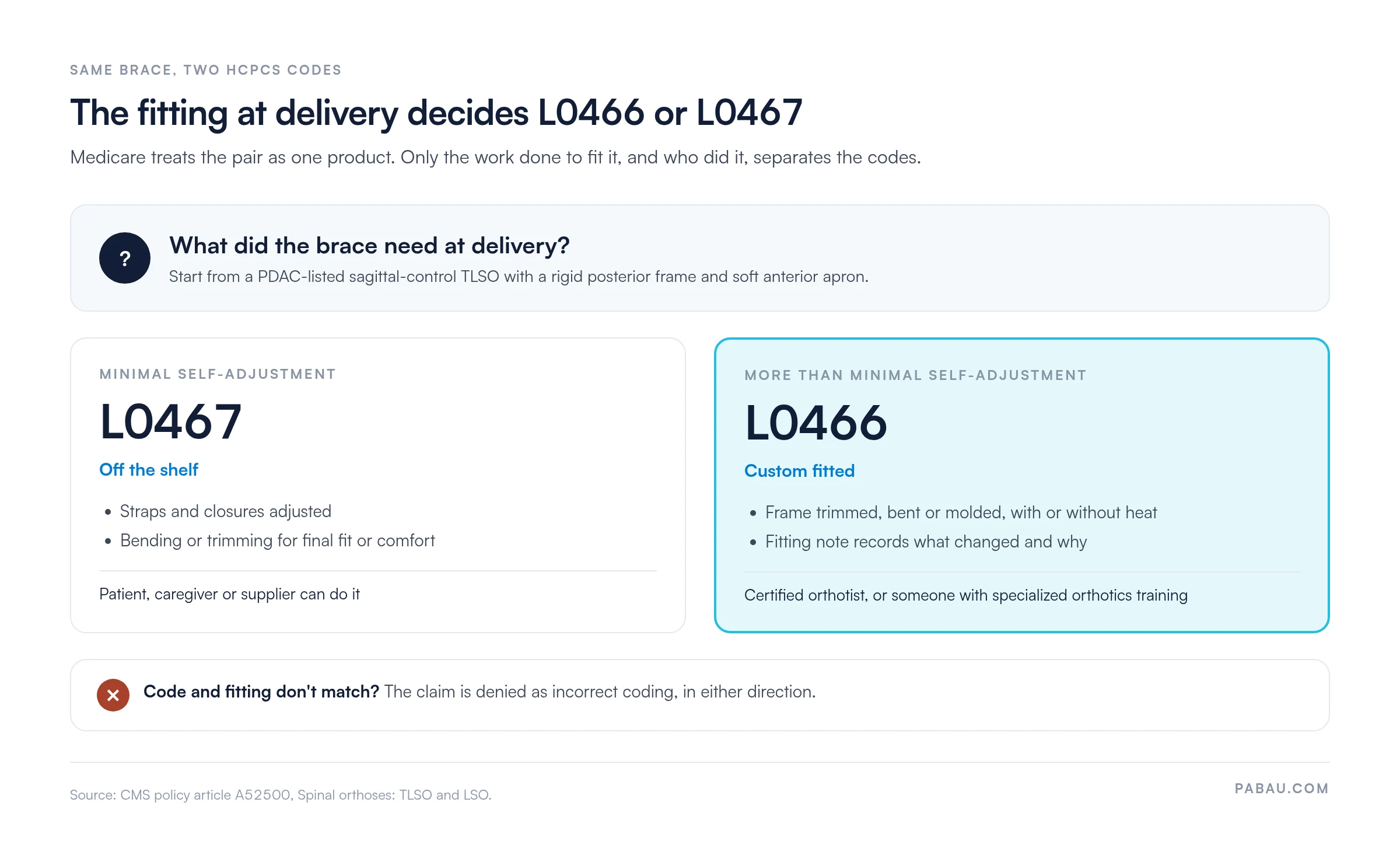
L0466 and L0467 describe the same product. Policy article A52500 says the pair is “only differentiated by the nature of the final fitting performed at the time of delivery.” So the question at the fitting is how much was done to the brace, and by whom.
Get it wrong in either direction and the claim fails. The policy article says a custom-fit code billed after minimal self-adjustment is denied as incorrect coding. An off-the-shelf code billed after substantial modification is denied the same way. The whole decision comes down to one question about the fitting.
The fitting only matters once the brace in hand is the L0466 product at all. This table rules it in or out against its neighbors.
The TLSO range runs from L0450 to L0492. Each descriptor names three things: how the brace is built, which planes of motion it restricts, and how it reaches the patient. The summaries below are condensed from the CMS long descriptors, which you can pull through the NLM HCPCS lookup.
Two details catch people out. First, codes worded “includes fitting and adjustment” are custom-fitted codes too, and A52500 sends an off-the-shelf delivery of one of them to L1499. Second, L0456 and L0466 look alike on paper, but L0456 and L0457 are being added to CMS’s prior authorization list while L0466 isn’t.
Medicare coverage comes from LCD L33790. A spinal orthosis is covered when it’s ordered for one of these reasons:
If none of them is met, the LCD says the brace is denied as not medically necessary. The indication has to live in the treating practitioner’s records, not only on your intake sheet. Auditors read the chart first, which is why medical billing compliance starts with what the practitioner wrote.
Commercial plans and Medicaid programs set their own criteria. Many follow the LCD’s logic, but some add a prior authorization step or a stricter definition. Pull the plan’s orthotics policy before the first fitting.
A clean L0466 claim is mostly sequencing. Each step below produces a document the next step depends on, so the order matters.
Many L0466 guides tell you to put KX on every Medicare claim. LCD L33790 and policy article A52500 don’t ask for KX on this code, so don’t add it by habit. The modifiers that do come up are about liability, replacement and one rule that belongs to other codes.
Before a new brace model goes on your shelf, print its PDAC listing and file it with the product. When an auditor asks why you billed L0466, the listing and the fitting note answer the question between them.
Take an illustrative patient, aged 78, with an osteoporotic vertebral fracture, coded M80.08XA. The practitioner orders a sagittal-control TLSO to reduce pain by restricting trunk motion, and the SWO arrives with every element filled in. The brace in stock is listed by the PDAC under L0466 and L0467.
Version A. The patient has a marked thoracic kyphosis. The certified orthotist heats and reshapes the posterior frame to clear it and trims the apron so it doesn’t dig in when the patient sits. The fitting note says what was changed and why. Bill L0466.
Version B. The brace fits as it comes out of the box. A staff member shows the patient’s daughter how to tighten the straps, and the patient goes home. Bill L0467.
The product, the order and the diagnosis are identical. Only the fitting changed, and only the fitting note proves which version happened.
The pattern is easy to spot once you sort your remits by cause. A supplier that keeps seeing incorrect-coding denials needs to fix its fitting notes before it touches the claims process. Use your denial codes to group them, then fix the step that failed.
Medicare sets the L0466 allowable in the DMEPOS fee schedule, which gives an amount for each code by state. CMS releases updated files through the year, so pull the current file rather than last year’s figure.
Medicare pays 80% of the allowed amount after the Part B deductible. The patient or a secondary plan owes the other 20%. Fitting and adjustment are part of the orthosis allowance, as is any CAD-CAM work, so there’s no separate fitting charge to bill Medicare.
In many supply practices, the SWO sits in a fax inbox and the fitting note sits in the orthotist’s chart. The delivery slip is on paper and the claim lives in a separate billing tool. When an auditor asks why the brace needed modifying, someone has to rebuild the file from four places.
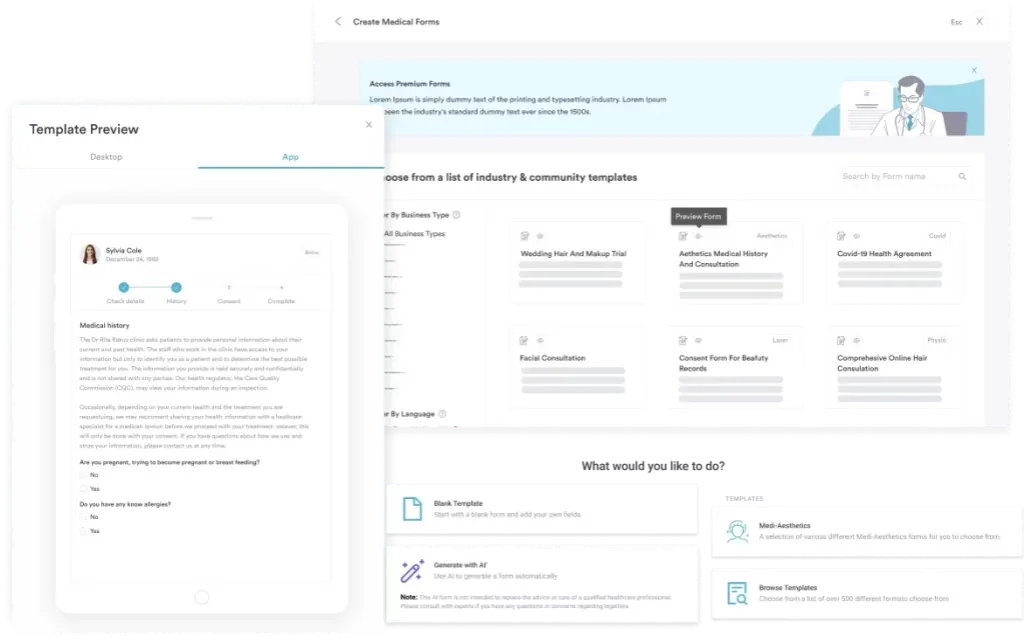
Pabau’s built-in insurance billing keeps those records on one patient file. Your fitting note and proof of delivery can be digital forms the patient signs on a tablet, saved straight to the record. The signed SWO is uploaded beside them.
When the claim is ready, Pabau’s claims management sends it to US payers through Claim.MD as a CMS-1500 or 837P. It checks that required fields, such as authorization numbers, are filled before you send. Eligibility checks run before the fitting, and ERA remittances post back to the same file.
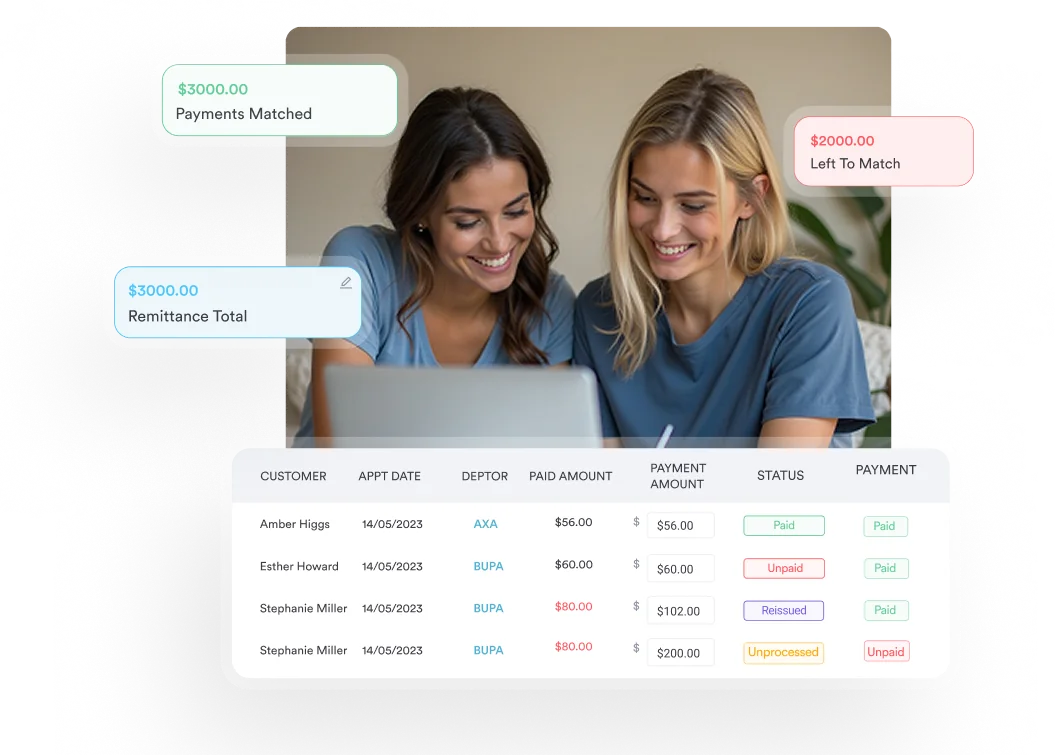

Pabau stores the fitting note, delivery signature and written order on the patient record. It sends the claim through Claim.MD, so the evidence and the claim stay together.

L0466 is won or lost at the fitting. The product on your shelf is the same one you’d bill as L0467. What you did to it at delivery, and whether you wrote that down, is what Medicare is paying for.
So make the fitting note non-negotiable and check the PDAC listing before the brace leaves the stockroom. Then let the SWO and proof of delivery travel with the claim. The trade-off is a few extra minutes per fitting, set against a claim denied as incorrect coding.
Book a demo to see how Pabau keeps fitting notes, delivery signatures and L0466 claims on the same patient record.

Billing the off-the-shelf version of this brace? HCPCS code L0467 covers the same TLSO when it’s delivered with only minimal self-adjustment.
Coding a modular shell brace instead? HCPCS code L0464 explains the four-shell triplanar TLSO that includes fitting and adjustment.
Is the brace sagittal-coronal rather than sagittal only? HCPCS code L0468 covers the frame with pelvic, thoracic and lateral pieces.
Need a broader overview of the billing cycle? Understanding medical billing walks through the revenue cycle from patient encounter to payment posting.
Want to tighten your audit defenses? Medical billing compliance covers audit triggers, documentation standards and risk management.
No. L0466 isn’t on CMS’s list of items that need a face-to-face encounter and a written order prior to delivery. You still need a standard written order before you submit the claim.
Not to Medicare. Policy article A52500 includes fitting and adjustment in the orthosis allowance. CAD-CAM work isn’t paid separately either.
No. A hyperextension TLSO with a rigid anterior and lateral frame matches the L0472 descriptor. L0466 uses a rigid posterior frame and soft apron to limit sagittal motion. Confirm the code on the product’s PDAC listing.
Medicare claims must be filed within 12 months of the date of service, which for a brace is the delivery date. Commercial plans set their own limits.
“Tlso r fram soft ant pre cst” abbreviates a TLSO with a rigid frame and soft anterior apron, prefabricated and custom fitted. The L0467 short descriptor ends in “ots” for off the shelf.



