CCSD Code T8950: Repair of perilymph fistula billing guide
CCSD Code T8950: Definition and clinical overview CCSD Code T8950 is the tariff ...

Last Updated: Nov 20, 2026
L0455 is the HCPCS Level II code for a flexible, prefabricated, off-the-shelf thoracic-lumbar-sacral orthosis (TLSO). It supports the trunk from the sacrococcygeal junction to above T-9 and limits forward and backward bending.
Two avoidable mistakes cause problems on TLSO claims. One is billing L0455 for a brace a qualified fitter customized, which belongs on L0454. The other is getting modifier CG wrong, since Policy Article A52500 requires it only on nonelastic or rigid-panel braces. L0455 needs no prior authorization, so those two checks carry most of the claim.
Let Pabau's smart automation suggest the right codes, reduce claim denials, and keep your practice compliant—effortlessly.
Automate repetitive tasks and focus on what matters most—your patients.
Reduce coding errors and ensure compliance with the latest regulations.
Clean claims, fewer denials, and faster reimbursements.
Powerful insights and reporting to help your practice thrive.
HIPAA compliant SOC 2 certified GDPR-compliant Trusted by 4,000+ clinics worldwide

HCPCS code L0455 is a flexible, prefabricated, off-the-shelf TLSO. The same brace, customized by a qualified fitter, bills as L0454 instead.
Medicare covers it under LCD L33790 when the order fits one of four indications. The LCD publishes no ICD-10-CM list, so the chart notes carry the claim.
Modifier CG is required only when the brace is mainly nonelastic or has a rigid posterior panel, per Policy Article A52500.
L0455 needs no prior authorization and no face-to-face encounter, unlike L0456 and L0457. It still needs a Standard Written Order before the claim.
Pabau’s claims management software records the modifiers you enter on each claim, submits 837P claims through Claim.MD, and tracks denials and ERA remittances.
HCPCS code L0455 is the Level II code for a flexible thoracic-lumbar-sacral orthosis (TLSO) that is prefabricated and supplied off the shelf. CMS Policy Article A52500 classes it as an off-the-shelf orthosis and pairs it with L0454, its custom-fitted twin. The brace supports the trunk from the sacrococcygeal junction to above the T-9 vertebra.
It restricts gross trunk motion in the sagittal plane, the plane of forward and backward bending. It also produces intracavitary pressure to reduce load on the intervertebral disks, using rigid stays or panel(s), and it includes shoulder straps and closures. CMS maintains the code set through its HCPCS program, and DMEPOS suppliers bill it under Medicare Part B.
Two words in that descriptor drive most coding decisions. Flexible describes the soft body of the brace, which can still carry rigid stays or panels, as opposed to a rigid plastic shell.
Off-the-shelf means the brace needs only minimal self-adjustment at delivery, with no customization by a trained fitter. When a qualified individual customizes the same brace to the patient, it bills as L0454 instead.
Medicare sorts prefabricated orthoses into two billing categories. An off-the-shelf item needs only minimal self-adjustment at delivery, such as fastening straps and closures, which the beneficiary could manage.
A custom-fitted item needs more than minimal adjustment by an individual with expertise, such as a certified orthotist. Policy Article A52500 defines both categories.
That split is the whole difference between L0455 and L0454. Both codes describe the same flexible design with the same sacrococcygeal-to-T-9 extent. Bill L0454 only when the record shows who customized the brace, what they changed and why. Without that fitting documentation, the claim belongs on L0455.
Custom-fabricated TLSOs, such as L0452 and L0480, are built from a model of the patient and form a third category. The AAPC HCPCS code lookup provides the full descriptor text for each code.
Three questions separate L0455 from its neighbors. How was the brace fitted: off the shelf, custom-fitted by an expert, or custom-fabricated? Is it flexible, or built on rigid panels or plastic shells? And which planes of motion does it control?
The table maps the codes billers most often confuse with L0455, plus their prior authorization status.
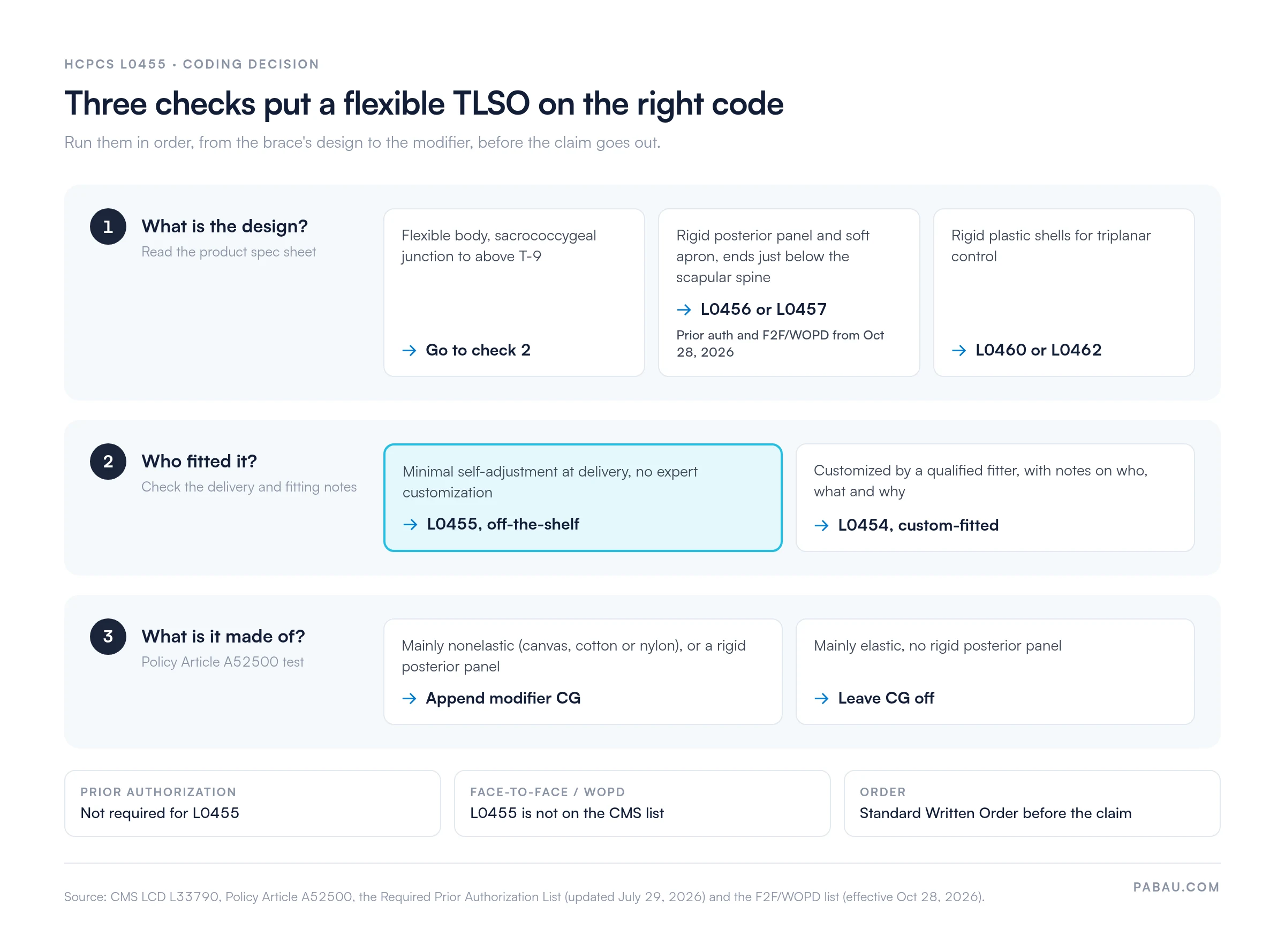
Fit trips up more suppliers than design does. A flexible brace handed over with minimal adjustment is L0455, and the same brace customized by a qualified fitter is L0454. A brace built on rigid plastic shells for triplanar control belongs on L0460 or L0462, not L0455.
L0456 adds a rigid posterior panel and a shorter extent, so it is not simply a custom version of L0455. It is also where the paperwork changes most. L0456 and L0457 joined the CMS Required Prior Authorization List on October 28, 2026, along with L0486.
The same three codes went onto the face-to-face and written-order-prior-to-delivery list that day, while L0455 stays off both lists. The decision path below runs these checks in order and ends with the CG test.
Medicare covers HCPCS code L0455 when it is ordered for one of the four indications in LCD L33790, Spinal Orthoses: TLSO and LSO. The order has to aim at one of these goals.
The LCD names no qualifying conditions beyond those four, and no excluded diagnoses. The treating practitioner’s records have to show which indication applies to this patient. General Medicare rules still hold, so a replacement inside the item’s useful lifetime needs a documented reason.
L33790 is a uniform LCD. All four DME MACs, CGS for Jurisdictions B and C and Noridian for Jurisdictions A and D, apply the same text. Rather than hunting for a local variant, check the current revision dates of the LCD and Policy Article A52500 before you bill.
Neither LCD L33790 nor Policy Article A52500 publishes an ICD-10-CM list for spinal orthoses. The article’s covered-diagnosis paragraph reads N/A, so no diagnosis code triggers automatic coverage or an automatic denial. The claim needs the most specific code the record supports, plus notes that tie it to an LCD indication.
The table shows diagnoses that often sit behind a TLSO order, with the indication the notes would need to show.
Treat the third column as a documentation guide, not a coverage rule. Low back pain codes (M54.50, M54.51 and M54.59) aren’t barred by the LCD. On their own, though, they rarely show which indication applies, so the notes have to do that work. Fracture codes also need the right 7th character for the encounter.
Read the chart note the way a reviewer would. It should say in plain words why the patient needs trunk support, such as pain on movement or healing after a fracture. If it doesn’t, ask the treating practitioner to clarify the record before you submit.
Documentation decides whether an L0455 claim survives a post-payment audit. The record must show medical necessity when the brace is delivered, not after the fact. Medical billing compliance for DMEPOS orthoses starts with five records.
A clean claim for L0455 has all five in place before the 837P or CMS-1500 is filed. A record written at the time of the visit holds up on audit, while one reconstructed later rarely does.
L0455 has no blanket modifier requirement. Policy Article A52500 names one code-specific modifier, CG, and it applies only to certain brace designs. The general DMEPOS modifiers GA, GY and RB apply when their own conditions are met. The table below maps each one.
CG is a coding statement about the product. By appending it, the supplier confirms the brace’s material or panel matches the A52500 description. Keep the product’s spec sheet in the patient file to support that choice. A missing CG on a qualifying brace is a common error, and so is a CG on an elastic one.
Medicare reimbursement for HCPCS code L0455 comes from the annual DMEPOS fee schedule published by CMS. Allowables vary by state, so check the rate for the beneficiary’s location. Where a competitive bidding program applies, contract suppliers bill at the single payment amount instead. The PGM Billing HCPCS lookup lets you query current fee schedule allowables by code and state.
The 2026 fee schedule allowable for L0455 must be verified directly from the CMS 2026 DMEPOS fee schedule file at the time of billing. CMS updates fee schedule rates annually, and carrying a prior-year figure is a common billing error. Key variables that affect your allowed amount:
L0455 is not on the CMS Required Prior Authorization List for DMEPOS, last updated July 29, 2026. So no prior authorization request is needed before delivery, in any jurisdiction.
Its neighbors are a different story. L0456 and L0457 joined the list nationwide on October 28, 2026, along with L0486, and L0631 has been on it since August 2024. If the brace on the order turns out to be one of those, three steps come first.
Run insurance eligibility verification at referral either way. Pair it with a same or similar check in your DME MAC portal, so a brace another supplier billed shows up before fitting.
An L0455 claim follows a fixed sequence, and a step done out of order is a common denial trigger. The superbill and the CMS-1500 or 837P each depend on the steps before them.
Run these eight checks on every L0455 claim before it leaves your office.
L0455 denials tend to trace back to a short list of errors, and each one has a fix. Effective denial management workflows for DMEPOS billers build these checks into the pre-submission step.
See CARC denial codes in medical billing for a full reference on claim adjustment reason codes and how to map them to corrective actions.
What is the MUE for L0455? We couldn’t confirm a published value, so check the current figure in the CMS MUE tables or your DME MAC’s lookup tool before billing. CMS revises MUE values quarterly.
Can you bill more units than the MUE? Only with a medically necessary reason. A claim-line edit can be overcome with an appropriate modifier and documentation, while a date-of-service edit is stricter. Never split dates of service to get around either one.
How many units does a normal claim carry? One. A beneficiary would not ordinarily receive more than one TLSO on the same day.
Update the MUE for L0455 and L0454 in your billing rules each quarter. Staff then check claims against the current figure, not one remembered from last year.
TLSO billing teams often track orders, fitting notes, modifiers and remittances across separate tools. That makes it easy to lose the fitting record that justifies L0454, or to miss a CG on a nonelastic brace.
Pabau, a practice management platform with built-in billing tools, keeps the claim beside the patient record. Its claims management software records the modifiers you enter on each claim and submits 837P claims through Claim.MD. It also tracks denials and ERA remittances.
Your team can see which L0455 claims came back, and why, without leaving the patient file. A CO-4 for a missing CG is then easy to trace back to the claim line that needs correcting.

Pabau records the modifiers you enter on each claim, submits 837P claims through Claim.MD, and tracks denials and ERA remittances. See how it keeps your TLSO billing organized.

L0455 is one of the simpler TLSO codes to get paid on. It needs no prior authorization and no face-to-face encounter, and the LCD sets four plain indications rather than a diagnosis list. That simplicity is also the trap, because two details still decide the claim.
Settle the fit before you settle the code. If a fitter customized the brace, it is L0454, and the notes have to say so. Then let the spec sheet, not habit, decide whether CG goes on.
Get those right, with an SWO in hand before you bill, and an L0455 claim leaves a reviewer little to question. Book a demo to see how Pabau tracks each TLSO claim from submission to remittance.

Billing the rigid-panel version instead? HCPCS code L0456 covers the custom-fitted TLSO with a rigid posterior panel, which now needs prior authorization.
Need a full reference on claim rejection codes? CARC denial codes in medical billing maps every common claim adjustment reason code to its corrective action.
Unsure how the clearinghouse fits into your billing workflow? Medical claims clearinghouse guide explains how EDI submission, eligibility checks, and ERA routing work end to end.
Looking to tighten your 837P submission process? 837 file format and submission guide covers transaction set requirements, loop structures, and common file-level rejection reasons.
A TLSO reaches into the thoracic spine. L0455 runs from the sacrococcygeal junction to above T-9. A lumbar-sacral orthosis (LSO) stops at or below T-9 and bills under codes in the L0625 to L0651 range. LCD L33790 governs both.
Yes, for coverage. Since 2024, CMS has required Medicare Advantage plans to follow the NCDs and LCDs that apply to Original Medicare. Plans can still set their own prior authorization and network rules, so check the plan before delivery.
Medicare pays for a replacement when the brace is lost, stolen or irreparably damaged, or when the patient’s condition changes. Inside the reasonable useful lifetime, add modifier RA and keep the reason in the record.
A supplier enrolled with Medicare as a DMEPOS supplier, billing under its own supplier number. Most suppliers must also be accredited, though some professionals, such as physicians and physical therapists, are exempt.
No. L0455 is not on the CMS Required Prior Authorization List. Its rigid-panel neighbors, L0456 and L0457, have needed prior authorization nationwide since October 28, 2026.