HCPCS code L0638: Custom fabricated LSO billing guide
HCPCS code L0638 is a brace built for one patient HCPCS code L0638 is the Level ...

Last Updated: Nov 2, 2026
K0864 is the HCPCS Level II code for power wheelchair, group 3 extra heavy duty, multiple power option, sling/solid seat/back.
It describes a Group 3 power wheelchair that can run a combined power tilt and recline seating system. The chair is rated for patients who weigh 601 pounds or more. Medicare covers it under LCD L33789 with prior authorization. The weight tier is the main wrong-code risk, because K0861, K0862 and K0863 describe the same chair at lower capacities.
Let Pabau's smart automation suggest the right codes, reduce claim denials, and keep your practice compliant—effortlessly.
Automate repetitive tasks and focus on what matters most—your patients.
Reduce coding errors and ensure compliance with the latest regulations.
Clean claims, fewer denials, and faster reimbursements.
Powerful insights and reporting to help your practice thrive.
HIPAA compliant SOC 2 certified GDPR-compliant Trusted by 4,000+ clinics worldwide

HCPCS Code K0864 is a Group 3 extra heavy duty power wheelchair with a multiple power option, rated for patients of 601 pounds or more.
Weight capacity is the only difference across K0861 to K0864, so the weight tier is the main wrong-code risk.
Group 3 has no single power option code above 600 pounds, and Group 4 power wheelchairs start at K0868.
Medicare covers K0864 under LCD L33789 and requires prior authorization before the chair is delivered.
Add the KX modifier when the coverage criteria are met and the supporting documentation is on file.
HCPCS Code K0864 is the Level II billing code for a Group 3 extra heavy duty power wheelchair with a multiple power option.
It is listed in the CMS HCPCS coding system. It describes a chair with a sling or solid seat and back, rated for patients who weigh 601 pounds or more.
Medicare reserves Group 3 chairs for patients whose mobility limitation comes from a neurological condition, a myopathy, or a congenital skeletal deformity. “Multiple power option” means the base can accept and operate a combined power tilt and recline seating system. “Extra heavy duty” is the highest weight tier in Group 3.
K0864 is the top weight tier of the Group 3 multiple power option family, K0861 to K0864. All four codes describe the same chair type with the same seating. Only the patient weight capacity changes, so the weight tier is where a wrong code most often slips in.
Two checks settle the code before the prior authorization request goes out. First, confirm the chair’s rated capacity sits in the 601-pound tier. Second, confirm the base supports a multiple power option and the order includes the combined tilt and recline system. If either check fails, browse the HCPCS reference for billers to find the base code that does match.
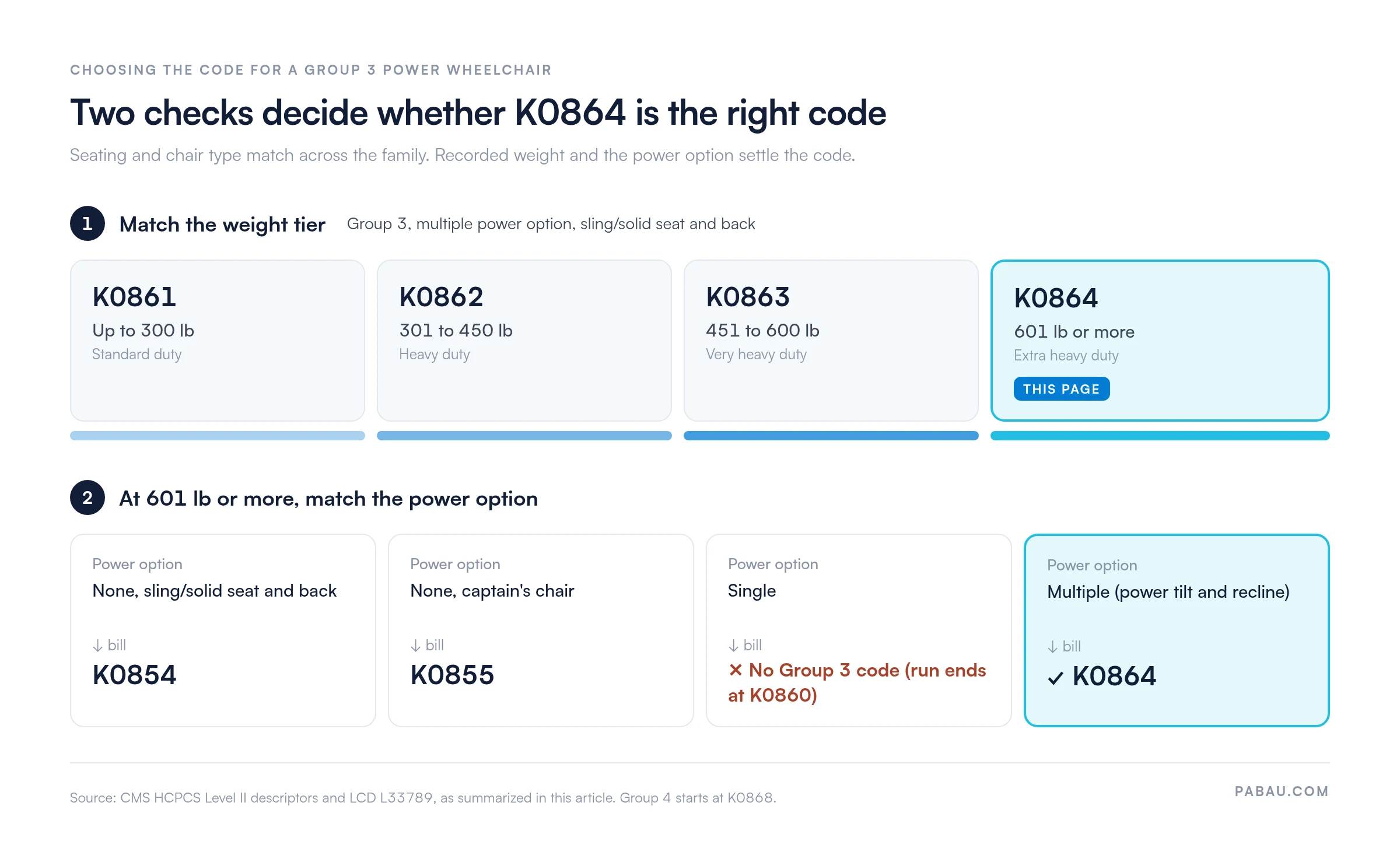
Group 3 has no single power option code above 600 pounds, because that run (K0856 to K0860) ends at K0860. At 601 pounds or more, the Group 3 options are K0854 or K0855 with no power option, or K0864. Group 4 is a separate class that starts at K0868, with its own coverage criteria.
Medicare Part B covers K0864 under LCD L33789 (Power Mobility Devices), administered by the DME Medicare Administrative Contractors (DME MACs). The patient has to meet the general power wheelchair criteria plus the Group 3, multiple power option, and weight criteria below.
A qualifying diagnosis does not guarantee coverage. The functional criteria must also be met and documented in the medical record. The patient’s weight belongs in the face-to-face notes, because a 601-pound rated chair with no recorded weight leaves the tier unsupported.
A face-to-face encounter with the treating practitioner is required before K0864 is ordered. The treating physician, nurse practitioner, clinical nurse specialist, or physician assistant who conducts it must also write the order. The supplier cannot fill that role.
For Group 3 chairs, the LCD also requires a specialty evaluation by a licensed medical professional, usually a physical or occupational therapist. That professional must have no financial relationship with the supplier. The evaluation needs to be complete before the order is written.
The records must document the diagnosis and mobility limitation, the home assessment, and the patient’s ability to operate the chair safely. They must also explain why less complex equipment is insufficient. Under current CMS rules, the encounter must fall within the six months before the order, and the written order must reach the supplier before delivery.
The DME MAC reviews the documents below at prior authorization and again on audit. A missing document is grounds for a non-affirmation or a denial. Maintaining medical billing compliance standards for DME claims means treating this checklist as a pre-delivery step.
K0864 is on the CMS Required Prior Authorization List for power mobility devices, which applies in every state and territory. The supplier must get an affirmed decision before the chair is delivered. A claim submitted without one is denied.
The request goes to the DME MAC for the patient’s address. The package includes the written order, the face-to-face notes, the specialty evaluation, and the diagnosis codes. CGS, the DME MAC for jurisdictions B and C, currently commits to a decision letter within five business days, not exceeding seven calendar days.
Expedited reviews target two business days when a delay could seriously jeopardize the patient’s health. An affirmed decision stays valid for six months, so the chair has to be delivered in that window. Review timeframes have changed before, so check your own DME MAC’s current prior authorization page.
An affirmation does not guarantee payment, because the claim must still meet every coverage and billing rule. After a non-affirmation, the decision letter explains what the record lacked, and the supplier can resubmit with those documents added.
Submit the prior authorization request once the face-to-face notes, specialty evaluation, and written order are complete. An affirmed request stays valid for six months, so plan the build and delivery inside that window.
Modifiers tell the DME MAC whether the coverage criteria are met and how the item is being supplied. The KX modifier carries the most weight. Without it, a K0864 claim is denied as not reasonable and necessary, however complete the record is.
Medicare generally pays power wheelchairs as capped rental items. The supplier bills monthly rental with the RR modifier, and title passes to the beneficiary after 13 months of continuous rental. Complex rehabilitative power wheelchairs, which include Group 3 multiple power option chairs like K0864, also carry a purchase option at the time of delivery.
Payment rules for this class have changed several times. Confirm the current rental, purchase, and maintenance rules with your DME MAC before setting up billing. Repairs after title transfers are billed separately under the applicable HCPCS repair codes.
CMS publishes the K0864 fee schedule amount each year in the DMEPOS fee schedule, adjusted by state. Group 3 complex rehab power wheelchairs are excluded from the DMEPOS competitive bidding program, so the fee schedule rate applies. Pull the current-year figure rather than a cached one, because CMS updates the schedule each January and sometimes mid-year.
LCD L33789 does not cover Group 3 chairs by a list of diagnosis codes. It covers them when the mobility limitation stems from a neurological condition, a myopathy, or a congenital skeletal deformity. The codes below are examples of diagnoses that can fall in those categories, not a covered-diagnosis list.
A qualifying diagnosis is necessary but not sufficient. The record must also show that the patient cannot perform mobility-related daily activities in the home without the chair, and that simpler equipment is inadequate.
CMS placed power wheelchairs on its prior authorization list because of high rates of unnecessary utilization. The denial management workflows for K0864 need to run before delivery. These are the common denial triggers and how to prevent them:
Running a pre-delivery checklist against this list catches most of these problems before a claim exists. Build a clean claim submission process into your DME intake workflow.
Only accredited DMEPOS suppliers enrolled in Medicare can bill K0864. Accreditation comes from a CMS-approved accrediting organization, such as The Joint Commission, ACHC, BOC, or HQAA. Enrollment runs through CMS’s DMEPOS enrollment contractor.
For Group 3 chairs, the LCD adds a staffing rule. The supplier must employ a RESNA-certified Assistive Technology Professional (ATP) who specializes in wheelchairs. That ATP must have direct, in-person involvement in selecting the chair for the patient.
The supplier must also conduct an on-site home evaluation before or at delivery. A supplier serving several states bills the DME MAC for each patient’s jurisdiction, so it needs to track which contractor applies to each claim.
Check your accreditation renewal date and Medicare enrollment record at the start of each year. A lapse in either one stops K0864 billing until it is restored.
Most K0864 paperwork starts at the treating practice. The face-to-face note, the recorded weight, the specialty evaluation, and the signed order all leave from there. When those records sit in separate files, the supplier chases signatures and the prior authorization request waits.
Pabau, the practice management platform we build, keeps that record in one patient file. Digital forms capture the mobility assessment and intake answers in a consistent structure. Treatment notes sit beside them with the date and author, and Pabau Scribe, our AI scribe, drafts the encounter note for the clinician to review.
Pabau’s claims management software ties invoicing to the same record, so the team can see what was billed against each visit. The supplier still owns accreditation, prior authorization, and the claim. Pabau helps the practice send a complete, consistent record the first time.

Pabau keeps assessments, treatment notes, and signed forms in one patient record. Your supplier gets a consistent face-to-face package for prior authorization.

K0864 billing rests on two facts the record has to prove. The chair is rated for 601 pounds or more, and the patient needs a combined power tilt and recline system or a chair-mounted ventilator. If either fact is missing, the claim belongs under a different code or falls outside coverage.
Settle both before the prior authorization request goes out. Record the weight at the face-to-face encounter, match it to the chair’s capacity tier, and confirm the Group 3 diagnosis category. That check takes minutes at intake and saves a resubmission cycle later. Book a demo to see how Pabau keeps assessments and signed forms in one record your supplier can rely on.

Need to understand how DME claims are processed end to end? Medical billing fundamentals covers the full claim lifecycle from patient encounter through payment posting.
Seeing high denial rates across your DME portfolio? Denial management in healthcare explains how to build systematic denial prevention workflows.
Want to ensure every claim leaves clean? Clean claim submission outlines the technical and documentation standards that prevent front-end rejections.
Billing a lighter chair with a single power option? HCPCS code K0860 covers the Group 3 very heavy duty single power option base.
HCPCS Code K0864 covers a Group 3 extra heavy duty power wheelchair with a multiple power option and a sling or solid seat and back. It is rated for patients who weigh 601 pounds or more. Medicare Part B covers it as durable medical equipment when the criteria in LCD L33789 are met.
No. K0864 is a Group 3 code. Group 4 power wheelchairs start at K0868 and have separate coverage criteria, so a Group 4 chair cannot be billed as K0864.
Both codes describe a Group 3 multiple power option power wheelchair with a sling or solid seat and back. K0863 is very heavy duty, for 451 to 600 pounds. K0864 is extra heavy duty, for 601 pounds or more. The recorded patient weight has to support the tier billed.
Yes. K0864 is on the CMS Required Prior Authorization List for power mobility devices nationwide. The supplier needs an affirmed decision from the DME MAC before delivery, and the decision stays valid for six months. Check your DME MAC’s current review timeframes before planning delivery.
The KX modifier is required when the coverage criteria are met and the documentation is on file. Without it, the claim is denied. NU applies to new equipment, RR to monthly rental claims, and UE to used equipment. GA applies when the patient has signed an Advance Beneficiary Notice, and GY when the item is known to be non-covered.
Common reasons include billing the wrong weight tier and a base without a multiple power option. Others are a missing KX modifier, no affirmed prior authorization, a face-to-face encounter outside the allowed window, and an incomplete or unsigned order. A pre-delivery checklist catches most of them.
No fixed list of ICD-10 codes guarantees coverage. LCD L33789 requires a mobility limitation caused by a neurological condition, a myopathy, or a congenital skeletal deformity. Examples include G12.21 for ALS, a G35 subtype for multiple sclerosis, G71.01 for Duchenne or Becker muscular dystrophy, and G80.9 for cerebral palsy. Obesity codes support the weight tier but do not meet the Group 3 criteria alone.