CCSD code 20210: Pure tone audiogram billing guide
CCSD code 20210 is the UK private billing code for a pure tone audiogram by air ...

Last Updated: Nov 16, 2026
K0859 is the HCPCS Level II code for a Group 3 heavy duty power wheelchair with a single power option and a captains chair. It fits patients weighing 301 to 450 pounds, covers the base only, and needs prior authorization before delivery.
Most K0859 denials trace back to three problems. The face-to-face exam notes are thin, the claim uses a neighboring code such as K0858 or K0860, or delivery comes before approval.
Let Pabau's smart automation suggest the right codes, reduce claim denials, and keep your practice compliant—effortlessly.
Automate repetitive tasks and focus on what matters most—your patients.
Reduce coding errors and ensure compliance with the latest regulations.
Clean claims, fewer denials, and faster reimbursements.
Powerful insights and reporting to help your practice thrive.
HIPAA compliant SOC 2 certified GDPR-compliant Trusted by 4,000+ clinics worldwide

K0859 bills a Group 3 heavy duty power wheelchair base with a captains chair and one power option, for patients of 301 to 450 pounds.
Its closest neighbor is K0858, the same chair with a sling or solid seat. K0856 and K0860 cover the lighter and heavier sling tiers.
Medicare needs the face-to-face exam, a written order after it, a detailed product description and prior authorization approval before delivery.
Group 3 coverage needs a neurological condition, myopathy or congenital skeletal deformity, plus a specialty evaluation and a RESNA-certified ATP.
Pabau tracks the prior authorization code, dates and sessions on the patient’s case and warns you when one is missing.
HCPCS code K0859 is the Level II code for a Group 3 heavy duty power wheelchair base with one power option and a captains chair. It fits patients weighing 301 to 450 pounds.
CMS’s DMEPOS master list entry carries that descriptor and marks K0859 for prior authorization. It also requires a face-to-face exam and a written order before delivery.
The full CMS descriptor reads: Power wheelchair, group 3 heavy duty, single power option, captains chair, patient weight capacity 301 to 450 pounds. The code describes the base. The seating system, batteries and other accessories are billed with their own codes.
K codes are temporary national codes that the DME MACs use for durable medical equipment. Check the descriptor against the current CMS HCPCS release before you bill, since CMS revises descriptors in its quarterly updates.
All four DME MAC jurisdictions, A to D, are run by Noridian and CGS. They share one local coverage determination, LCD L33789 for power mobility devices, so the criteria read the same nationwide.
The base power wheelchair criteria come first. The patient must meet all of these:
Group 3 adds a diagnosis test. The mobility limitation has to come from a neurological condition, myopathy or a congenital skeletal deformity. A strong case for a heavy chair doesn’t override that rule.
A single power option adds two more requirements. The patient needs a power tilt or recline system they will use, or a drive control other than a standard joystick. And the file needs two evaluations:
Most K0859 problems are timing problems. Good medical billing compliance here means each document exists, is signed, and is dated in the order Medicare expects.
The treating physician, nurse practitioner, physician assistant or clinical nurse specialist examines the patient in person. The written order follows the exam, never the other way around. An order dated before the exam is one of the top reasons CGS gives for non-affirmed requests.
CMS guidance has used two windows here. Older wording asked the supplier to receive the exam notes and order within 45 days of the exam. Later wording lets the order follow within six months. Check the current LCD before you set your internal deadline.
The exam note should spell out:
Telehealth exams became acceptable in some situations during and after the public health emergency. Confirm the current CMS policy before you rely on one.
The Certificate of Medical Necessity (CMS-849) isn’t part of this list. Medicare no longer requires it for power mobility devices, so don’t hold a claim waiting for one.
CMS requires prior authorization for the K0848 to K0864 range in every state and territory, according to the CGS prior authorization page. That is a separate step from the written order prior to delivery. You need both.
Here is how a request moves:
A non-affirmed decision doesn’t legally block delivery, but a claim sent without an affirmation will be denied. Fix what the decision letter names and resubmit before the chair leaves the warehouse.
Suppliers bill K0859 on the CMS-1500 or its electronic form, the 837P, usually with place of service 12 (home). Before the first claim, the patient chooses how to pay.
Either way, the patient pays 20% coinsurance after the Part B deductible, and Medicare pays 80% of the allowed amount.
Rental claims carry RR, a month modifier and an election modifier. Purchase claims carry NU or UE instead of RR.
Your DME MAC’s supplier manual lists any extra modifiers, such as the KX attestation where a policy calls for it. The AAPC HCPCS lookup is handy for checking descriptors on the accessories billed alongside the base.
Group 3 complex rehab power wheelchairs, K0848 to K0864, are permanently excluded from the DMEPOS Competitive Bidding Program. That exclusion comes from the Medicare Improvements for Patients and Providers Act of 2008. So the DMEPOS fee schedule sets the K0859 allowable in every area.
The amount still varies by state, and CMS updates it every year. Pull the current figure from the CMS DMEPOS fee schedule files, using the rental (RR) or purchase (NU, UE) row that matches your claim. Don’t quote a dollar amount from last year’s file.
Diary the K0859 rental months the day the chair is delivered. Month four is where KI must change to KJ, and month 13 is the last rental claim. A missed switch is an easy denial to prevent and a slow one to fix.
Three facts pick the code: the patient’s weight tier, the seat type and the number of power options. Get one wrong and the claim is wrong, even when the chair itself is right.
The grid below shows how the single power option codes divide up.
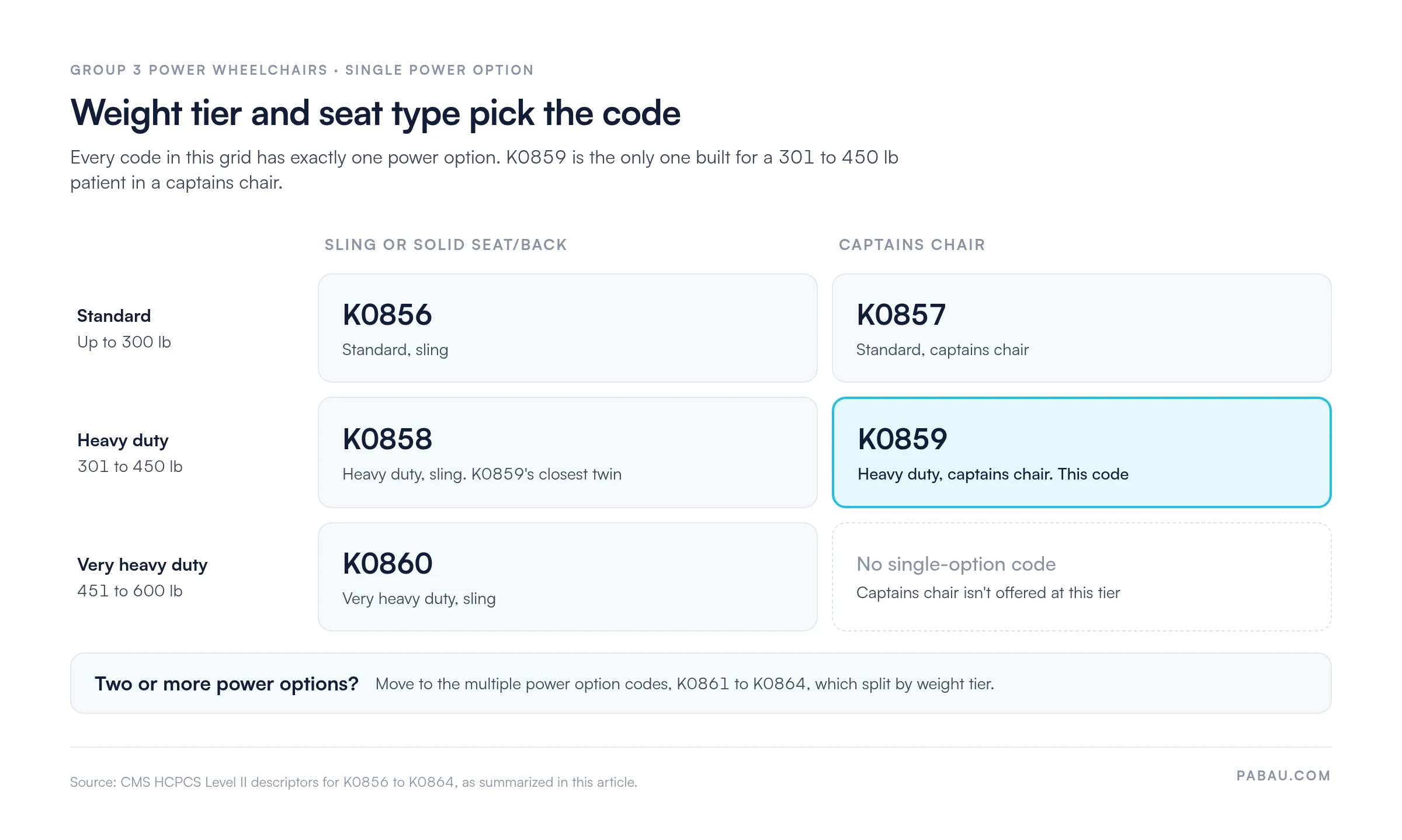
Take a 380 pound patient who needs power tilt. In a captains chair, that is K0859. Put the same patient in a sling or solid seat and the code becomes K0858, the pairing auditors check most closely.
If the patient weighs 300 pounds or less, you’re in the standard tier, with K0856 for a sling seat. Above 450 pounds, K0860 covers the very heavy duty sling chair. No single power option captains chair code exists at that tier. With no power option, a captains chair rated for 601 pounds or more is K0855.
A second power option, such as tilt plus recline, moves the claim to the multiple power option codes. Those start at K0861 for the standard tier and run to K0864. Document each option and why the patient needs it.
A K0859 claim needs a diagnosis that fits the Group 3 rule: a neurological condition, myopathy or congenital skeletal deformity.
The codes below are examples, not a covered list. Confirm each against the current LCD and its policy article. The PGM Billing HCPCS lookup can help cross-check pairings.
Power mobility devices draw steady attention from Recovery Audit Contractors, DME MAC reviews and the Office of Inspector General. So prevention matters more than appeals. Strong denial management for K0859 starts before delivery, while the file can still change.
The denial code definitions page covers the full CARC and RARC lists used on DME remittances.
Medicare has five appeal levels. Most winnable K0859 appeals end at the first two, where you can still add clinical evidence.
For a CO-50 appeal, send the exam note, the specialty evaluation and a letter answering each LCD criterion in turn. General letters of support rarely change the outcome.
Many supplier teams track K0859 authorizations in a spreadsheet next to the billing system. The spreadsheet holds the approval, and the claim goes out from somewhere else, so one missed update sends a chair claim without its UTN.
Pabau, the practice management and billing software we build, keeps the prior authorization code, dates and sessions on the patient’s case. It warns you when a case has no authorization on file.
In the US, electronic claims go through Claim.MD, with eligibility checks and ERA remittances in the same place. That is what cleaner claims management looks like for a code with this many checkpoints.
The result is fewer claims sent before the authorization is ready, and one record to show an auditor what was approved and when.

Pabau tracks prior authorization codes, dates and sessions on the patient’s case and warns you when one is missing. US claims go out through Claim.MD from the same record.

K0859 rewards suppliers who settle the code before the paperwork starts. Weigh the patient, confirm the seat and count the power options. Then build the exam, order, evaluations and prior authorization around that one code.
The trade-off is time up front. A file that takes an extra week to assemble usually saves months of rental claims from a recoupment later.
Book a demo to see how Pabau keeps K0859 authorizations on the patient’s case and sends the claim from the same record.

Need the same rules for the sling-seat version? HCPCS code K0858 covers the heavy duty Group 3 chair with a sling or solid seat.
Getting recurring CO-50 denials across your DME claims? Denial management in healthcare outlines root-cause analysis and appeals tracking.
Want your documentation to survive an audit? Medical billing compliance explains the documentation and coding standards that keep claims out of the denial queue.
Looking for the bigger picture on cash flow? Revenue cycle management follows a claim from scheduling through payment posting.
New to the claim lifecycle? Medical billing fundamentals covers each step from service documentation to payment.
Yes, when the patient meets the power mobility LCD. In Group 3 with one power option, K0857 covers the captains chair up to 300 pounds and K0859 covers 301 to 450 pounds.
Yes. Group 3 complex rehab chairs can be bought as a lump-sum purchase, but only when the chair is first supplied. Otherwise it is a 13-month capped rental, after which the patient owns it.
No. K0859 bills the base only. The power seating system, batteries, cushions and other accessories are billed under their own HCPCS codes, each with its own coverage rules.
Many do, because HCPCS Level II codes are national. Their coverage criteria and prior authorization rules can differ from Medicare’s, so check the payer’s own policy.
Usually after its five-year reasonable useful lifetime, or sooner if the chair is lost, stolen or irreparably damaged. A replacement needs a new order and supporting documentation.