

HCPCS code E0198: Water pressure pad billing guide
HCPCS code E0198 is a water pad for a standard mattress HCPCS code E0198 is the ...

Last Updated: Oct 13, 2026
K0860 is the HCPCS Level II code for a group 3 very heavy duty power wheelchair. The chair carries a single power option and a sling or solid seat and back. It is built for patients weighing 451 to 600 pounds.
Medicare Part B pays K0860 as durable medical equipment under a capped rental, and prior authorization is required before delivery. Suppliers bill K0858 instead when the patient weighs 301 to 450 pounds, and K0863 when the chair adds multiple power options.
Let Pabau's smart automation suggest the right codes, reduce claim denials, and keep your practice compliant—effortlessly.
Automate repetitive tasks and focus on what matters most—your patients.
Reduce coding errors and ensure compliance with the latest regulations.
Clean claims, fewer denials, and faster reimbursements.
Powerful insights and reporting to help your practice thrive.
HIPAA compliant SOC 2 certified GDPR-compliant Trusted by 4,000+ clinics worldwide

HCPCS code K0860 covers a group 3 very heavy duty power wheelchair with one power option and a sling or solid seat.
It fits patients weighing 451 to 600 pounds, while K0858 covers 301 to 450 pounds and K0863 adds multiple power options.
Medicare requires prior authorization before delivery under the Power Mobility Devices program, and a claim without it is denied.
Group 3 complex rehab power wheelchairs are permanently excluded from DMEPOS competitive bidding under MIPPA section 154(a).
Medicare pays K0860 as a capped rental, so KH, KI and KJ track the rental month on each claim.
HCPCS Code K0860 falls under the HCPCS Level II K-code series, which CMS administers for durable medical equipment not covered by CPT. The short descriptor used on claims and billing software is Pwc gp3 vhd sing pow opt s/b. The long descriptor reads: Power wheelchair, group 3 very heavy duty, single power option, sling/solid seat/back, patient weight capacity 451 to 600 pounds.
Each element of that descriptor is a coverage criterion. Group 3 sets the performance standards the chair must meet, and very heavy duty fixes the weight capacity tier.
Single power option limits the drive and control features the billed chair may carry, and sling/solid seat/back specifies the seating system. A chair that misses any one of those four elements belongs under a different code.
Medicare Part B covers K0860 under the durable medical equipment benefit, subject to medical necessity criteria. Those criteria come from the applicable Medicare Administrative Contractor (MAC) Local Coverage Determination (LCD). Coverage is not automatic, and three conditions must all be true at the time of ordering.
Coverage also depends on supplier accreditation. Only CMS-accredited DME suppliers may bill K0860 to Medicare. Billing without accreditation produces an automatic denial rather than a request for more documentation.
Competitive bidding does not reach this code. Group 3 complex rehabilitative power wheelchairs, K0860 among them, are permanently excluded from the DMEPOS Competitive Bidding Program under section 154(a) of MIPPA. Suppliers bill K0860 at the standard DMEPOS fee schedule rate everywhere, with no bidding contract and no KE modifier involved.
Group 3 very heavy duty power wheelchairs carry a higher weight capacity than standard or heavy duty group 3 chairs. The treating practitioner has to document that the patient’s weight exceeds what a heavy duty chair supports, which tops out at 450 pounds. That weight finding is one of several clinical indicators, not a standalone qualifier.
The face-to-face evaluation must establish all of the following. The checklist reflects typical MAC LCD requirements, so verify it against the LCD governing your jurisdiction.
The treating physician or qualified non-physician practitioner (NPP) must conduct the face-to-face evaluation in person. Telehealth evaluations do not satisfy the face-to-face requirement for power mobility device orders under Medicare rules.
Prior authorization for K0860 is mandatory under the CMS Medicare Prior Authorization Program for Power Mobility Devices (PMDs). Suppliers must obtain a prior authorization decision from the relevant MAC before the wheelchair is delivered. Delivering first and billing afterward produces an automatic denial with no appeal on medical necessity grounds.
The program applies across all Medicare fee-for-service jurisdictions. CMS updates the list of states and codes subject to mandatory prior authorization periodically, so confirm current requirements with your MAC before each order.
The prior authorization workflow for K0860 follows these steps in sequence.
Run the beneficiary’s Medicare eligibility check before the CMN and the prior authorization request. An enrollment problem found at that point costs a phone call rather than a full documentation package.
Complete documentation is the single largest driver of K0860 claim success or failure. CMS and MAC LCDs specify a defined set of records that must be on file at the time of claim submission. Incomplete files trigger Additional Documentation Requests (ADRs) and delays of 30 to 90 days or longer.
The required documentation package generally includes all of the following. Verify the exact list against your MAC’s current LCD and Policy Article, since requirements change between annual reviews.
An ADR asks for documentation that was missing at submission or needs verifying. Responding promptly and completely is the only way to keep the claim alive. Keeping the full documentation package in claims software for DME before submission makes an ADR response faster to assemble.
Build a K0860 documentation checklist into your order intake workflow. Confirm the physician order, the CMN, the face-to-face notes and the prior authorization request are all in your system. Do that before you order equipment from the manufacturer. Collecting documentation retroactively after delivery is the fastest path to a permanent denial.
Medicare reimburses K0860 under a capped rental payment methodology. The beneficiary pays 20% of the Medicare-approved amount after the Part B deductible, and Medicare pays the other 80%. Payment runs monthly for up to 13 months, after which ownership transfers to the beneficiary. Maintenance and repair coverage then applies.
The 2026 rates vary by state and by rural or non-rural status, and CMS republishes them each year. Pull the current figures from the CMS DMEPOS fee schedule files rather than a physician fee schedule lookup, which does not price DME. The table below shows the rate tiers rather than dollar amounts.
Confirm the amount for the delivery state and its rural status before you submit. A rate mismatch surfaces later as a payment adjustment, long after the claim has been paid.
K0860 sits in a family of group 3 power wheelchair codes that differ by weight class, number of power options, and seating type. Picking the wrong one is the most common billing error on power wheelchair claims. The grid below places K0860 among its neighbors.
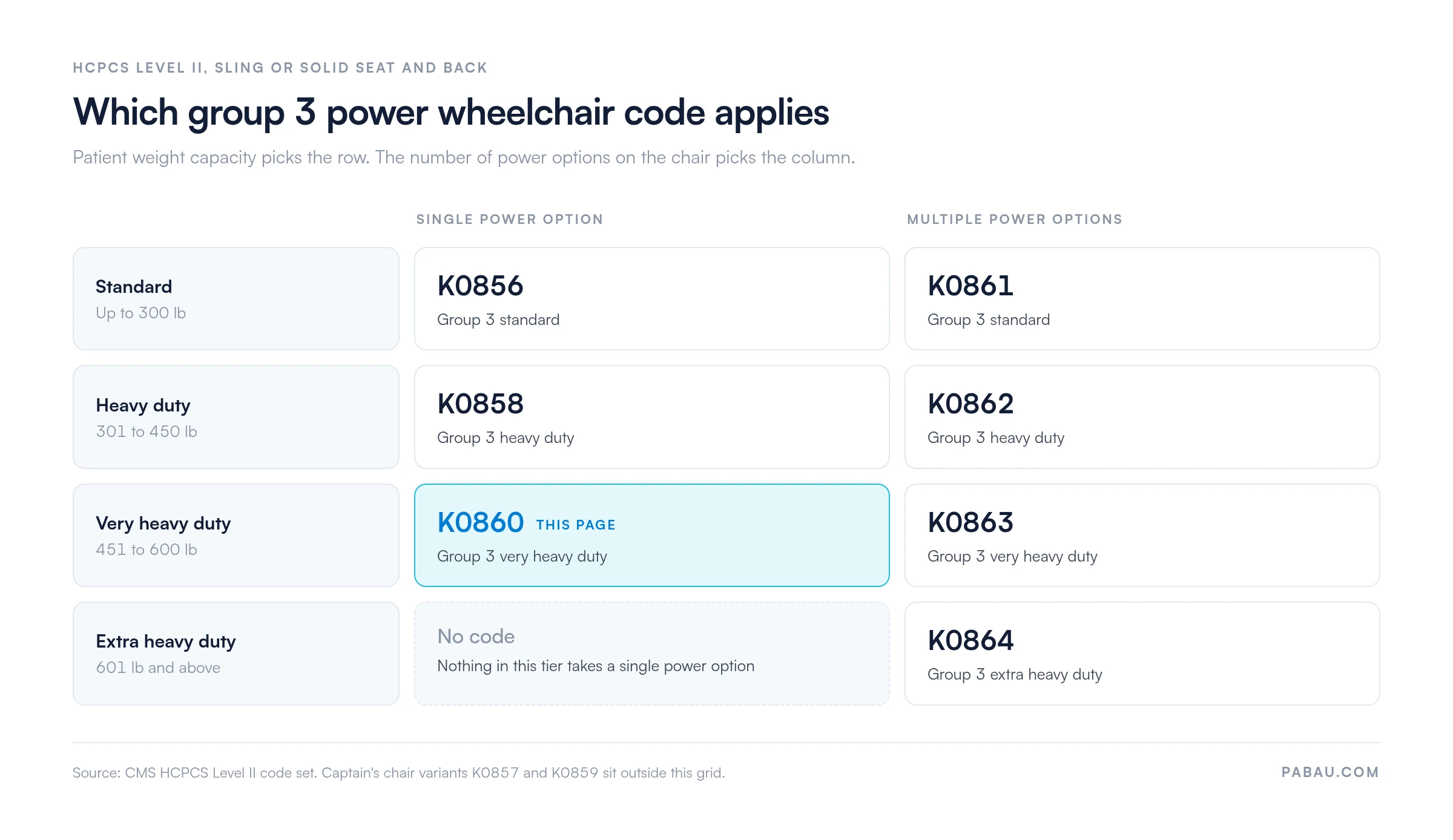
Two questions settle the choice. If the chair carries more than one power option, such as power tilt plus power seat elevation, the code moves across to K0863. If the patient weighs 301 to 450 pounds, the code is K0858 instead, and that is the swap coders get wrong most often.
A clean K0860 claim needs the right claim form, the correct place of service, and the applicable modifiers. Errors in any of those fields trigger automatic edits at the clearinghouse or the MAC before a reviewer sees the claim.
K0860 is billed on the CMS-1500 paper form or the 837P electronic transaction. Most MACs require electronic submission for DME suppliers above a minimum claims volume. The 837P electronic claim format is the standard for Medicare DME billing, and it must match the prior authorization data submitted earlier.
K0860 is billed with place of service code 12 (Home) in most Medicare DME scenarios. Which modifiers apply depends on the claim context and the rental month.
Every K0860 claim needs a modifier showing purchase, rental, or used status, and omitting it is a routine clean-claim failure. Because K0860 is a capped rental, KH, KI and KJ then track which rental month is being billed.
Run a pre-submission audit on every K0860 claim. Confirm the prior authorization number sits in field 23 of the CMS-1500, or the Loop 2300 REF segment of the 837P. Confirm the modifier matches the rental month or the purchase status. Confirm the CMN signature date precedes the order date. Those three checks catch most K0860 clean-claim failures at the clearinghouse.
K0860 denials cluster around a predictable set of documentation and workflow failures. The denial codes that appear most often on these claims map to the errors below.
Each category has its own remediation step, so tracking denials by category shows which part of the K0860 process generates the rework. A supplier with repeated CMN denials has an intake problem. A supplier with repeated modifier errors has a billing configuration problem.
A DME supplier billing K0860 usually tracks the order, the CMN, the face-to-face notes and the prior authorization in separate places. The prior authorization number lives in an email, the delivery receipt in a scanned folder, and the rental month in a spreadsheet.
Pabau, practice management software that includes claims management, holds those records against one patient and one claim. Prior authorization numbers, modifier requirements and documentation status stay visible through the whole capped rental period. An ADR response is then assembled rather than reconstructed.
Claims go out as 837P files, and the status of each one comes back to the same record. A biller can see which K0860 claims are waiting on authorization and which are ready to submit.

Pabau’s claims management tools keep prior authorization numbers, rental modifiers and documentation status on one claim record. Your team submits 837P files without rebuilding the paperwork first.

K0860 turns on three facts. The patient’s weight tier, the number of power options on the chair, and the seating system decide the code. The prior authorization sequence decides whether the claim survives.
Treat the documentation checklist as a gate on the order, not a file you assemble after delivery. A chair delivered before the MAC’s affirmative decision cannot be rescued, whatever the notes say afterward.
Suppliers who bill K0860 cleanly catch the problem at intake rather than at appeal. Book a demo to see how Pabau tracks K0860 authorizations, rental modifiers and documentation through the capped rental period.

Need to understand how clearinghouses process DME claims? How medical claims clearinghouses work explains the validation steps between claim submission and MAC adjudication.
Want to reduce denial rates on power mobility device claims? Denial management in healthcare covers the structured workflows that catch documentation errors before they become denials.
Looking for guidance on 837P electronic claim submission? 837P electronic claim file guide covers the transaction format, loop structure, and common submission errors for Medicare DME billing.
HCPCS Code K0860 is the HCPCS Level II code for a group 3 very heavy duty power wheelchair. The chair has a single power option and a sling or solid seat and back. DME suppliers bill it to Medicare Part B for patients weighing 451 to 600 pounds.
Yes. K0860 requires prior authorization under the CMS Medicare Prior Authorization Program for Power Mobility Devices. The supplier must receive an affirmative decision from the applicable MAC before delivering the wheelchair. Delivering first and billing afterward produces an automatic denial with no appeal on medical necessity grounds.
You need a signed Certificate of Medical Necessity, a written physician order specifying K0860, and face-to-face evaluation notes. The notes must cover the clinical justification and the home accessibility assessment. You also need the supplier’s detailed product description, the prior authorization approval, and a signed proof of delivery. The applicable MAC LCD governs the exact list.
Every K0860 claim carries a modifier showing purchase, rental, or used status. KH covers the initial claim or first rental month, KI covers the second and third months, and KJ covers month four onward. NU, RR and UE indicate new, rented and used equipment. The KE competitive bidding modifier does not apply, because K0860 is excluded from the bidding program.



