Pabau Engage inbox

Pabau Engage is here: every patient conversation in one inbox.

Learn more
HCPCS Code

HCPCS code K0855 – Power wheelchair group 3 extra heavy duty captains chair


Code Definition

K0855 is the HCPCS Level II code for a power wheelchair, group 3 extra heavy duty, captains chair, patient weight capacity 601 pounds or more. It's a Group 3 base with no power options, so a chair with power tilt or recline takes a different code.

If the chair has a sling or solid seat instead of a captains chair, bill K0854. Either way, the claim needs prior authorization, a specialty evaluation, a RESNA-certified ATP and a written order before delivery.

Level
Level II
Category
K Temporary codes assigned to DME MACs (K0000-K9999)
Code range
K0848-K0864 Power wheelchairs, group 3
Billable
No
Code also known as
bariatric power wheelchair, extra heavy duty power chair, group 3 power mobility device
Save time. Improve accuracy. Get paid faster.
Automate coding with Pabau

Let Pabau's smart automation suggest the right codes, reduce claim denials, and keep your practice compliant—effortlessly.

  • AI-powered code suggestions
  • Real-time compliance checks
  • Faster claims, fewer denials
Why practices choose Pabau
Save hours every week

Automate repetitive tasks and focus on what matters most—your patients.

Improve accuracy

Reduce coding errors and ensure compliance with the latest regulations.

Get paid faster

Clean claims, fewer denials, and faster reimbursements.

Grow with confidence

Powerful insights and reporting to help your practice thrive.

HIPAA compliant SOC 2 certified GDPR-compliant Trusted by 4,000+ clinics worldwide

Key takeaways

Key takeaways

HCPCS code K0855 is a Group 3 extra heavy duty power wheelchair with a captains chair, rated for patients of 601 pounds or more.

K0855 is a base with no power options. A chair with power tilt or recline needs one of the Group 3 power option bases, K0856 to K0864.

K0855 is on CMS’s Required Prior Authorization List in every state, so a claim without a provisional affirmation is denied.

LCD L33789 covers an extra heavy duty chair from a patient weight of 570 pounds. Group 3 also needs a neurological condition, myopathy or congenital skeletal deformity.

Group 3 power wheelchairs are excluded from competitive bidding, so Medicare pays from the national DMEPOS fee schedule.

HCPCS code K0855 covers one narrow chair

HCPCS code K0855 is a Group 3 extra heavy duty power wheelchair base with a captains chair, rated for 601 pounds or more.

The Power Mobility Devices LCD lists K0855 among its Group 3 bases with no power options and sets the criteria for covering one. Each word in the descriptor narrows the chair, so read it against the order before you code.

Descriptor elementWhat it means for billing
Power wheelchairA powered wheelchair base, not a scooter or a manual chair.
Group 3A complex rehab tier with stricter coverage criteria than Group 2.
Extra heavy dutyThe top weight band, for a patient weight capacity of 601 pounds or more.
Captains chairA one-piece, automotive-style seat. A sling or solid seat and back is K0854 instead.
No power optionsNot in the descriptor, but K0855 sits in the Group 3 no power option range, K0848 to K0855.

Watch that last row. K0855 has no “single power option” in its name, so the descriptor never warns you. A chair that adds power tilt, recline or seat elevation needs a power option base code.

Weight, seat and power options pick the code

The Group 3 no power option codes split two ways, by weight capacity and by seat. Each weight band has a sling/solid code and a captains chair code, so a heavy duty patient in a captains chair bills K0851. Power options move you out of this range altogether.

CodeWeight capacitySeatPower options
K0852Very heavy duty, 451 to 600 lbsSling/solid seat and backNone
K0853Very heavy duty, 451 to 600 lbsCaptains chairNone
K0854Extra heavy duty, 601 lbs or moreSling/solid seat and backNone
K0855Extra heavy duty, 601 lbs or moreCaptains chairNone
K0856Standard duty, up to 300 lbsSling/solid seat and backSingle power option

Start with the documented weight. LCD L33789 covers an extra heavy duty chair for a patient who weighs 570 pounds or more, even though the base is rated from 601. Then check the seat on the product data sheet, not the brochure name. A sling or solid seat and back makes it K0854.

If the order adds a power seating function, recode to a single (K0856 to K0860) or multiple (K0861 to K0864) power option base. At this weight band, the multiple power option base is K0864. The chart runs the four checks in the order a coder should take them.
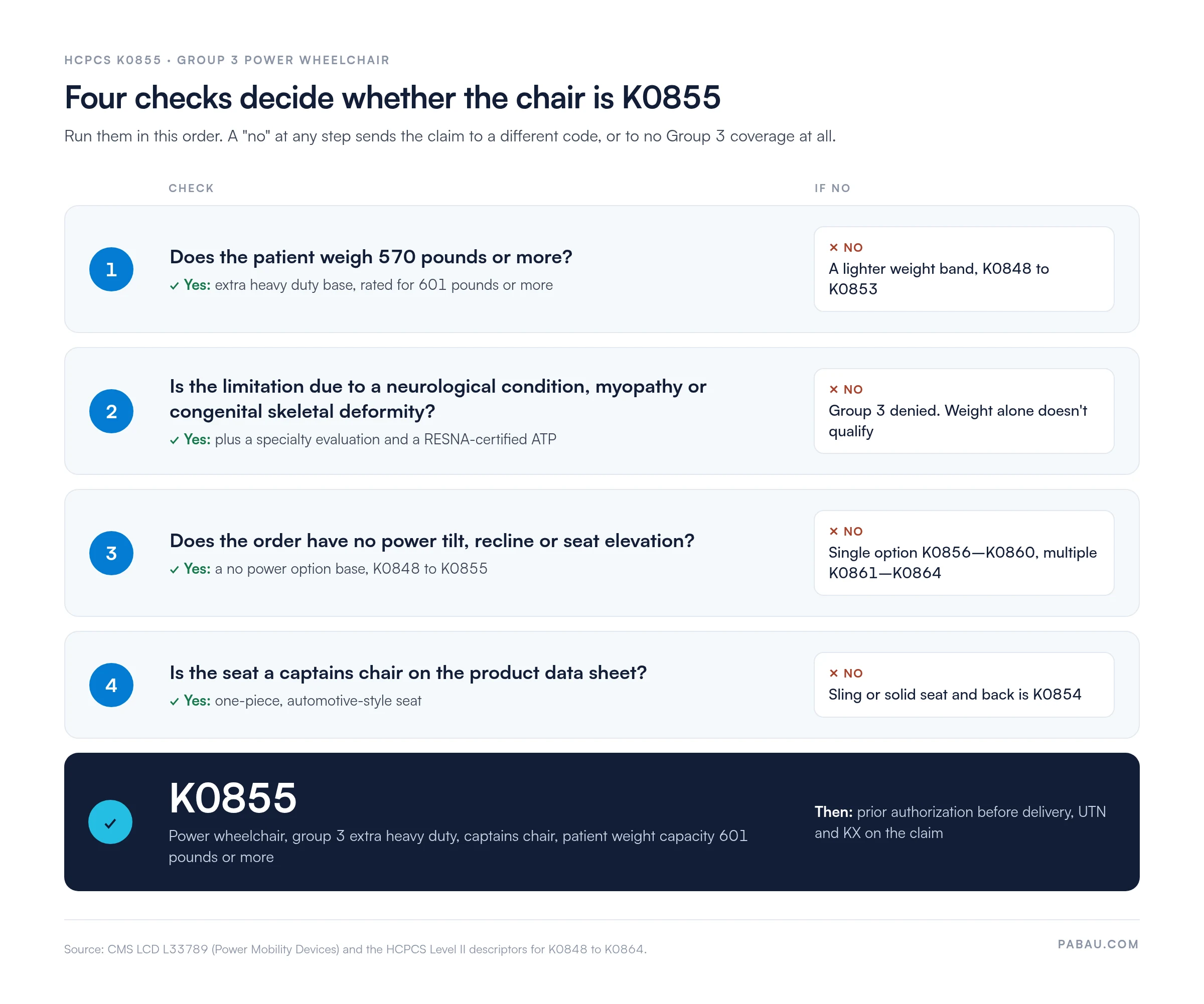
Four-step decision chart for HCPCS K0855
Three of the four checks only move the order to another code, while the condition check ends Group 3 coverage outright. Criteria from LCD L33789.

Weight alone won’t qualify a patient for Group 3

Weight gets a patient into the extra heavy duty band, but it doesn’t get them into Group 3. Under LCD L33789, the patient must first meet the general power wheelchair criteria, then the Group 3 ones.

  • A mobility limitation in the home. It must stop the patient from doing mobility-related activities of daily living, such as toileting, feeding or dressing, in the home.
  • Lesser devices won’t work. A cane, walker, manual wheelchair or scooter can’t safely meet the need.
  • A qualifying condition. The limitation is due to a neurological condition, a myopathy or a congenital skeletal deformity.
  • A specialty evaluation. A PT, OT or physician with rehab wheelchair training assesses the patient. That person has no financial relationship with the supplier.
  • An ATP on the supplier side. The supplier employs a RESNA-certified Assistive Technology Professional who’s directly involved, in person, in choosing the chair.
  • A home that fits the chair. The supplier checks before or at delivery that the patient can use the chair in their home.

The qualifying condition is where weight-driven orders fail. Severe obesity on its own doesn’t meet the Group 3 test. A patient over 600 pounds with no neurological condition, myopathy or congenital skeletal deformity won’t qualify for K0855, however strong the weight case is.

Group 3 condition typeExamplesWhat the notes must show
Neurological conditionALS (G12.21), cerebral palsy (G80.-), paraplegia or quadriplegia (G82.-)How the condition limits mobility in the home.
MyopathyMuscular dystrophy (G71.0-)Weakness that rules out a manual chair or scooter.
Congenital skeletal deformityCodes from ICD-10-CM Chapter 17 (Q00-Q99)The deformity and its effect on mobility tasks.

Code to the condition the specialty evaluation documents. If you also report obesity, it supports the weight band, not the Group 3 eligibility.

A worked example: Two patients, two codes

Take two illustrative patients with cerebral palsy, both ordered a captains chair with no power options. Both have a specialty evaluation on file and an ATP involved in choosing the chair.

  • Patient A weighs 585 pounds. That clears the 570-pound coverage line for extra heavy duty, so the order codes to K0855.
  • Patient B weighs 565 pounds. An extra heavy duty chair would be denied as not reasonable and necessary. The very heavy duty band covers 428 to 600 pounds, so the captains chair code is K0853.

The 20 pounds between them change the base, the fee schedule line and the prior authorization request. Weigh the patient at the face-to-face visit and record it, rather than copying an old figure from the chart.

A K0855 claim moves through seven steps in order

A K0855 file is built in a fixed order. Each step needs the one before it, and a step done out of sequence is a common reason for denial.

  1. Face-to-face encounter. The treating practitioner sees the patient and documents the mobility limitation. The encounter must fall within the 6 months before the order.
  2. Written order prior to delivery. The practitioner signs the order, and the supplier must have it before the chair goes out.
  3. Specialty evaluation and ATP assessment. The independent PT, OT or rehab-trained physician evaluates the patient. The supplier’s ATP takes part in choosing the chair.
  4. Prior authorization request. The supplier sends the request and the full file to the DME MAC. A decision comes within 5 business days, or 2 business days for an approved expedited request.
  5. Delivery within the validity window. A provisional affirmation stays valid for 6 months, according to CGS, a DME MAC. Miss that window and you’ll need a new request.
  6. Home assessment and proof of delivery. The supplier confirms the chair works in the home and gets a signed proof of delivery.
  7. Claim to the DME MAC. The supplier bills K0855 on the CMS-1500 or 837P with the unique tracking number (UTN) from the decision and the KX modifier.

Power wheelchairs don’t use a certificate of medical necessity. CMS-484 is the oxygen CMN, so it has no place in a K0855 file. Put that effort into the face-to-face notes and the specialty evaluation.

Prior authorization for K0855 comes before delivery

K0855 has been on CMS’s Required Prior Authorization List nationwide since September 1, 2018. Since April 17, 2023, it has also needed a face-to-face encounter and a written order prior to delivery. Both are billing compliance requirements the DME MAC checks before it pays.

  • No decision, no payment. A K0855 claim that reaches the DME MAC without a provisional affirmation is denied.
  • The supplier submits. The request comes from the supplier, with the practitioner’s notes, the order and the specialty evaluation attached.
  • A non-affirmation isn’t final. The supplier can fix the gaps the decision letter names and resubmit the request.
  • Accessories ride along. PMD accessories can go on the same request, so the whole chair is reviewed at once.

Medicare pays K0855 from the DMEPOS fee schedule

The Medicare Improvements for Patients and Providers Act of 2008 (MIPPA) settled this. It permanently excluded Group 3 and higher complex rehab power wheelchairs from DMEPOS competitive bidding.

K0855 is paid from the CMS DMEPOS fee schedule, which updates each year. Pull the current state amount there rather than relying on a figure from an old claim.

Payment factorWhat it means for K0855
Fee scheduleSet by the DMEPOS fee schedule, with no competitive bidding contract needed.
Rental or purchaseA capped rental item, with the option to buy when the chair is first supplied.
Cost sharingMedicare pays 80% after the Part B deductible. The patient owes 20% coinsurance.
AccessoriesBilled with their own codes only when the LCD doesn’t bundle them into the base.

Modifiers tell the DME MAC how the chair was supplied

ModifierUse
KXThe LCD coverage criteria are met and documented.
RRThe item is rented.
KHFirst month of a capped rental.
KISecond or third month of a capped rental.
KJMonths 4 to 13 of a capped rental.
NUNew equipment, purchased.

Run this K0855 checklist before the chair ships

Work through this list before the chair leaves the warehouse. A clean claim for K0855 depends on every box being ticked before delivery, because a missing item can’t be fixed on the claim form.

  • The patient’s weight is documented and is 570 pounds or more, the coverage line for extra heavy duty.
  • The seat on the data sheet is a captains chair, and the chair has no power seating options.
  • The notes name a neurological condition, myopathy or congenital skeletal deformity.
  • The face-to-face encounter falls within 6 months before the order.
  • The written order is signed and dated, and it reached you before delivery.
  • The specialty evaluation is on file, from someone with no financial tie to you.
  • Your ATP’s in-person involvement is documented.
  • The provisional affirmation is in hand, still inside its 6-month window, with the UTN recorded.
  • The home assessment and signed proof of delivery are on file.

Six mistakes that get K0855 claims denied

K0855 denials tend to repeat the same few errors. Building denial management workflows around them costs less than reworking each claim.

MistakeWhy it failsHow to prevent it
Delivering before the affirmationThe claim reaches the DME MAC with no prior authorization decision.Don’t schedule delivery until the UTN is on the case.
Coding a power option chair as K0855K0855 is a no power option base.Recode to K0856 to K0864 when the order adds tilt, recline or other power seating.
Wrong seat codeA sling or solid seat and back is K0854, not K0855.Match the code to the seat on the product data sheet.
Weight-only justificationObesity alone doesn’t meet the Group 3 condition test.Document the neurological condition, myopathy or congenital deformity.
Missing specialty evaluation or ATPBoth are Group 3 coverage criteria in LCD L33789.Book the evaluation early and file the ATP’s notes with the order.
Missing UTN or KXThe claim can’t be matched to its decision or its criteria.Check both fields on the claim before it’s sent.

When a denial does land, match its denial codes to the row above before you resubmit.

Pabau keeps the whole K0855 file on one record

A K0855 file passes through several hands before it’s billed. The authorization number sits in one inbox and the delivery date in another. Then someone keys the claim by hand at the end.

Pabau, the practice management platform we build, keeps that file on the patient record. Its cleaner claims management pre-fills the CMS-1500 from the record and checks required claim fields before submission. Authorization codes and dates stay on the case.
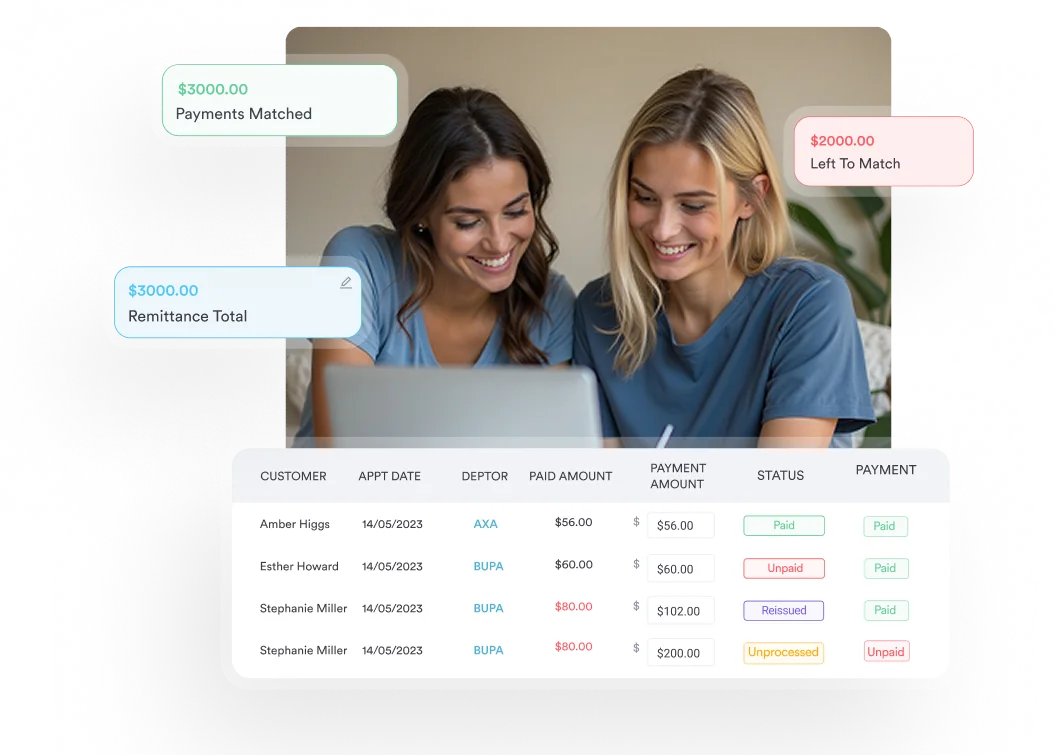
Pabau billing screen integrated with the patient record
Pabau’s billing view pre-fills the claim from the patient record, so a K0855 claim goes out with its authorization details already attached.

Your team sees the affirmation date next to the planned delivery date, so a lapsed affirmation gets caught before the chair ships. Fewer claims go out with a missing field.

Send cleaner DME claims the first time

Pabau pre-fills the CMS-1500, checks required claim fields and keeps authorization codes and dates on each case.

Pabau claims management dashboard

Conclusion

Treat K0855 as a decision you make once, at the order. Confirm the weight, the qualifying condition, the seat and the lack of power options before anyone requests prior authorization. Correcting the code after the request goes in is far harder than getting it right first.

After that, protect the timeline. The affirmation lasts 6 months, so delivery, the home check and the claim all have to land inside it.

Book a demo to see how Pabau keeps affirmation dates beside each delivery, so a K0855 chair never ships on a lapsed authorization.

Continue your research

Continue your research

Coding a Group 3 chair with one power option? HCPCS code K0859 covers the heavy duty captains chair base with a single power option.

Ordering power tilt for a lighter patient? HCPCS code K0856 explains the standard duty single power option base.

Need more than one power seating function? HCPCS code K0861 walks through the standard duty multiple power option base.

Is the patient on a UnitedHealthcare plan? UnitedHealthcare prior authorization form sets out what that payer asks for before it approves equipment.

Frequently asked questions

Is K0855 the same as a bariatric power wheelchair?

Not exactly. “Bariatric” is a trade term, not a HCPCS category. A bariatric chair bills as K0855 only when it’s a Group 3 base with a captains chair rated for 601 pounds or more.

How often will Medicare replace a K0855 wheelchair?

Medicare expects durable equipment to last at least five years, its reasonable useful lifetime. Inside that window, replacement is covered only if the chair is lost, stolen or irreparably damaged. A new chair also needs a new order and prior authorization.

Can a patient use a K0855 chair outside the home?

Yes. Coverage rests on the mobility limitation inside the home, though, so notes that only describe trips outside won’t support the claim.

Are repairs to a K0855 chair covered?

Once the patient owns the chair, Medicare covers reasonable and necessary repairs. Replacement parts are billed with their own codes and the RB modifier, and technician labor is billed with K0739.

Do Medicare Advantage plans follow the same K0855 rules?

Not always. Medicare Advantage plans set their own prior authorization and supplier rules. Check the plan’s policy before you order the chair.
Avatar photo
Monika Lazarevska
Content Writer

Monika Lazarevska writes content for owners and healthcare professionals who want clear, no-fluff content that actually helps them run their practice better. With a background in storytelling and SEO, she knows how to make even the driest topics worth reading. Off the clock, you'll find her in a café somewhere in Europe, probably with a good book and an even better coffee.
×