CCSD Code 22023: EMG and nerve conduction studies billing guide
CCSD code 22023: Definition and clinical context CCSD code 22023 is the procedur...

Last Updated: Nov 4, 2026
A4575 is the HCPCS Level II code for a topical hyperbaric oxygen chamber, disposable. Medicare denies it as not reasonable and necessary under DME MAC LCD L33797, whatever the diagnosis.
Suppliers still have work to do on these claims. They need an advance beneficiary notice signed before treatment and modifier GA or GZ on the claim line. They also need a route to the commercial payers that cover topical oxygen.
Let Pabau's smart automation suggest the right codes, reduce claim denials, and keep your practice compliant—effortlessly.
Automate repetitive tasks and focus on what matters most—your patients.
Reduce coding errors and ensure compliance with the latest regulations.
Clean claims, fewer denials, and faster reimbursements.
Powerful insights and reporting to help your practice thrive.
HIPAA compliant SOC 2 certified GDPR-compliant Trusted by 4,000+ clinics worldwide

HCPCS code A4575 describes a disposable topical hyperbaric oxygen chamber, a supply-category Level II code distinct from systemic HBOT codes.
Medicare denies A4575 as not reasonable and necessary under DME MAC LCD L33797, a national position held since January 1, 2004.
Because the denial applies whatever the diagnosis, no ICD-10-CM code makes A4575 payable and no Medicare fee schedule amount is paid.
A signed ABN before treatment, plus modifier GA on the claim line, is what makes the charge collectable from the patient.
The Part A/B LCDs for topical oxygen therapy govern a wound care service in another jurisdiction, so they never make A4575 payable.
A proposed revision, DL33797, would cover topical oxygen for some diabetic foot ulcers, but it was not final policy as of September 2026.
HCPCS code A4575 is a Level II HCPCS supply code maintained by the Centers for Medicare and Medicaid Services (CMS). It describes a single-use, disposable device applied directly to a wound to deliver a localized, pressurized oxygen environment to the wound bed. The official code descriptor is: Topical hyperbaric oxygen chamber, disposable.
This is a supply code, not a procedure code. The device itself is billed under A4575, while any associated physician evaluation or wound care management services are billed separately using the appropriate CPT codes. Understanding that distinction prevents unbundling errors and inappropriate billing on the same claim.
Topical hyperbaric oxygen therapy (TOT) delivers concentrated oxygen directly to a localized wound site using a sealed, pressurized chamber placed over the wound. It is fundamentally different from systemic hyperbaric oxygen therapy (HBOT), where a patient enters a whole-body hyperbaric chamber.
That distinction matters for billing. Systemic HBOT bills under codes such as 99183 and G0277. Topical HBO uses A4575 for the disposable chamber supply. Billing A4575 for a patient who received systemic HBOT produces a denial. Confusing the two modalities on a claim may also trigger a compliance review.
TOT is primarily used in outpatient wound care centers for chronic, non-healing wounds. The clinical rationale is that increased local oxygen tension promotes angiogenesis and bacterial suppression in hypoxic wound tissue. The DME MACs judged the published evidence insufficient for the supply itself. Rather than write coverage criteria for the chamber, they denied it outright, which is the position that still governs A4575 claims.
Medicare does not cover A4575 for any diagnosis, in any state. The code sits in the DME jurisdiction, where coverage is set by the local coverage determination Oxygen and Oxygen Equipment (L33797). That policy lists topical hyperbaric oxygen chambers among the items denied as not reasonable and necessary.
Two contractors administer the policy. CGS Administrators covers DME jurisdictions B and C. Noridian Healthcare Solutions covers jurisdictions A and D, and all four apply the same determination. No region pays for the chamber. The denial dates to a revision effective January 1, 2004, and the current revision (R11, effective April 1, 2023) carries it forward.
Part A/B MACs publish their own topical oxygen therapy policies, including Palmetto GBA’s L37873. Those policies govern topical oxygen as a wound care service billed to a Part A/B contractor. They do not address the A4575 supply code, which the DME MACs adjudicate under L33797.
Noridian’s Part A/B article A56025 makes the split explicit. It assigns A4575 and E0446 to the DME MACs, and states that such claims are not expected under a Part A/B contractor. Quoting a Part A/B policy in support of an A4575 claim will not change the outcome. A different contractor and a different policy decide the code.
The DME MACs posted a proposed revision to L33797, numbered DL33797, on July 23, 2026. It would add a coverage category for topical oxygen therapy in non-healing diabetic foot ulcers. The draft criteria include four consecutive weeks of optimized ulcer care without at least a 50% reduction in ulcer area. The comment period closed on September 5, 2026.
None of this is current policy. A4575 stays denied until a final LCD is published with an effective date, and any coverage that arrives will carry its own documentation criteria. Track the Medicare Coverage Database entry for L33797 so your billing rules change on the day the final policy takes effect.
Those four steps resolve into three routes, and the paperwork signed at intake decides which one a patient lands on.
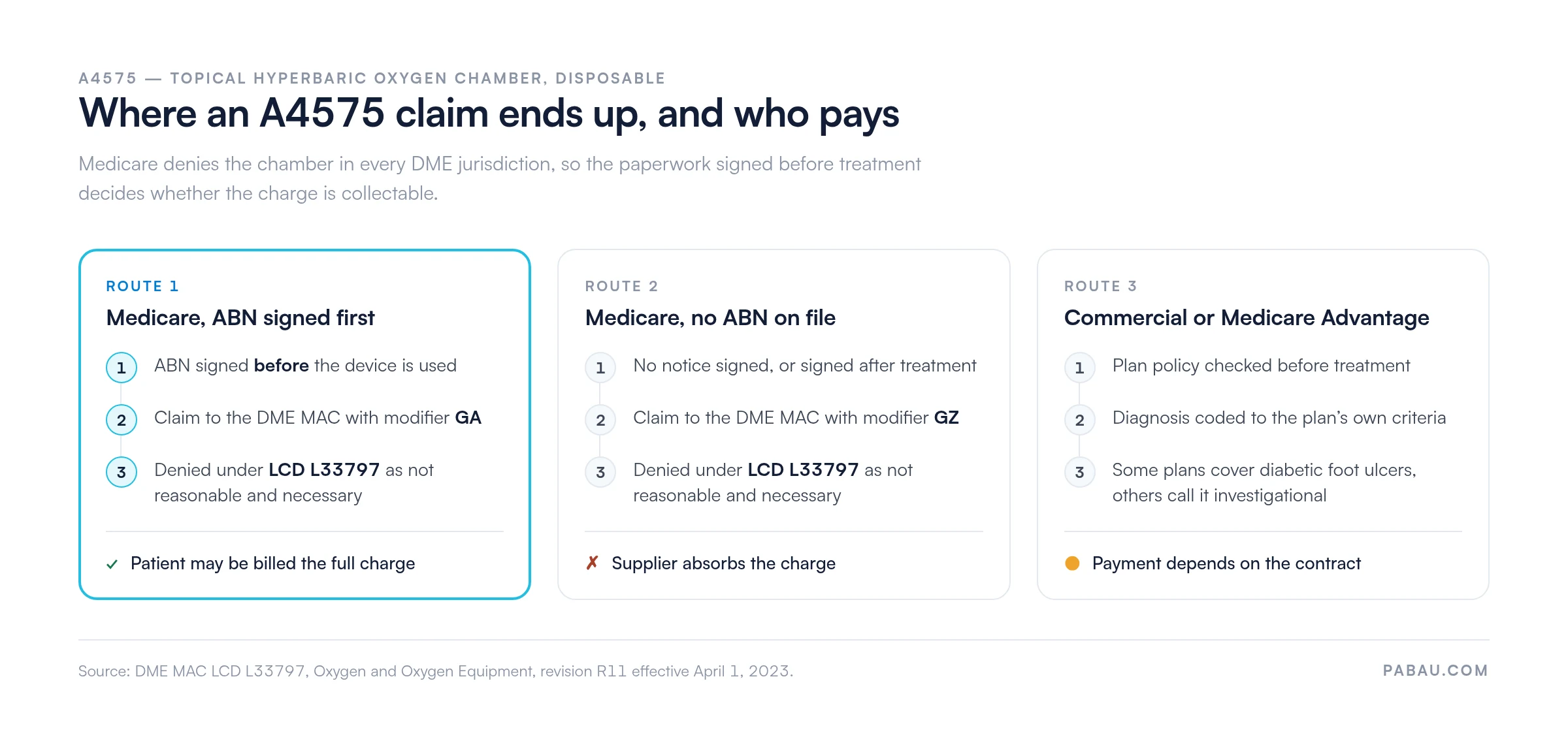
Solid insurance eligibility verification before treatment tells the front desk which patients face the full charge. That conversation belongs at booking, before a device is opened.
Commercial payers take their own positions on this therapy. Aetna and UnitedHealthcare treat topical oxygen as investigational for some indications, while other plans cover it for diabetic foot ulcers with criteria attached. Check the policy before treatment, not after, and record the pre-authorization decision in the patient chart while you are in it.
No ICD-10-CM code makes A4575 payable under Medicare. The denial in L33797 applies whatever diagnosis appears on the claim, so diagnosis selection cannot establish medical necessity for this supply. The codes below serve a different purpose. They describe the wound accurately for the medical record, for commercial payer review, and for the wound care services billed alongside the device.
Code to the highest level of specificity available. Unspecified codes such as L97.909 weaken a commercial appeal and blur the clinical picture later reviewers depend on. If the proposed DME MAC policy is finalized, diabetic foot ulcer coding such as E11.621 will decide whether a claim qualifies. Accurate coding habits now save rework later.
There is no payable Medicare rate for A4575. A DMEPOS fee schedule entry is a pricing reference, not a coverage decision, and L33797 denies the item. No allowed amount is paid, and no Part B coinsurance is calculated against it. Any published dollar figure presented as a Medicare rate for this code is describing a payment that does not happen.
Patient liability takes the place of Medicare payment here. With a signed ABN on file, the supplier may bill the beneficiary the full charge once the denial posts. Without one, the charge cannot be collected from the patient, and the practice absorbs it. One piece of paperwork decides who pays for the chamber.
Commercial contracts set their own allowances, and that is where a wound care service line recovers its cost. Review every topical oxygen contract term once a year, alongside the October DMEPOS fee schedule release.
A clean A4575 claim reaches the right contractor with the right modifier and a defensible record behind it. The steps below follow the DME MAC policy and the joint billing guidance the contractors publish for topical oxygen.
A workflow that runs from intake through claim submission catches missing records before they cost money. Confirm payer, ABN, modifier, enrollment, and documentation on every A4575 submission before the claim leaves the practice. The claim then stands up as an auditable record if a reviewer asks for one.
Documentation for A4575 carries more weight than usual, because the Medicare claim is denied by policy. The record has to support the patient’s financial liability, any commercial claim behind the denial, and the clinical decision to use the device.
Practices that build the file at the point of care answer a Medicare audit without disruption. Every A4575 encounter should generate a complete record the same day, rather than one reassembled months later from memory.
Wound photographs and treatment logs are protected health information. They belong in a HIPAA-compliant system with access controls, not on a staff phone or a shared drive.
Run an A4575 documentation audit quarterly. Pull ten recent claims and check each one for a signed physician order, a dated ABN, and documented failure of standard wound care. A document missing from that sample is missing from your live billing too, and an unsigned ABN turns a routine denial into a write-off. Fix the intake workflow on your own schedule, well before an audit sets it for you.
Wound care billing typically involves a cluster of related codes billed on the same or adjacent dates of service as A4575. A debridement billed under 97597 at the same visit, for example, is reported as its own service. Knowing which codes pair with A4575, and which are mutually exclusive, prevents unbundling violations and claim edits.
Use AAPC’s HCPCS code lookup to verify related code descriptors and any bundling edits that apply to your specific payer or MAC jurisdiction.
A4575 is denied by policy, so the errors worth attention are the ones that move cost onto the practice or create audit exposure. These patterns show up most often in wound care billing reviews.
Start by separating the denials you expect from the ones that signal a process failure.
Some suppliers still submit A4575 expecting payment, then appeal the denial on medical necessity grounds. L33797 denies the item whatever the diagnosis, so neither the claim nor the appeal recovers money. Prevention: treat a Medicare A4575 line as a denial by design, and set the patient liability process up before treatment.
Part A/B coverage policies for topical oxygen therapy govern a wound care service in a different jurisdiction. Citing one in support of an A4575 claim does not change how the DME MAC adjudicates the code. Prevention: confirm which contractor adjudicates a code before quoting any policy at it, and keep the DME and Part A/B policies filed separately.
Without an ABN signed before treatment, the expected denial leaves the supplier holding the charge with no way to bill the patient. This is the costliest error on the list, because the device has already been used. Prevention: make ABN capture a required step in wound care intake, with the signed copy attached to the encounter.
Commercial payers that cover topical oxygen publish their own diagnosis criteria, usually narrowed to diabetic foot ulcers. A claim coded to an unspecified ulcer code is denied on medical necessity grounds. Prevention: keep a current copy of each contracted policy’s diagnosis list and audit coding at intake. Review the list at each ICD-10 annual update cycle.
A4575 is billed by DMEPOS-enrolled suppliers. A physician practice that is not enrolled as a DMEPOS supplier cannot bill this supply code directly. Billing under the wrong NPI or an entity without DMEPOS enrollment produces a claim rejection. Prevention: confirm supplier enrollment status annually and before onboarding any new wound care service line.
Tracking denial codes by category shows whether A4575 denials follow the expected pattern. It also shows when they point to missing ABNs or enrollment problems, so the fix targets the root cause. Pabau, the practice management platform we build, includes claims management software that shows denial patterns by code and payer. Billing teams can then spot a recurring A4575 issue early, before it repeats across a month of claims.
One A4575 device generates three separate records. There is the signed ABN, the Medicare denial that follows it, and often a commercial claim behind that. Tracked in a spreadsheet, the three records drift apart, and the patient balance goes uncollected.
Pabau keeps all three together on the patient record. Claims management in Pabau shows status and denial reasons by code and payer. A billing lead can see which A4575 lines have a signed ABN behind them, and which have become write-offs.
The result is a shorter route from treatment to resolution. Your team stops re-checking a Medicare position that has not moved since 2004. That time goes to the commercial claims and patient balances that can still be collected.

Pabau’s claims management software helps wound care practices track claim status and manage denials. It also holds the documentation audit trail Medicare requires for A4575 and other supply codes.

HCPCS code A4575 is a denied Medicare supply code with a working commercial market around it. The DME MACs have treated topical hyperbaric oxygen chambers as not reasonable and necessary since 2004, and the current LCD holds that position. The preventable losses come from billing the code as covered, or from leaning on a Part A/B policy that governs another jurisdiction. Treating a patient without a signed ABN costs the practice the same way.
A proposed revision may open coverage for some non-healing diabetic foot ulcers, so watch the Medicare Coverage Database for a final LCD. Pabau’s claims management software keeps the documentation trail Medicare requires and tracks denial patterns by code. Billing leads can see which balances are still collectable. To see how Pabau handles billing workflows end to end, book a demo.

Need a foundation for your billing compliance process? Understanding medical billing workflows covers the full cycle from patient intake through payment posting, including where supply codes like A4575 fit in.
Worried about Medicare audit exposure? Medical billing compliance best practices walks through the documentation standards and internal audit processes that protect wound care practices.
Struggling with denied A4575 claims? Denial management in healthcare explains how to categorize, appeal, and systematically prevent the most common claim denials across supply and procedure codes.
Want the claim to go out right the first time? What makes a clean claim sets out the payer, coding and documentation checks that stop a submission bouncing back.
Building the record behind a denied supply line? How a superbill works explains which fields the document carries and how it supports a patient or secondary payer claim.
HCPCS code A4575 is used to bill for a disposable topical hyperbaric oxygen chamber. The single-use device delivers localized, pressurized oxygen directly to a chronic wound bed. It is used in outpatient wound care for diabetic foot ulcers, venous stasis ulcers, and arterial insufficiency ulcers. These are wounds where conventional care has not produced adequate healing.
No. Medicare denies A4575 as not reasonable and necessary under the DME MAC local coverage determination Oxygen and Oxygen Equipment (L33797). That determination has been in place since January 1, 2004, and it applies in every DME jurisdiction, so no diagnosis makes the supply payable. Give the patient an advance beneficiary notice before treatment and append modifier GA to the claim line.
ICD-10-CM codes reported with topical oxygen therapy include E11.621 (type 2 diabetes with foot ulcer) and I83.009 (varicose veins with ulcer). Others include L97.319 (non-pressure chronic ulcer of ankle) and the L89 pressure injury codes. None of them makes A4575 payable under Medicare, because the DME MAC denial applies whatever the diagnosis. They matter for the medical record, for commercial claims, and for the wound care services billed alongside the device.
No payable Medicare amount applies to A4575. The item is denied under LCD L33797, so no allowed amount is paid and no Part B coinsurance is calculated against it. Where a signed ABN is on file, the supplier may bill the patient the full charge once the denial posts. Commercial contracts set their own allowances for topical oxygen.
Required documentation for A4575 includes a signed physician order, an ABN signed before treatment, and a wound assessment with site and severity. The record also needs evidence that standard wound care failed, a medical necessity justification, a treatment log, and a supported ICD-10-CM diagnosis. The signed ABN is what makes the charge collectable from the patient after the Medicare denial.
Topical HBO billed under A4575 delivers oxygen locally to a wound site using a disposable chamber placed over the wound. Systemic hyperbaric oxygen therapy (HBOT) requires the patient to enter a whole-body pressurized chamber and is billed under CPT code 99183 or HCPCS G0277. The two modalities have different coverage criteria, billing codes, and claim submission pathways, and must never be confused on a claim.
A4575 falls under a single policy, the DME MAC local coverage determination Oxygen and Oxygen Equipment (L33797). Two contractors apply it, and both deny the code as not reasonable and necessary. CGS Administrators covers DME jurisdictions B and C, while Noridian Healthcare Solutions covers the rest. Part A/B contractors publish their own topical oxygen therapy LCDs, such as Palmetto GBA’s L37873. Those policies govern a wound care service in a different jurisdiction, so they do not apply to this supply code.
It may, but not yet. The DME MACs posted proposed LCD DL33797 on July 23, 2026. It would cover topical oxygen therapy for non-healing diabetic foot ulcers under defined criteria. The comment period closed on September 5, 2026. Until a final LCD is published with an effective date, A4575 remains denied.