

CCSD code G5100: Bypass of duodenum billing guide
CCSD code G5100 bills a bypass that leaves the duodenum in place CCSD code G5100...

Last Updated: Oct 16, 2026
99183 is the CPT code for physician or other qualified health care professional attendance and supervision of hyperbaric oxygen therapy, per session.
One unit covers one session, whatever its duration, and the chamber time itself is billed separately under HCPCS G0277. Denials cluster around two failures. One is a missing individualized physician attendance note for the session. The other is a diagnosis outside Medicare's approved indications list.
Let Pabau's smart automation suggest the right codes, reduce claim denials, and keep your practice compliant—effortlessly.
Automate repetitive tasks and focus on what matters most—your patients.
Reduce coding errors and ensure compliance with the latest regulations.
Clean claims, fewer denials, and faster reimbursements.
Powerful insights and reporting to help your practice thrive.
HIPAA compliant SOC 2 certified GDPR-compliant Trusted by 4,000+ clinics worldwide

CPT Code 99183 covers physician supervision of each HBOT session, while the chamber time itself is billed under G0277.
Medicare requires an individualized physician attendance note for every session, and blanket supervisory notes are the top denial trigger.
Approved indications are LCD-specific, so billing a non-covered diagnosis such as autism or Lyme disease draws a denial and a compliance review.
99183 pays roughly $109.55 nationally before geographic adjustment, at about 2.06 work RVUs per session.
Pabau’s claims management software links session documentation to claim submission, which cuts denials caused by missing per-session notes.
The American Medical Association defines CPT Code 99183 as: “Physician or other qualified health care professional attendance and supervision of hyperbaric oxygen therapy, per session.” Three words in that descriptor carry the billing logic. Attendance means the physician is physically present. Supervision means clinically directing the session. Per session means one unit per treatment, whatever its duration.
CPT Code 99183 is not time-based. Billing two units because a session ran ninety minutes instead of sixty is a coding error. One session, one unit, every time.
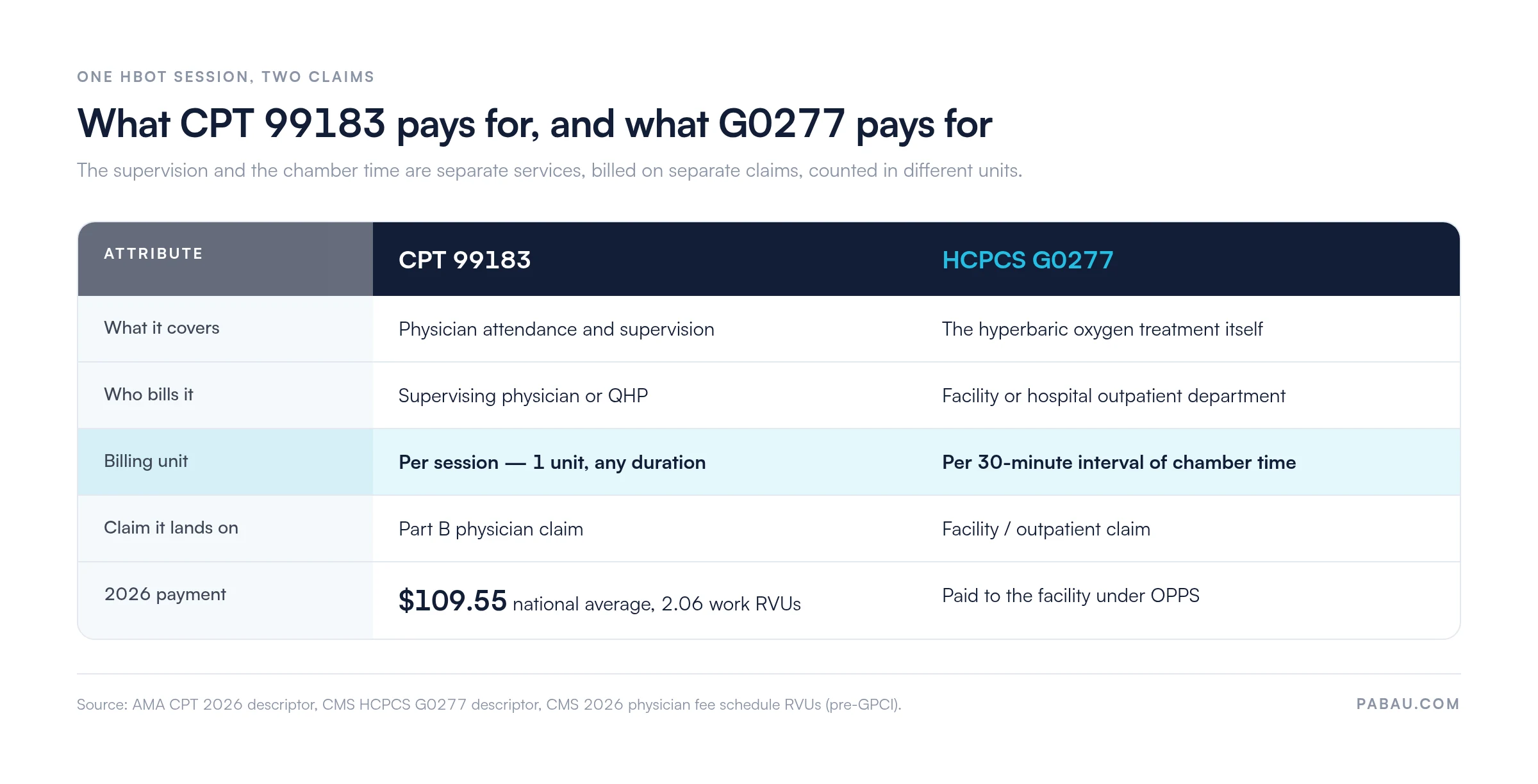
CPT 99183 covers physician supervision. HCPCS G0277 covers the hyperbaric oxygen treatment itself. Both are reported for most Medicare-covered HBOT sessions, but they are different services payable to different entities. Confusing them, or billing only one when both apply, leads to underpayment or a denial.
When HBOT is delivered in a hospital outpatient setting, 99183 appears on the physician’s Part B claim and G0277 appears on the facility’s claim. In a freestanding HBOT facility, both billing patterns still apply based on who owns each service. The units differ as well. 99183 is reported once per session, while G0277 is reported per 30-minute interval of chamber time.
Medicare Part B covers CPT Code 99183 when three conditions hold together. The diagnosis appears on CMS’s approved HBOT indications list. Medical necessity is documented for that individual patient. A physician or qualified health care professional is physically present and supervising the session.
Coverage is governed by Local Coverage Determinations (LCDs) published by Medicare Administrative Contractors (MACs). Criteria and session limits vary by jurisdiction, so verify against the current LCD issued by your MAC before billing.
Medicare’s approved indications for HBOT are specific and periodically updated. The following diagnoses are among those recognized under current CMS guidance, though providers must confirm coverage against the applicable LCD for their MAC region.
Diagnoses not on this list, including autism spectrum disorder, Lyme disease, cerebral palsy, and most sports injuries, are non-covered under Medicare. Billing a non-approved indication exposes the practice to a compliance review on top of the denial.
Every CPT Code 99183 claim requires a supporting ICD-10-CM diagnosis code from Medicare’s covered indications list. The table below pairs the most common conditions with their diagnosis codes, sourced from AAPC and CMS coding references. Our ICD-10-CM code library carries the full descriptor and billable status for each one.
Verify each code against the AAPC code reference and the current Medicare LCD for your MAC before submitting. ICD-10 codes are updated annually and coverage crosswalks do change.
Inadequate physician documentation is the leading cause of CPT Code 99183 denials, according to FCSO Medicare’s service-specific audit findings. Each session carries its own documentation requirement. A single supervisory note written at treatment start does not satisfy the per-session rule.
Build these elements into the session workflow itself. Reconstructing them at claim time is slower, and an auditor can usually tell the difference.
Audit your HBOT session note template against your MAC’s LCD documentation checklist before treating the first patient. Building the required fields into your EHR template eliminates the most common denial triggers before they reach the claims queue.
Medicare does not publish a single universal session cap for CPT Code 99183. Limits are set by each MAC’s LCD and may vary by indication. The 60-session figure cited across coding references reflects the typical cap for wound-healing indications under several major MACs. Verify the specific limit in your own LCD before projecting a treatment course.
Sessions beyond the LCD-specified limit require documented medical necessity and, in many MAC regions, prior authorization. Exceeding the cap without authorization is a frequent audit flag for HBOT providers.
CPT Code 99183 is billed by the physician (MD or DO) or qualified health care professional who attends and supervises the session. The billing provider must hold appropriate licensure and, for Medicare claims, must be enrolled in Medicare with a valid NPI.
For commercial payers, provider eligibility rules for CPT Code 99183 supervision differ from Medicare. Always check individual payer contracts for HBOT-specific provider qualification requirements.
Medicare physician fee schedule rates for CPT Code 99183 are geographically adjusted. Verify them against your MAC’s local fee schedule with the CMS Physician Fee Schedule lookup tool. The figures below are 2026 national averages from published RVU data, before the GPCI adjustment for your locality.
Compare every remittance against that national rate as it posts. Underpayments and geographic adjustment errors are cheap to correct on one claim and expensive to unpick across a 30-session course.
FCSO’s Medicare Part B service-specific review of HBOT claims identified missing physician attendance documentation as the most common audit finding. The table below covers the full denial pattern set, with resolution steps for each.
Pre-authorization for borderline indications and live session tracking prevent more denials than a retrospective claim audit. Our guide to denial management in healthcare sets out how to build that loop around an HBOT program.
Run a monthly audit of your HBOT session logs against submitted 99183 claims. Any session missing a dated physician attendance note is a denial waiting to happen. Finding that note takes minutes at the session level and costs far more after a Medicare audit.
Accurate CPT Code 99183 billing follows a consistent workflow from referral through payment posting. The steps below cover the full claim lifecycle, with the failure points from the denial table above mapped to each stage.
HBOT billing usually breaks down in the session workflow long before a denial arrives. A 30-session diabetic wound course produces 30 physician attendance notes, 30 session logs, and 30 claim lines. Tracking those by hand across a scheduler, a chart and a billing system leaves elements missing.
Practice management software like Pabau connects clinical documentation to claim generation. Each completed session note populates the matching claim fields, and the workflow flags a missing physician NPI, session number or ICD-10 code before submission. Pabau’s claims management software also produces per-session billing summaries in the review-ready format a MAC asks for.
For programs running multi-payer HBOT panels, a running session count across the treatment course prevents session-limit denials. The system flags a patient approaching the LCD threshold, so the care team can start prior authorization before the cutoff.

Pabau links each HBOT session note to the claim it supports. Missing attendance notes and non-covered diagnoses surface in the workflow, while the claim can still be fixed.

CPT Code 99183 is simple to assign and unforgiving to document. Each session produces its own billing record and its own denial risk, so the per-session attendance note is the control that matters most. Match the diagnosis to your MAC’s LCD, record attendance every time, and keep the G0277 split straight.
The trade-off is front-loaded work. Checking coverage and building the note template before session one costs far less than appealing a 30-claim course afterwards. Pabau connects session documentation directly to claim submission, so that discipline holds at the point of care. Book a demo to see how it fits an HBOT billing workflow.

Need to choose a clearinghouse for your HBOT claims? Medical claims clearinghouse guide explains how claims are validated and routed before they reach the MAC.
Adding a hyperbaric provider to your Medicare panel? Insurance credentialing guide walks through the enrollment that decides who may bill at all.
Want the compliance rules behind per-session documentation? Medical billing compliance guide covers the record-keeping standards auditors apply to Part B claims.
Comparing clearinghouse integrations for Part B submission? Claim.MD clearinghouse overview details how CPT validation and ERA matching work in practice.
Looking at denials across the whole revenue cycle? Revenue cycle management guide maps where a 99183 claim can stall between encounter and payment.
CPT Code 99183 is the billing code for physician attendance and supervision of hyperbaric oxygen therapy. One unit is reported per session, whatever the session’s duration. It covers the supervisory role only, and the chamber treatment itself is billed under HCPCS G0277 per 30-minute interval.
No. CPT Code 99183 is billed per session, not per unit of time. One unit is reported per HBOT session regardless of whether the session lasts 60 or 90 minutes. Billing two units for a longer session is a coding error that will result in denial.
A physician (MD or DO) enrolled in Medicare may bill 99183 without restriction. Nurse practitioners and physician assistants may be eligible in some MAC jurisdictions, but eligibility depends on state scope-of-practice law and individual MAC policy. Verify NP/PA billing eligibility with your MAC before submitting claims under a non-physician provider.
The most common denial trigger is missing per-session physician attendance documentation. Next come diagnosis codes absent from the MAC’s LCD approved indications list. Claims for sessions past the LCD limit without prior authorization also deny. Billing more than one unit per session is a frequent coding error too.



