

HCPCS Code L0472: Hyperextension TLSO billing guide
HCPCS code L0472: Official descriptor and device definition HCPCS code L0472 des...

Last Updated: Nov 5, 2026
Billable Code
94799 is the CPT code for unlisted pulmonary service or procedure. Coders use it only when no specific code in the 94002-94799 range describes the respiratory service performed.
Claims for this code are often delayed or denied when a specific code exists. They also stall when the claim lacks the narrative documentation payers need to price it. Because 94799 has no Medicare RVUs, the payer sets the rate from the submitted report and the analogous code cited.
Let Pabau's smart automation suggest the right codes, reduce claim denials, and keep your practice compliant—effortlessly.
Automate repetitive tasks and focus on what matters most—your patients.
Reduce coding errors and ensure compliance with the latest regulations.
Clean claims, fewer denials, and faster reimbursements.
Powerful insights and reporting to help your practice thrive.
HIPAA compliant SOC 2 certified GDPR-compliant Trusted by 4,000+ clinics worldwide

CPT code 94799 covers unlisted pulmonary services that have no specific code in the 94002-94799 range.
It is carrier-priced with no assigned Medicare RVU, so the rate varies by payer and documentation.
Using 94799 when a specific code exists is the leading denial trigger and a compliance risk.
Commercial payers commonly require prior authorization before the service is delivered.
Pabau’s claims management software tracks 94799 claims and flags missing claim details before submission.
CPT code 94799 is the official unlisted code for pulmonary services or procedures in the 94002-94799 range that have no specific CPT code. The American Medical Association (AMA) maintains the CPT code set and provides an unlisted code for every specialty section. These codes handle novel, experimental, or non-standard procedures that emerge before the code set is updated.
Its position at the end of the pulmonary range is deliberate. Coders reach for 94799 only after every specific code in the section has been ruled out.
CPT 94799 applies when no specific code in the 94002-94799 range describes the pulmonary procedure performed. Legitimate uses fall into three groups.
The key test is a negative one. Can you find a specific CPT code that adequately describes what was done? If you can, bill that code instead.
CPT 94799 billing guidelines are explicit. Never use the code when a more specific CPT code in the 94002-94799 range accurately describes the procedure. This is both a coding accuracy requirement and a compliance issue. Using an unlisted code when a specific one exists can trigger payer audits and overpayment recovery. Static lung volumes are one example: gas dilution or washout testing already has its own code, CPT 94727.
When in doubt, check the AAPC’s CPT code range reference for the full 94002-94799 listing before defaulting to 94799.
The most common billing error with CPT 94799 is misusing it for procedures that already have an assigned code. The table below shows the codes most frequently confused with 94799 and the decision criteria coders need.
Because CPT 94799 has no assigned RVU, payers set the allowed amount based entirely on what the submitted documentation demonstrates. Weak documentation means a low payment or a denial. Understanding medical billing fundamentals helps, but the documentation burden for an unlisted code is substantially higher than for any specific CPT.
Every 94799 claim package must contain:
Build a reusable 94799 documentation template that includes all five required elements. Attach it as a standard attachment whenever you submit this code. Payers that receive a complete package on first submission are far more likely to price and pay without a records request.
Commercial payers commonly require prior authorization for CPT 94799 claims. Because the code is unlisted, payers cannot apply standard medical policy criteria automatically. Prior authorization gives them the chance to review the procedure before it occurs and agree on a reference code for pricing. Treating this step as optional is a significant denial risk.
Follow sound medical billing compliance practices when handling payer-specific requirements:
In 2026, CPT 94799 is reimbursed case by case, because it has no assigned relative value units (RVUs) in the Medicare Physician Fee Schedule. The CMS Physician Fee Schedule lookup lists it as carrier-priced (status C). The MAC sets payment from the submitted report rather than a pre-set rate. There is no standard national reimbursement figure for 94799, so treat any dollar amount not tied to a specific payer contract with caution.
How payers arrive at the rate:
CPT 94799 claims are commonly denied or pended for review. The reasons are predictable and largely preventable. Effective denial management workflows start with understanding what triggers the rejection in the first place.
Review the full list of medical billing denial codes to see how payers report each rejection reason on the remittance advice.
Billing CPT 94799 takes a more deliberate workflow than billing a specific pulmonary code. The whole claim turns on one question, shown in the decision path below.
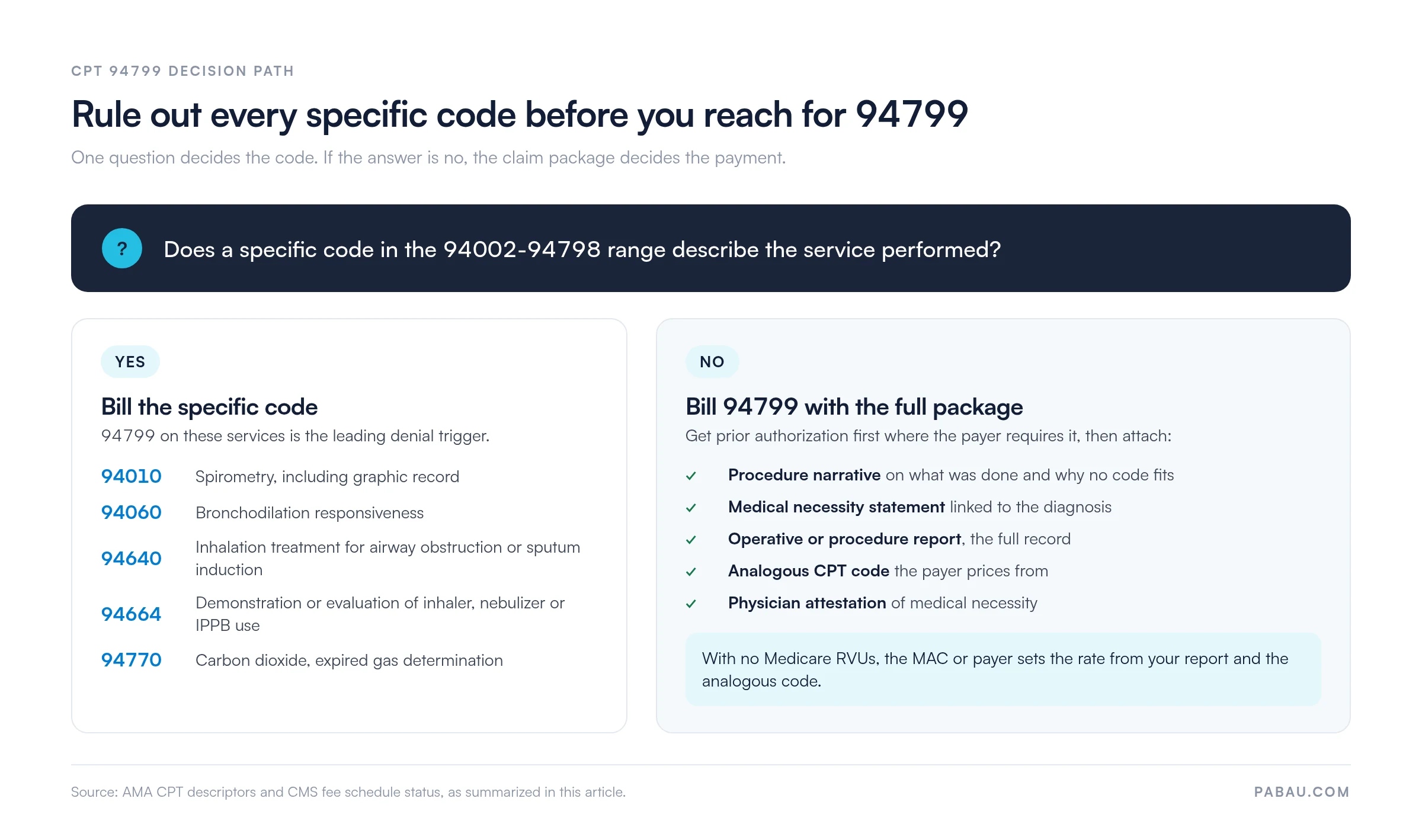
Each step after that decision affects whether the claim is accepted, priced, and paid.
Modifier use with CPT 94799 is narrow and payer-specific. Not all modifiers that apply to standard CPT codes are accepted on unlisted codes. Verify modifier acceptability with each payer before submission.
Avoid appending modifiers speculatively. An unlisted code with an unsupported modifier compounds the documentation review burden and increases denial risk. Review clean claim best practices before finalizing any 94799 submission with a modifier.
Track every 94799 claim in a separate log with the analogous CPT cited, the payer, the authorization number, and the outcome. After 20-30 claims, you will see which analogous codes each payer accepts for pricing and which modifiers it rejects. Use those patterns to refine your submissions payer by payer.
An unlisted-code claim is usually assembled by hand. The narrative sits in one file, the authorization number in an email, and the analogous code in a coder’s notes. Each loose piece gives the payer a reason to pend the claim.
In Pabau, the payer’s authorization code is stored on the patient’s case and follows the appointment through to the claim. Claim validation checks each claim for missing or invalid details before it leaves Pabau. The claim then goes out as a CMS-1500 through Claim.MD.
Status updates and electronic remittance advice files come back into the same billing workflow. You can see which 94799 claims are paid, pending or denied, so the 15- and 30-day follow-ups happen on time.

Pabau’s claim validation flags missing details before a 94799 claim goes out. Claim.MD status updates then show which claims are paid, pending or denied.

Bill 94799 only after you have ruled out every specific pulmonary code, and send the full package the first time. A claim that arrives with the narrative, the analogous code and the authorization attached can be priced on review. One missing piece usually turns it into a records request.
The trade-off is time spent up front. A reusable documentation template and a per-payer claim log take an hour to set up, and they shorten every 94799 claim after that.
Book a demo to see how Pabau tracks authorizations and validates unlisted pulmonary claims before they reach the payer.

Need to understand how clearinghouse submissions work? Pabau’s Claim.MD clearinghouse guide covers how electronic claims reach payers and what happens when they don’t.
Struggling with recurring denials on specialty codes? Revenue cycle management fundamentals explains the full billing loop from charge capture to payment posting.
Want to verify payer eligibility before submitting unlisted codes? Insurance eligibility verification outlines the checks that prevent authorization-related denials.
CPT code 94799 covers any pulmonary service or procedure in the 94002-94799 range that lacks its own specific CPT code. It is used for novel, experimental, or non-standard respiratory procedures where no existing code adequately describes the service performed.
Use CPT 94799 only after confirming that no specific code in the 94002-94798 range adequately describes the procedure. If any specific code fits, that code must be used. CPT 94799 is the last resort.
Yes, but there is no pre-set rate. CPT 94799 has no RVUs in the Medicare Physician Fee Schedule and is carrier-priced (status C). The MAC sets payment from the submitted documentation and the analogous CPT code cited. The rate varies by contractor, region, and documentation quality.
Every 94799 claim needs five elements. The first three are a detailed procedure narrative, a medical necessity statement linked to the diagnosis, and the full operative or procedure report. The claim also needs an analogous CPT code for pricing and a physician attestation.
The most common reason is billing 94799 when a specific code exists. Weak medical necessity documentation, missing prior authorization, and no analogous code for pricing follow close behind. A structured claim checklist catches each of these before submission.
Prior authorization is commonly required by commercial payers for CPT 94799. Because no standard fee schedule rate exists for this code, most payers want to review and approve the procedure before it occurs. Medicare does not require prior auth but does require a detailed report for pricing.
There is no standard national fee schedule rate for CPT 94799 in 2026. The code is carrier-priced, so each payer sets its rate from the analogous CPT cited and the supporting documentation. Use FastRVU or the CMS fee schedule lookup to find the rate for the analogous code you plan to reference.
The 94002-94799 range covers pulmonary diagnostic and therapeutic procedures. It includes ventilation management (94002-94005), spirometry and pulmonary function tests (94010, 94060, 94070), and inhalation treatments (94640, 94664). Gas exchange studies (94770) and other respiratory diagnostic services sit there too. CPT 94799 closes the range as the unlisted catch-all.



