CPT Code 22630: Posterior lumbar interbody fusion billing guide
CPT code 22630: Official description and procedure overview CPT code 22630 repor...

Last Updated: Nov 2, 2026
94727 is the CPT code for gas dilution or washout for determination of lung volumes and, when performed, distribution of ventilation and closing volumes. It covers nitrogen washout and helium dilution, the two techniques that measure functional residual capacity.
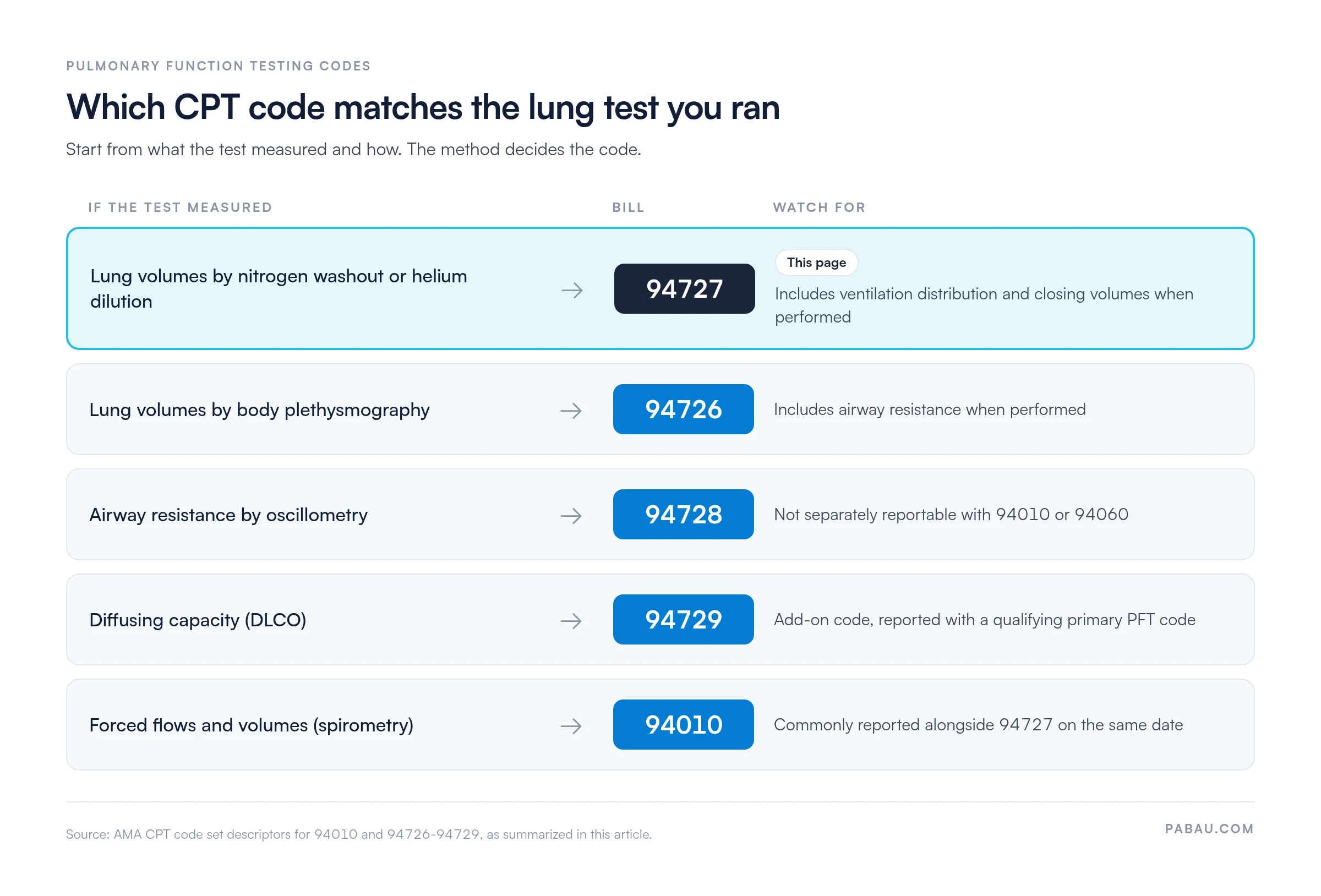
Total lung capacity and residual volume are then calculated from that measurement. Lung volumes measured by body plethysmography are billed under 94726 instead, so the test report must name the method used.
Let Pabau's smart automation suggest the right codes, reduce claim denials, and keep your practice compliant—effortlessly.
Automate repetitive tasks and focus on what matters most—your patients.
Reduce coding errors and ensure compliance with the latest regulations.
Clean claims, fewer denials, and faster reimbursements.
Powerful insights and reporting to help your practice thrive.
HIPAA compliant SOC 2 certified GDPR-compliant Trusted by 4,000+ clinics worldwide

CPT code 94727 measures absolute lung volumes by nitrogen washout or helium dilution. Lung volumes measured by body plethysmography are billed as 94726 instead.
Bill 94727 globally when one entity owns the equipment and interprets the test. Otherwise, append modifier 26 for the interpretation or TC for the equipment and technician.
Missing prior authorization and an unsupported ICD-10 diagnosis are the two most common denial triggers for 94727 claims, so verify both before submission.
Pabau’s claims management software helps catch missing authorizations, unsupported diagnosis codes and modifier conflicts before 94727 claims go out.
CPT code 94727 is a pulmonary function code in the AMA’s CPT code set. Its official descriptor reads: Gas dilution or washout for determination of lung volumes and, when performed, distribution of ventilation and closing volumes.
The patient breathes either pure oxygen or a known helium concentration. The dilution or washout of that gas lets the equipment back-calculate absolute lung volumes.
Two methods fall under this single code. In nitrogen washout, the patient breathes 100% oxygen while nitrogen washes out of the lungs over multiple breaths. The equipment measures the expired nitrogen volume and calculates FRC from it.
Helium dilution uses a closed-circuit rebreathing bag with a known helium concentration, and the helium’s equilibration between bag and lungs yields FRC. Either technique, reported under one physician order on the same date of service, maps to 94727. If the study also reports ventilation distribution or closing volumes, those fall within 94727 too.
CPT code 94727 captures three absolute lung volume parameters that spirometry alone cannot measure. Understanding what each parameter represents helps coders confirm that the test performed matches the code billed.
Gas dilution methods only equilibrate with ventilated lung regions. In patients with bullous emphysema or significant air trapping, gas dilution therefore reads lower than body plethysmography, which also counts trapped gas. When the physician needs volumes that include trapped gas, 94726 is the correct code. When gas dilution is ordered and performed, 94727 applies.
The four codes immediately surrounding 94727 in the Pulmonary subsection are frequently confused. Each covers a distinct measurement method or physiological parameter. The rest of the 94002-94799 range sits in our searchable CPT code library.
Key bundling note: 94726 and 94727 measure the same physiological parameters by different methods. Billing both for one patient on the same date of service requires documented clinical justification. Some payers apply NCCI edits that restrict concurrent reporting. Verify the current NCCI edit table before billing both codes together, because the edit status changes with each quarterly update.
When one report lists several measurements, match each to the method that produced it before you code. The chart below maps each method to its code.
CPT code 94727 has two components. The technical component covers the equipment, the respiratory therapist’s time and the gas supply. The professional component covers the physician’s interpretation and written report. The modifier you apply depends on who owns the equipment and who bills the interpretation.
A common error: Outpatient pulmonology practices that own their PFT equipment sometimes append modifier 26 out of habit from hospital-based work. Billing 94727-26 when the practice owns the equipment means surrendering the technical component payment, roughly $38 per test. Verify equipment ownership before selecting a modifier on every claim.
Medical necessity is the most consequential factor in 94727 approvals. The ICD-10-CM diagnosis code on the claim must align with a covered indication under the applicable Local Coverage Determination (LCD) or payer policy. The table below lists common pairings. Payer-accepted diagnoses vary, so verify them against the relevant LCD before submitting.
Use the most specific code available. Submitting J44.9 when the record documents J44.1 is under-coding and may trigger audit flags under certain payer policies. When the indication is pre-surgical evaluation, pair Z01.810 with the relevant procedure code from the planned surgery to provide full medical necessity context.
Incomplete documentation is the fastest route to a 94727 denial on audit. The medical record must contain all of the following before the claim is submitted.
Auditors look specifically for the “interpretation” element. A test report without a signed interpretation does not support billing for the professional component. Respiratory therapy departments that route reports directly to the billing system without triggering a physician review step account for a disproportionate share of 94727 recoupments.
Original Medicare (Parts A and B) does not require prior authorization for CPT code 94727. Medicare Advantage plans and most commercial insurers have their own policies, and those policies differ substantially by plan.
Conducting insurance eligibility verification before scheduling any PFT panel is the safest approach. At verification, confirm whether the patient’s specific plan requires prior authorization for 94727 and which diagnosis codes the plan recognizes as covered indications.
Some plans cover spirometry without PA but still require it for the lung volume component. That is because 94727 is a higher-cost study on top of a basic PFT battery.
When PA is required, send the spirometry results and the ICD-10 diagnosis code with the request. Add the treating physician’s rationale for needing absolute lung volumes beyond spirometry. A PA request that lacks documented spirometry findings is a common reason for authorization denial.
Medicare pays for CPT code 94727 under the Medicare Physician Fee Schedule (MPFS). Rates are updated annually on January 1 and vary by geographic locality (GPCI adjustments). For 2026, 94727 carries 1.49 total RVUs, about $49.77 nationally at the $33.4009 conversion factor, per the CMS 2026 physician fee schedule RVU file. The professional component (modifier 26) is 0.36 RVUs and the technical component (TC) is 1.13. The table below splits that global rate.
Use the CMS Physician Fee Schedule lookup tool or the FastRVU 2026 RVU lookup for the exact rate in your locality.
In a facility setting, the physician bills 94727-26 and the hospital bills the technical component on its UB-04 claim.
These figures are national averages. Rates in high-cost localities (Manhattan, San Francisco) run 15-25% above the national average; rural localities may run 5-15% below it. For revenue cycle management planning, pull your locality’s rates from the CMS tool by ZIP code before projecting reimbursement per PFT session.
Pull your locality-adjusted 94727 rate from the CMS Physician Fee Schedule lookup tool every January after the annual update takes effect. The conversion factor and GPCI values change each year, and planning reimbursement off prior-year figures is a common forecasting error in pulmonology revenue cycle reviews.
A clean 94727 claim depends on each of these steps being completed in sequence. Skipping any step is the proximate cause of most 94727 denials.
Most 94727 denials fall into a small number of repeating patterns. A structured denial management process can resolve most of them before they become write-offs.
The six-step billing workflow above depends on several manual checkpoints: PA status, modifier selection, ICD-10 specificity, and documentation completeness. Each checkpoint is a failure point when it relies on a coder working from memory or a static checklist.
In Pabau, the practice management platform we build, error-catching claims software checks each claim as it is created. It flags missing authorization, unsupported diagnosis codes and modifier conflicts before the claim transmits.
Scheduling, clinical notes and billing share one patient record, so coders work from the test order and report instead of reconciling separate systems. For pulmonology practices running high-volume PFT panels, that upstream check cuts the rework cost of 94727 denials.
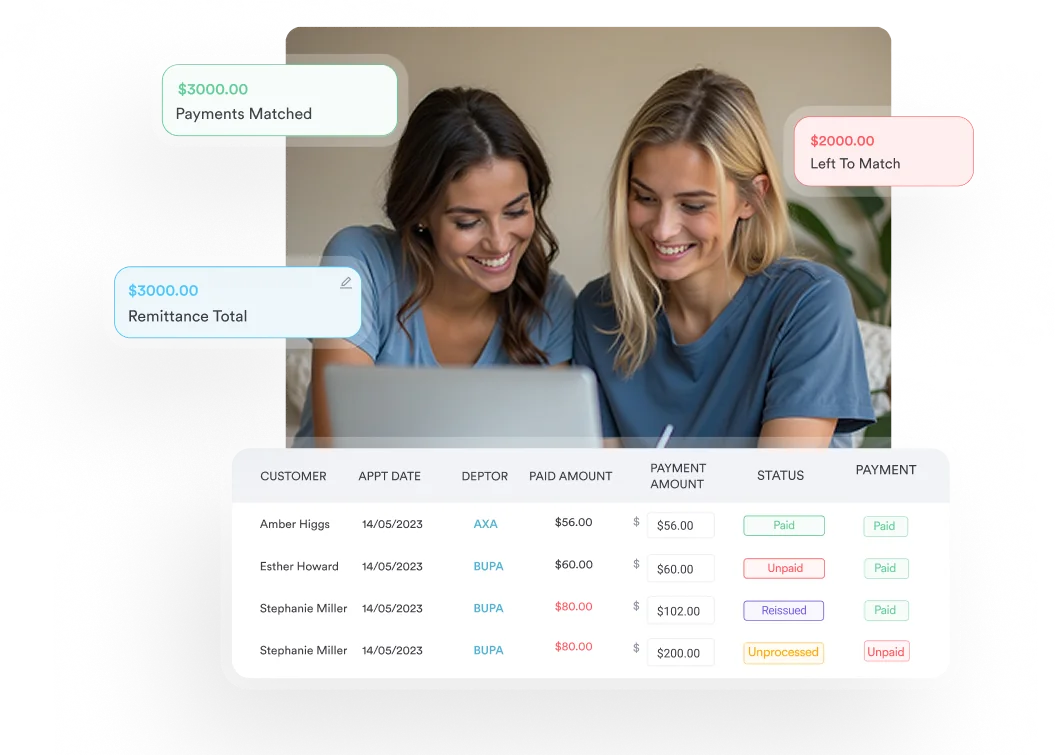
Denial tracking in Pabau surfaces the CARC reason code from each remittance. Your team can then see which denial type keeps recurring on 94727 claims. That turns the root-cause table above into a weekly worklist.

Pabau’s claims management software helps catch missing authorizations, unsupported diagnosis codes and modifier conflicts before 94727 claims leave your practice. See how it works for pulmonology billing.

CPT code 94727 denials almost always trace back to three preventable errors. The claim lacks prior authorization, carries a diagnosis the payer does not cover, or uses a modifier that ignores who owns the equipment. Fix those three checkpoints and the majority of 94727 rework disappears.
Start with the modifier, because it costs the most per claim and takes the least effort to fix. A practice that owns its PFT equipment and appends 26 out of habit gives up roughly $38 of the $50 global rate on every test.
Pabau’s claims management software helps catch missing authorizations, unsupported diagnosis codes and modifier conflicts before claims go out. It also surfaces recurring CARC denial patterns, so your billing team can act on data rather than instinct. To see how it works for a pulmonology or respiratory care practice, book a demo.

Coding the plethysmography version instead? CPT code 94726 covers lung volumes measured in a body box, with airway resistance included when performed.
Adding a diffusing capacity study? CPT code 94729 explains how the DLCO add-on code is reported alongside a primary PFT code.
Supporting medical necessity for a COPD patient? ICD-10 code J44.1 covers COPD with acute exacerbation, a common diagnosis paired with 94727.
Want a structured approach to reducing claim rejections? How Claim.MD clearinghouse works walks through the validation and ERA workflow that catches 94727 errors at the source.
Looking to benchmark your PFT billing denial rate? Denial codes in medical billing decodes the CARC and RARC codes that appear on 94727 remittances.
CPT code 94727 covers lung volume measurement by gas dilution or washout, using nitrogen washout or helium dilution. It determines absolute lung volumes such as FRC, TLC and RV, plus ventilation distribution and closing volumes when performed. It does not cover body plethysmography (94726) or spirometry (94010), which are reported under separate codes.
CPT 94726 measures lung volumes by body plethysmography, with the patient seated in a sealed pressure box. CPT 94727 measures the same parameters by gas dilution or washout. Plethysmography captures trapped gas that gas dilution cannot reach, making 94726 more accurate in patients with significant air trapping or bullous disease.
Yes, Medicare covers CPT code 94727 under the Medicare Physician Fee Schedule when medical necessity is documented. Original Medicare does not require prior authorization, but Medicare Advantage plans set their own PA policies. Always verify the patient’s specific plan before scheduling.
Modifier 26 applies when the interpreting physician does not own the testing equipment and is billing only for the professional component (interpretation and report). Modifier TC applies when the facility bills only for the technical component. No modifier is used when the same physician or group owns the equipment and performs the interpretation (global billing).
Yes, 94727 and 94010 (spirometry) can generally be billed together on the same date of service when both tests are performed and medically indicated. Spirometry measures flow rates and volumes from a forced exhalation; 94727 adds the absolute lung volumes that spirometry cannot capture. No NCCI bundling edit currently prevents concurrent reporting, but verify the current edit table before submitting.
The nitrogen washout test is billed under CPT code 94727. Nitrogen washout and helium dilution share the same code, so the choice of technique does not change code selection. The test report must still document the method used.