CCSD Code V2543: Revision posterior disc excision with facetectomy
What is CCSD Code V2543? CCSD Code V2543 is the Clinical Coding and Schedule Dev...

Last Updated: Nov 25, 2026
94690 is the CPT code for oxygen uptake, expired gas analysis; rest, indirect (separate procedure). It reports resting indirect calorimetry, where a metabolic cart analyzes exhaled air to measure oxygen uptake at rest.
The measured oxygen uptake, usually with carbon dioxide output, gives the patient's resting energy expenditure. Clinicians use it to set calorie targets for critically ill or malnourished patients and to investigate unexplained weight change. It belongs to the 94680-94690 oxygen uptake family and is not an oximetry code.
Let Pabau's smart automation suggest the right codes, reduce claim denials, and keep your practice compliant—effortlessly.
Automate repetitive tasks and focus on what matters most—your patients.
Reduce coding errors and ensure compliance with the latest regulations.
Clean claims, fewer denials, and faster reimbursements.
Powerful insights and reporting to help your practice thrive.
HIPAA compliant SOC 2 certified GDPR-compliant Trusted by 4,000+ clinics worldwide

CPT code 94690 reports resting indirect calorimetry, which measures oxygen uptake by expired gas analysis while the patient is at rest.
The code belongs to the 94680-94690 oxygen uptake family. Use 94680 for rest and exercise testing, and 94681 when CO2 output and percentage oxygen extracted are reported.
94690 is not an oximetry code. Pulse oximetry is reported with 94760-94762, and home oxygen qualification rules do not apply to 94690.
The separate procedure label means 94690 is not reported when the measurement is part of a larger test, such as cardiopulmonary exercise testing (94621).
Coverage turns on the indication. Aetna lists indirect calorimetry as unproven for weight reduction, while ESPEN recommends it for ventilated ICU patients.
CPT code 94690 reports oxygen uptake measured by expired gas analysis while the patient is at rest, using the indirect method. In practice, that is resting indirect calorimetry, the metabolic cart test that gives a patient’s resting energy expenditure. Aetna’s clinical policy on weight reduction labels 94690 as indirect calorimetry in its code table.
The descriptor carries the “separate procedure” label, which limits when the code can be reported alongside a larger test. The code sits in the Medicine section of CPT, under the pulmonary diagnostic testing subheading.
The American Medical Association (AMA) publishes the CPT code set. The official long descriptor and the main reference facts for 94690 are below.
94690 is not an oximetry code. Noninvasive ear or pulse oximetry has its own family, 94760-94762. A saturation reading taken to qualify a patient for home oxygen is coded there, never as 94690.
Resting indirect calorimetry works out how much energy the body uses at rest from the gases the patient breathes. The patient breathes into a hood, mask or mouthpiece, or the cart samples gas from the ventilator circuit.
Most metabolic carts report four values:
REE is the figure clinicians act on. It replaces a predictive equation with a measured value, which matters most where equations are least reliable. The ESPEN guideline on clinical nutrition in the ICU notes that predictive equations can be inaccurate by up to 60% in critically ill patients.
Clinicians order resting indirect calorimetry when a measured energy requirement will change the care plan. The usual settings are these:
The indication on the order decides the diagnosis code and, often, whether the claim pays. Record it before the test runs.
A resting measurement is only valid when the patient was rested and stable during the reading. The report has to show that, because “rest” is part of the code descriptor. Good records also support medical billing compliance if the claim is audited later.
If the report also lists CO2 output and percentage oxygen extracted, flag it for the coder. Those values appear in the 94681 descriptor, so the code choice should follow what was measured and reported.
The three codes share the stem “oxygen uptake, expired gas analysis” and differ in test conditions and scope. Choosing between them is the main coding decision for a metabolic cart test.
Coders disagree on one point. A resting metabolic cart test usually reports VCO2 as well, which overlaps the 94681 descriptor. Check the payer’s policy and the AMA’s CPT Assistant guidance, then code what the report documents.
Two neighboring codes are often mixed up with this family. Cardiopulmonary exercise testing is 94621, a broader test that already includes oxygen uptake. Pulse oximetry is 94760-94762, which measures saturation rather than uptake. Serial saturation checks during exercise, for example, are reported with 94761.
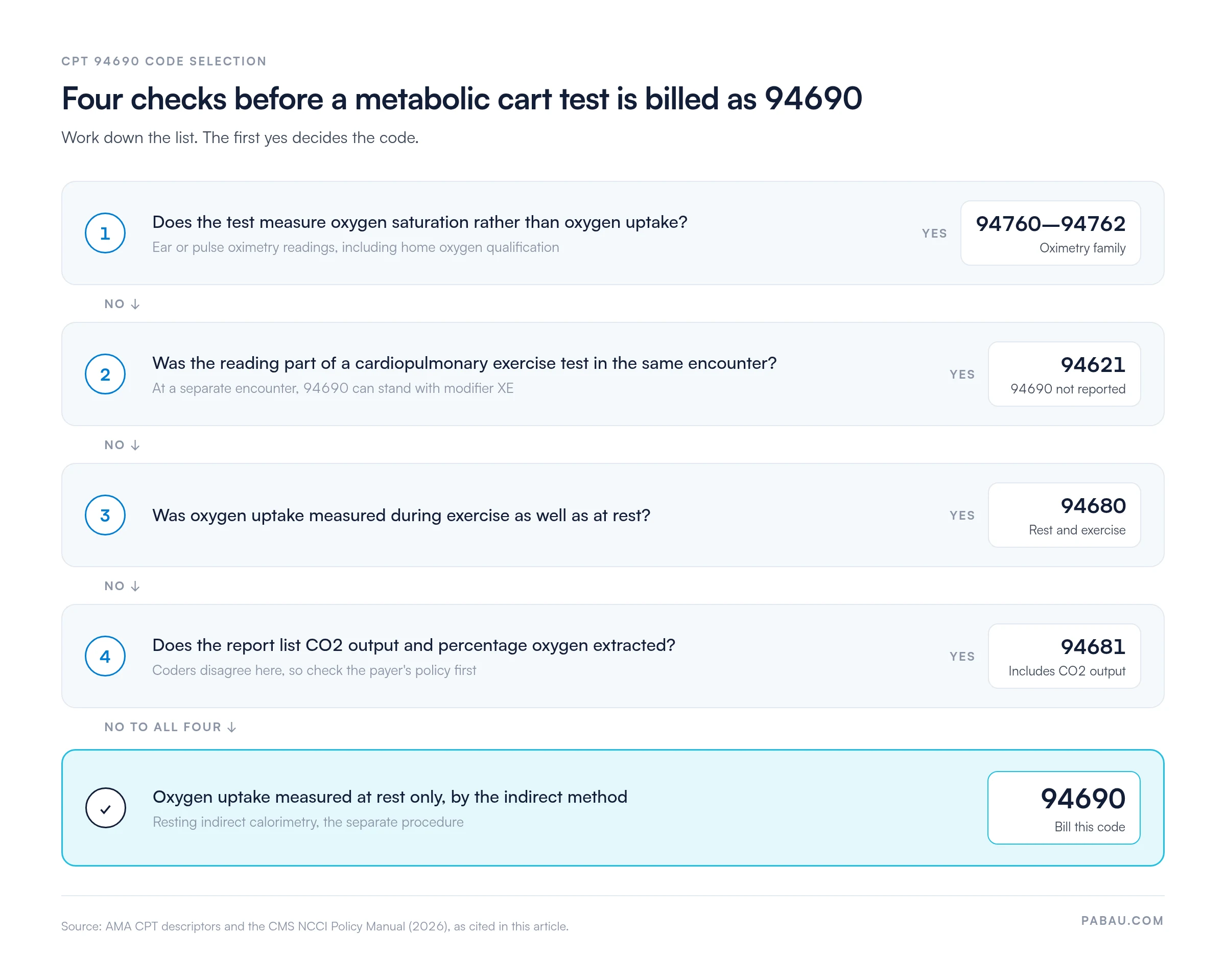
Run a metabolic cart report through four checks, in order, before it is billed as 94690. The first check that answers yes decides the code.
The “separate procedure” label tells payers the test is often performed as part of a larger service. The CMS NCCI Policy Manual says a code with this label may not be reported separately with a related procedure.
It can still be reported when performed at a separate patient encounter on the same date of service. In that case, NCCI allows modifier 59 or XE to show that it qualifies as a separately reportable service.
For 94690, the related procedure that matters most is cardiopulmonary exercise testing. The NCCI medicine chapter bars separate reporting of O2 consumption and CO2 production measured in the same encounter as 94621.
Before billing 94690 and 94621 on the same date, compare the times on both reports. A resting reading taken as the baseline of the exercise test is part of 94621. A resting test at a separate encounter can stand on its own with modifier XE.
Medicare pays physician services through the Medicare Physician Fee Schedule (MPFS), which assigns each code its relative value units. Look up the current status and locality rate for 94690 in the CMS Physician Fee Schedule Look-Up Tool for the year of service.
Commercial coverage depends on the indication. Aetna’s Clinical Policy Bulletin 0039, last reviewed on March 10, 2026, lists indirect calorimetry as experimental, investigational or unproven for weight reduction. It names 94690 among the codes not covered for those indications.
Coverage for critical care and nutrition indications varies by plan, so check the payer’s policy before the test. Medicare Advantage and commercial plans may also require prior authorization.
The diagnosis on a 94690 claim should name the reason a measured energy requirement was needed. No single crosswalk covers every payer, so the codes below are common documented indications, not a list that guarantees payment.
Code the condition that drove the order, as specifically as the record allows. For a ventilated ICU patient, that usually means J96.01, with Z99.11 as a secondary code. On a plan that excludes indirect calorimetry for weight reduction, an obesity code such as E66.01 is likely to deny. Careful documentation will not rescue that claim.
Most 94690 denials trace back to the indication, the code family or the bundling rule. Effective denial management workflows start by sorting denials by cause before drafting appeals.
Read the CARC and RARC on the remittance before appealing. The denial codes in medical billing guide explains how each pair maps to a reason.
A few claim fields decide whether a correctly coded 94690 test gets paid. Submitting a clean claim means each one is right before the claim leaves the practice.
In many practices, the metabolic cart report sits in one system and the claim is built in another. The coder reads the report, chooses between 94680, 94681 and 94690, and keys in the diagnosis by hand. Each handoff is a chance for the code and the report to disagree.
Pabau, a practice management platform with built-in billing, keeps the order, the signed report and the invoice on one patient record. Its claims management software scrubs each claim for missing or invalid details before it leaves.
US practices submit through Claim.MD to thousands of payers, with eligibility checks before the visit. Remittance files come back into Pabau, so a denied 94690 line returns with its reason codes attached.


Pabau keeps the calorimetry order, the signed report and the claim on one patient record. Claim validation catches missing details before submission, so fewer claims come back denied.

CPT 94690 is a resting metabolic test, and coding it well starts with treating it as one. Read the report before choosing a code. Rest only points to 94690, exercise to 94680, and CO2 output with oxygen extracted to 94681.
The trade-off is a few minutes at the front of the process. A coverage check and a signed interpretation cost little, while a denial for an excluded indication may never be recovered. Book a demo to see how Pabau keeps the calorimetry report, the code and the claim in step.

Need a framework for managing claim denials systematically? Denial management in healthcare covers the full workflow for categorizing, appealing and preventing recurring claim rejections.
Want to know what a clean claim looks like field by field? Clean claim submission breaks down every required element and the errors that cause first-pass rejections.
Looking for a plain-English overview of ERA and 835 remittance files? Electronic remittance advice explains how to read ERA files and map remark codes to their denial reasons.
CPT code 94690 describes oxygen uptake, expired gas analysis, at rest, by the indirect method. It is the code for resting indirect calorimetry, the metabolic cart test that measures resting energy expenditure.
No. CPT 94690 measures oxygen uptake from exhaled air, not oxygen saturation. Pulse oximetry is reported with 94760, 94761 or 94762, and home oxygen qualification testing is coded there.
All three describe oxygen uptake by expired gas analysis. 94680 covers rest and exercise, 94681 adds CO2 output and percentage oxygen extracted, and 94690 covers rest only, by the indirect method.
Not for the same encounter. The NCCI manual treats O2 consumption and CO2 production as components of 94621. A resting test at a separate encounter may be reported with modifier XE.
Often not. Aetna’s Clinical Policy Bulletin 0039 lists indirect calorimetry as unproven for weight reduction and names 94690 among the non-covered codes. Check each plan’s policy before the test.
Keep a signed order with the clinical question, the preparation conditions, and the collection method. The record also needs VO2, RQ and REE results with a signed interpretation of what they mean.
Medicare pays 94690 under the Medicare Physician Fee Schedule, with rates adjusted by locality and updated each year. Check the CMS Physician Fee Schedule Look-Up Tool for the current rate.