HCPCS code G0257: Unscheduled or emergency dialysis billing guide
HCPCS code G0257: Official descriptor and code overview HCPCS code G0257 is defi...

Last Updated: Oct 27, 2026
CPT code 93793 reports anticoagulant management for a patient taking warfarin. A physician or other qualified health care professional reviews and interprets a new home, office, or lab INR result. The same contact covers patient instructions, any dose adjustment, and scheduling of further tests when performed.
The code took effect on January 1, 2018, when CPT deleted 99363 and 99364. Report it once per day at most, and never on the same day as an E/M service. Patients on DOACs such as apixaban fall outside it, because they have no INR result to review.
Let Pabau's smart automation suggest the right codes, reduce claim denials, and keep your practice compliant—effortlessly.
Automate repetitive tasks and focus on what matters most—your patients.
Reduce coding errors and ensure compliance with the latest regulations.
Clean claims, fewer denials, and faster reimbursements.
Powerful insights and reporting to help your practice thrive.
HIPAA compliant SOC 2 certified GDPR-compliant Trusted by 4,000+ clinics worldwide

CPT code 93793 covers anticoagulant management for warfarin patients only, and each unit starts from a new home, office, or lab INR result.
A dose change is not required, but the note must show the result was interpreted, the patient was instructed, and the next test was planned.
Report 93793 once per day at most, and never on the same day as an E/M service, which already includes the INR work.
Patients on DOACs such as apixaban or rivaroxaban fall outside 93793, so their follow-up contacts go under an E/M code that fits the visit.
CPT 93792 is a separate service: face-to-face training that gets a patient or caregiver started on a home INR meter.
CPT code 93793 reports anticoagulant management for a patient taking warfarin. Under the American Medical Association descriptor, every contact must include four elements:
The new INR result is the trigger. It can come from the patient’s home meter, an in-office device, or an outside lab. Each unit of 93793 is tied to that result, whether the follow-up happens by phone or in the office.
The code took effect on January 1, 2018. That year, CPT deleted the older anticoagulant management codes 99363 and 99364 and opened a new Medicine subsection for home and outpatient INR monitoring. 93793 and its companion code, 93792, are the only two codes in it.
Who may bill: Physicians and other qualified health care professionals report 93793 for interpreting the result and setting the plan. That group includes nurse practitioners and physician assistants. Nurses or anticoagulation pharmacists often make the call and relay the instructions. When clinical staff handle that part, the billing provider directs the plan and must meet the payer’s supervision rules, including Medicare’s incident-to requirements.
A contact qualifies only when all four descriptor elements are met, with dosing and test scheduling done as the result requires. The line between included and separate work is where most unbundling errors start.
Included in 93793:
Outside 93793:
A dose change is not a requirement. A stable INR with a documented decision to continue the current dose still supports the code, as long as the result is new.
Report 93793 once per day at most, however many INR results you review that day. Don’t report it alongside telephone or online digital E/M codes for the same work. When you also bill 85610 on that date, check NCCI edits and your payer’s rules for your setting first.
The note for each contact should let a reviewer rebuild the service from the descriptor. Following medical billing compliance standards means each element below appears in the chart.
The interpretation is the element notes most often leave thin. A line such as “INR reviewed, patient called” records that someone saw the result. It does not record a decision, so state the decision even when the dose stays the same.
The diagnosis codes on a 93793 claim need to show why the patient takes warfarin and that the therapy is ongoing. These are the codes that most often support it.
Lead with the condition that requires anticoagulation, and add Z79.01 to show the therapy is current. A claim carrying Z79.01 alone says the patient takes an anticoagulant, but not why.
Once a quarter, pull every 93793 denial coded CO-11. Compare the diagnosis codes on those claims with the condition documented in the note. A repeating pattern usually traces back to one template or one step in the workflow.
CPT 93792 and 93793 entered CPT together in 2018, but they describe different work. 93792 trains a patient to test at home, while 93793 manages warfarin after a result comes in.
93792 carries no physician work RVU, because clinical staff usually deliver the training. CMS published both codes with payment status A, which means Medicare pays them separately. Check each commercial plan’s policy before billing either code.
A nurse INR visit can look like a 99211 visit on the schedule. Since 2018, CPT routes warfarin INR management to 93793, so the visit’s purpose decides which code applies.
The decision path below runs those checks in order, from the drug the patient takes to what the note records.
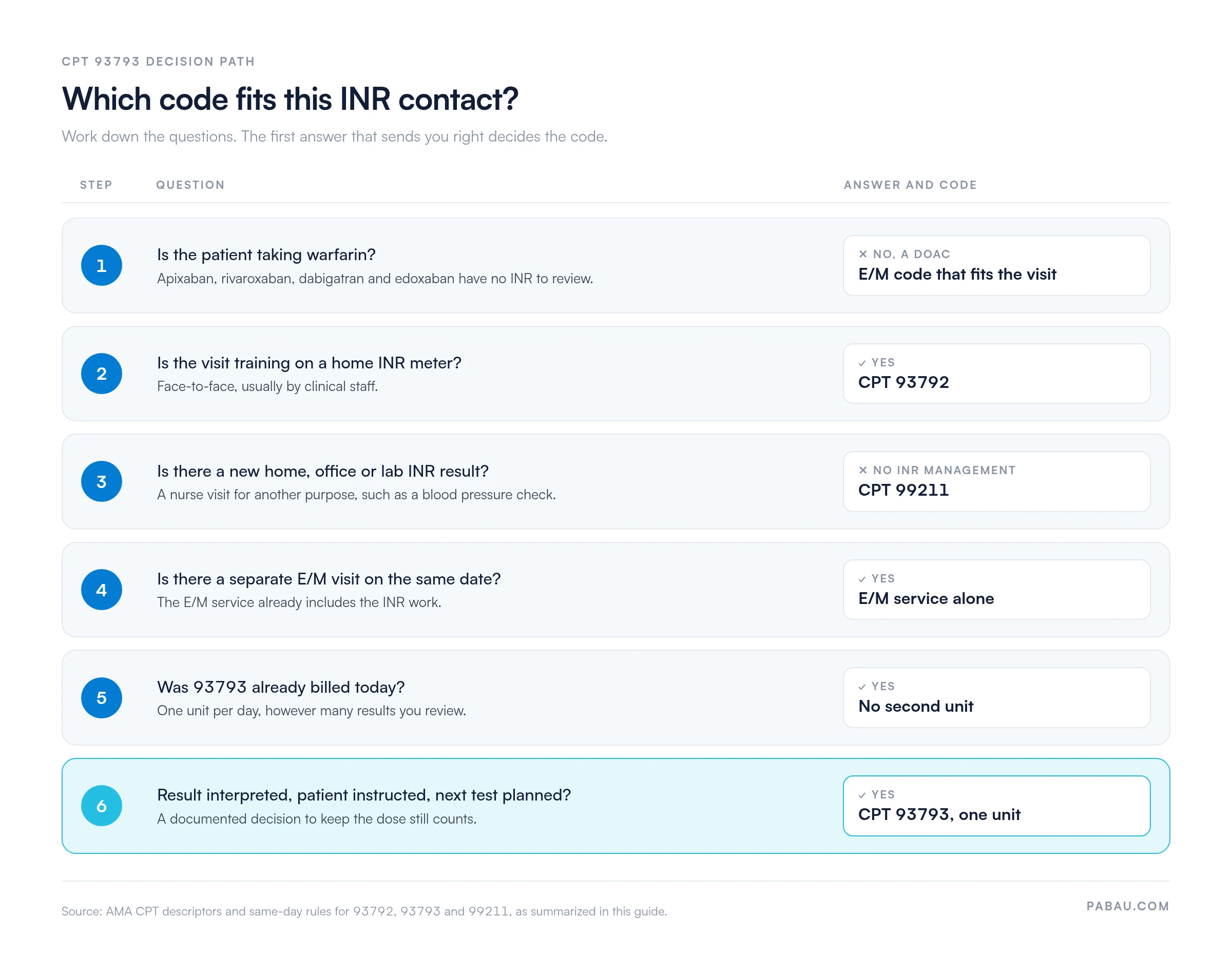
Medicare pays CPT code 93793 under the Physician Fee Schedule. The amount changes each year and varies by locality. Search 93793 in the CMS Physician Fee Schedule lookup tool for your current rate.
Key points for Medicare billing:
For commercial plans, run insurance eligibility verification when warfarin therapy starts. Confirm the plan covers 93793 and whether it adds its own rules.
Yes, a phone or video contact can support 93793, because the descriptor does not require a face-to-face visit. What it needs is a new INR result, its interpretation, and instructions to the patient.
The documentation requirements stay the same however the contact happens. The chart still needs the result, the decision, the instructions, and the next test.
Run this check on every 93793 line before it leaves the practice. Each item maps to a denial in the table further down.
From there, each claim follows the same short path. The contact note supports a 93793 charge, which carries the date of service and diagnosis codes onto the claim. A claim scrub checks the fields before you submit, and the payer’s remittance shows whether the line paid or needs a fix.
Most 93793 denials trace back to a few coding and documentation errors. The table pairs each one with its usual CARC and the fix.
Track CARC denial codes at the code level, so patterns specific to 93793 surface quickly. Building clean claim requirements into the contact note costs less than correcting claims after a denial.
No, CPT 93793 applies only to patients taking warfarin. The descriptor names warfarin and requires a new INR result. Apixaban (Eliquis), rivaroxaban (Xarelto), dabigatran (Pradaxa), and edoxaban (Savaysa) are prescribed without routine INR monitoring, so their follow-up contacts don’t meet it.
Report a DOAC follow-up under an E/M code that fits the visit, based on medical decision making or time. Document the kidney and liver results you reviewed, adherence, and the dose decision, as you would for any E/M visit.
A practice that manages warfarin patients sends a steady stream of small claims. Each one needs the right date, diagnosis codes, and place of service, and a single missed field can hold up payment.
Pabau, the practice management platform we build, pre-fills each claim from the patient record. The 93793 charge and the diagnosis codes on the patient’s problem list carry over. Claim validation flags missing or invalid details before the claim leaves Pabau.
In the US, claims go out electronically through Claim.MD, with eligibility checks, claim-status tracking, and payment reconciliation from remittance files. Pabau’s claims management for practices keeps those steps together, so your billers can follow each 93793 claim from charge to payment.
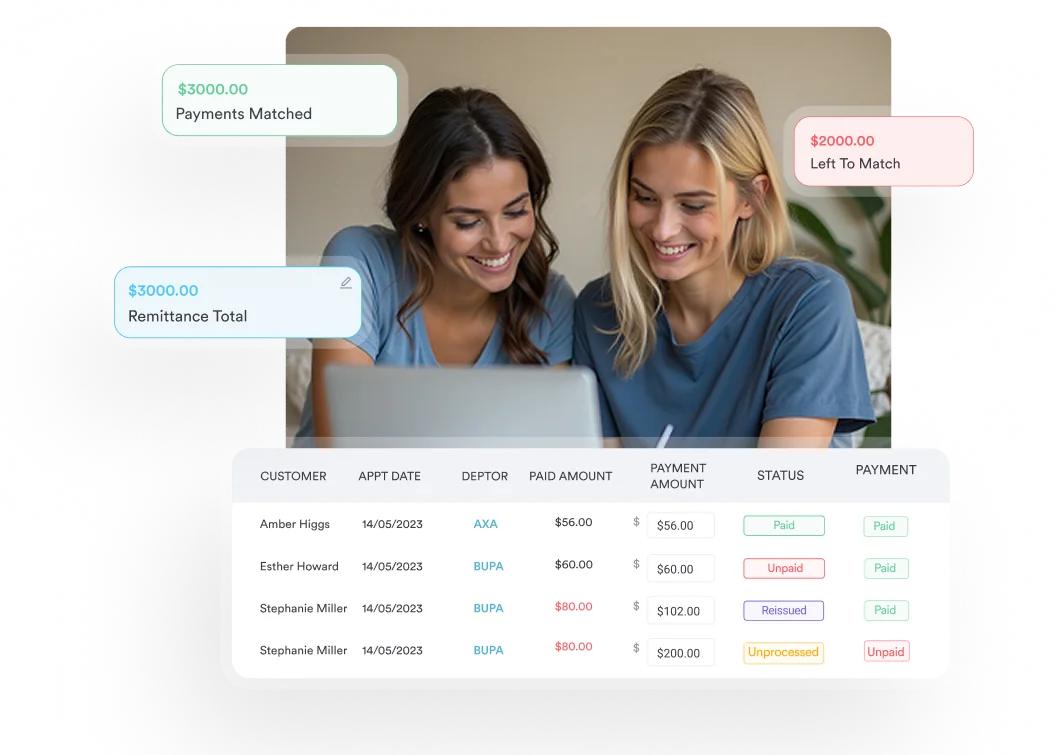

Pabau pre-fills each 93793 claim from the patient record and submits it electronically through Claim.MD, with eligibility checks and claim-status tracking built in.

CPT 93793 rewards a disciplined note more than clever coding. Each billable contact starts with a new INR result for a warfarin patient and ends with a stated decision and a next test. DOAC follow-up and INR review inside an E/M visit belong under other codes.
So build the contact note around the four descriptor elements, and run the pre-submission check on every line. Your team then codes each contact without chasing the clinician, and fewer claims come back for missing documentation.
Book a demo to see Pabau pre-fill, submit, and track your 93793 claims from the patient record.

Need to understand how clearinghouse submission works for 93793? Medical claims clearinghouse guide explains the electronic submission pathway from practice to payer.
Want to reduce denial rates across your billing team? Denial management in healthcare covers systematic approaches to tracking and resolving claim rejections.
Billing warfarin patients through a superbill workflow? Superbill documentation guide outlines how to structure superbills that support 93793 and companion code billing.
Training a Medicare patient on a home INR meter? HCPCS code G0248 covers the home INR monitoring demonstration and when Medicare pays for it.
New to the billing cycle behind each 93793 claim? What is medical billing walks through how a charge becomes a paid claim.
Usually not. A nurse or anticoagulation pharmacist can make the call. The claim still goes out under the physician or qualified health care professional who directs the plan. For Medicare, the service must also meet the incident-to rules for that setting.
No. The descriptor does not require one, so a phone call about a new INR result can support the code. Bill it with the place of service where the work is furnished.
Put each code on its own line with the same date of service and the same supporting diagnosis codes. Report 85610 only when your in-office lab runs the test. Check NCCI edits and your payer’s policy first, since rules vary by setting.
It still supports 93793, as long as the result is new and you act on it. Warfarin patients are managed against their own target range, not the lab’s normal range. Document the value, the dose decision, and the retest date.
Then no instructions reached the patient, so the contact doesn’t support 93793 yet. Document the attempt, and bill once you reach the patient and complete the instructions.