HCPCS Code Q4175: Billing, coverage, and documentation guide
HCPCS Code Q4175: Code Description and Product Identity HCPCS Code Q4175 is the ...

Last Updated: Nov 20, 2026
83986 is the CPT code for pH; body fluid, not otherwise specified. It reports a standalone pH measurement on urine, vaginal secretions, pleural fluid or another body fluid with no more specific pH code.
Blood pH, blood gases and gastric acid analysis have their own codes. Denials usually trace to a mismatched ICD-10 code or a CLIA certificate the payer has no record of. A missing QW modifier on a waived point-of-care test is the third.
Let Pabau's smart automation suggest the right codes, reduce claim denials, and keep your practice compliant—effortlessly.
Automate repetitive tasks and focus on what matters most—your patients.
Reduce coding errors and ensure compliance with the latest regulations.
Clean claims, fewer denials, and faster reimbursements.
Powerful insights and reporting to help your practice thrive.
HIPAA compliant SOC 2 certified GDPR-compliant Trusted by 4,000+ clinics worldwide

CPT code 83986 reports a standalone pH test on any body fluid that has no more specific pH code. It is not a urinalysis panel and does not replace CPT 81003.
Blood pH and blood gases (82800, 82803, 82805, 82810) and gastric acid analysis (82930) have their own codes, so 83986 never covers them.
When 83986 and 81003 run on the same urine specimen, NCCI edits typically bundle 83986 into the panel.
A point-of-care pH test on an FDA-cleared, CLIA-waived device needs the QW modifier, and leaving it off is a frequent cause of denials.
Pabau, a practice management platform, sends electronic insurance claims through Claim.MD in the US, so your team can track each 83986 claim to payment.
CPT code 83986 reports a standalone pH measurement on a body fluid, under the official descriptor “pH; body fluid, not otherwise specified.” CMS’s new waived tests notice lists a vaginal pH screening kit under 83986QW, so in-office strip tests bill on this code with the QW modifier.
The American Medical Association maintains the CPT code set, and 83986 sits in its Chemistry subsection (82009-84999). Older references still quote the previous wording, “pH; body fluid, except blood.” The current descriptor points coders to a more specific code wherever one exists, such as 82800 for blood pH or 82930 for gastric acid analysis.
A pH result shows the hydrogen ion concentration of a specimen. A value below 7 is acidic, and a value above 7 is alkaline. What the result tells the clinician depends on the specimen:
CPT 83986 covers pH on any body fluid that has no more specific pH code. In practice, that means most fluids other than blood. Blood pH and blood gases have their own codes, and so does gastric acid analysis.
Qualifying specimen types:
Non-qualifying specimens: Whole blood, serum and plasma don’t take 83986. Blood pH is reported with the blood pH and blood gas codes (82800, 82803, 82805, 82810), chosen by the analytes measured.
Gastric acid analysis has its own code, 82930, which already includes pH. Don’t bill 83986 with 82930 on the same gastric specimen. A blood specimen billed as 83986 is a coding error, because a more specific code exists.
Code choice for a pH result comes down to the specimen and the test that ran, as the decision chart shows.
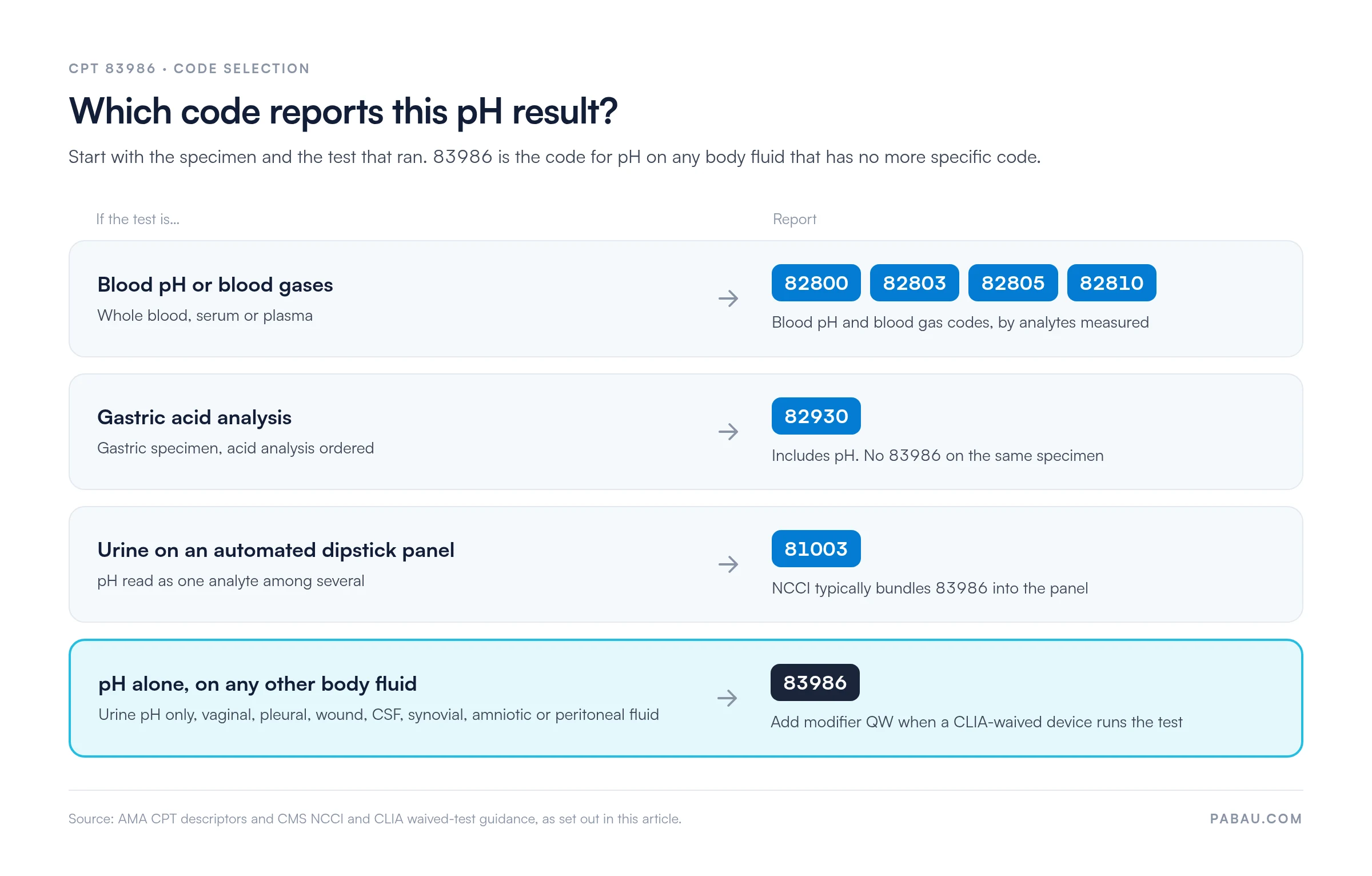
Choose 83986 when pH is the only test ordered or the specimen isn’t urine, and 81003 when a full automated dipstick panel runs. 81003 is automated urinalysis without microscopy. It’s a dipstick panel that reads several analytes at once, including pH, glucose, protein and blood. 83986 measures pH alone, as a single-analyte chemistry test.
Under the National Correct Coding Initiative (NCCI), 83986 generally bundles into 81003 when both are billed on one urine specimen on the same day. The rationale is that the urinalysis dipstick already captures pH. A separate pH charge on the same specimen is considered redundant. Verify current NCCI edit tables on CMS.gov before billing, as edits update quarterly.
When to bill 83986 instead of 81003: Three situations call for 83986.
When a descriptor is in doubt, cross-check it in AAPC’s CPT code lookup.
The Clinical Laboratory Improvement Amendments (CLIA) govern any facility that performs laboratory testing on human specimens for health purposes. pH measurement of body fluids falls under CLIA jurisdiction, and the CLIA certificate category for a practice depends on the device used.
CLIA-waived pH testing: A test run on an FDA-cleared, CLIA-waived device, such as a waived vaginal pH strip, counts as waived complexity. The practice must hold a CLIA Certificate of Waiver and add the QW modifier to the CPT code on the claim. Without QW, Medicare’s claims system can’t recognize the test as waived, and the claim denies.
CLIA certificate on file: Payers including Medicare require the billing provider’s CLIA certificate number to be on file. Missing CLIA information is a frequent administrative denial trigger. Verify that the CLIA number is loaded in your payer credentialing records before billing 83986 from an in-office setting.
Payers require a diagnosis code that establishes why the pH measurement was clinically necessary. A non-specific or mismatched ICD-10 code is a frequent reason CPT 83986 claims are denied. Payer Local Coverage Determinations (LCDs) vary, so check the applicable Medicare Administrative Contractor (MAC) LCD for your region before assuming any pairing is universally accepted.
Always use the most specific ICD-10 code the chart supports. A catch-all code like R82.998 may satisfy some payers but fail LCD requirements for others. For vaginal pH, N76.0 fits when the note documents acute vaginitis. When a patient presents with several conditions, sequence first the code that most directly supports the pH test.
Medicare pays for CPT 83986 under the Clinical Laboratory Fee Schedule (CLFS), not the Physician Fee Schedule used for most other services. The CLFS rate for 83986 is low, reflecting the simplicity of the test, and CMS updates it each year. Check the current rate in the CMS Clinical Laboratory Fee Schedule files before you plan revenue around it.
Key reimbursement facts for 83986 under Medicare:
Electronic claims through a clearinghouse such as Claim.MD add eligibility checks and electronic remittance advice. Your team can then reconcile each 83986 payment against the CLFS rate and spot underpayments early.
Before billing CPT 83986, run an eligibility check to confirm the patient’s plan covers standalone laboratory pH testing. Some commercial plans exclude low-complexity lab tests not ordered as part of a panel. Catching an exclusion at check-in keeps the test from turning into a denial.
Documentation failures drive many CPT 83986 denials. The medical record and claim must each contain specific elements. Missing any one of them gives payers grounds to deny on medical necessity or insufficient documentation.
A clean claim submission for CPT 83986 requires all of the following on file before billing:
Reading the specific denial code on your remittance advice is the fastest path to resolution. A strong denial management workflow routes each 83986 denial to the right corrective action. That action depends on whether the root cause is coding, documentation or an administrative problem.
Check the full list of CARC denial codes when you read remittance advice. The claim adjustment reason code (CARC) gives the reason category, and the remittance advice remark code (RARC) narrows it. You need both before choosing an appeal approach.
The medical billing process for a lab code like 83986 is straightforward when each step is completed in sequence. Steps 3 and 4 are where avoidable denials on this code tend to start.
Vaginal pH testing is one of the most common uses of CPT 83986 in primary care and OB/GYN settings. It is also a common source of denials. The test takes seconds in the office. A pH paper strip touches the vaginal secretions and is read against a color reference card. The billing takes more care than the test itself.
Three problems generate most of the denials in this use case:
ICD-10 codes for vaginal pH billing:
OB/GYN and sexual health practices that bill vaginal pH often should build QW and the right ICD-10 code into that billing template. That takes manual modifier entry, the usual source of this error, out of the workflow.
In many practices, the pH result lands in the chart note while the claim gets built somewhere else. Someone at the billing desk then re-keys the code, the QW modifier and the diagnosis. That re-keying is where 83986 claims pick up a missing modifier or a mismatched ICD-10 code.
Pabau’s claims management software keeps the clinical note, the patient’s insurance details and the claim in the same patient record. In the US, claims go to payers electronically through Claim.MD, with eligibility checks before the visit and electronic remittances when the payer responds.
Your team runs the eligibility check at check-in and sees each remittance against the claim it pays. A CO-4 or CO-16 denial then surfaces while the strip result and the note are still fresh, so the fix and resubmission are quick.

Pabau keeps the clinical note, insurance details and claim in one patient record. US practices send claims and receive remittances electronically through Claim.MD.

CPT code 83986 pays little per test, so one denial and appeal can cost more staff time than the test earns. Prevention is the only approach that pays on a code this small.
Build three checks into your template: QW on waived strip tests, a specimen type in the note, and an ICD-10 code your payer accepts. After that, vaginal and urine pH claims should stop coming back for the same reasons.
Pabau supports insurance billing through electronic claims (US via Claim.MD), so your team can track every 83986 claim from submission to remittance. Book a demo to see how it handles lab billing for a practice like yours.

Need to understand how clearinghouse submission works for lab claims? Claim.MD clearinghouse overview explains how electronic lab claims are validated and transmitted to payers.
Seeing recurring denials across your lab codes? Revenue cycle management guide covers how to structure a denial-prevention workflow from order through payment posting.
Ordering blood gases alongside body fluid pH? CPT code 82803 covers the blood gas panel that reports blood pH, so those specimens stay off 83986.
Ordering urine pH for a kidney stone patient? ICD-10 code N20.0 covers calculus of kidney, a diagnosis that often supports a standalone urine pH test.
Handing patients a superbill for in-office lab tests? Superbill billing guide explains how superbill data maps to the fields on a claim.
CPT code 83986 covers pH measurement of any body fluid that has no more specific pH code. Its descriptor, “pH; body fluid, not otherwise specified,” applies to urine, vaginal secretions, wound fluid, pleural fluid, gastric aspirate, amniotic fluid, CSF and synovial fluid. Blood pH goes to the blood pH and blood gas codes, and gastric acid analysis goes to 82930.
CPT 83986 measures pH alone, as a standalone analyte on any qualifying body fluid. CPT 81003 is an automated urinalysis panel that reads several analytes on urine, including pH, glucose, protein and blood. NCCI edits typically bundle 83986 into 81003 when both are billed on the same urine specimen. Billing both on urine needs separate specimen documentation or a valid modifier. Use 83986 when only pH is ordered, or when the specimen isn’t urine.
pH testing on an FDA-cleared, CLIA-waived device is classified as waived complexity. The waiver belongs to the device, not the code, so the test kit or meter your practice uses must hold an active FDA waiver. If it does, the practice needs a CLIA Certificate of Waiver. It then adds QW to 83986 on Medicare claims and for payers that require it.
Common pairings include N76.0 (acute vaginitis) for vaginal pH, and N20.0 (calculus of kidney) or R82.998 (other abnormal findings in urine) for urine pH. For pleural fluid pH, J91.0 or J86.9 fit, and K21.00 fits gastric aspirate pH in documented reflux esophagitis. Payer LCD policies vary by MAC jurisdiction, so verify acceptance with your payer before assuming coverage.
The most common triggers are a missing QW modifier on a waived test (CO-4) and NCCI bundling with 81003 on one urine specimen (CO-97). Others are a nonspecific or mismatched ICD-10 code (CO-50) and a CLIA number the payer can’t match (CO-16 with RARC MA120). Fixing QW omissions and ICD-10 specificity clears most 83986 denials.
The medical record and claim need a physician order for the pH test and the specimen type in the chart note. They also need the clinical indication tied to the ICD-10 code, the test method or device name, the pH result and the facility’s CLIA number. When a CLIA-waived device is used, recording the device supports the QW modifier in any later audit or appeal.
Yes. Vaginal pH testing for bacterial vaginosis is one of the most common clinical uses of CPT 83986. Bill it with the QW modifier when a CLIA-waived strip or device runs the test. Pair it with the most specific ICD-10 code available, typically N76.0 for acute vaginitis. Also check whether your payer wants modifier 25 on a same-day E/M service.
Medicare pays for CPT 83986 under the Clinical Laboratory Fee Schedule (CLFS). The rate is low, reflecting the simplicity of the test. Since 2018, the CLFS has set one national rate per code, and CMS updates it each year. Check the current figure in the CMS CLFS files rather than relying on a static number.