HCPCS Code Q4175: Billing, coverage, and documentation guide
HCPCS Code Q4175: Code Description and Product Identity HCPCS Code Q4175 is the ...

Last Updated: Nov 20, 2026
S1420 is the CCSD code for a shave biopsy of a lesion of skin. Practices bill it to UK private medical insurers when a raised skin lesion is shaved off at skin level and sent for histology.
The code sits in chapter 15 of the CCSD Schedule, under Lesions of skin. CCSD lists S1500, S1110 and S4720 among its unacceptable combinations, and each insurer sets its own fee.
Let Pabau's smart automation suggest the right codes, reduce claim denials, and keep your practice compliant—effortlessly.
Automate repetitive tasks and focus on what matters most—your patients.
Reduce coding errors and ensure compliance with the latest regulations.
Clean claims, fewer denials, and faster reimbursements.
Powerful insights and reporting to help your practice thrive.
HIPAA compliant SOC 2 certified GDPR-compliant Trusted by 4,000+ clinics worldwide

CCSD code S1420 covers a shave biopsy of a lesion of skin, in the schedule UK private medical insurers bill against.
It sits in chapter 15 of the CCSD Schedule, under Lesions of skin, and AXA Health lists it as a minor procedure.
CCSD lists S1500, S1110, S4720 and the skin excision codes as unacceptable combinations with S1420.
Each insurer sets its own fee and decides how it applies CCSD principles, so the patient’s policy settles cover.
A clear technique description, a matching ICD-10 (WHO) diagnosis and the pre-authorisation number answer most insurer queries.
CCSD code S1420 is the UK private healthcare code for a shave biopsy of a lesion of skin. AXA Health’s specialist code list files it in chapter 15 of the CCSD Schedule, under Lesions of skin, as a minor procedure.
The code comes from the Clinical Coding and Schedule Development Group, whose CCSD Schedule holds the standard procedure codes for the UK independent sector. The group is made up of representatives from four major private medical insurers: Aviva, AXA Health, Bupa and Vitality.
You bill S1420 to the insurer that covers the patient, alongside an ICD-10 diagnosis that explains why the lesion was sampled.
In practice, S1420 turns up when a consultant shaves a raised lesion off at skin level and sends it for histology. A dermatologist checking a changing mole is a typical case, and so is a GP with a special interest removing a seborrhoeic keratosis.
Our CCSD code guides cover the neighbouring skin codes one by one. The guide to Bupa CCSD codes explains how one insurer’s schedule uses them. A lump that turns out to be a collection of pus or blood is drained, not biopsied. A large subcutaneous one is coded code S4740.
A shave biopsy removes a raised skin lesion by cutting horizontally across its base with a blade. The cut stays superficial, so the deeper dermis and the subcutaneous tissue are left in place. The wound usually heals without stitches.
The technique suits lesions that sit above the skin surface, where a superficial sample is enough for the pathologist. Common examples include:
A shave biopsy isn’t the right tool when the pathologist needs the full depth of the lesion. Many clinicians avoid it for a suspected melanoma, for example, and choose an excision biopsy instead. The code follows the technique you used, so write that technique into the note. A benign tumour below the skin, such as a glomus or giant cell tumour, is cut out rather than shaved. Older notes may still quote CCSD code T7790 for that excision, but the code is retired.
The CCSD principles for S1420 list a set of unacceptable combinations. AXA Health’s specialist code list shows the full set, and the skin codes below are the ones you’re most likely to meet.
Two of these matter most in day-to-day billing. CCSD code S1500 is the general skin biopsy code, so it never goes on the claim beside S1420 for the same sample. An excision code such as CCSD code S0602 replaces S1420 when the lesion was cut out with a margin rather than shaved. Matched technique by technique, the codes line up like this.
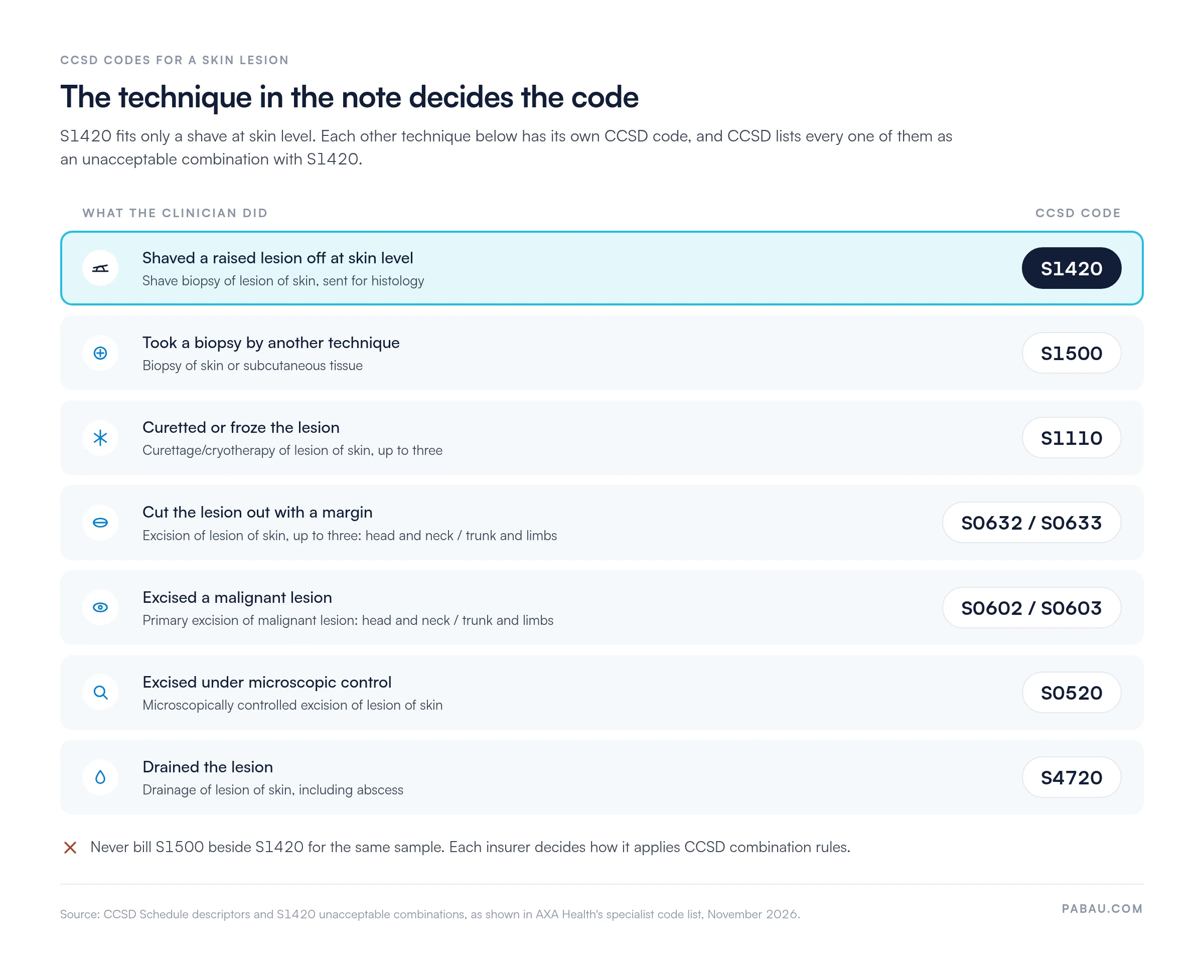
These are CCSD’s coding principles, and CCSD doesn’t determine classifications, reimbursement or fees. Each insurer decides whether it adopts a combination rule and how it applies it. AXA Health, for one, asks for codes that are within their intended purpose, as defined by the CCSD.
Two parts of the episode cause most of the confusion at billing time. Neither one is a separate line for the consultant who performs the shave.
Keep the laboratory name, the request reference and the specimen date on the patient record. When an insurer matches the pathology charge to your procedure, those details make the link.
Every S1420 claim carries a diagnosis code from the WHO edition of ICD-10, the version UK insurers use. The table below is illustrative only. None of these diagnoses is tied to S1420 by CCSD or by any insurer.
Code from what the clinical finding supports. Before the histology report is back, that is usually the clinical diagnosis written in the notes. Look codes up in the WHO ICD-10 browser rather than a US ICD-10-CM tool, which carries extra characters UK insurers don’t use.
A small procedure still needs a full record. Pabau, a practice management platform, can turn the fields below into a structured procedure-note form, so none of them gets skipped.
Keep these in the record for every S1420 procedure:
Write the word shave into the procedure note every time. A note that only says lesion removed leaves the insurer guessing whether you shaved it or excised it.
The claim is the last step. Most of the work happens before the patient is on the couch.
Cover is the step that catches people out. An insurer can decline a lesion it treats as cosmetic, even when the consultant sees a clinical reason. State that reason plainly in the notes.
CCSD publishes codes, not prices. Each insurer sets its own fee for S1420 and its own rules for paying it.
When we checked in November 2026, AXA Health’s specialist code list showed S1420 as a minor procedure with a procedure fee of £100. Fees change, and other insurers pay differently, so check the patient’s insurer schedule before you quote a price.
In many practices, the procedure note sits in one place and the pre-authorisation number sits in an email. Someone keys in the claim days later, often without the note in front of them. That is where a shave biopsy gets billed as something else.
Pabau keeps those pieces on one patient record. A procedure-note template in its digital forms can ask for the site, technique and specimen details, so they’re written once, at the point of care.
Pabau’s claims management software then submits and tracks the claim from the data already on that record. UK insurer claims go electronically through Healthcode. Your team still chooses the codes, and Pabau carries them through to the insurer and tracks the remittance.

Pabau keeps procedure notes, pre-authorisation numbers and insurer claims on one patient record. Your claims go to UK insurers through Healthcode with the record behind them.

S1420 is a short code for a short procedure, and most problems with it start in the note. Name the technique, state the reason and keep the specimen details, and the code choice defends itself.
The rest comes down to the insurer. CCSD writes the principles, but each insurer decides what it adopts and what it pays. Confirm cover before the procedure, and leave S1500 off the same claim.
Pabau keeps procedure notes, pre-authorisations and insurer claims together for dermatology and skin practices. Book a demo to see how it fits a practice billing UK insurers.

Taking a biopsy by another technique? CCSD code S1500 covers biopsy of skin or subcutaneous tissue.
Excising a malignant lesion instead? CCSD code S0602 covers primary excision of a malignant lesion on the head or neck.
Destroying a wide field of lesions by laser? CCSD code S0923 covers laser destruction of skin lesions over 25 cm².
Billing Bupa for the first time? CCSD billing codes for Bupa providers covers code structure, submission and fee schedules.
S1420 covers a shave biopsy of a lesion of skin. The clinician shaves a raised lesion off at skin level and sends it for histology. It sits in chapter 15 of the CCSD Schedule, under Lesions of skin.
No. CCSD lists S1500, biopsy of skin or subcutaneous tissue, as an unacceptable combination with S1420. Bill the code that matches the technique used for the sample.
Not usually. AXA Health treats local anaesthetic for these skin procedures as intrinsic to the procedure, with no separate benefit. Check the patient’s insurer if you’re unsure.
Each insurer sets its own fee. CCSD doesn’t determine reimbursement or fees. In November 2026, AXA Health listed S1420 as a minor procedure with a £100 procedure fee.
The descriptor names a single lesion of skin. If you shave several lesions in one session, ask the insurer how it wants them billed before the claim goes in.
UK insurers use the WHO edition of ICD-10. Common examples are L82 for seborrhoeic keratosis, D22 for melanocytic naevi and L57.0 for actinic keratosis. Code what the clinical finding supports.