



HCPCS code E0198: Water pressure pad billing guide
HCPCS code E0198 is a water pad for a standard mattress HCPCS code E0198 is the ...

Last Updated: Oct 13, 2026

CPT code 85610 reports the prothrombin time (PT) test, which also covers the INR calculation derived from PT results.
Medicare covers 85610 under NCD 190.17 for anticoagulant monitoring, bleeding disorder evaluation, and liver function assessment.
Medicare pays 85610 under the Clinical Laboratory Fee Schedule at one national rate, not through RVUs or locality adjustments.
Missing the correct ICD-10 code or ordering physician documentation are the two most common denial triggers for 85610 claims.
Pabau gives billing teams one claims dashboard, patient-to-insurer record links, and validation checks that run before submission.
CPT code 85610 reports the prothrombin time (PT) test, run on a single venous blood sample. The AMA CPT code set descriptor is just two words: Prothrombin time. The code sits in the Hematology and Coagulation subsection of the Pathology and Laboratory section (80047-89398).
The test measures how long the extrinsic coagulation pathway takes to form a fibrin clot. The result is reported in seconds, alongside the INR (International Normalized Ratio) calculated from that result. Both values come from one specimen draw and bill under 85610 as a single unit of service.
This guide covers CPT code 85610 from every billing angle. You get the clinical indications that establish medical necessity, the ICD-10 codes that pair with it, and the 2026 fee schedule. It also covers modifier rules and the denial patterns coders see most often.
Medical necessity for CPT code 85610 hinges on a documented clinical indication. The Centers for Medicare and Medicaid Services (CMS) recognizes three primary categories under NCD 190.17.
Document the specific clinical scenario in the physician order and in the encounter note. A generic order of “routine labs” does not satisfy medical necessity requirements for 85610.
There is no separate CPT code for INR, and that is the question billing staff ask most about 85610. INR is not a standalone test. It is a ratio calculated from the prothrombin time result using a laboratory-specific ISI (International Sensitivity Index) calibration factor.
The formula is INR = (Patient PT / Mean Normal PT) raised to the power of the ISI.
Because INR is derived from PT, both values are reported under CPT code 85610 as a single billable unit. Billing 85610 twice on the same date to capture “PT” and “INR” separately is incorrect. Virtually every payer will bundle or deny the second line. The AAPC’s CPT code database confirms that 85610 includes the INR calculation in its descriptor.
Selecting the right ICD-10-CM code is the single most controllable factor in avoiding 85610 denials. The table below maps the most frequently used diagnosis codes to their clinical scenarios, based on CMS coverage data and CMS ICD-10 coding guidelines. Our ICD-10-CM code library carries a fuller entry for each diagnosis listed below.
Always use the most specific code available. For warfarin monitoring, Z79.01 combined with the underlying condition code (I48.91 for AFib, I82.401 for DVT, etc.) provides the strongest claim support. Submitting 85610 with only an unspecified coagulation defect code when a more specific diagnosis is known is a common audit flag.
CMS covers prothrombin time testing under National Coverage Determination (NCD) 190.17. Coverage is not blanket. The NCD identifies three covered indications: monitoring anticoagulant therapy, diagnosis and management of bleeding disorders, and evaluation of liver function. Testing ordered outside these indications requires a signed ABN (Advance Beneficiary Notice) before the draw.
Check which rules a Medicare Advantage plan follows before you schedule coagulation labs. Some plans apply the same NCD criteria. Others apply a more restrictive Local Coverage Determination (LCD) through their MAC (Medicare Administrative Contractor). MAC-level LCDs can impose frequency limits beyond the national policy, so always check the MAC serving your state.
Point-of-care PT/INR testing (performed in the office rather than sent to a reference lab) may qualify as CLIA-waived under specific device approvals. CLIA-waived status is device-specific, not a blanket classification. The FDA maintains the list of CLIA-waived tests.
If your office performs POCT with a CLIA-waived device, append modifier QW to 85610. Billing without QW when the device is waived, or adding QW when it is not, both generate claim edits.
CPT code 85610 is a clinical diagnostic laboratory test, so Medicare pays it under the Clinical Laboratory Fee Schedule (CLFS). It is not paid under the Medicare Physician Fee Schedule (MPFS).
On the physician fee schedule the code carries status indicator X, a statutory exclusion. CMS assigns it no work, practice expense, or malpractice RVUs, so there is no RVU breakdown to look up and no MPFS payment to calculate.
The CLFS pays a single national amount per test. PAMA replaced the old local fee and national limitation amount structure on January 1, 2018. Since then the rate has been uniform across the country, with no locality adjustment and no facility versus non-facility differential. The 2026 national payment amount for 85610 is approximately $4.29.
That single national figure makes the margin math on in-house PT/INR testing simple. Medicare pays about $4.29 per test wherever you are, so the only variables you control are cuvette or strip cost, staff time, and instrument maintenance. Practices running high monthly volumes should price those inputs against the CLFS amount before committing to point-of-care testing.
Download the current CLFS file before you set posting amounts in your billing system. Quoting a third-party rate table is how a stale amount ends up in a fee schedule and stays there for a year.
Commercial payers set their own allowables for 85610 and usually publish them in a laboratory exhibit attached to your contract. Those exhibits are typically expressed as a percentage of the CLFS amount, not of the physician fee schedule. Check the lab exhibit rather than assuming your general professional-services percentage applies.
Self-pay pricing is set by the practice or the reference lab. Publish that price where patients can find it before the draw, and keep it consistent with the good faith estimate you give uninsured patients. Load the contracted and self-pay amounts into your practice management system so expected reimbursement posts correctly.
Documentation for 85610 starts with the order. Every claim needs a paper trail that auditors can follow from the physician order to the reported result. These are the required documentation elements.
For practices generating a superbill at the point of care, attach the lab order number and the collected specimen time. Independent labs billing under their own NPI still need the referring physician’s NPI and a copy of the original order.
Run a monthly audit of your 85610 claims. Pull every denial flagged for “missing documentation” or “medical necessity not established”, then trace each one back to the ordering note. Most documentation denials cluster around a small number of providers or ordering workflows. Fix the template or workflow, and the denials stop.
Four modifiers appear regularly on 85610 claims. Using the wrong one, or omitting a required one, triggers edits at the clearinghouse or payer level.
A patient may present for a warfarin management visit and have a PT/INR ordered at the same encounter. Both the E/M code and 85610 can be billed separately. The E/M has to represent a significant, separately identifiable service beyond the lab order itself. Append modifier 25 to the E/M code to signal that distinction.
If the visit consists solely of reviewing a PT result and adjusting the warfarin dose, payers may argue the E/M is not separately identifiable. Document the complexity of the management decision in the encounter note to support the separate E/M charge.
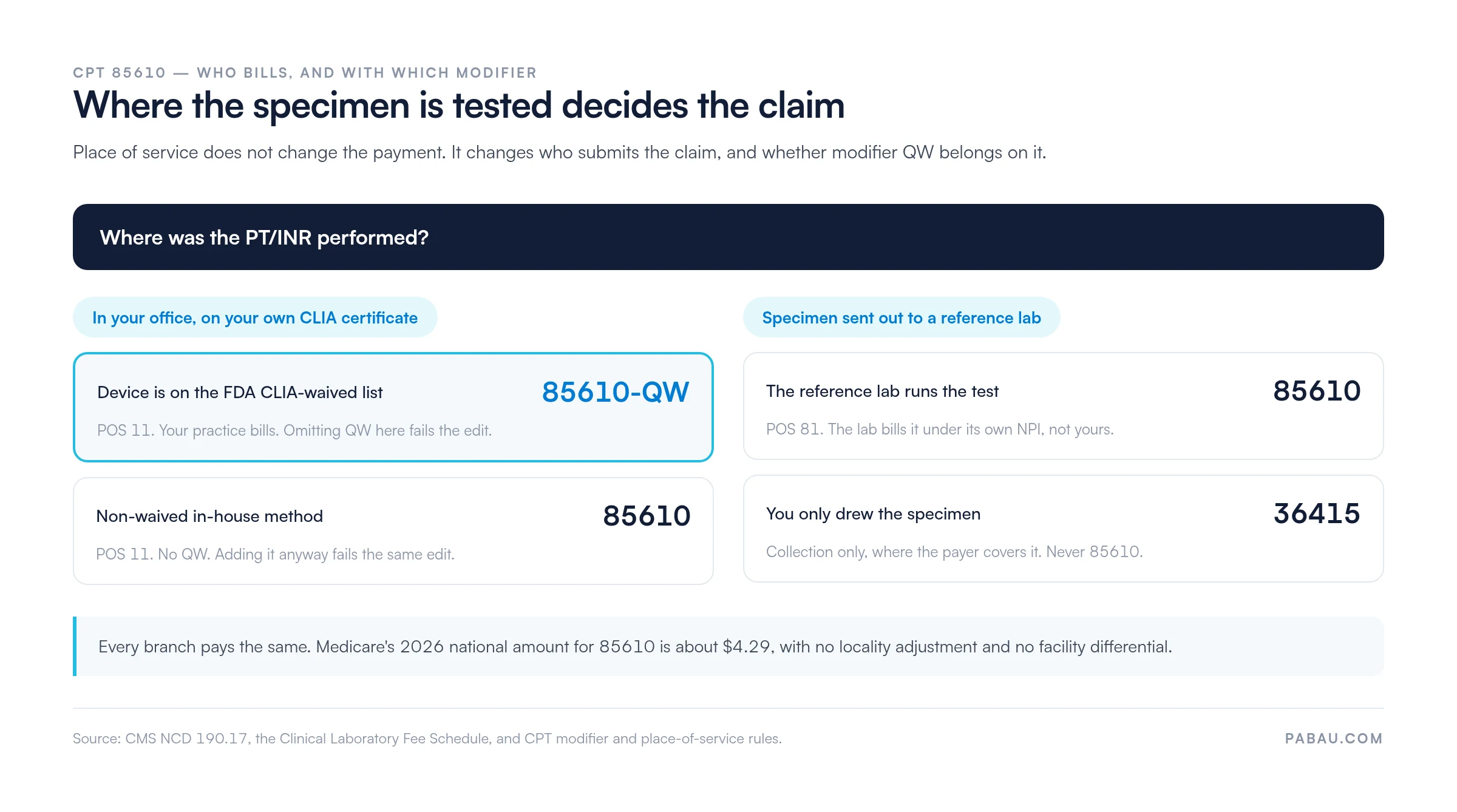
Place of service does not change what Medicare pays for 85610. The CLFS amount is identical in a physician office (POS 11), an independent laboratory (POS 81), or a hospital outpatient department (POS 22). What place of service does signal is which entity performed the test and under whose CLIA certificate.
If your practice runs the test in-house on its own CLIA certificate, bill 85610 with POS 11. If you collect the specimen and send it to a reference lab, that lab bills 85610 under its own NPI.
Your practice then bills only the collection service, using 36415 where the payer covers it. Never bill 85610 twice for the same specimen from two entities, unless each is billing a distinct service. The four routes a PT/INR order can take, and the claim each one produces, are set out below.
CPT 85611 describes a substitution prothrombin time, also called an inhibitor screen or factor substitution study. It is not an alternative way to bill the routine PT/INR test. The two codes serve different clinical purposes.
Coagulation workups frequently include multiple panel codes ordered together. Understanding how these codes interact prevents both undercoding and inadvertent bundling errors. The AAPC’s coding guidelines note that these codes each represent a distinct test methodology and can be reported together when separately performed and medically necessary.
When billing 85610 and 85730 together as a coagulation panel, check whether your payer requires a bundled panel code instead of the individual component codes. Some payer LCD policies bundle coagulation codes if ordered together routinely.
The majority of 85610 denials fall into a handful of predictable categories. Effective denial management means knowing which of these patterns your practice generates most frequently and fixing the upstream workflow before claims leave the building.
Reading the denial code correctly is what routes the appeal to the right place. Two CARC codes show up most often on 85610. CO-4 means the procedure is inconsistent with the modifier used. CO-57 means the information submitted does not support this level, frequency, or duration of service.
CO-57 is the frequency-limit code, not the prior authorization code. Prior authorization denials return CO-197 instead. Practice management software like Pabau keeps those reason codes on the claims dashboard next to the claim. Your billing team triages denials in one place, without opening each remittance file separately.
Coagulation billing errors cluster at the handoff between the lab order and the claim. A clinician orders a PT/INR and the specimen is collected. A separate billing workflow then turns that order into a CPT code with the right ICD-10 pairing. That handoff is where codes get dropped, diagnoses get mislinked, and modifiers get missed.
Pabau’s claims management software gives billing teams a single dashboard for every claim on the book. Each patient record links to their insurer, so the coverage details travel with the claim. Claims submit directly through integrated partners such as Claim.MD, with validation checks running before each one leaves the practice.
This matters most in cardiology, internal medicine, and anticoagulation practices running high monthly PT volumes. A single missed modifier or ICD-10 mismatch, repeated across hundreds of claims, adds up to serious write-off exposure. Catching those patterns before submission costs far less than appealing them afterwards.
For practices running their own point-of-care testing, Pabau also handles the lab side of the order. Clinicians order labs straight from the patient record. A request dashboard then tracks each one through backlog, requested, received, and reviewing.
Results file back to the patient record automatically, and abnormal values are highlighted for the reviewing clinician. Barcode labels print for the specimen, and Pabau connects to over 123 lab partners.

Pabau links each patient record to their insurer, runs validation checks before a claim is submitted, and sends it straight to your clearinghouse. Your billing team tracks coagulation claims without opening a second system.

CPT code 85610 is a high-volume, low-complexity code that should be straightforward to bill. The denials practices see trace back to the same four upstream failures. Missing orders, wrong ICD-10 codes, frequency overruns, and modifier errors account for most of them. Fix those workflows and 85610 becomes one of the cleanest codes on your remittance report.
The decision worth making now is where the coding happens. When the lab order, the diagnosis code, and the claim sit in separate systems, someone re-keys them. That re-entry step is where most 85610 errors start.
Pabau keeps the order, the result, and the claim in one patient record, so your coders work from the clinician’s own documentation. Book a demo to see it running in an anticoagulation or hematology practice.

Want to understand how claims flow from order to payment? Revenue cycle management fundamentals explains the full billing lifecycle from patient scheduling through ERA reconciliation.
Seeing denials you can’t trace? Denial management in healthcare covers how to categorize, appeal, and prevent the most common claim rejection patterns.
Need to clean up your claim submission process? Submitting a clean claim walks through the pre-submission checklist that prevents the majority of first-pass denials.
CPT code 85610 covers the prothrombin time (PT) test. It is a hematology and coagulation study that measures how long plasma takes to clot via the extrinsic pathway. The INR calculation derived from the PT result is included in 85610 as a single billable unit.
CPT 85610 reports the standard prothrombin time test used for warfarin monitoring, bleeding disorder evaluation, and liver function assessment. CPT 85611 reports a substitution prothrombin time, also called a mixing study. The lab runs it when a PT result is unexpectedly prolonged and needs to show whether a factor deficiency or an inhibitor is responsible. The two codes serve different clinical purposes and can be billed together when both are performed.
The most common ICD-10-CM codes paired with 85610 are Z79.01 (long-term anticoagulant use), I48.91 (atrial fibrillation), and I26.99 (pulmonary embolism). Others include D68.9 (coagulation defect, unspecified), K74.60 (liver cirrhosis), Z01.812 (preprocedural laboratory examination), and E56.1 (vitamin K deficiency). Always use the most specific code available and confirm it matches the documented clinical indication.
Yes. When a physician provides a significant, separately identifiable evaluation and management service on the same date as a PT draw, both codes can be billed. Append modifier 25 to the E/M code (not to 85610) to indicate the services are distinct. The encounter note must document the complexity of the management decision beyond the lab order alone.
CLIA-waived status for PT/INR testing is device-specific, not a blanket classification for all PT testing. Certain point-of-care PT/INR devices (such as the CoaguChek and similar FDA-approved POCT instruments) hold CLIA-waived status. When billing 85610 for a test performed on a CLIA-waived device, append modifier QW. Confirm your specific device’s status on the FDA CLIA waiver list before applying the modifier.
Modifier 91 applies when the same PT test is repeated on the same date with documented clinical necessity. Modifier QW applies to CLIA-waived point-of-care testing. Modifier 25 goes on the E/M code (not 85610) when a same-day evaluation and management service is also billed. Modifier 59 may be needed to override an incorrect bundling edit, but only with a legitimate clinical or coding rationale.
Document the specific clinical indication in the encounter note: for warfarin monitoring, note the medication, current dose, therapeutic INR range, and the monitoring interval. For bleeding disorder workup, describe the presenting symptoms. For liver disease, note the diagnosis and the role of PT in tracking hepatic synthetic function. The ICD-10 code on the claim must match the indication documented in the record.



