CPT Code 19361: Latissimus dorsi flap breast reconstruction
CPT code 19361: Official descriptor and payment basics CPT code 19361 is the Cat...

Last Updated: Nov 18, 2026
G0248 is the HCPCS Level II code for a face-to-face demonstration given before a patient starts home INR monitoring. It applies to a patient with a mechanical heart valve, chronic atrial fibrillation, or venous thromboembolism who meets Medicare coverage criteria. Under a physician's direction, the session covers the INR monitor, a blood sample, and how to report results.
To bill it, the patient needs a covered diagnosis and warfarin therapy, and the demonstration must happen before home testing begins. G0248 opens a three-code family. G0249 covers test materials and equipment, and G0250 covers physician review of the results, each billed per 4 tests.
Let Pabau's smart automation suggest the right codes, reduce claim denials, and keep your practice compliant—effortlessly.
Automate repetitive tasks and focus on what matters most—your patients.
Reduce coding errors and ensure compliance with the latest regulations.
Clean claims, fewer denials, and faster reimbursements.
Powerful insights and reporting to help your practice thrive.
HIPAA compliant SOC 2 certified GDPR-compliant Trusted by 4,000+ clinics worldwide

HCPCS code G0248 covers a one-time, face-to-face demonstration before home INR self-monitoring begins, and it can’t be billed once testing is underway.
Medicare covers it for a mechanical heart valve, chronic atrial fibrillation, or venous thromboembolism, in a patient on long-term warfarin rather than a DOAC.
The patient must have been anticoagulated for at least three months before using the home INR monitor.
G0249 and G0250 follow the demonstration, and both are billed per 4 tests rather than monthly.
Pabau’s claims management software checks diagnosis-to-code pairing and flags missing documentation before a G0248 claim is submitted.
HCPCS code G0248 is a Medicare Level II G-code for a demonstration given before home INR monitoring starts. It applies to a patient with mechanical heart valve(s), chronic atrial fibrillation, or venous thromboembolism who meets Medicare coverage criteria. The face-to-face session runs under a physician’s direction and covers use of the monitor, a blood sample, and how to report results.
The official CMS long descriptor is a single long sentence, so here it is split into its parts, word for word.
The descriptor’s “includes” clause then lists four elements, and each one has to happen during the session.
Each element maps to something an auditor checks. “Prior to initiation” is a coverage condition, so the timing has to show in the record.
“Under the direction of a physician” sets the supervision standard. “At least one blood sample” means the patient performs a test during the session. Any element missing from the medical record gives an auditor grounds for denial.
A patient qualifies for HCPCS code G0248 when four conditions hold at once. They need a covered diagnosis and long-term warfarin therapy. They must have been anticoagulated for at least three months, and they can’t have started home INR monitoring yet.
Qualifying diagnoses (must appear on the claim):
Anticoagulant requirement: The patient must be on long-term warfarin therapy. Warfarin has a narrow therapeutic window, so small changes in diet, other medications, or illness can shift the INR. That’s why home self-testing helps these patients.
Direct oral anticoagulants (DOACs) such as apixaban, rivaroxaban, and dabigatran don’t need INR monitoring. Medicare doesn’t cover G0248 for DOAC patients, because the demonstration serves no clinical purpose for them.
Anticoagulation history: CMS National Coverage Determination (NCD) 190.11 requires at least three months of anticoagulation before the patient uses the home INR device. Once home testing starts, it should happen no more than once a week.
Timing requirement: The service must happen before the patient starts home INR monitoring. NCD 190.11 makes “prior to initiation” a hard coverage condition. A patient who is already self-testing can’t be trained retroactively under G0248, because the demonstration is a prerequisite for monitoring.
The four conditions work as gates in a fixed order, and the chart below shows where a referral stops when one of them fails.
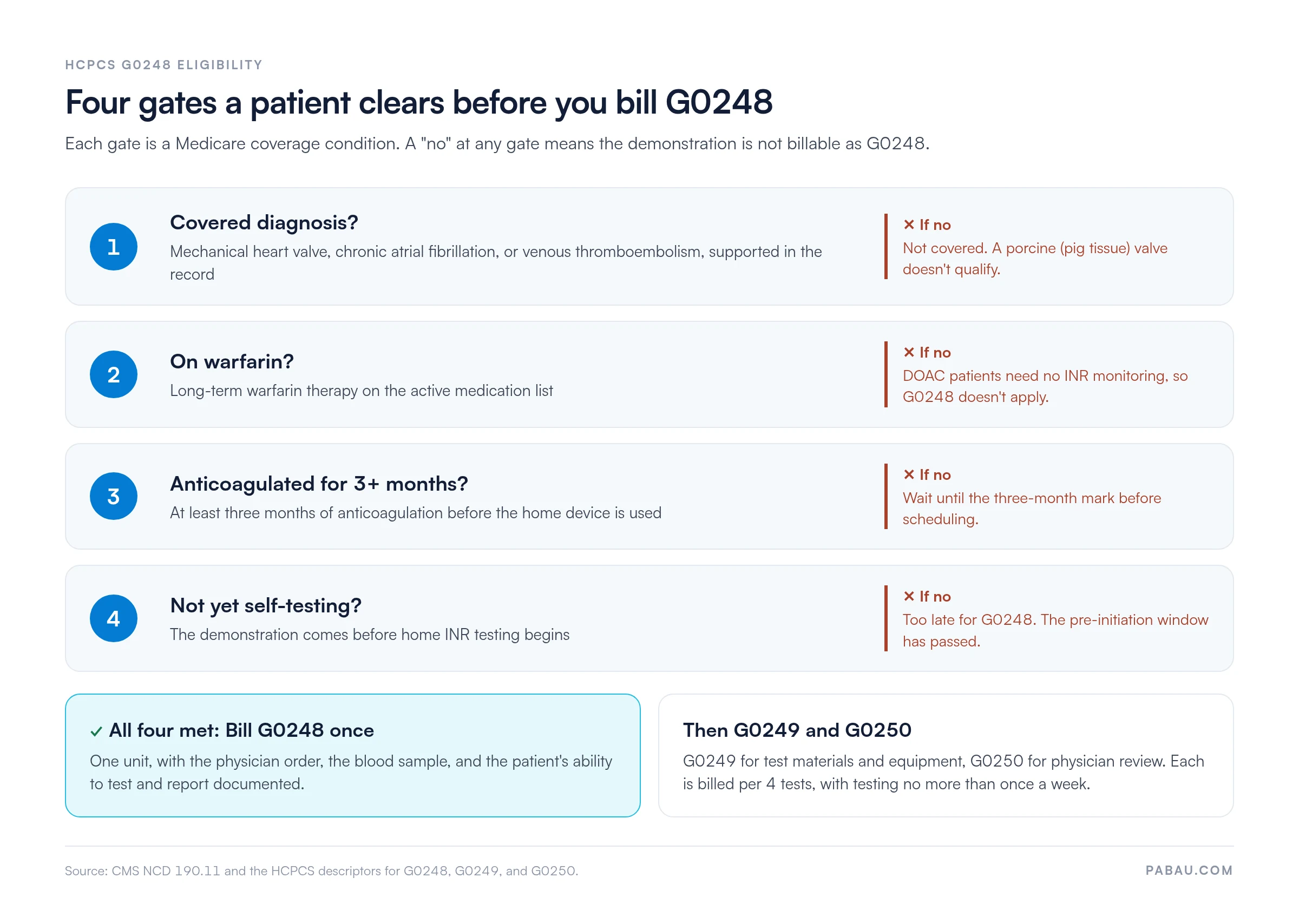
Every G0248 claim must carry at least one qualifying ICD-10-CM diagnosis code that matches the patient’s covered condition. A G0248 claim without a supporting diagnosis code is denied automatically.
A personal history code such as Z86.718 doesn’t show a current VTE that needs anticoagulation, so it won’t support the claim on its own. Verify each code against the current fiscal year CMS ICD-10-CM tabular list before billing, because revised or deleted codes are rejected.
Your Medicare administrative contractor (MAC) may also publish local coverage determinations (LCDs). Those from Noridian JE Part B or Palmetto GBA may list extra accepted or excluded codes beyond the NCD baseline.
The three G-codes for home INR monitoring each cover a distinct phase of the patient’s self-testing program. Billing a code out of sequence, or for a phase the practice didn’t perform, leads to denial.
G0249 and G0250 can’t be billed before G0248 is complete, because they continue the program G0248 starts. Billing G0249 for a patient who never had the demonstration is a coverage problem as well as a coding one. Our page on G0250 covers the physician-review code in detail.
Knowing what G0248 doesn’t cover keeps practices from overcoding and from scheduling patients whose claims will be denied.
Run an eligibility check before scheduling the G0248 demonstration. Confirm the patient’s Medicare record shows no prior G0248 claim from another provider. A second lifetime G0248 for the same patient will be denied as a duplicate.
Medicare auditors reviewing G0248 claims look for a paper trail that mirrors each element of the official descriptor. Solid medical billing compliance means building this checklist into the workflow before the session, rather than reconstructing it after a denial.
Accurate submission of G0248 on the CMS-1500 depends on place of service, diagnosis linkage, and claim timing. Pabau’s claims management software checks diagnosis-to-code pairing before submission, which catches the most common G0248 errors early.
The Medicare Physician Fee Schedule (MPFS) sets the national payment rate for G0248, and each contractor applies a geographic adjustment. Rates change every calendar year when CMS publishes the annual update. The table below explains how the rate is built. Always check the current-year figure with the CMS Physician Fee Schedule lookup tool before billing.
Understanding medical billing workflows for G-codes like G0248 means checking both the national rate and your locality-adjusted rate. The national unadjusted rate is the starting point, and your payment reflects your MAC’s locality adjustment. In high-cost areas such as Manhattan, San Francisco, and Boston, the adjusted rate is noticeably higher. In rural localities it’s usually lower.
G0248 denials cluster around a few predictable root causes. Good denial management in healthcare starts by catching these patterns before the claim goes out. When a claim does come back, its claim denial codes tell you which cause the payer found.
The DOAC error deserves extra attention because it often starts as a clinical handoff problem rather than a coding mistake. A cardiologist switches a patient from warfarin to apixaban, then sends a referral for “home INR monitoring training” to your practice. The front desk accepts the referral without checking the current anticoagulant, schedules G0248, and bills. The claim is denied.
The fix is a structured intake question, asked before any G0248 appointment is confirmed: “Is the patient currently on warfarin?”
Build a G0248 pre-visit checklist into your scheduling workflow. Confirm the qualifying diagnosis, warfarin on the active medication list, and at least three months of anticoagulation. Then check for no prior G0248 in the Medicare history and a signed physician order.
Several codes are commonly confused with G0248 or submitted alongside it incorrectly. The table below separates each code by service type and billing context, and shows when it duplicates G0248.
G0248 is a Medicare-specific HCPCS G-code. Commercial insurers don’t recognize it by name and may not cover the equivalent service under any code.
Commercial plans that do cover home INR monitoring usually need a different approach. Options vary by payer and may include these routes.
Ongoing warfarin management has its own CPT code outside the G-code family. 93793 reports the contact after a new INR result, including interpretation, dose adjustment, and scheduling. Where G0248 is a once-per-lifetime demonstration, 93793 is reported no more than once a day. Coverage still varies by payer, so check the plan policy before billing.
Some commercial plans have published medical policies for prothrombin time or INR self-monitoring. LifeWise WA and Healthy Blue Louisiana, for example, have done so in the past. Their eligibility criteria may or may not mirror CMS NCD 190.11.
MAC-specific LCD requirements add another layer within Medicare itself. Noridian JE Part B and Palmetto GBA have each published LCDs with documentation and eligibility rules that go beyond the national NCD. Review your regional MAC’s current LCD before billing G0248.
The CMS HCPCS overview and AAPC’s HCPCS code lookup are useful starting points for confirming code status. To submit a clean claim every time, pair the current MAC LCD with a structured pre-submission checklist.
When eligibility lives in paper notes and spreadsheets, it often gets checked only when the claim is built. By then the demonstration has already happened, and a failed condition can’t be fixed after the fact.
Pabau, the practice management platform we build, keeps the diagnosis, the medication list, and the session notes in one patient record. Its claims management software checks diagnosis-to-code pairing and flags missing documentation before a claim leaves the practice. That puts the warfarin check, the three-month history, and the blood sample result where your biller can see them.
The result is a G0248 claim that goes out once, with its diagnosis linked and its documentation complete. The same record supports the wider revenue cycle management work for the G0249 and G0250 claims that follow.

Pabau links each procedure code to its qualifying diagnosis and flags missing documentation before a claim is submitted. That helps G0248 and its companion codes go out clean the first time.

G0248 rewards the practices that check eligibility at scheduling. The code pays once per patient, and every condition that decides coverage is set before the demonstration starts.
So move the checks to scheduling. Confirm the diagnosis, warfarin, three months of anticoagulation, and that home testing hasn’t begun. Then document every descriptor element during the visit. The trade-off is a few minutes of intake work against a lifetime benefit that may never be paid.
Book a demo to see how Pabau builds those G0248 checks into your scheduling and claims workflow.

Need a structured workflow for anticoagulation billing? Superbill documentation guide covers how to build superbills that capture every required element for HCPCS G-code claims.
Want to reduce denials across all HCPCS codes? Denial codes in medical billing explains the most common CARC reason codes and how to prevent them upstream.
Billing G0249 or G0250 alongside G0248? Electronic remittance advice explains how to read ERA files to spot companion-code bundling errors before they become write-offs.
HCPCS code G0248 is a Medicare HCPCS Level II G-code for the one-time, face-to-face demonstration a qualifying patient receives before home INR self-monitoring begins. The session covers use and care of the INR monitor, at least one blood sample, and instructions for reporting results. It’s limited to patients with a mechanical heart valve, chronic atrial fibrillation, or venous thromboembolism who are on long-term warfarin.
G0248 is a once-per-patient-lifetime benefit under Medicare. A second claim for the same beneficiary will be denied as a duplicate, regardless of which provider submits it or how much time has passed. Always verify the patient’s Medicare claims history before billing.
No. G0248 requires that the patient be on warfarin (or Coumadin). Direct oral anticoagulants such as apixaban (Eliquis), rivaroxaban (Xarelto), and dabigatran (Pradaxa) do not require INR monitoring. There is no clinical basis for the demonstration service, so Medicare does not cover it for DOAC patients.
Under NCD 190.11, the patient must have been anticoagulated for at least three months before using the home INR device. Schedule the G0248 demonstration once that three-month mark has passed, and record the start date in the chart.
The qualifying ICD-10-CM codes fall into three groups. A mechanical heart valve uses Z95.2, and chronic atrial fibrillation uses I48.11, I48.19, or I48.20. Venous thromboembolism, including DVT and pulmonary embolism, uses codes such as I82.401 and I26.09. The specific code must be supported by the medical record and linked to G0248 on the claim. Verify against the current fiscal year CMS tabular list before submitting.
The G0248 rate is set annually by the CMS Medicare Physician Fee Schedule and varies by geographic locality. Non-facility rates (office setting, POS 11) are higher than facility rates (outpatient hospital, POS 22). Use the CMS fee schedule lookup tool at cms.gov to find the current-year rate adjusted for your MAC locality before billing.
G0248 is a Medicare-specific HCPCS G-code and is not universally recognized by commercial payers. Some commercial plans have published separate medical policies for home prothrombin time or INR self-monitoring with their own eligibility criteria. Contact the commercial payer directly or submit with an unlisted procedure code and written description when billing outside Medicare.