CPT Code 52352: Ureteroscopic stone removal billing guide
CPT Code 52352: Official descriptor and procedure overview CPT Code 52352 descri...

Last Updated: Oct 30, 2026
88321 is the CPT code for consultation and report on referred slides prepared elsewhere. A consulting pathologist reviews slides that another institution has already prepared and issues a signed written report, with no new sections or stains.
The code sits in the 88321-88325 consultation group. Use 88323 when the consulting lab prepares slides from the referred material, and 88325 for a comprehensive consultation with review of records and specimens.
Let Pabau's smart automation suggest the right codes, reduce claim denials, and keep your practice compliant—effortlessly.
Automate repetitive tasks and focus on what matters most—your patients.
Reduce coding errors and ensure compliance with the latest regulations.
Clean claims, fewer denials, and faster reimbursements.
Powerful insights and reporting to help your practice thrive.
HIPAA compliant SOC 2 certified GDPR-compliant Trusted by 4,000+ clinics worldwide

CPT code 88321 covers a pathologist’s review of slides prepared at another institution, with a signed written report and no new slide preparation.
Most payers expect the referred material to come from another institution, so verify your payer’s policy before billing an internal second opinion.
Use 88323 when the consulting lab prepares new slides, and 88325 when the consultation includes a comprehensive review of records and specimens.
Pabau’s claims software sends consultation claims to thousands of US payers through Claim.MD and tracks each one from submission to remittance.
CPT code 88321 is a surgical pathology consultation code for reviewing slides referred from another institution and writing a report on them.
The American Medical Association (AMA) maintains it as part of the CPT code set. The consulting pathologist reads slides the referring lab has already prepared, with no new sections or stains.
88321 has been part of the CPT code set for years, alongside 88323 and 88325 in the 88321-88325 consultation group. Check the current AMA CPT code set for the exact descriptor before you code.
CPT 88321 covers three core elements:
The code applies when the slides come from a different institution and the referring pathologist formally requests an opinion. The consulting pathologist must also produce a signed, written report. Verbal-only consultations do not qualify.
Common clinical scenarios include:
Knowing where 88321 stops matters as much as knowing what it covers. Billing it in the wrong context is a common reason these claims get denied.
The three pathology consultation codes (88321, 88323 and 88325) all cover material referred from another institution. They differ in how much work the consulting pathologist performs. Picking the wrong one is both a compliance risk and a reimbursement issue. Consult the AAPC CPT code lookup to verify current descriptors before submitting.
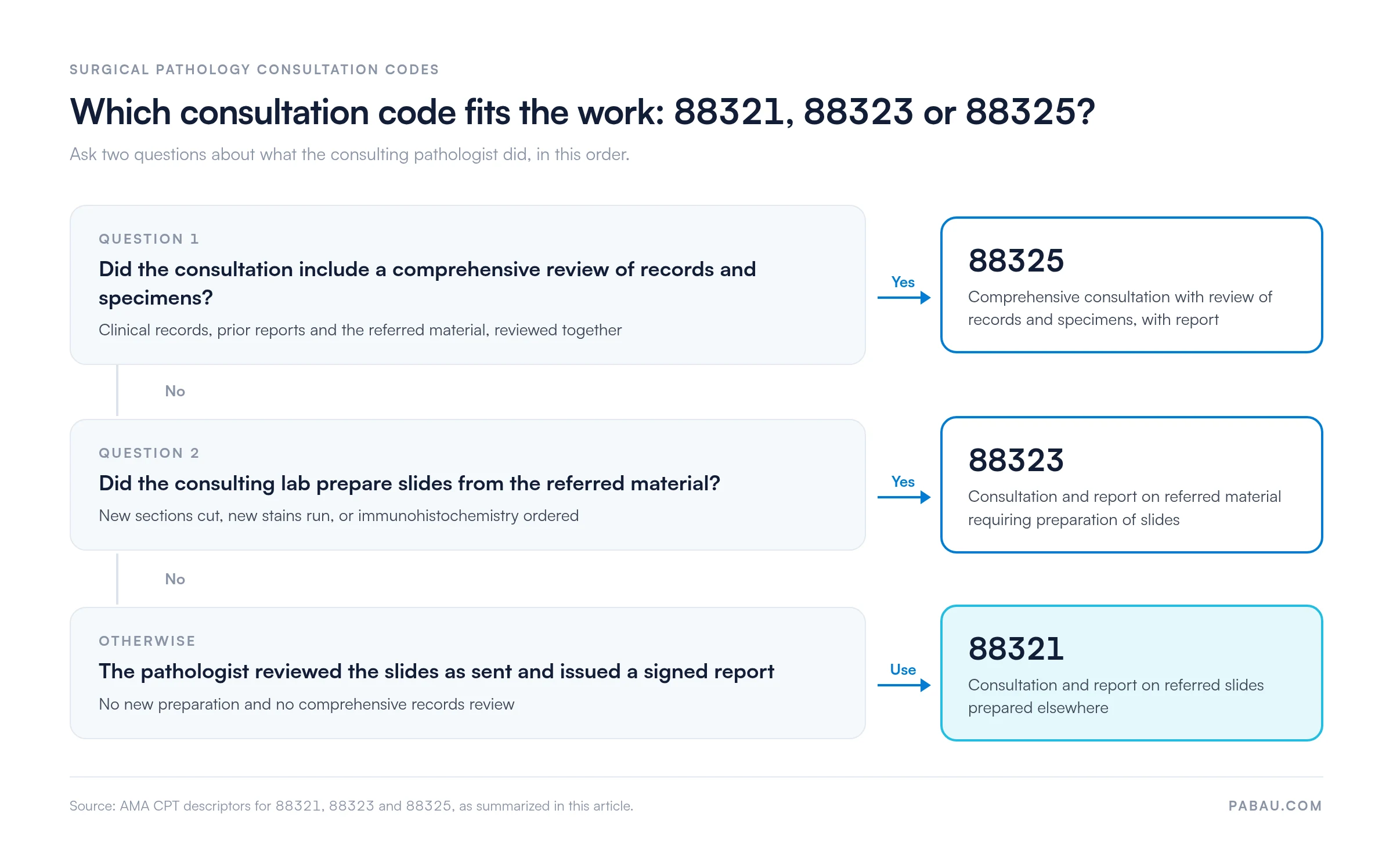
A straightforward rule: Start with 88321 when the slides are read as sent. If the consultation involves additional routine preparation, use 88323. If it involves comprehensive review of records and specimens, use 88325. The decision diagram below puts those two questions in order.
Whether 88321 can be billed more than once for a single patient encounter depends on payer policy rather than one universal rule.
Coders generally treat 88321 as a per-case code. The consultation covers a report on a referred case, not individual specimen blocks. Most payers follow the same logic: One unit per consultation event, regardless of how many slides are reviewed.
Some MACs and commercial payers may allow separate billing when specimens from distinctly separate anatomic sites are referred on different dates of service. Billing 88321 twice for two blocks from the same case on the same date is likely to trigger a duplicate claim denial. Always check your MAC’s local coverage determination (LCD) before reporting multiple units for the same patient and date.
Flag any 88321 claim where units exceed one before submission. Pull your MAC’s LCD for pathology consultation and confirm whether per-specimen billing is covered. A single denial for extra units is recoverable. A pattern of duplicate claims can trigger a compliance audit.
Every 88321 claim needs documentation showing that the material came from another institution and what professional work was performed. Missing any single element is enough for a denial.
Use claims management software to build a documentation checklist that runs before a claim is submitted. The required elements are:
Medicare covers CPT code 88321 under the Medicare Physician Fee Schedule (MPFS) when medical necessity and the outside referral are documented. Rates vary by geographic location, through the Geographic Practice Cost Index, and by place of service.
For 2026 rates, use the CMS Physician Fee Schedule lookup tool to retrieve current national non-facility and facility rates for 88321. The FastRVU 2026 RVU lookup tool gives the Work, Practice Expense and Malpractice RVU components that drive the final payment. Rates change each January 1, when the annual MPFS final rule takes effect.
Key Medicare billing considerations for 88321:
Commercial payers vary widely in what they require for 88321. What is straightforward under Medicare may need extra steps with a commercial plan. Running insurance eligibility verification before scheduling a referred consultation surfaces payer-specific authorization rules before the work is done.
Build payer-specific rules into your pre-submission workflow to meet medical billing compliance requirements for consultation codes. That beats fixing denials after the fact.
Six denial triggers come up again and again with 88321. Each one can be caught before the claim goes out.
Clear denial management workflows for pathology codes cut rework time. An 88321 denial is far easier to prevent when the claim is created than to overturn on appeal. Our guide to medical billing denial codes explains how to read claim adjustment reason codes (CARCs) on these remittances.
The appropriate modifier depends on whether the pathologist is billing the professional component only, the technical component only, or both. It also depends on whether the work is reported through a reference lab arrangement.
Modifier applicability is payer-specific. Before applying modifiers 26 or TC, verify that your MAC’s MPFS data file gives 88321 a modifier indicator that accepts split billing. Some payers bundle the professional and technical components for this code family and will deny a claim that splits them. Confirm this rule before building a billing template.
Check the modifier indicator for 88321 in your MAC’s MPFS data file each January. A code that accepted split billing in one year may be reclassified the next. Build a step into your annual coding review that pulls the updated modifier indicator alongside RVU values.
Electronic filing adds one more check. Clean claims depend on testing modifier combinations against current National Correct Coding Initiative (NCCI) edits before the 837P file is generated.
In many pathology groups, an 88321 claim is built by hand from the signed report. Staff re-key the referring pathologist’s NPI, choose between 88321, 88323 and 88325, then wait to hear whether the payer accepted it.
Pabau, the practice management and billing platform we build, keeps the claim next to the patient record. It sends claims to thousands of US payers through its Claim.MD clearinghouse integration. Real-time eligibility checks run before the consult, so a coverage problem surfaces while you can still act on it.
Each claim’s status updates from submission through to payment or denial. Electronic remittance advice comes back into Pabau, tied to the claim it settles. Your team sees which 88321 claims were paid and which need a corrected resubmission, without opening each remittance file.

Pabau sends CPT claims to thousands of US payers through its Claim.MD integration. Check eligibility before the consult, then track every claim through to its remittance.

Treat 88321 as the default only when the slides arrive ready to read. Once your lab cuts a section or runs a stain, the claim belongs to 88323. Once the consult becomes a full review of records and specimens, it belongs to 88325.
The cheapest place to make that call is at report sign-out, while the pathologist still has the case open. Settle the code, the referring NPI and the payer’s outside-material rule there, and your appeal queue stays short.
To see how Pabau tracks pathology consultation claims from submission to remittance, book a demo.

Need to understand how clearinghouse claims validation works? Medical claims clearinghouse guide explains how electronic claim routing and validation reduce rejections before payers receive your submissions.
Want to see how a clearinghouse handles specialty claims? Claim.MD clearinghouse overview covers how Pabau sends pathology and other specialty claims to thousands of US payers, with real-time eligibility checks.
Did the consultation include immunohistochemistry? CPT code 88342 covers billing for the initial single antibody stain procedure.
Looking for a structured billing document? Superbill guide outlines how to build a compliant billing document that captures the elements codes like CPT 88321 need before submission.
CPT code 88321 covers consultation and report on referred slides prepared elsewhere. The consulting pathologist reviews the slides and signs a written report without preparing new material. Most payers expect the slides to come from another institution.
88321 applies when the consulting pathologist reviews slides as sent, with no new stains, sections, or immunohistochemistry. 88323 applies when the consulting pathologist orders or performs additional tissue preparation, such as new stains or IHC, before giving an opinion. If any preparation work occurs, 88323 is the correct code.
No, in most cases 88321 is reported as one unit per consultation case, not per slide or block. Some MACs may allow separate billing for specimens from distinct anatomic sites submitted on different dates. Billing two units for the same case and date of service typically triggers a duplicate claim denial. Verify your MAC’s local coverage determination before reporting multiple units.
Yes, Medicare covers CPT code 88321 under the Medicare Physician Fee Schedule when medical necessity and the outside referral are documented. Payment rates update each January 1. Use the CMS MPFS lookup tool to retrieve current 2026 rates for your area.
The most common denial reasons are a missing or unsigned consultation report and same-institution billing that the payer won’t accept. Others include choosing 88321 when additional preparation was performed, a missing referring pathologist NPI, duplicate unit billing, and thin medical necessity documentation.
Generally no. 88321 and 88323 describe different levels of work. One is review only, and the other includes additional preparation. Billing both for the same consultation event is likely to be treated as unbundling. If both occur for separate cases on the same date, document each case distinctly, though payer edits may still flag the combination.