

CCSD code XR940: Foreign body retrieval billing guide
CCSD code XR940 is the UK private healthcare code for retrieval of a foreign bod...

Last Updated: Nov 26, 2026
56606 is the CPT code for biopsy of vulva or perineum; each separate additional lesion. It is an add-on code, reported once for each distinct lesion sampled after the first and always alongside primary code 56605.
The code sits in the vulva, perineum and introitus subsection of the female genital system surgery codes. Each unit needs its own documented lesion site, size and technique, with a matching labeled specimen.
Let Pabau's smart automation suggest the right codes, reduce claim denials, and keep your practice compliant—effortlessly.
Automate repetitive tasks and focus on what matters most—your patients.
Reduce coding errors and ensure compliance with the latest regulations.
Clean claims, fewer denials, and faster reimbursements.
Powerful insights and reporting to help your practice thrive.
HIPAA compliant SOC 2 certified GDPR-compliant Trusted by 4,000+ clinics worldwide

CPT code 56606 is the add-on code for each separate additional vulvar or perineal lesion biopsied, and it is always reported with primary code 56605.
56606 cannot stand alone, so a claim that carries it without 56605 is denied.
Bill one unit of 56606 per distinct lesion, and document each one with its own site, size, technique and labeled specimen.
Destroying a different vulvar lesion in the same session takes 56501 or 56515 with the XS or 59 modifier, backed by the operative note.
Pabau, a practice management platform, sends claims to US payers electronically through Claim.MD and tracks each claim until the remittance comes back.
CPT code 56606 is the add-on code for biopsy of vulva or perineum, each separate additional lesion, and it is always billed with 56605. In the AMA’s CPT code set, the official descriptor reads “Biopsy of vulva or perineum; each separate additional lesion.” The plus sign prefix (+56606) marks it as an add-on, so it never stands alone. The CPT parenthetical instruction reads: “Use 56606 in conjunction with 56605.”
Within the CPT female genital system range (56405 to 58999), in the vulva, perineum and introitus subsection (56405-56821), 56606 sits immediately after 56605. It reports the added work of biopsying each distinct vulvar or perineal lesion after the first. The CPT codebook sets no unit maximum, so bill 56606 once for each additional lesion documented as separate.
CPT code 56606 captures punch biopsy, shave biopsy, and excisional biopsy of distinct vulvar or perineal lesions performed as separate procedures at separate anatomical sites. Common clinical indications include suspected vulvar intraepithelial neoplasia (VIN), lichen sclerosus, condyloma acuminata, and atypical pigmented lesions.
The key phrase in the descriptor is “separate.” One continuous lesion biopsied at two points does not support two units of 56606. Each additional unit requires documentation of a distinct, separately identified lesion with its own anatomical site notation. The six scenarios below show how that rule plays out on the claim.
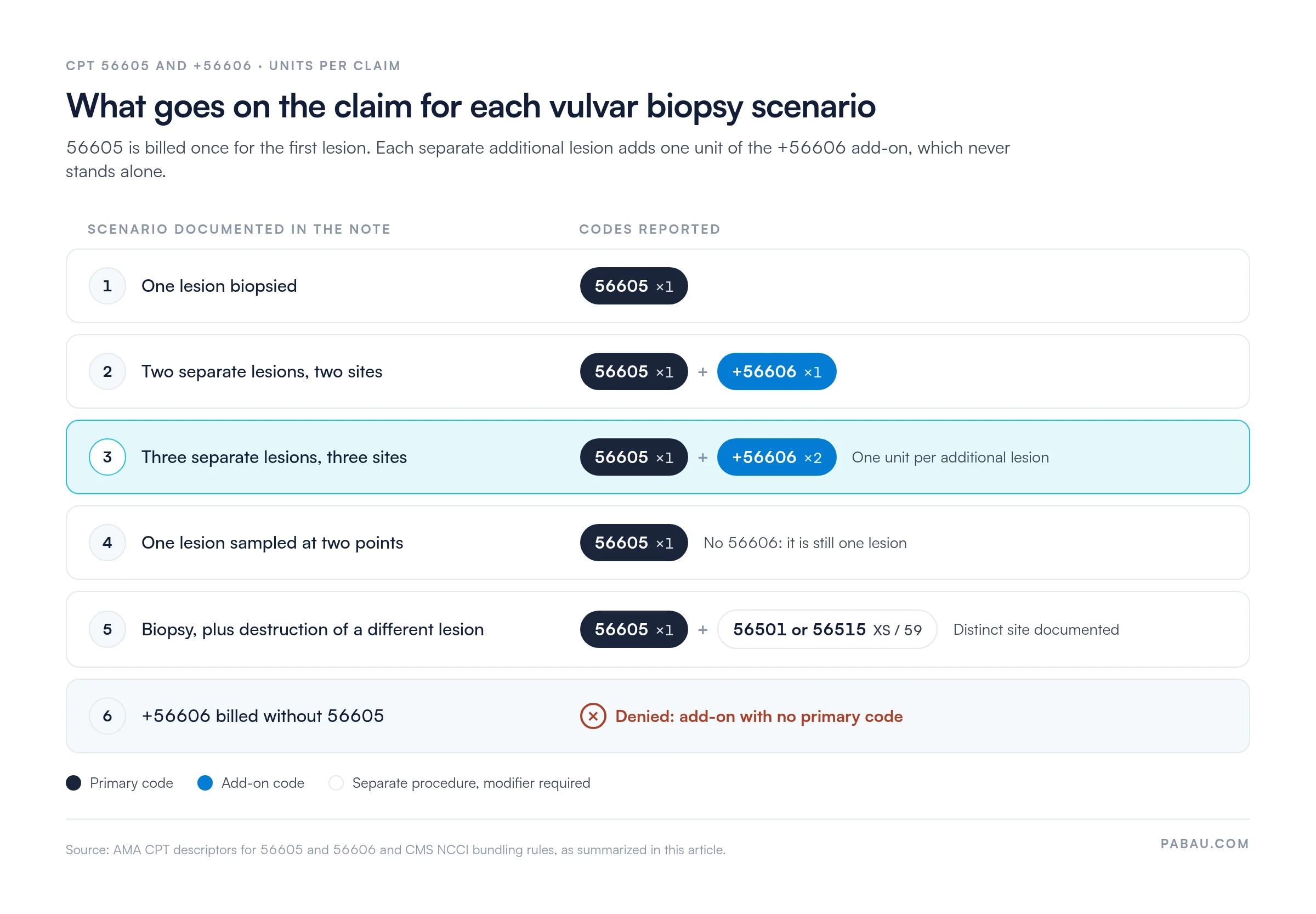
Reporting a skin biopsy code from the 11102 to 11107 range (formerly 11100/11101) for a vulvar biopsy is an auditable coding error. ACOG and AAPC guidance specifies that site-specific codes supersede general skin biopsy codes at a gynecological site.
Every 56606 claim must carry a diagnosis code that justifies medical necessity for the additional lesion biopsy. An unspecified symptom code alone routinely triggers denial. The ICD-10 codes below represent the most defensible pairings when the clinical record supports each.
Assign the most specific ICD-10 code the documentation supports for each individual lesion. When multiple lesions carry different pathological presentations, different ICD-10 codes may apply to 56605 and to each unit of 56606. Document this in the operative note and match it to the pathology submission labels.
The National Correct Coding Initiative (NCCI) governs how 56606 may be billed alongside other same-session codes. CMS updates the NCCI edit files quarterly, so check each edit pair against the current file before submission.
The key bundling scenarios to know:
CMS has issued guidance against routine Modifier 59 attachment. Appending it without operative note documentation confirming distinct sites is an audit red flag. The XS modifier (separate structure) is preferable when the distinction is anatomical rather than temporal.
Add-on codes are exempt from the multiple procedure payment reduction that CMS applies to secondary procedures under the Medicare Physician Fee Schedule (MPFS). That exemption means 56606 is paid at its full fee schedule rate when reported alongside 56605. Most secondary surgical procedures take a 50% reduction instead.
Use the CMS Physician Fee Schedule lookup tool to retrieve the current-year national payment amounts. Rates are updated each January and vary by place of service. As a reference point, verify the current work RVU, practice expense RVU, and malpractice RVU values against the published FastRVU lookup for the current year.
Commercial payer rates vary by contract and may differ significantly from Medicare rates. Cross-reference the payer contract fee schedule when calculating expected reimbursement for 56606. In Pabau, US claims go out electronically through Claim.MD, which reaches thousands of US payers and runs eligibility checks before the encounter.
Every unit of CPT code 56606 needs lesion-level detail behind it. Each unit billed requires its own documentation thread from the operative note through the pathology report.
The operative note must include all of these elements for each additional lesion billed under 56606, to support a clean claim submission:
Sometimes the pathology report returns a specimen labeled only as “vulvar biopsy,” with no site. Any units of 56606 beyond the first then become difficult to defend on audit. Establish a practice standard of labeling each specimen jar by anatomical sub-site at the time of procedure.
Medicare generally does not require prior authorization for CPT code 56606. Many commercial payers and Medicaid managed care organizations do. That requirement may not be clearly stated in the authorization issued for the primary code 56605.
When authorization is required, submit the following to support approval of the additional lesion unit:
Confirm with the payer whether authorization for 56605 covers additional units of 56606 or whether a separate authorization line is needed. This varies by plan and by state Medicaid program.
Most 56606 denials trace back to one of six avoidable errors. Structured denial management workflows catch these before submission rather than after the remittance arrives. When a denial does arrive, the remittance denial codes on the ERA point to the reason the line was rejected.
Several codes appear routinely on the same encounter as 56606. Knowing which are separately billable, which are bundled, and which require a modifier prevents claim errors before submission. The pathology code 88305 is the one most often misplaced, because the pathologist bills it rather than the physician who took the biopsy.
Run a pre-submission audit on every encounter with 56606. Confirm 56605 is present and each 56606 unit maps to a separately documented lesion in the operative note. Then check that 88305 appears only where a specimen went to pathology. These three checks catch the most common causes of 56606 denials before the claim goes out.
Without a shared record, the clinician writes up each lesion in the procedure note and the billing team rebuilds the claim from it later. Lesion counts, sites and specimen labels get retyped, and a dropped unit of 56606 only shows up when the remittance comes back.
With Pabau’s gynecology claims management, the procedure note, the patient’s insurance case and the claim sit in the same system. US claims go to payers electronically through Claim.MD as CMS-1500/837P claims, with eligibility checks before the visit. Prior authorization codes, dates and sessions are tracked on the case, with a warning when one is missing.
ERA remittances post back to Pabau and each claim stays tracked there, so a short-paid or denied 56606 line is easy to find and work. That gives your billing team time to check lesion documentation before claims go out.

Pabau connects scheduling, clinical notes, and claim submission in a single workflow, so your 56606 documentation and billing stay aligned from procedure to payment.

Getting 56606 paid comes down to one discipline: every unit on the claim maps to a separate lesion the note can prove. Bill 56605 first, add one unit of 56606 per additional lesion, and stop where the documentation stops.
The trade-off is time at the point of care. Recording the site, size, technique and a matching specimen label for each lesion takes minutes during the procedure. It is also the only defense when an auditor asks which lesion a unit paid for.
Book a demo to see how Pabau keeps biopsy notes, insurance cases and claims together for gynecology practices.

Did the lesion call for a wider excision? CPT code 56620 covers simple partial vulvectomy, which cannot be billed with 56606 for the same area.
Confused about claim denials and how to appeal them? Denial codes in medical billing explains the most common remittance denial codes and how to respond to each one.
Want to understand how the clearinghouse fits in? Medical claims clearinghouse guide explains how electronic claim routing works between practices and payers, including eligibility verification.
CPT code 56606 is an add-on code for biopsy of the vulva or perineum, reported once for each separate additional lesion biopsied beyond the first. It must always be reported alongside its primary code, 56605, and it cannot be billed as a standalone code.
Yes, CPT code 56606 is an AMA-designated add-on code, indicated by the plus sign prefix (+56606) in the CPT codebook. The parenthetical instruction reads: “Use 56606 in conjunction with 56605.” Add-on codes are exempt from the Medicare multiple procedure payment reduction.
CPT 56605 is the primary code for biopsy of one vulvar or perineal lesion. CPT 56606 is the add-on code reported for each additional separate lesion beyond the first. Bill 56605 once per encounter, and bill 56606 once for each additional distinct lesion documented in the operative note.
No. Using 11102-11107 (formerly 11100/11101) for a vulvar biopsy is a coding error. ACOG and AAPC guidance specifies that the site-specific vulvar biopsy codes, 56605 and 56606, supersede the general skin biopsy codes at a gynecological site. Submitting a skin biopsy code for a vulvar biopsy is an auditable substitution error.
Medicare does not generally require prior authorization for CPT code 56606. Many commercial payers and Medicaid managed care plans do require authorization. That authorization may not automatically extend from 56605 to the additional-lesion units billed via 56606. Verify with the specific payer before the encounter.
CPT 88305 (surgical pathology, gross and microscopic examination) is separately billable when a biopsy specimen from a 56606 encounter is submitted to pathology for interpretation. Bill 88305 only when a pathologist interprets the specimen. The physician performing the biopsy does not bill 88305.
The office (POS 11) pays at the non-facility rate, which is higher because practice expense RVUs include overhead. When 56606 is performed in a hospital outpatient department or ambulatory surgical center (POS 22 or 24), the physician receives the lower facility rate. The facility bills its own fee separately. Use the AAPC code lookup to compare rate differentials by site.



