

CCSD code XR940: Foreign body retrieval billing guide
CCSD code XR940 is the UK private healthcare code for retrieval of a foreign bod...

Last Updated: Nov 26, 2026
59612 is the CPT code for vaginal delivery only, after previous cesarean delivery. It covers the delivery itself when another provider managed the prenatal care and no postpartum care is billed with it.
Its global counterpart, 59610, adds the antepartum visits and postpartum care for the same physician. The AMA deletes the whole VBAC code family on January 1, 2027, when a VBAC delivery moves to 59432.
Let Pabau's smart automation suggest the right codes, reduce claim denials, and keep your practice compliant—effortlessly.
Automate repetitive tasks and focus on what matters most—your patients.
Reduce coding errors and ensure compliance with the latest regulations.
Clean claims, fewer denials, and faster reimbursements.
Powerful insights and reporting to help your practice thrive.
HIPAA compliant SOC 2 certified GDPR-compliant Trusted by 4,000+ clinics worldwide

CPT code 59612 covers vaginal delivery after a previous cesarean, delivery only, with no antepartum or postpartum care bundled in.
Use 59610 when the same physician provided the antepartum care, and 59614 when the delivering physician also provides postpartum care.
ICD-10-CM code O34.211, low transverse scar from previous cesarean, is the usual supporting diagnosis on a 59612 claim.
The AMA deletes 59612 on January 1, 2027, and VBAC deliveries from that date are coded with 59432.
Pabau, a practice management platform, sends US claims through Claim.MD with eligibility checks and ERA posting built in.
CPT code 59612 reports a vaginal delivery after a previous cesarean when the billing physician provides the delivery only. The AAFP’s maternity coding summary lists its descriptor as “vaginal delivery only, after previous cesarean delivery.” The American Medical Association, which publishes CPT, places it in the Maternity Care and Delivery section (59000-59899). It covers the intrapartum service only, with no antepartum or postpartum care.
The clinical scenario is specific. A patient with at least one prior cesarean scar presents for delivery. She undergoes a trial of labor after cesarean (TOLAC) and delivers vaginally. The delivering physician bills for the delivery encounter only. This happens most often in hospital-based or laborist models, where a separate provider or practice managed the antepartum care.
Accurate coding for vaginal birth after cesarean (VBAC) starts with what the physician does during the delivery encounter. TOLAC management carries more surveillance than routine labor. The team monitors continuously for uterine rupture, and the prior surgical history shapes each decision. The facility must also be able to convert to an emergency cesarean.
Payers audit the documentation that comes out of that care. Structured intrapartum note templates help the record support the code from admission onward, instead of being patched together after a denial.
The most useful thing to know about 59612 is what it leaves out. The global obstetric packages for routine deliveries (codes 59400, 59510 and 59610) bundle antepartum visits, delivery, and the postpartum visit. CPT code 59612 deliberately excludes the antepartum and postpartum parts.
The VBAC code family has six members, and picking the wrong one is a common billing error in this code set. Two variables decide it. The first is whether the TOLAC ended in a vaginal delivery or a repeat cesarean. The second is which parts of the care the billing physician provided.
Quick rule: A successful TOLAC with delivery-only billing is 59612. Add postpartum care and it becomes 59614, and the full global package is 59610. A failed TOLAC with delivery-only billing is 59620, and the global package after a failed TOLAC is 59618. Laid out as a grid, the two questions leave only one cell for each code.
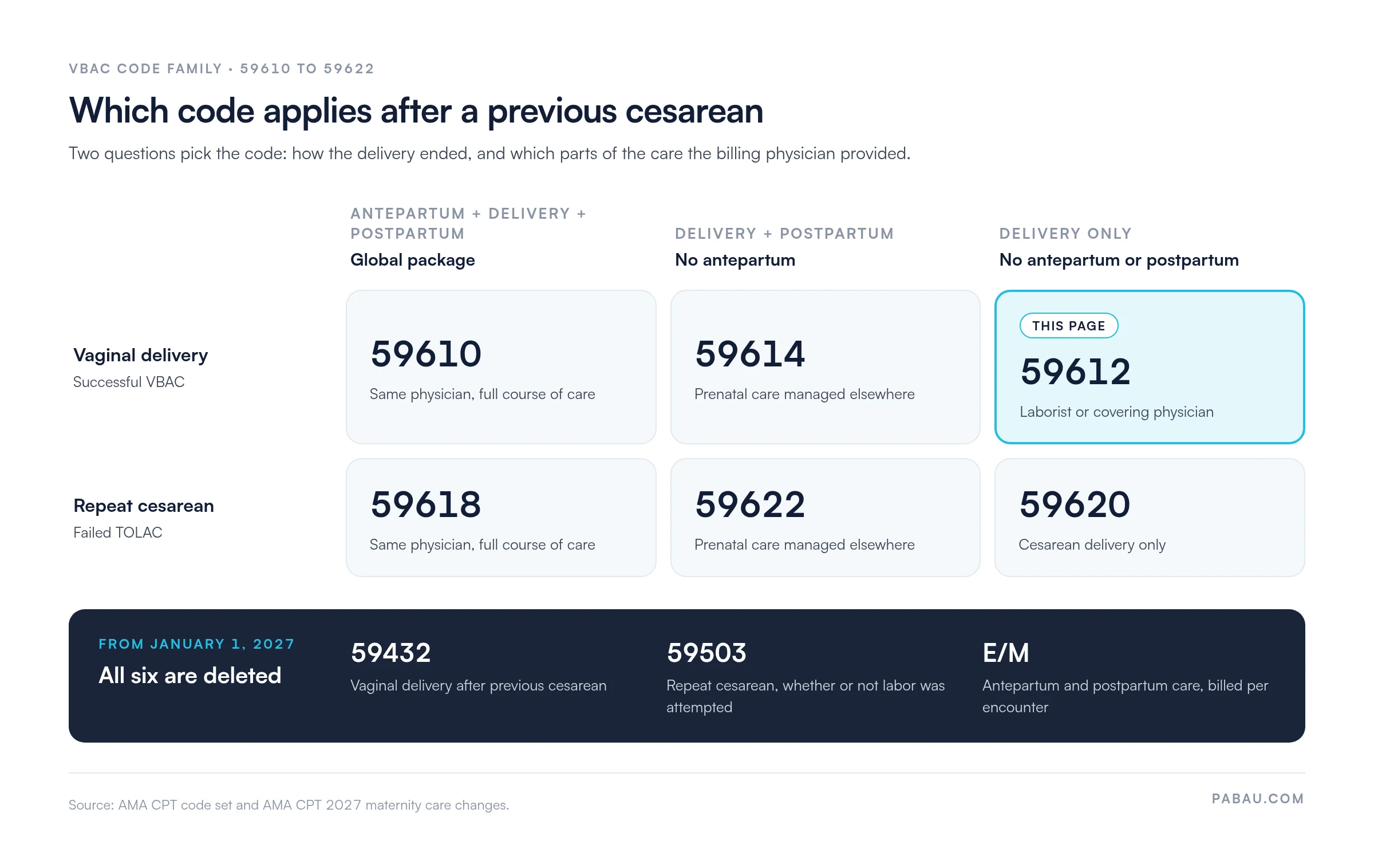
The AMA deletes CPT 59612 in the CPT 2027 code set, along with the rest of the 59610-59622 family. Its 2027 delivery coding FAQ says a VBAC delivery is then coded with 59432, “vaginal delivery, with or without episiotomy; after previous cesarean delivery.” A repeat cesarean moves to 59503, whether or not a vaginal delivery was attempted.
Antepartum and postpartum care stop being bundled codes as well. The AMA’s maternity care overview says both are reported per encounter with E/M codes. Labor management gets its own daily codes, 59080 to 59083, and the AMA notes that a patient attempting VBAC qualifies for complex labor management.
The date of service decides which set applies. A VBAC delivery on December 31, 2026 still bills as 59612, while one on January 1, 2027 bills as 59432. Update charge masters, claim templates and coding cheat sheets before the switch, and keep 59612 for late claims with a 2026 date of service.
Every CPT code 59612 claim needs ICD-10-CM diagnosis codes that establish medical necessity and confirm the clinical scenario. Missing or incorrect diagnosis codes are a common cause of VBAC denials. Under the ICD-10-CM Official Guidelines, Chapter 15 obstetric codes (O00-O9A) take priority when the patient is pregnant. An outcome-of-delivery code belongs on every delivery claim.
Sequencing rule: The uterine scar code (O34.21-) sequences as a principal or secondary diagnosis, depending on whether the VBAC attempt was the focus of care. Its 6th character gives the scar type, and O34.211 (low transverse) is the usual one. The Z37.0 outcome code always sequences as an additional code, never as principal. Code to the highest specificity, because an unspecified scar type invites payer scrutiny.
Documentation failures are a frequent reason 59612 claims are denied or downcoded. The record must show three facts: a prior cesarean occurred, TOLAC was clinically indicated and consented, and the delivery was vaginal and successful. Sound medical billing fundamentals require each of these elements before a claim leaves the practice.
Prior authorization rules for VBAC deliveries vary by payer, plan year, and state, so check them rather than assume none apply. Obstetric billing compliance starts with verifying auth requirements when the TOLAC is planned, not at the delivery encounter.
Medicare assigns work relative value units (wRVUs) to CPT code 59612 under the Physician Fee Schedule. Reimbursement rates change annually and vary by geographic pricing locality. Use the CMS Physician Fee Schedule Look-Up Tool to retrieve current-year rates for a specific MAC jurisdiction. The table below shows the general structure, so verify current dollar amounts before contract negotiations or fee schedule benchmarking.
For RVU benchmarking, the FastRVU look-up tool provides work, practice expense, and malpractice RVU breakdowns for 59612 by locality. This is useful for contract negotiations and physician compensation calculations.
Incorrect or missing modifiers on 59612 claims lead straight to rejections. The modifiers that apply fall into two groups: Complexity modifiers and split-care modifiers.
Important note on Modifier 22: Payer acceptance of Modifier 22 on obstetric delivery codes is inconsistent. Always verify the specific payer’s policy before appending it. Include a letter of medical necessity with objective documentation supporting the increased complexity.
VBAC delivery claims fail more often than routine vaginal delivery claims. The code choice is less obvious, the documentation is heavier, and payers look harder at any delivery after a uterine scar. Effective denial management starts with knowing which patterns repeat, and the common CARC denial codes below are where they show up.
A clean 59612 claim needs the clinical documentation team and the billing staff working from the same facts. The workflow follows the same sequence whatever practice management system the practice uses.
For OB practices in a laborist or split-care model, build a standard workflow that flags every VBAC delivery for billing review before the encounter closes. The physician’s delivery note should explicitly state that antepartum care was provided by another practitioner. That single sentence prevents the most common 59612-to-59610 substitution error and reduces retrospective medical record requests.
In a laborist or split-care model, the delivery note and the claim are often built by different people on different days. The biller reads the note, works out who managed the prenatal care, and picks between 59610, 59612 and 59614. When the note says nothing about antepartum care, that choice becomes a guess.
Pabau keeps the delivery note, the TOLAC consent and the claim on the same patient record. The biller sees the prior cesarean history and who provided prenatal care before choosing the code. US claims then go out through Claim.MD, with eligibility checks and ERA posting handled in the same system.
Fewer claims come back for the wrong member of the VBAC family. The ones that do are quicker to fix, because the supporting notes already sit on the patient record.

Pabau links delivery-day documentation to the claim, so the code, scar diagnosis and outcome code go out together. US claims, eligibility checks and ERA posting run through Claim.MD.

CPT 59612 turns on one question the delivery note has to answer: Who provided the prenatal care? If it was someone else and the TOLAC ended in a vaginal delivery, 59612 is the code. Pair it with the scar diagnosis and Z37.0, and make sure the note says in one sentence that care was split.
The code also has a short shelf life. Deliveries from January 1, 2027 move to 59432, with antepartum and postpartum visits billed as E/M encounters. Update templates and payer contracts now, so the first January claims don’t bounce on a deleted code.
Book a demo to see how Pabau ties the delivery note to the claim, so VBAC deliveries stay coded right through the 2027 switch.

Billing a cesarean outside the VBAC family? CPT code 59514 covers cesarean delivery only, when no antepartum or postpartum care is billed with it.
Coding the global package for a planned cesarean? CPT code 59510 covers routine obstetric care with cesarean delivery and postpartum care in one claim.
Coding a first-degree tear after delivery? ICD-10 code O70.0 explains the diagnosis code for a first-degree perineal laceration during delivery.
Want to understand how clearinghouse submissions work? Electronic remittance advice explains ERA and 835 transaction processing for obstetric and other claims.
Trying to reduce claim denials across your OB practice? Denial codes in medical billing breaks down the most common CARC codes and resolution strategies.
CPT code 59612 is the AMA procedure code for vaginal delivery only after a previous cesarean delivery. It covers the delivery service alone, with no antepartum or postpartum care included. It applies when the delivering physician did not manage the prenatal care. That separates it from CPT 59610, which bundles up to 13 antepartum visits and postpartum care into one global package.
CPT 59610 is the global VBAC package code. It includes antepartum care (up to 13 visits), the vaginal delivery after cesarean, and the postpartum visit, all billed by the same physician. CPT 59612 covers the delivery only. Use 59612 when a laborist or covering physician delivers the patient but did not provide prenatal care. Use 59610 when the same OB managed the full course of care.
No. CPT 59612 excludes antepartum care. If the delivering physician also provided the antepartum care, the correct code is 59610, which includes up to 13 prenatal visits. Billing 59612 when the same physician also billed antepartum codes creates a global package bundling conflict that payers will deny. The antepartum-only codes 59425 and 59426 apply only when antepartum care is billed separately, without the delivery.
A 59612 claim usually pairs a scar code from O34.21- with the outcome-of-delivery code Z37.0 (single live birth). The 6th character of the scar code gives the scar type, and O34.211, low transverse scar, is the usual supporting diagnosis. Complication codes sequence as secondary diagnoses based on what happened during the delivery. A missing O34.21- or Z37 code is a common denial trigger for VBAC claims.
If the trial of labor after cesarean fails and the physician performs a repeat cesarean, do not bill CPT 59612. Use CPT 59620 for cesarean delivery only after the failed TOLAC. If the same physician provided the full global package, including antepartum and postpartum care, the correct code is 59618. If the physician provided the cesarean and postpartum care but not antepartum care, use 59622.
Yes, Medicare Part B covers CPT code 59612 for the physician professional fee. Reimbursement follows the Medicare Physician Fee Schedule RVU values for the geographic pricing locality. Facility fees for the hospital stay are covered separately under the DRG system and billed on a UB-04, not the CMS-1500. Verify current-year rates in the CMS Physician Fee Schedule Look-Up Tool, as amounts change annually.
No, not for deliveries on or after January 1, 2027. The AMA deletes 59612 in the CPT 2027 code set, and a VBAC delivery from that date is coded with 59432. Antepartum and postpartum visits are then billed per encounter with E/M codes. Claims for deliveries on or before December 31, 2026 still use 59612.



