

CCSD code XR940: Radiology billing guide for UK private practice
CCSD code XR940 is a UK private healthcare radiology procedure code used to bill...

Last Updated: Nov 26, 2026
90970 is the CPT code for end-stage renal disease (ESRD) related services for dialysis less than a full month of service, per day. It is for patients 20 years of age and older, and Medicare pays one unit for each day the physician managed outpatient ESRD care.
The full-month codes, such as 90960-90962, pay one amount for a calendar month of management. 90970 replaces them when the physician manages the patient's outpatient ESRD care for only part of the month.
Let Pabau's smart automation suggest the right codes, reduce claim denials, and keep your practice compliant—effortlessly.
Automate repetitive tasks and focus on what matters most—your patients.
Reduce coding errors and ensure compliance with the latest regulations.
Clean claims, fewer denials, and faster reimbursements.
Powerful insights and reporting to help your practice thrive.
HIPAA compliant SOC 2 certified GDPR-compliant Trusted by 4,000+ clinics worldwide

CPT code 90970 reports ESRD-related physician services for less than a full month of outpatient dialysis care, billed per day for patients 20 and older.
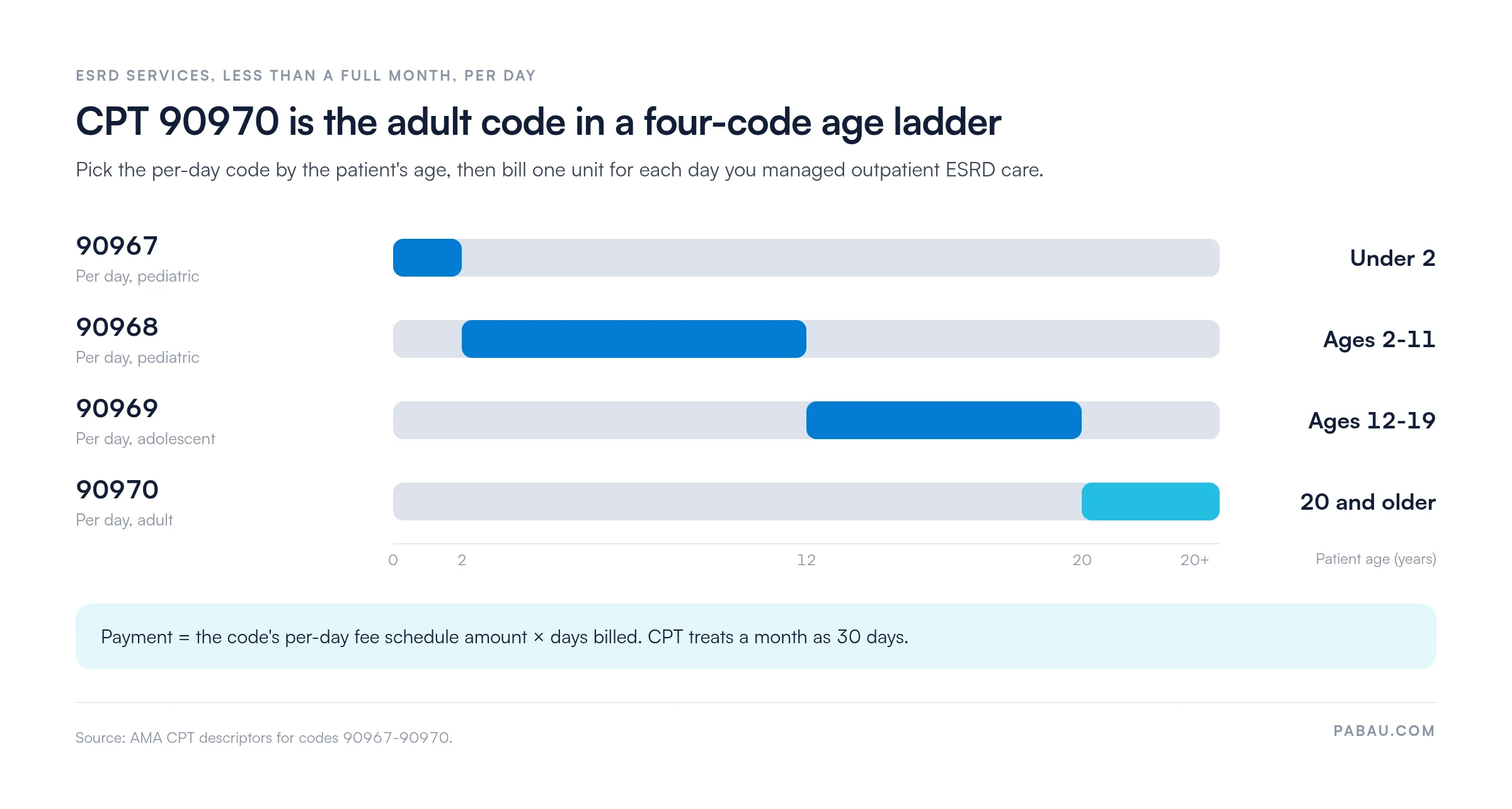
Patients under 20 take the age-matched per-day codes instead, which are 90967 under age 2, 90968 for ages 2-11, and 90969 for ages 12-19.
Medicare pays 90970 at its own per-day fee schedule amount times the days billed, and CPT treats a month as 30 days.
Every 90970 claim needs a dated note of the event that made the month partial, such as a hospitalization, transplant, or death.
Report the place of service that matches where dialysis was furnished, such as POS 65 for an ESRD facility, and confirm it with your MAC.
CPT code 90970 reports end-stage renal disease (ESRD) related services for dialysis less than a full month of service, billed per day. Medicare’s Claims Processing Manual, chapter 8 pays these less-than-full-month services on a per diem basis. The descriptor limits the code to patients 20 years of age and older.
90970 belongs to the ESRD monthly capitation payment (MCP) family, which the American Medical Association maintains in the CPT code set. The family bundles physician oversight of dialysis into one payment instead of an E/M visit each session.
“Less than a full month” is the operative phrase. The physician managed the patient’s outpatient ESRD care for only part of the calendar month. That can happen at the start, when a patient is new to dialysis, or at the end, after a death, transplant, or transfer. It can also happen mid-month, when a hospitalization moves care to the inpatient setting.
CPT code 90970 covers the physician’s management of ESRD-related services during the partial month. That work includes:
All of this physician work is bundled into the per-day rate. Several services fall outside the code’s scope:
Choosing between 90970 and the full-month ESRD codes comes down to one question. Did the patient receive physician-supervised outpatient ESRD services for the entire calendar month? If yes, use 90960 through 90962 based on the number of face-to-face visits. If no, use 90970 and bill per day.
The MCP family (90960-90970) bundles physician ESRD management into one monthly or partial-month payment. The per-session codes, 90935 and 90937, cover individual hemodialysis encounters billed outside that monthly relationship. Check your MAC’s local coverage determination before you bill across these code families.
The per-day codes also split by age, and 90970 is the adult code in that set. Patients under 20 take 90967, 90968, or 90969 instead.
Five distinct partial-month events trigger CPT code 90970 billing. Each has its own documentation requirements and coding logic.
Always document the clinical event that created the partial month. A generic note saying “patient received dialysis” is not enough. The record must state the date dialysis started, the date of transplant or hospitalization, or the date of death. Without a dated trigger event, the payer cannot verify that 90970 fits better than a full-month code, and the claim will deny.
Medicare pays CPT code 90970 on a per-day basis. The code carries its own per-day amount in the Medicare Physician Fee Schedule (MPFS). Expected payment is that per-day MPFS amount × days billed, and CPT treats a month as 30 days.
Rates update each year through the MPFS. Check the CMS Physician Fee Schedule lookup tool each January for the current figures. Cite the fee schedule year in any internal audit documentation.
Three reimbursement caveats apply:
Report the place of service that matches where dialysis is furnished. For an independent ESRD facility, that is POS 65 (End-Stage Renal Disease Treatment Facility). Home dialysis MCP claims and hospital-outpatient dialysis units use other POS codes, such as 12 or 22. Confirm the right code with your MAC before you set a billing default.
Documentation failures drive many 90970 denials and much of the code’s audit exposure. The medical record must support both the ESRD diagnosis and the partial-month status. Clean claim submission depends on every required element being in the chart before the claim goes out.
Required documentation elements for a compliant 90970 claim:
CMS requires ESRD-specific diagnosis codes on 90970 claims. An acute kidney failure code (N17.x) will generate a denial, because those codes describe a reversible condition rather than ESRD. The CMS ICD-10 codes page carries the annual update files that confirm valid codes for each fiscal year.
List the comorbidities you actively manage during the ESRD encounter, such as hypertension, diabetes, or cardiovascular disease. Those secondary codes support medical necessity, and some commercial payers require them.
Revenue cycle teams with structured denial management workflows catch most 90970 denials before they pass the timely filing deadline. The table maps the most frequent denial patterns to their root causes and fixes. For CARC and RARC definitions, see the denial codes reference.
Medicare covers most ESRD patients in the United States, including many under age 65. The CMS Medicare Benefit Policy Manual, Chapter 11, governs coverage rules. The Medicare Claims Processing Manual, Chapter 8, governs claim submission. MAC Local Coverage Determinations (LCDs) can add stricter requirements, so confirm your MAC’s LCD for dialysis physician services.
State Medicaid programs may pay secondary to Medicare for dual-eligible ESRD beneficiaries. Medicaid rules for 90970 vary by state. Most follow Medicare’s methodology, but some impose their own prior authorization or documentation requirements. Review the state’s Medicaid provider manual if you have dual-eligible patients.
Commercial payers and self-insured employers generally follow Medicare’s ESRD MCP framework for 90970, because no widely adopted alternative exists. Some plans still require pre-authorization, use different proration formulas, or bundle services differently. Verify each plan through the payer’s provider portal. A grounding in medical billing fundamentals helps your team work through these payer-by-payer differences.
A quarterly internal audit of 90970 claims surfaces systemic errors before the OIG or a MAC does. A repeatable checklist keeps your ESRD coding within medical billing compliance standards.
Run the duplicate-MCP check as a front-end edit before claims go out. Flag any month where the same patient appears on both a 90960, 90961, or 90962 claim and a 90970 claim. Catching it before submission takes minutes, while catching it in a CMS audit costs far more.
A nephrology billing team often checks eligibility in one portal and builds claims in another. The partial-month day counts then sit in a spreadsheet beside both.
In Pabau, a practice management platform, claims management for nephrologists runs through Claim.MD, the US clearinghouse it integrates with. Your team submits CMS-1500/837P claims and checks eligibility through Claim.MD before each billing cycle. ERA remittances come back into the same system, so you can compare each payment with the days you billed.
Eligibility checks matter for 90970, because ESRD entitlement must be active for every day you bill. Your team spends less time reconciling partial-month claims by hand and more time working the denials that need attention.
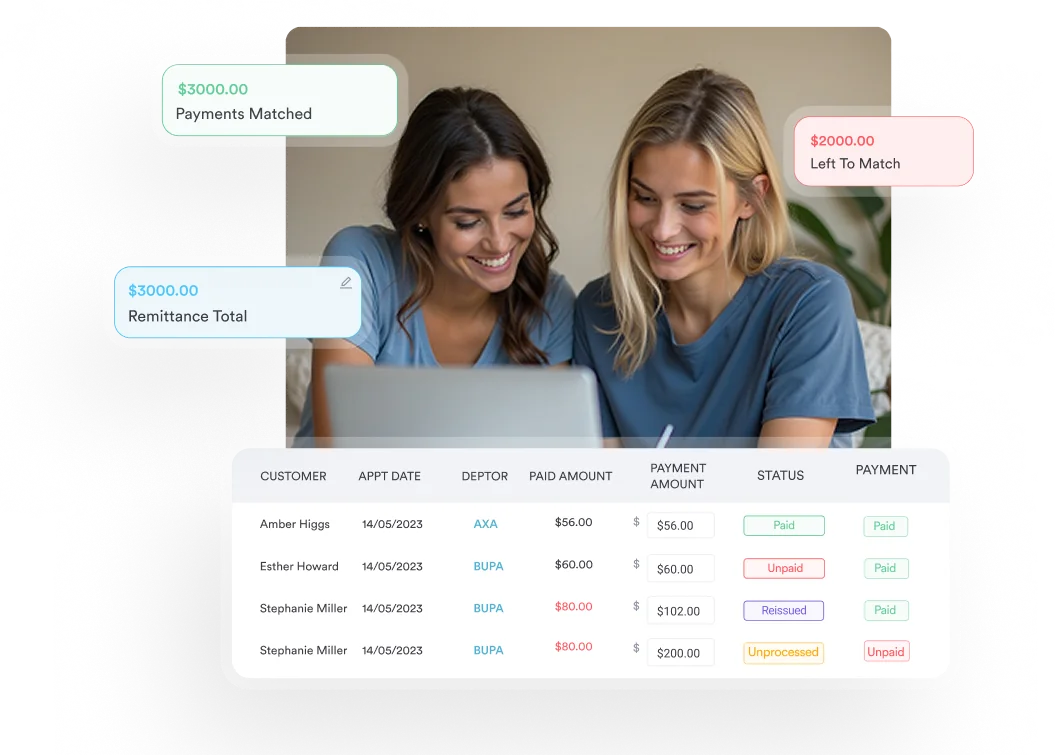

Pabau’s claims management submits CMS-1500/837P claims and checks eligibility through Claim.MD. Your team keeps ESRD claims, remittances, and patient records in one place.

CPT code 90970 pays cleanly when three decisions are settled before the claim is built. Confirm the patient is 20 or older, record the dated event that made the month partial, and use the POS that matches where dialysis happened.
Then make sure no full-month MCP code covers the same patient and month, and take edge cases to your MAC before you bill. A practice that audits these points every quarter finds its errors before a payer does.
Book a demo to see how Pabau submits ESRD claims and checks eligibility through Claim.MD.

Managing a home dialysis patient for the full month? CPT 90966 covers ESRD-related services for home dialysis per full month for patients 20 and older.
Billing a full month with two or three visits? CPT 90961 covers full-month ESRD services for adults with 2-3 face-to-face visits.
Want to understand the full claims lifecycle? How medical clearinghouses work explains how 837P files move from your EHR to payer adjudication.
Struggling with remittance reconciliation? Electronic remittance advice (ERA) explained covers 835 file structure and how to match ERAs to your 90970 per-day payments.
Building a denial prevention workflow? Denial codes in medical billing maps CARC and RARC codes to the most common ESRD billing errors.
CPT code 90970 covers ESRD-related physician services furnished during a less-than-full calendar month of outpatient dialysis. They include lab review, dialysis prescription management, vascular access assessment, and comorbidity management. It is a bundled per-day payment, so individual services within ESRD management are not billed separately.
CPT 90960 covers a full calendar month of ESRD outpatient physician management for patients age 20 and older with four or more face-to-face visits. It is billed once per month. CPT code 90970 covers any partial month for patients 20 years of age and older. It is billed per day for each day of service. If the patient received care for every day of the calendar month, use 90960, 90961, or 90962 by visit count.
Use the place of service that matches where dialysis is furnished. For an ESRD facility, that is POS 65 (End-Stage Renal Disease Treatment Facility). Home dialysis and hospital-outpatient settings use other codes, such as 12 or 22. A POS that does not fit the service can deny with CO-5, so confirm the right code with your MAC.
CPT code 90970 can apply to home dialysis patients during a partial month. The physician must be the designated managing physician, and the partial-month trigger must be documented. The deciding factor is whether a full calendar month of physician management was provided. Confirm home dialysis billing details with your MAC, as rules vary by jurisdiction.



