HCPCS code J7190: Factor VIII billing, units and reimbursement
HCPCS code J7190 bills human Factor VIII by the unit HCPCS code J7190 describes ...

Last Updated: Nov 10, 2026
CPT code 88363 covers a pathologist’s examination and selection of archived, previously diagnosed tissue for molecular analysis, such as KRAS mutation testing. It applies after the original case is signed out, when a treating physician orders a gene test and someone has to choose the right block.
That choice takes medical judgment, so it earns its own code. Plenty of online references still describe 88363 as a general re-review with immunohistochemistry (IHC) bundled in. That reading leads straight to wrong units, wrong modifiers and avoidable denials.

CPT code 88363 pays a pathologist to review a signed-out case and select the archived tissue best suited to a molecular test.
It is a stand-alone code, reported once per selection episode, however many molecular tests follow.
IHC, microdissection and the molecular assay itself are coded separately and never folded into 88363.
Medicare’s fee schedule doesn’t allow modifiers 26 or TC on 88363, so the line goes out without a split-billing modifier.
Pulling blocks or slides from storage doesn’t support the code. The report has to show the pathologist’s selection and reasoning.
CPT code 88363 reports the examination and selection of retrieved archival tissue for molecular analysis. In plain terms, a pathologist pulls a case that was already diagnosed and signed out. They review the original report and slides, then pick the block with enough viable tumor for the requested gene test.
AAPC’s CPT 88363 code summary and its Pathology/Lab Coding Alert print the descriptor along these lines. Check the exact wording in your current AMA CPT codebook before quoting it on an appeal. Four terms in it drive billing decisions:
Most coding errors on this code come from asking it to do more than it does. Use this split when a molecular workup lands on your desk.
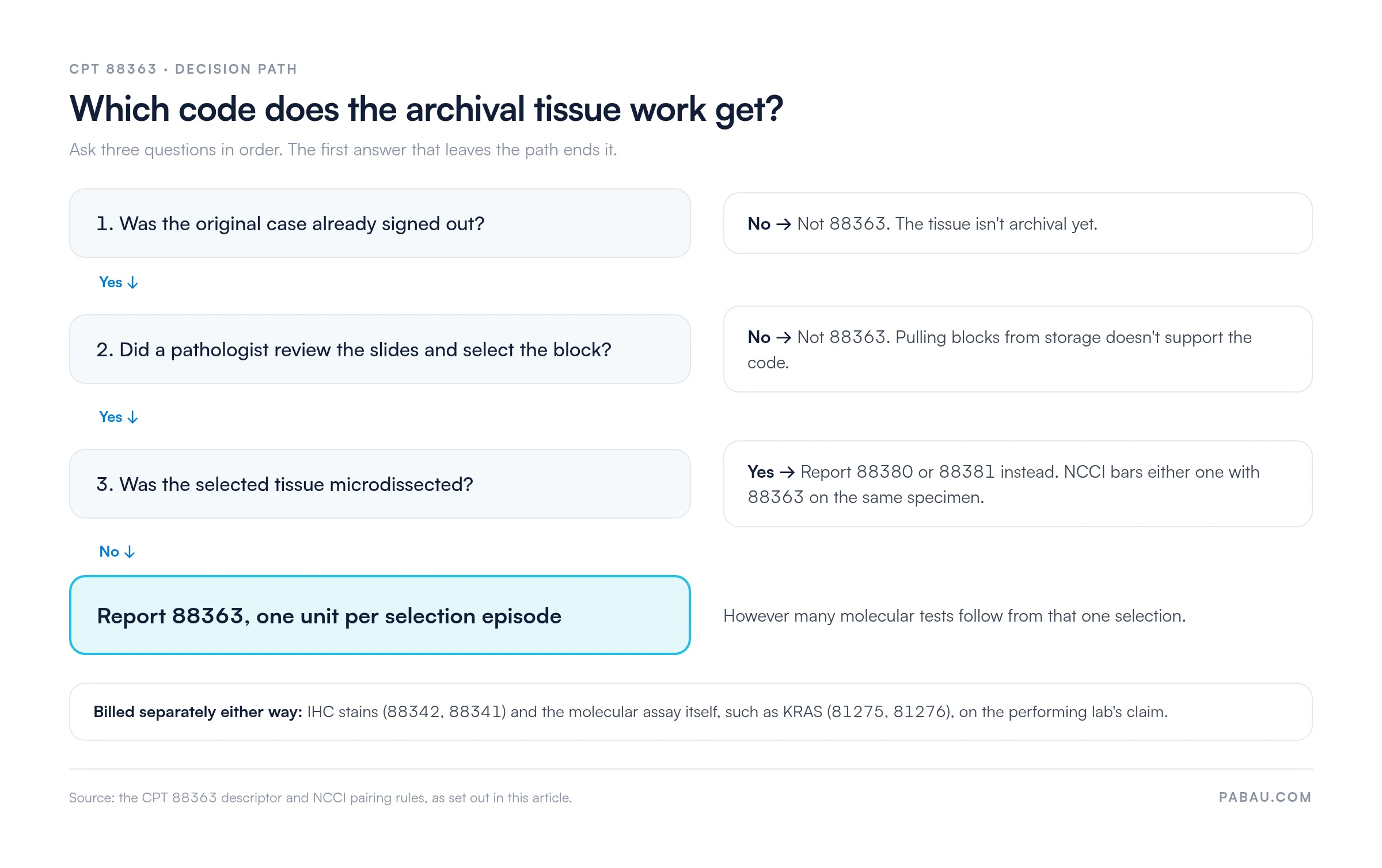
Retrieval is the line most often crossed. If a block was simply pulled and shipped to a reference lab, there was no selection, and the code doesn’t apply.
The same split works as three questions, asked in order. The first answer that leaves the path tells you 88363 isn’t the code to bill.
The claim only holds up if each step leaves a record. Here’s the usual path, from the oncologist’s order to the remittance.
Who sends the bill depends on setting. AAPC notes that an independent lab, place of service 81, is paid at the non-facility rate. A hospital supplying the technical support gets APC payment under the outpatient system instead. In general billing practice, the independent lab reports the line on the CMS-1500, while a hospital outpatient department uses the UB-04.
Picture a patient whose sigmoid colon resection was signed out eight months ago. The cancer has now spread to the liver, and the oncologist wants KRAS and NRAS status before choosing treatment.
Your pathologist pulls the case, reviews six slides and picks block A4, which holds about 60% tumor. The addendum names A4, the tumor estimate and the tests ordered. The block goes to the molecular lab, and the oncologist gets a note saying where it went.
On the claim, that is one unit of 88363 with C18.7 for the sigmoid primary and C78.7 for the liver metastasis. No IHC was done and nobody microdissected, so 88363 is the only pathology line. The reference lab bills its KRAS and NRAS codes on its own claim.
Run this list against the record before the 88363 line leaves your system. Each item answers a question a payer reviewer is likely to ask.
Medicare’s fee schedule doesn’t allow modifier 26 or TC on 88363, so the code can’t be split into professional and technical parts. AAPC’s coding alert spells this out, even though sectioning a block is technical work. That work is reflected in the higher non-facility rate.
Most rejected 88363 modifiers come from habit. Coders used to splitting surgical pathology codes like 88305 append 26 or TC by reflex, and the line comes back. Check the code’s current status in the CMS Physician Fee Schedule look-up tool each year, and use it for the rate in your locality too.
National Correct Coding Initiative (NCCI) edits pair 88363 with the microdissection codes 88380 and 88381. When the selected tissue is microdissected, report the most extensive service rather than both. Don’t add modifier 59 to force the pair through.
IHC is a different story. If the pathologist orders stains to confirm tumor type before selecting a block, those stains go under 88342 and 88341. They are never assumed into 88363.
The diagnosis on an 88363 line should explain why a gene test was needed. That almost always means a specific malignancy code, and often a secondary site when spread is what prompted the order.
Code to the highest specificity the record supports. A site-unspecified code such as C18.9 or C34.90 is valid, but it invites a records request when the resection report names the exact site. Check the molecular code with the performing lab too, because panel codes vary by assay.
When a denial does come back, sort it by its denial codes before you appeal. A modifier rejection needs a corrected claim, while a medical necessity denial needs the order and the pathologist’s note. Our guide to denial management in healthcare covers how to set that triage up.
Billing a code like 88363 often runs on handoffs. The order sits in one system, the pathologist’s addendum in another, and the claim gets keyed in by hand days later.
Pabau, the practice management platform we build, pairs the patient record with built-in claims management software. US practices send CMS-1500 and 837P claims through its Claim.MD integration. They can run eligibility checks before the claim goes out, so coverage questions surface early.
When the payer responds, ERA remittances come back into Pabau, and secondary claims go out from the same place. Your team reconciles each 88363 line against the remittance without switching systems. Your coders still choose the codes, and Pabau carries the claim from submission through ERA remittance.

Pabau sends US claims through Claim.MD, runs eligibility checks first and tracks every 88363 line from submission through ERA remittance.

Treat 88363 as a narrow code. It pays for one judgment call, choosing the right archived tissue for a gene test, and it pays once.
If you fix one habit, make the pathologist’s selection note non-negotiable. With that note on file, the units, the modifiers and the medical necessity questions mostly answer themselves. Without it, even a correctly coded line is hard to defend on audit.
Book a demo to see how Pabau sends your insurance claims through Claim.MD and tracks each one from submission through ERA remittance.

Want to see how a claim file is built? 837 file explained walks through the electronic claim format your 88363 line travels in.
Reading payer responses line by line? Electronic remittance advice (ERA) shows how to read 835 files and match adjustments to claims.
Coding the IHC that often comes first? CPT code 88342 covers the initial immunohistochemistry stain per specimen.
Trying to cut first-pass rejections? What is a clean claim explains what payers need to pay a claim on the first submission.
Reviewing slides for a second opinion? CPT code 88321 covers consultation and report on referred slides prepared elsewhere.
Yes, if there are separate selection episodes. A new order months later, for a different test or a different specimen, can support another unit. Several tests from one selection still get one unit.
88387 covers macroscopic examination, dissection and preparation of tissue for non-microscopic analytical studies, such as molecular tests, during the original case. 88363 applies only after that case is signed out and archived.
For the molecular test, Medicare’s archived-specimen rule usually sets the date the specimen was retrieved from storage, when it was stored more than 30 days. The 88363 date is the day the pathologist made the selection.
No. The code rests on a pathologist’s judgment in reviewing the case and choosing tissue. A technician pulling blocks can’t support it.
No. A consultation on referred slides uses 88321, 88323 or 88325. 88363 is limited to selecting tissue for molecular analysis.