

HCPCS Code Q4175: Billing, coverage, and documentation guide
HCPCS code Q4175: Code description and product identity HCPCS Code Q4175 is the ...

Last Updated: Nov 20, 2026
57505 is the CPT code for endocervical curettage not done as part of a dilation and curettage. It covers an ECC performed on its own, with no colposcopy at the same encounter.
Once a colposcope is used, the curettage moves into colposcopy code 57454 or 57456, and 57505 is not billed alongside either one. This reference covers the official descriptor, the procedure steps, neighboring codes, ICD-10 pairing, Medicare reimbursement and denial prevention.
Let Pabau's smart automation suggest the right codes, reduce claim denials, and keep your practice compliant—effortlessly.
Automate repetitive tasks and focus on what matters most—your patients.
Reduce coding errors and ensure compliance with the latest regulations.
Clean claims, fewer denials, and faster reimbursements.
Powerful insights and reporting to help your practice thrive.
HIPAA compliant SOC 2 certified GDPR-compliant Trusted by 4,000+ clinics worldwide

CPT code 57505 reports an endocervical curettage performed on its own, with no colposcopy or dilation and curettage at the same encounter.
Colposcopy codes 57454 and 57456 both include ECC in their descriptors, so 57505 is never billed with either one.
Modifier 59 or XS cannot unbundle 57505 from a colposcopy, because the curettage is part of the colposcopy code itself.
The ECC specimen goes to pathology, and the lab bills CPT 88305 on its own claim.
Pabau’s claims management software keeps the procedure note beside the claim and sends 57505 claims through the Claim.MD clearinghouse.
CPT Code 57505 is the code for “Endocervical curettage (not done as part of a dilation and curettage),” the official descriptor. It sits in the AMA’s CPT code set, which an editorial panel appointed by the AMA maintains.
The parenthetical is what makes the code specific. ECC performed as a standalone gynecologic procedure, with no colposcopy or D&C at the same encounter, falls under 57505.
The procedure sits in the Female Genital System subsection of CPT’s Surgery chapter (codes 56405-58999). It is classified as a minor surgical procedure with a 10-day global period. Post-operative care within those 10 days is included in the payment. OB-GYN practices and gynecologic oncology teams bill it most often.
Endocervical curettage is the scraping of tissue from the endocervical canal using a small curette. Clinicians perform it to sample cells that a standard speculum exam cannot show. The usual trigger is an abnormal Pap result, or clinical suspicion about the canal above the transformation zone.
Understanding the clinical steps helps coders confirm that documentation supports the standalone nature required by 57505.
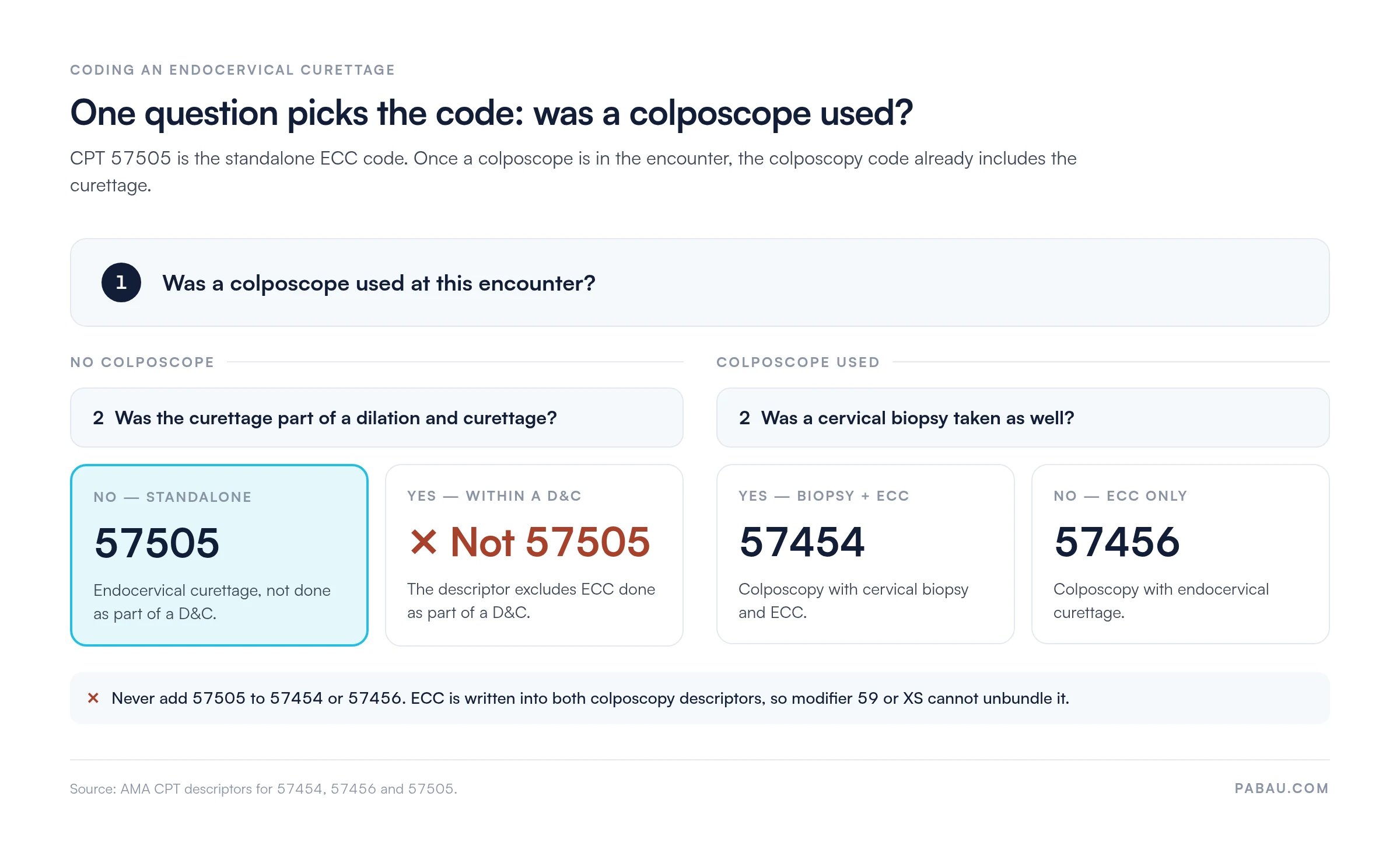
Once a colposcope enters the encounter, CPT 57505 is no longer the right code. Colposcopy code 57454 or 57456 takes over, and each one already includes the curettage.
The most common reason for CPT 57505 denials is billing it on the same date as a colposcopy code that already includes ECC. CPT 57456 is defined as “Colposcopy of the cervix including upper/adjacent vagina; with endocervical curettage.” The ECC is part of 57456, so billing 57505 on top of it trips an NCCI edit.
CPT 57454 reads “Colposcopy of the cervix including upper/adjacent vagina; with biopsy(s) of the cervix and endocervical curettage.” The ECC is written into that descriptor, just as it is in 57456.
A curettage done at a colposcopy is therefore never billed as 57505, with or without modifier 59 or XS. The chart below maps each encounter to its code.
A colposcopy with cervical biopsy but no curettage is reported with 57455, not 57454. That pairing still leaves no room for 57505, because no ECC was performed.
OB-GYN coders regularly see the 57454-57530 range together on encounter records. Each code maps to a distinct cervical procedure, and confusing them is a common audit trigger.
If a specimen comes from the endocervical canal and no colposcope was used, 57505 is the right choice. With a colposcope, the biopsy decides the code. Report 57454 when a cervical biopsy was taken along with the ECC, and 57456 when the ECC was the only sample. A loop electrode biopsy under colposcopy moves to 57460 instead.
The tissue collected during endocervical curettage almost always goes to pathology. Under current AMA pathology coding guidelines, the lab reports the ECC specimen with 88305. That code covers surgical pathology at level IV.
Important billing distinctions to know before submitting:
Before submitting a CPT 57505 claim, confirm with your lab whether they will bill 88305 or 88307 for the ECC specimen. When the surgical and pathology claims carry different diagnosis codes, a payer audit of both charges often follows.
Medicare assigns work relative value units and a facility/non-facility payment differential to CPT Code 57505 through the Medicare Physician Fee Schedule. Rates change every January 1.
Check current figures in the CMS Physician Fee Schedule search tool or a real-time RVU calculator such as FastRVU before you quote reimbursement.
Key reimbursement concepts for 57505:
Update the 57505 charge in your fee schedule each January. A charge carried over from last year can sit below the new Medicare allowance and leave money unbilled.
Every CPT 57505 claim needs at least one ICD-10 diagnosis code that establishes medical necessity. Payers, including Medicare and Medicaid, use Local Coverage Determinations (LCDs) and internal edits to check that the diagnosis justifies the procedure. The codes below are the ones most commonly accepted, and commercial payer policies may vary.
Always use the most specific ICD-10 code available. Z12.4 alone on a 57505 claim, with no abnormal finding or dysplasia code beside it, often triggers a medical necessity denial. A screening code does not by itself justify an invasive diagnostic procedure. For a diagnosis outside this table, the ICD-10-CM code reference covers the wider library.
Payers audit CPT 57505 claims for documentation that confirms the ECC was performed as a standalone, distinct service. A thin operative note is the second leading cause of denial after the bundling issue with 57456. Ensuring medical billing compliance starts with complete documentation at the point of care.
The procedure note for 57505 must include all of the following:
A clean claim submission for CPT 57505 depends on this documentation being in the note before the claim is generated. Adding it after a denial turns a first-pass payment into an appeal.
CPT 57505 denials follow predictable patterns, and each of the five below has a preventable root cause.
CMS introduced the X-modifiers (XE, XS, XP, XU) as more specific versions of modifier 59, the distinct procedural service modifier. They override an NCCI edit only when two services are separate procedures.
That never applies to 57505 at a colposcopy. Both 57454 and 57456 name endocervical curettage in their own descriptors, so the ECC is part of the colposcopy code itself.
Attaching 59 or XS to 57505 in that pairing bills the same curettage twice, which is an audit and compliance risk. Good denial management workflows track modifier patterns. A reflexive 59 on 57505 then surfaces in your own report before a payer finds it.
Run a quarterly report of every 57505 claim that carries modifier 59 or XS. Check each one for a colposcopy code on the same date of service, since that pairing should never reach a payer.
In a busy OB-GYN practice, the 57505 decision is made in the exam room and the claim is built later in billing. NCCI edit pairs change quarterly, and ICD-10 coverage criteria vary by payer. A biller working from a re-keyed charge slip cannot see whether a colposcope was used.
Pabau’s claims management software keeps the procedure note and the claim in one patient record. The biller reads the clinician’s note, including the line confirming no colposcopy, before coding the visit. Claims go out as 837P files through the Claim.MD clearinghouse, and remittances post back to the same record.
Note templates in Pabau can carry each element the 57505 note needs. That means the instrument, the specimen destination and the line stating that no colposcopy was performed.
With the note complete at the point of care, billers code the visit without chasing an addendum. The medical billing fundamentals guide follows the revenue cycle from encounter to payment.

Pabau’s claims management software keeps the procedure note beside the claim and submits 837P claims through the Claim.MD clearinghouse. Eligibility checks and remittances come back to the same patient record.

CPT 57505 gets paid when the note proves the curettage stood alone. One line saying no colposcope was used, plus a diagnosis that shows medical necessity, gives the claim what it needs.
The trade-off sits with the colposcopy codes. When a colposcope is in the room, 57454 or 57456 already pays for the ECC. Reporting 57505 on top adds audit risk without adding revenue. Book a demo to see how Pabau keeps the procedure note and the 57505 claim in one record.

Need a billing compliance framework for your OB-GYN practice? Medical billing compliance covers the documentation and audit controls that keep gynecologic procedure claims defensible.
Submitting claims through a clearinghouse for the first time? Claim.MD clearinghouse overview explains how the 837P workflow routes your claims to US payers.
Treating the cervix after an abnormal ECC result? CPT code 57511 covers cryocautery of the cervix, initial or repeat, and how to bill it.
CPT code 57505 covers endocervical curettage performed as a standalone procedure, not as part of a colposcopy or dilation and curettage. The clinician scrapes tissue from the endocervical canal with a curette to obtain a specimen for histologic examination. The usual reason is abnormal cervical cytology or dysplasia.
No. CPT 57454 and CPT 57456 both include endocervical curettage in their descriptors, so the ECC is already paid as part of the colposcopy. Billing 57505 with either code on the same date duplicates the curettage, and modifier 59 or XS does not unbundle it. Report 57505 only when no colposcopy was performed.
Medicare pays CPT 57505 from its relative value units, multiplied by the annual conversion factor and adjusted for geographic locality. The non-facility rate for an office setting is higher than the facility rate for a hospital or ASC. Rates update every January 1, so check current figures in the CMS Physician Fee Schedule search tool.
Most denials come from four causes. The first is billing 57505 on the same date as colposcopy code 57454 or 57456, which already include ECC. The others are a nonspecific diagnosis such as Z12.4 alone, a note silent on colposcopy, and a repeat ECC inside the global period. Pre-submission claim checks and a complete procedure note prevent each one.
Yes, in most cases. When the ECC specimen goes to an independent or hospital-based pathology lab, that lab bills CPT 88305 (Surgical Pathology, Level IV) separately. The performing clinician does not add 88305 to their surgical claim unless they personally perform the pathologic examination in-house. The operative note must document that the specimen was sent to pathology to support the companion lab charge.
CPT 57456 is colposcopy of the cervix with endocervical curettage, so the colposcopic exam and the ECC are reported together under one code. CPT 57505 is ECC performed entirely without colposcopy, as a standalone office procedure. Use 57456 when a colposcope was used during the encounter, and 57505 when the clinician performed ECC without colposcopic guidance.





