

CCSD code G5100: Bypass of duodenum billing guide
CCSD code G5100 bills a bypass that leaves the duodenum in place CCSD code G5100...

Last Updated: Oct 16, 2026
57452 is the CPT code for colposcopy of the cervix including upper/adjacent vagina.
It is the base colposcopy code. Use it when the physician examines the cervix and upper vagina under magnification but takes no tissue sample at that visit. A cervical biopsy moves the claim to 57455, endocervical curettage to 57456, and both together to 57454.
Let Pabau's smart automation suggest the right codes, reduce claim denials, and keep your practice compliant—effortlessly.
Automate repetitive tasks and focus on what matters most—your patients.
Reduce coding errors and ensure compliance with the latest regulations.
Clean claims, fewer denials, and faster reimbursements.
Powerful insights and reporting to help your practice thrive.
HIPAA compliant SOC 2 certified GDPR-compliant Trusted by 4,000+ clinics worldwide

CPT code 57452 covers colposcopy of the cervix and upper/adjacent vagina without biopsy or endocervical curettage.
Use 57455 when a cervical biopsy is taken, 57456 for endocervical curettage alone, and 57454 when both happen in the same session.
The paired ICD-10-CM code must reflect a documented indication, such as abnormal cytology, a positive high-risk HPV test, or confirmed dysplasia.
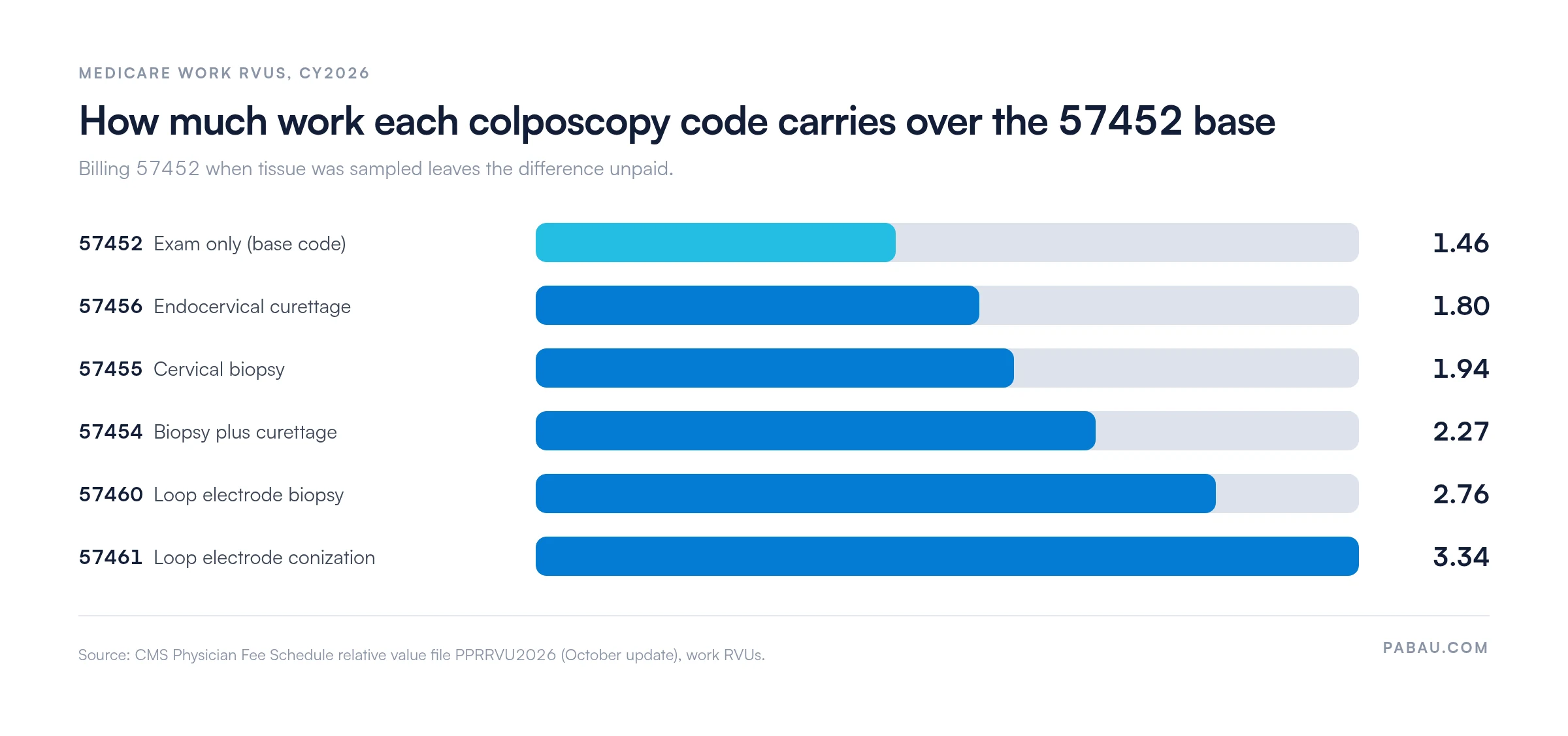
For CY2026, Medicare assigns 57452 1.46 work RVUs, the lowest value in the colposcopy family.
Pabau, the practice management platform we build, submits 57452 claims through Claim.MD and tracks each one to payment.
CPT code 57452 is defined by the American Medical Association as: Colposcopy of the cervix including upper/adjacent vagina. The code sits within the surgery section of the CPT code set, under the female genital system. It describes an examination-only colposcopy. The physician inserts a speculum, applies acetic acid to the cervix, and views the transformation zone under magnification. No biopsy forceps or endocervical curette is used.
The “including upper/adjacent vagina” language is deliberate. The code’s scope covers both the ectocervix and any immediately adjacent vaginal tissue the examiner evaluates during the same colposcopic session. A separate vaginal inspection code is not required or appropriate when the upper vagina is visualized as part of a standard cervical colposcopy.
A colposcopy under CPT code 57452 follows a defined clinical sequence. OB/GYN practices can build their note templates around these steps, so each required element is captured before the claim leaves the practice.
Auditors look for the biopsy decision first when they review a 57452 claim. Make the negative biopsy statement a required field in your note template.
CPT code 57454 is easy to confuse with 57452, but it requires both a cervical biopsy and endocervical curettage in the same session. A biopsy alone is 57455, and curettage alone is 57456. The colposcopic exam is identical across all four codes. Billing 57452 when tissue was sampled is undercoding. Billing 57454 when only one sampling procedure was done is overcoding and an audit risk.
A frequent error is billing 57452 after a biopsy because the pathology results are still pending. Code what was performed on the date of service, not what the results later show.
CPT code 57452 is the base examination code in a structured family of colposcopy and cervical procedure codes. Each higher code adds a procedure or changes the anatomical scope. Understanding the full family prevents both unbundling and missed charges.
Every colposcopy code from 57454 through 57461, 57455 included, contains the examination in 57452. The CMS fee schedule file lists 57452 as the endoscopic base code for all of them. Report one code per colposcopy session, the one that matches what was performed. Billing 57452 alongside 57454 or 57455 on the same date is an NCCI bundling violation.
Loop excision done without a colposcope is a separate procedure, reported as CPT 57522. Cold knife or laser conization is reported as 57520. Check current National Correct Coding Initiative edits before submitting any code pair, because CMS updates the edit tables quarterly.
The work values below show how much each added procedure is worth over the base exam.
Every CPT code 57452 claim requires a paired ICD-10-CM diagnosis code that establishes medical necessity. The diagnosis must match the indication documented in the note, not a presumptive or rule-out diagnosis. Use the AAPC CPT-to-ICD-10 crosswalk as a quick check, then confirm each code in the coder’s ICD-10-CM reference for the current fiscal year.
Payers often flag 57452 claims that carry Z12.4, the code for cervical cancer screening, instead of a specific cytology or dysplasia code. A screening code describes a routine visit, so it does not establish medical necessity for a diagnostic colposcopy.
HPV results need the same care. A positive high-risk HPV test is coded R87.810, while B97.7 is a secondary code that never goes first. For surveillance after treated CIN, Z09 with Z87.410 tells the payer why the patient is back.
Always list the most specific ICD-10-CM code available. If the cytology report reads ‘ASC-US,’ use R87.610 rather than a general abnormal Pap code. Specificity reduces payer scrutiny and supports medical necessity without an appeal.
Medicare covers CPT code 57452 under the Medicare Physician Fee Schedule (MPFS) when medical necessity is documented. Coverage is not automatic, because the diagnosis code on the claim must point to a recognized indication. For CY2026, CMS lists 57452 at 1.46 work RVUs, with 3.76 total RVUs in the office and 2.47 in a facility. Pull your local payment from the CMS Physician Fee Schedule Look-Up Tool before quoting figures to patients, since rates vary by locality.
The FastRVU 2026 RVU lookup tool breaks each code into work, practice expense, and malpractice RVUs. It also shows the calculated Medicare allowable by locality.
Denials for CPT code 57452 trace back to five root causes, and each one can be caught at charge entry. A working process for denial management in healthcare traces every rejected claim back to one of them.
Submitting a clean claim on the first attempt costs less than any appeal. Rework adds staff time, appeal letters, and payment delays, and on a 1.46 work RVU code that cost eats into a small payment quickly.
Most CPT code 57452 claims go out without a modifier. In the scenarios below one is needed, and using the wrong one, or leaving it off, leads to a denial or a payment reduction.
Modifier 59 abuse is a known audit target for CMS and commercial payers. Use XE (distinct encounter), XS (separate structure), XP (separate practitioner), or XU (unusual non-overlapping service) where they apply. They are more specific than modifier 59 and carry less audit risk.
CPT code 57452 comes up daily in OB/GYN and women’s health practices, so small fixes at charge capture pay off across many claims. Before you write a colposcopy billing protocol, review the medical billing compliance rules for gynecologic codes. The superbill workflow shows how to capture the charge at the point of care.
Review the AAPC’s colposcopy coding resources annually. The AAPC Codify platform provides code-specific guidance, bundling alerts, and payer policy references that complement your own billing checks.
The coding decisions above happen in the note and at charge entry. Getting the claim to the payer and knowing where it stands comes next. That is where billing teams lose time to payer portals and paper remittances.
Pabau connects to the Claim.MD clearinghouse, so its claims management software sends colposcopy claims electronically to thousands of US payers. Real-time eligibility checks run before the visit, so coverage problems surface before the procedure rather than after the denial.
Electronic remittance advice flows back into Pabau’s claims dashboard and is tied to the claim it settles. Your team sees which 57452 claims are paid, pending, or denied, and can correct a rejected claim while the procedure note is still fresh.

Pabau’s Claim.MD integration submits 57452 claims electronically, checks patient eligibility in real time, and brings remittance data back into one claims dashboard. See how OB/GYN teams follow each claim from submission to payment.

CPT code 57452 pays for looking, not sampling. Once a biopsy or curettage enters the note, the claim belongs to 57455, 57456, or 57454, and the exam code drops out.
The fixes cost far less than an appeal. Put the biopsy decision and the indication code into the note template. Code the date of service rather than the pathology result, and check the family’s NCCI edits each quarter.
Practices that build those three habits stop losing 57452 claims to avoidable errors. Book a demo to see how Pabau submits colposcopy claims and tracks each one to payment.

Need a complete billing framework for OB/GYN claims? What is revenue cycle management covers the end-to-end process from eligibility check to final payment posting.
Want to understand how clearinghouses validate claims before submission? Medical claims clearinghouse explains how payers receive and process electronic claims.
Looking for guidance on 837P and ERA workflows? Electronic remittance advice walks through how ERAs and 835 files work in practice.
Billing the HPV test that often comes before colposcopy? CPT code 87624 covers coding for high-risk HPV DNA testing.
CPT code 57452 is the procedure code for colposcopy of the cervix including upper/adjacent vagina, without biopsy or endocervical curettage. It applies when a physician examines the cervix and adjacent vagina under magnification and takes no tissue sample.
Yes, Medicare covers CPT code 57452 under the Physician Fee Schedule when the diagnosis code establishes medical necessity. For CY2026, CMS assigns it 1.46 work RVUs. Payment varies by locality, so check the CMS MPFS Look-Up Tool for your local rate.
The top reason is a screening code such as Z12.4 on a diagnostic colposcopy. NCCI bundling edits follow, triggered by billing 57452 with a higher colposcopy code on the same date. Notes that omit the biopsy decision and MAC frequency limits on repeat colposcopy cause the rest.
Reimbursement for CPT 57452 varies by payer, locality, and contract terms. For CY2026, Medicare lists 3.76 total RVUs in the office and 2.47 in a facility. The CMS Physician Fee Schedule Look-Up Tool converts those to your local rate. Commercial payer rates often differ from Medicare and vary by contract.
No. CPT 57452 is the base colposcopy code and is bundled into every higher colposcopy code (57454, 57455, 57456, 57460, 57461). Bill only the single code that reflects the procedure performed. Billing 57452 alongside any of these codes on the same date violates NCCI bundling rules and will be denied or recouped on audit. Check the current CMS NCCI edit files before submitting any code pair.



