ICD-10 Code S42.444P: Medial epicondyle fracture, right humerus
ICD-10 Code S42.444P: full descriptor and code validity ICD-10 Code S42.444P car...

Last Updated: Oct 13, 2026
Billable Code Specific Code
Z09 is the billable ICD-10-CM code for encounter for follow-up examination after completed treatment for conditions other than malignant neoplasm.
One rule decides most Z09 claims. The note has to state that treatment is complete. If the patient is still being managed, or the original diagnosis was cancer, a different code applies.
That distinction lands on the billing team more than on the clinician. Z09 tells a payer why a recovered patient is back in the room. A note that never says treatment ended is what turns the visit into a denial.
Below is what the code covers, how it differs from its neighbors, and the checks worth running before the claim goes out.
Let Pabau's smart automation suggest the right codes, reduce claim denials, and keep your practice compliant—effortlessly.
Automate repetitive tasks and focus on what matters most—your patients.
Reduce coding errors and ensure compliance with the latest regulations.
Clean claims, fewer denials, and faster reimbursements.
Powerful insights and reporting to help your practice thrive.
HIPAA compliant SOC 2 certified GDPR-compliant Trusted by 4,000+ clinics worldwide

Z09 is a billable ICD-10-CM code for a follow-up visit after completed treatment of a non-malignant condition, effective October 1, 2025 for FY2026
Use Z09 only when the note documents that treatment is finished, because active care takes the condition’s own code
Z08 covers cancer follow-up and Z09 covers every other completed treatment, so the two are never interchangeable
Pair Z09 with a history code from Z86.- or Z87.-, and never report it with an aftercare code from Z43-Z49 or Z51
Pabau’s claims management software includes a searchable ICD-10 code library and required-field checks, so a follow-up claim is complete before it goes out
Z09 is a billable, specific code, so it can stand on a claim without a more detailed child code beneath it. The FY2026 edition took effect on October 1, 2025 and runs through the fiscal year.
You will find it in the Z00-Z13 block of the ICD-10-CM code set, the block used for people encountering health services for examinations.
Two instructions travel with it in the tabular list. First, add the applicable history of disease code from Z86.- or Z87.- alongside Z09. Second, keep aftercare codes off the same encounter, because the code carries an Excludes1 note for them.
Z09 applies when a patient returns after treatment has ended, and when the condition treated was not a malignant neoplasm. Both halves have to be true. Encounters that typically qualify:
The tabular list gives you a useful test in its inclusion term: medical surveillance following completed treatment. If the visit is surveillance, Z09 fits. When any part of the visit is treatment, code the condition instead and leave Z09 for the next appointment.
Four questions settle which code an encounter needs, and only the last one lands on Z09.
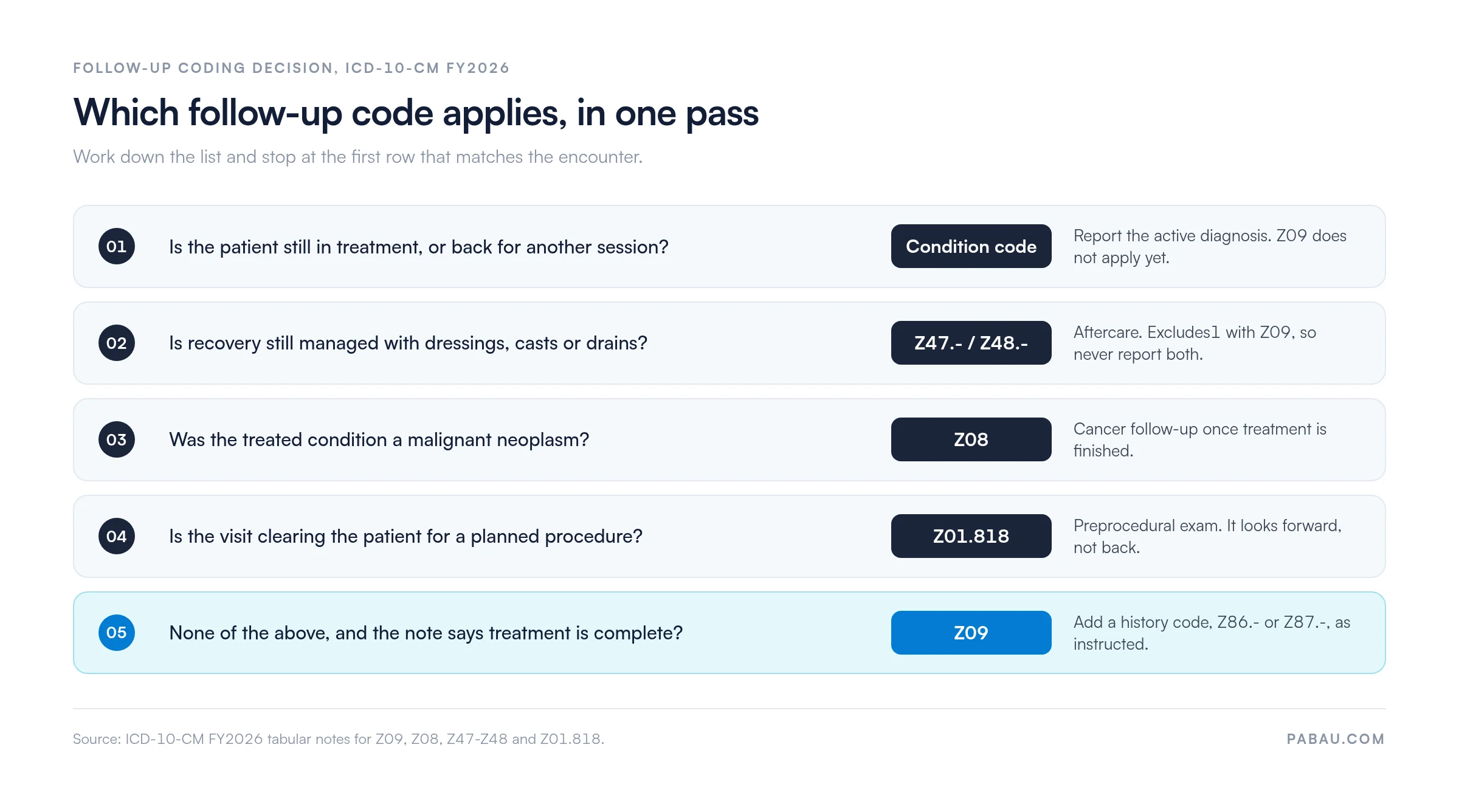
Only one factor separates the two codes, and that is whether the treated condition was cancer.
Z08 covers follow-up after completed treatment for a malignant neoplasm, and Z09 covers follow-up after every other completed treatment. Mixing them up is one of the most common denial triggers on post-treatment claims.
Both codes share the completed-treatment requirement, so the history is what you check. When the record is unclear, read the pathology documentation before you choose.
Never default to Z09 because Z08 feels uncertain, since a misfiled cancer follow-up costs you the claim and invites the audit.
Aftercare means somebody is still managing the recovery.
Z09 means the managing is over. The tabular list treats that as a hard rule rather than a preference. Z09 carries an Excludes1 note for aftercare following medical care (Z43-Z49, Z51), and Excludes1 means the two codes never appear on the same encounter.
Aftercare (Z47.-, Z48.- and related codes). The condition has been treated, but the patient still needs clinical attention to heal. Wound dressing changes, drain management, cast care, and therapy coordination during recovery all sit here. Treatment has moved into a support phase rather than stopped.
Follow-up (Z09). The patient has finished treatment and aftercare. They come back so somebody can confirm resolution, review surveillance results, or rule out further treatment. The visit is evaluative rather than therapeutic.
Sequencing follows the timeline. Aftercare codes come first, then Z09 once the aftercare stops. If the phase is genuinely unclear, the discharge summary and the most recent provider note usually settle it in under a minute.
Z01.818 (Encounter for other preprocedural examination) gets confused with Z09 because both show up around a procedure. They do opposite jobs, and swapping them changes how the visit is paid.
One question sorts them out. Is the visit looking back at treatment that finished, or forward to a procedure that has not happened? Backward is Z09. Forward is Z01.818.
A Z09 claim stands or falls on one line in the note, a statement that treatment for the original condition has ended. Medicare and commercial payers both want to see it before they accept a follow-up code.
Records also have to be accurate and retrievable on audit, which is where HIPAA-compliant documentation practices and coding accuracy overlap.
The record supporting Z09 should carry all five of these:
Some payers ask for more than the baseline ICD-10-CM guidelines. Check the local coverage determination (LCD) or the plan’s own policy first.
Solid medical billing compliance habits keep post-payment audits short, and they make a repeat request for records much less likely.
Before you assign Z09, look for the phrase ‘treatment complete’ or an equivalent attestation in the provider’s note. If it is not there, send the record back for clarification before you submit. A missing completion statement is the most avoidable Z09 denial there is.
Most Z09 encounters are outpatient office visits, so the CPT partner is usually an established-patient E/M code between 99211 and 99215.
The level follows the medical decision-making documented in the note. A visit does not drop to 99212 simply because it was a follow-up.
Check pairing rules against the AAPC’s ICD-10-CM lookup and your payer’s crosswalk policy. Building the superbill at checkout, with the code pair already attached, saves the coder from rebuilding the encounter days later.
Medicare pays for follow-up encounters coded with Z09 under fee-for-service when the documentation supports medical necessity.
Rules vary by Medicare Administrative Contractor (MAC) jurisdiction, so confirm the LCD for your region on the CMS ICD-10 codes page. Medicare Advantage plans set their own terms, and those often differ from fee-for-service.
Commercial payers usually follow CMS guidance, then layer their own medical necessity criteria on top. Four points to watch:
Running insurance eligibility verification before the visit confirms the plan is active and the service type is covered.
For submission, practices using Pabau’s Claim.MD clearinghouse integration reach thousands of US payers electronically. Remittance advice comes back quickly too, which surfaces a coverage problem while it is still fixable.
A Z09 claim travels the same road as any other office visit. Reception books the follow-up, the provider documents it, and the coder assigns Z09 with its history code.
From there the clearinghouse forwards the claim, and the payer answers with a remittance. Almost all of the trouble starts in the two minutes between the note and the submission.
So run these five checks while the encounter is still open:
A second lookup against a public database such as ICD List takes seconds and catches a transposed character. The rest of the claim follows the route every visit takes, which our guide to medical billing walks through from encounter to payment.
Z09 denials cluster around the same short list. A working denial management workflow catches them before submission instead of after the remittance.
When the same reason keeps coming back, look at the pattern rather than the single claim. A review of your revenue cycle management process shows where follow-up denials are piling up and what they cost each month.
Audit your Z09 and Z08 claims monthly by pulling the remittance codes. CARC 96 (non-covered charges) and CARC 97 (the benefit is included in another service’s payment) catch most follow-up misassignments while they are still correctable.
These codes turn up in the same workflows as Z09, and each one does a job Z09 cannot.
A follow-up visit arrives in the calendar as an ordinary appointment. The coder opens the encounter and reaches for a diagnosis code.
Without a set routine, it is easy to default to a familiar code, hesitate between Z09 and Z08, or forget the history code. None of that shows up until a remittance lands weeks later.
Practice management software like Pabau does not make the coding decision for you, and no software should. What it removes is the friction around the decision.
Pabau’s claims management module carries a searchable ICD-10 code library, so your coder finds Z09 and its history codes without leaving the encounter. It also checks that the fields a claim needs are filled in before anyone hits submit.
After that, electronic remittance advice comes back through the clearinghouse with the denial reason at CARC level. Your billing team can then correct and resubmit without phoning the payer.
Across a month of follow-up visits, that is the difference between a clean claim rate you can report on and a rework queue nobody owns.
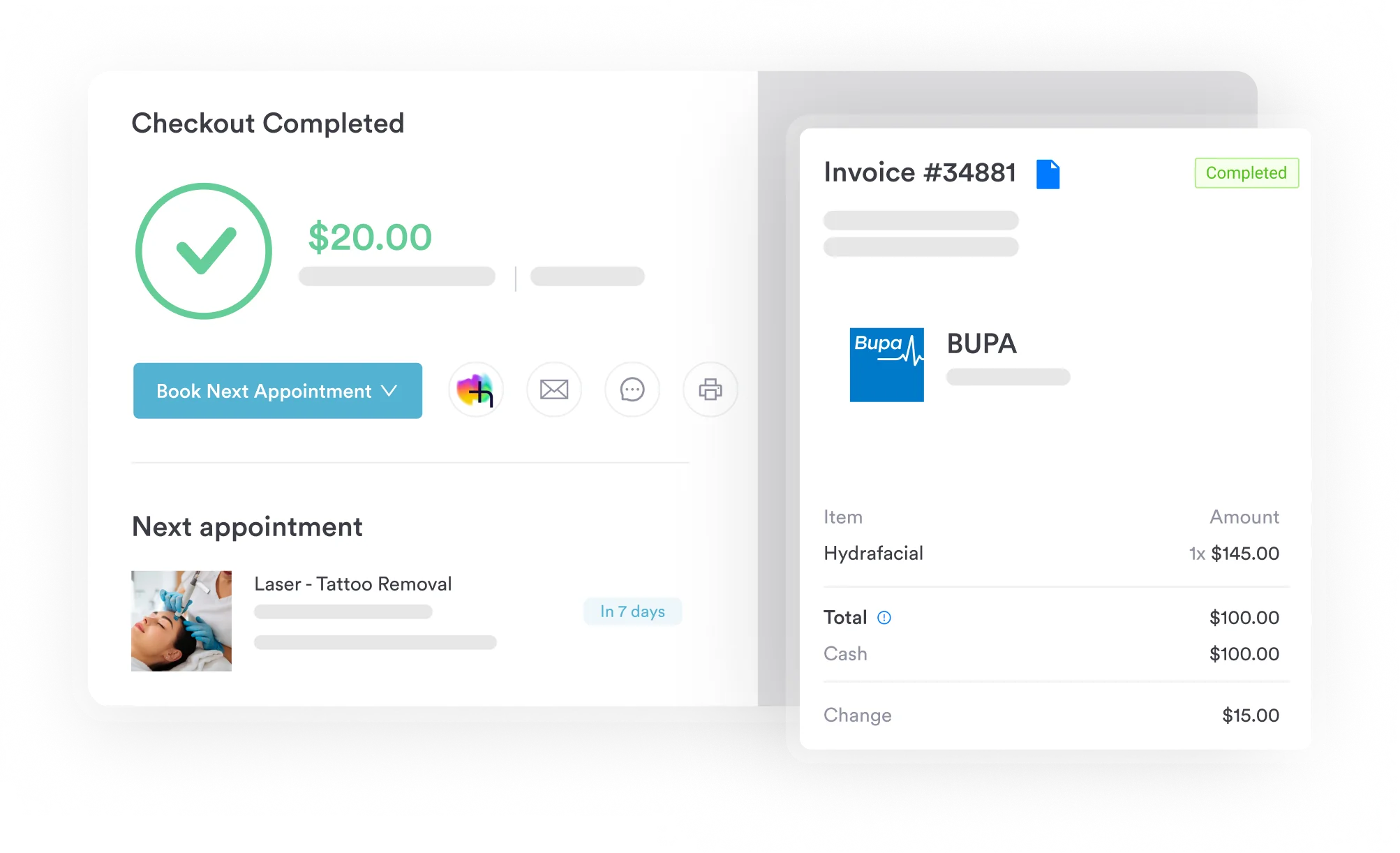

Pabau’s built-in ICD-10 code library helps your team find the right follow-up code without leaving the encounter. Required-field checks then flag an incomplete claim before it reaches a payer.

Z09 comes down to three questions. Is treatment finished? Was the condition non-malignant? Does the note say so in writing? Three yeses make Z09 the right code, and one no sends you elsewhere in the Z chapter.
Keep the history code in the habit as well. It is the instruction coders skip most often on a Z09 claim, and adding Z86.- or Z87.- costs nothing while the encounter is still open.
Practices with low follow-up denial rates tend to share one habit. The check happens before submission, not after a remittance comes back.
Pabau’s claims management software handles the mechanical half of that, from the code library your coder searches to the completeness check on the claim itself. Book a demo to see how a follow-up visit moves from note to submitted claim.

Need a compliant framework for billing post-treatment encounters? Revenue cycle management explained covers how claims flow from encounter to payment and where coding errors compound into revenue loss.
Unsure whether your claims meet clean-claim standards before submission? Clean claim submission guide outlines exactly what payers check before processing a diagnosis code claim.
Want to understand how clearinghouse integrations handle Z09 claims? Claim.MD clearinghouse overview explains how electronic claim routing and ERA delivery work for follow-up encounters.
No. Z09 is post-treatment surveillance for a condition that was treated, so it is tied to that history. A routine annual physical with no abnormal findings is Z00.00 instead. Plans usually apply preventive benefits to Z00.00, not to Z09.
ICD-10-CM sets no time limit. The code depends on the documentation, not the calendar, so a check two years later still qualifies if treatment is complete. Payers are stricter. Many cap how many follow-up visits they cover in a period, so check the plan’s frequency rules.
No. Modifiers attach to CPT and HCPCS procedure codes, never to an ICD-10 diagnosis code. If a payer asks for a modifier on a follow-up visit, it belongs on the office visit line, not on Z09.
Yes, once treatment is finished and the patient has recovered. Report Z09 with Z86.16 for personal history of COVID-19. If symptoms are still being managed, the patient is not in follow-up yet, so code the ongoing condition instead.
Yes. Z09 describes why the patient came in, not who saw them. A brief nurse-led check such as a suture removal supports Z09 with 99211, provided the note records completed treatment and the reason for the visit.