CPT code 28008: Fasciotomy, foot and/or toe
What is CPT code 28008? CPT code 28008 is the surgical code for a fasciotomy per...

Last Updated: Oct 19, 2026
57460 is the CPT code for colposcopy of the cervix including upper/adjacent vagina; with loop electrode biopsy(s) of the cervix. It applies when the clinician examines the cervix under magnification and removes targeted tissue with a wire loop electrode in the same session.
Its closest neighbors are 57454, which uses punch biopsy with endocervical curettage, and 57461, which excises the whole transformation zone. The procedure note's description of the instrument and the excision scope decides which code fits.
Let Pabau's smart automation suggest the right codes, reduce claim denials, and keep your practice compliant—effortlessly.
Automate repetitive tasks and focus on what matters most—your patients.
Reduce coding errors and ensure compliance with the latest regulations.
Clean claims, fewer denials, and faster reimbursements.
Powerful insights and reporting to help your practice thrive.
HIPAA compliant SOC 2 certified GDPR-compliant Trusted by 4,000+ clinics worldwide

CPT code 57460 describes colposcopy of the cervix including upper/adjacent vagina with loop electrode biopsy(s) of the cervix.
57460 is distinct from 57454 (punch biopsy with ECC) and 57461 (excision of the full transformation zone).
ECC performed at the same session can be billed separately as 57505 when documented as a distinct procedure.
Pabau’s claims management software validates each claim before submission, so a 57460 claim with a missing diagnosis or wrong place of service is caught early.
CPT code 57460 reports a colposcopy of the cervix and upper or adjacent vagina during which the clinician takes one or more loop electrode biopsies. The official descriptor in the AMA’s CPT code set.
The official descriptor reads: Colposcopy of the cervix including upper/adjacent vagina; with loop electrode biopsy(s) of the cervix.
Two elements define what 57460 covers. First, the visualization component: colposcopic examination of the cervix and upper or adjacent vaginal walls. Second, the tissue removal component: one or more loop electrode biopsies of the cervical tissue.
Both must occur at the same session for 57460 to apply. A procedure note template that prompts for both elements makes the code easy to defend on audit.
The code falls under CPT range 57452-57465 (Endoscopy Procedures on the Cervix Uteri). Within that range, 57452 is the base colposcopy with no biopsy, and 57460 adds the loop electrode biopsy to it.
It is a surgical CPT code, not an evaluation and management code. It carries its own relative value units (RVUs), separate from any office visit billed on the same date.
The procedure begins with the patient in the lithotomy position. The clinician applies acetic acid (and sometimes Lugol’s iodine) to the cervix to highlight abnormal tissue. The colposcope then magnifies the transformation zone, ectocervix, and adjacent vaginal fornix for inspection.
When an area of abnormal acetowhite change, vascular atypia, or visible lesion is identified, the clinician uses a loop electrode to excise the targeted tissue.
The loop passes an electrical current through a thin wire loop, which cuts and coagulates simultaneously. Unlike a punch biopsy, the loop removes a larger and deeper core of tissue, making it both diagnostic and potentially therapeutic.
Clinical indications that justify 57460 include:
Scope is what separates 57460 from conization, which is billed as 57522. CPT 57460 removes a biopsy specimen from a discrete lesion. It does not remove the entire transformation zone. When the goal is full transformation zone excision for treatment of confirmed CIN, CPT 57461 or 57522 applies instead.
These four codes cover the colposcopy-to-excision spectrum for cervical procedures. Picking the wrong one is a common cause of denials in this code family.
57460 vs 57454: The defining difference is the instrument. CPT 57454 uses a punch biopsy forceps and bundles ECC into the code. CPT 57460 uses a loop electrode and does not include ECC. If the procedure note describes a punch biopsy and endocervical curettage, 57454 is correct. If it describes a loop biopsy without ECC, 57460 is correct.
57460 vs 57461: CPT 57461 is LEEP of the transformation zone, which means the entire transformation zone is removed as a therapeutic excision. CPT 57460 removes a targeted biopsy specimen from a discrete area. Using 57460 when the operative note describes full transformation zone removal understates the procedure and leads to underpayment.
Read the procedure note in two passes, instrument first and scope second, and the right code follows.
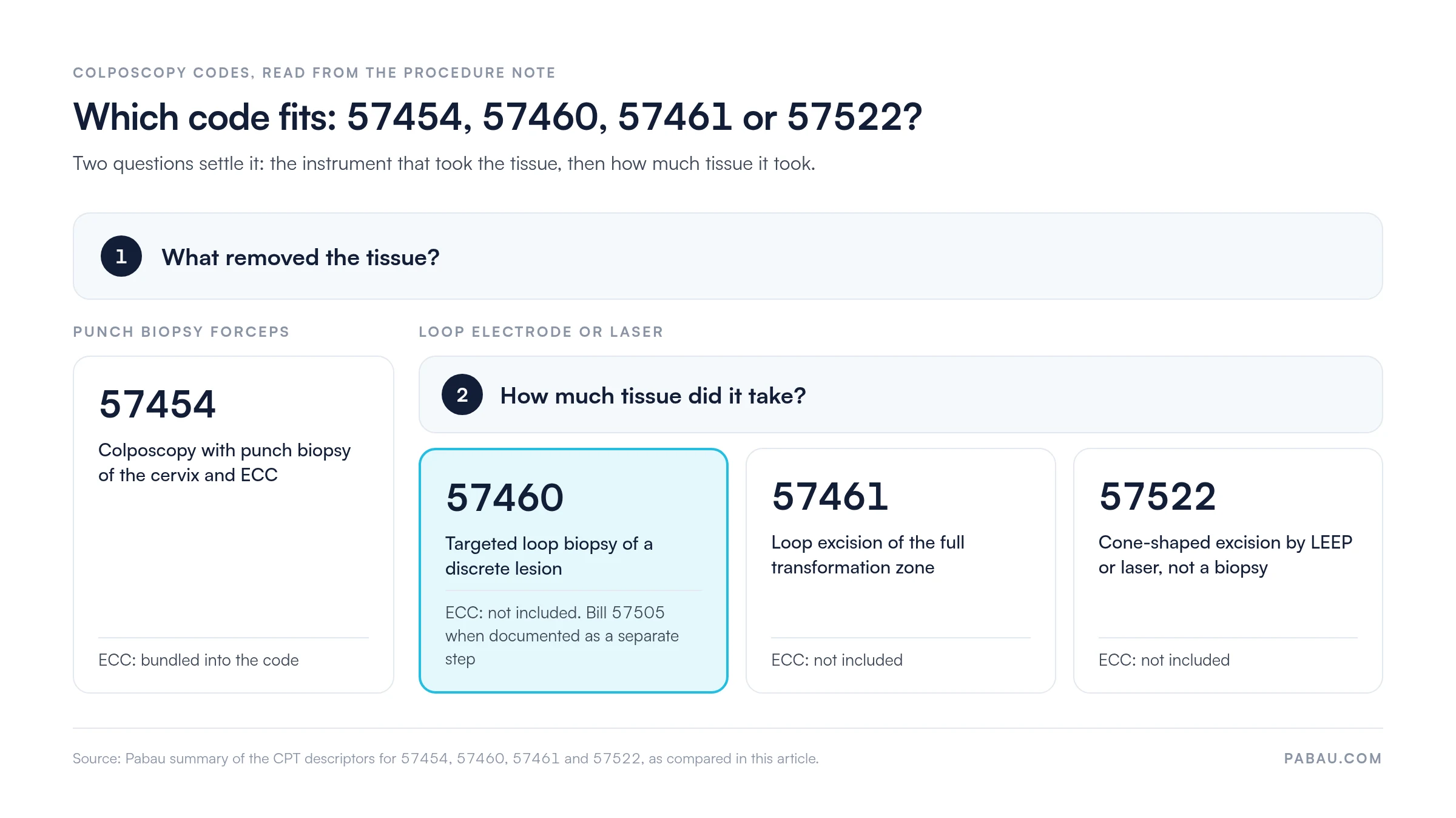
Check the procedure note for two things before choosing between 57460 and 57461. (1) Does the note specify loop electrode biopsy of a discrete lesion, or excision of the transformation zone? (2) Does the pathology requisition label the specimen as a biopsy or a LEEP specimen? When the operative note is ambiguous, the specimen label often settles the intent.
Every CPT 57460 claim requires a supporting ICD-10 diagnosis code that establishes medical necessity. Payers will not reimburse a loop biopsy performed without a documented clinical indication in the diagnosis field.
Z12.4 alone is not sufficient to justify a loop biopsy on most payer policies. Combine it with a finding code (R87.619, N87.x) that explains why the colposcopic biopsy was necessary.
Payers apply local coverage determination (LCD) criteria, and a claim submitted with only a screening code risks automatic denial for lack of medical necessity.
Medicare reimbursement for CPT 57460 varies by place of service and geographic locality. The CMS Physician Fee Schedule lookup tool provides current national and locality-adjusted rates. Use the tool with the current fiscal year and your MAC jurisdiction to get accurate figures.
Before submission, check that the place-of-service code on the claim matches where the procedure happened. That check catches the POS mismatches behind facility versus non-facility rate disputes.
Commercial payer rates are negotiated separately and typically exceed Medicare rates, so verify each payer contract for the contracted allowed amount.
Practices should also confirm that the claims management software they use supports real-time eligibility checks before the procedure. Some commercial plans require prior authorization, and a missing one turns an otherwise correct claim into an automatic denial.
A compliant procedure note supporting CPT 57460 must contain all of the following elements. Missing any one of them is enough for a payer to downcode or deny the claim on audit.
Modifier usage is required in specific same-session scenarios. When 57460 is billed with another distinct gynecologic procedure at the same encounter, append modifier 59 to the separately billable code.
Modifier XS (separate structure) also works. Do not append a modifier to 57460 itself; attach it to the additional code to signal distinct procedural identity. Consult the CMS coding and billing guidelines and your payer’s NCCI edit policy before finalizing same-session claim submissions.
A note template built around these six elements makes each 57460 claim far easier to submit as a clean claim on the first pass.
A colposcopy encounter often includes more than the loop biopsy, so same-session rules decide what else goes on the claim. Misread them and the practice either overbills or leaves payment on the table.
When ECC is performed alongside a loop biopsy, verify the procedure note explicitly states the ECC was a separate, distinct step before appending 57505. If the note only mentions ‘curettage’ and never separates it from the loop biopsy, payers will bundle it and deny 57505. A two-line entry in the operative note for each procedure reduces this risk.
Denials on CPT 57460 cluster around five root causes, and each one can be caught before the claim leaves the practice.
On appeal, the strongest supporting documents are the operative note, the pathology requisition, and the signed consent form. Add the prior Pap smear or cytology report that established the indication. Submit all four proactively on any denial citing medical necessity.
Medicare does not require prior authorization for CPT 57460 under standard fee-for-service coverage, but Medicare Advantage plans operate under different rules. Check each MA plan’s authorization requirements before scheduling the procedure, through the plan’s provider portal or its authorization line.
Commercial payers vary significantly. Select Blue Cross Blue Shield plans, Humana, and certain Medicaid managed care organizations require prior authorization for colposcopy with loop biopsy.
That is most likely when the indication is CIN 1 or a prior colposcopy took place in the same plan year. Verify authorization requirements using the AAPC code lookup as a reference alongside the specific payer’s LCD or coverage policy document.
Medical necessity can be uncertain for some Medicare patients, such as a low-risk patient whose indication is CIN 1. In that case, consider issuing an Advance Beneficiary Notice (ABN) before the procedure.
An ABN protects the practice from writing off the procedure cost if Medicare denies on medical necessity grounds. It also lets the patient proceed knowing they may be financially responsible.
In many OB/GYN practices, the colposcopy note lives in one system and the signed consent in a scanned file. The claim then goes out from a separate billing tool. Every handoff is a chance to drop the finding code or the place of service.
Pabau, the practice management and billing platform we build, keeps those steps on one patient record. Treatment note templates can prompt for loop passes, clock-face locations, and specimen labels. Digital consent forms are signed and stored against the same record.
When the claim goes out, Pabau’s claim validation flags errors before the payer bounces it back. Prior authorization codes sit with the patient’s case, and each claim is tracked from pending to paid. Your billing team spends less time on appeals and more on clean first submissions.

Pabau’s claim validation and claims tracking help OB/GYN practices submit colposcopy claims with the right diagnosis codes and place-of-service data the first time.

Code 57460 from the procedure note, not from memory. If the note names a loop electrode and a discrete lesion, 57460 fits. If it describes removing the whole transformation zone, the claim belongs to 57461.
The bigger risk sits around the code. A screening-only diagnosis, an ECC nobody documented as separate, or the wrong place of service can sink a correctly chosen 57460. Fix those once in the note template, and every colposcopy claim after it inherits the fix.
Book a demo to see how Pabau keeps colposcopy notes, consent forms, and claims on one record for your OB/GYN practice.

Need to understand how clearinghouses handle colposcopy claims? Medical claims clearinghouse overview covers how claims move from practice to payer and where edits fire.
Want to reduce denials across your entire OB/GYN billing workflow? Medical billing fundamentals explains the end-to-end revenue cycle process relevant to gynecologic practices.
Checking IVF or other gynecologic CPT codes? IVF CPT codes covers the reproductive medicine procedure code set alongside documentation requirements.
Planning around payer authorization rules? The prior authorization process walks through each step practices take before a procedure like 57460.
CPT code 57460 reports colposcopy of the cervix including upper/adjacent vagina with a loop electrode biopsy of the cervical tissue. It applies when the clinician performs both the colposcopic examination and the loop biopsy at the same session. The usual trigger is abnormal cervical tissue found on a prior Pap smear or HPV co-test.
CPT 57454 uses a punch biopsy and bundles endocervical curettage (ECC) into the code. CPT 57460 uses a loop electrode biopsy and does not include ECC, which can be billed separately as 57505 when performed. If the operative note describes a punch biopsy with curettage, 57454 is correct. If it describes a loop electrode biopsy without ECC, 57460 is correct.
No, CPT 57460 does not include ECC. ECC can be billed separately using CPT 57505 when it is performed and documented as a distinct, separately performed step during the same encounter. This differs from CPT 57454, where ECC is bundled and not separately reportable.
Generally, no. Billing both 57460 (targeted loop biopsy) and 57461 (loop excision of the full transformation zone) at the same session conflicts with standard NCCI edit policy. The visualization component is bundled into both codes. If LEEP of the transformation zone was performed, 57461 is the correct single code. Check the current NCCI edit table for the code pair before submitting.
The most commonly paired ICD-10 codes are R87.619 (abnormal cytological findings, cervix), N87.1 (CIN 2), N87.0 (CIN 1), and B97.7 (HPV as the cause). Pair a screening-only code such as Z12.4 with a finding code rather than submitting it alone. Routine screening without a documented abnormal finding typically does not meet medical necessity for loop biopsy.
Most 57460 denials trace to five causes. The wrong code was selected, such as 57454 or 57461 in place of 57460. The ICD-10 code does not support medical necessity, as with Z12.4 alone. An NCCI bundling edit fired because 57420 was billed alongside 57460. Or the place of service does not match the actual site, or a commercial or Medicaid managed care plan needed prior authorization. On appeal, submit the operative note, pathology requisition, and prior cytology report.