HCPCS Code L0472: Hyperextension TLSO billing guide
HCPCS code L0472: Official descriptor and device definition HCPCS code L0472 des...

Last Updated: Nov 5, 2026
K0039 is the HCPCS Level II code for leg strap, H style, each. It covers one H-style wheelchair leg strap, and each strap is billed as one unit.
K0039 sits next to K0038, which covers a standard leg strap. Both codes bill per strap, so the strap's style decides which one you use. Medicare pays K0039 under the DMEPOS benefit when the record supports the medical need.
Let Pabau's smart automation suggest the right codes, reduce claim denials, and keep your practice compliant—effortlessly.
Automate repetitive tasks and focus on what matters most—your patients.
Reduce coding errors and ensure compliance with the latest regulations.
Clean claims, fewer denials, and faster reimbursements.
Powerful insights and reporting to help your practice thrive.
HIPAA compliant SOC 2 certified GDPR-compliant Trusted by 4,000+ clinics worldwide

K0039 is billed per strap: one H-style leg strap is one unit, so two straps are billed as two units.
K0038 and K0039 differ by strap style, not quantity. K0038 is a standard leg strap and K0039 is the H-style version.
Medicare Part B covers K0039 when medical necessity is documented. KX is required when the applicable LCD or billing article says so, so verify it for your DME MAC jurisdiction.
Check the current allowable in the CMS DMEPOS fee schedule for your state before billing, because rates change every year.
Pabau’s claims management software helps you track K0039 claims and their supporting documents from submission to payment.
HCPCS code K0039 is the HCPCS Level II code for one H-style leg strap used on a wheelchair.
Its official descriptor is Leg strap, H style, each. It sits in the K0001–K0195 range for wheelchairs, components, and accessories.
K codes are temporary national codes that CMS created for the DME Medicare Administrative Contractors (DME MACs). CMS updates them through the HCPCS Level II files listed on CMS’s HCPCS overview. Coders new to DME claims can start with our guide to medical billing fundamentals.
The AAPC’s K0001–K0195 code range and the PGM Billing HCPCS tool both let you verify a descriptor for free. Checking K0039 there before a claim drops confirms the strap style and catches adjacent-code errors early.
K0039 covers one H-style leg strap for a manual or power wheelchair. The strap positions and secures the user’s lower legs during wheelchair use. Its H-style design is what separates it from a standard leg strap, so confirm the style against the manufacturer’s product description before you code it.
Covered scenarios: An H-style leg strap dispensed as a separately billable wheelchair accessory, either with a new chair or as a replacement. Each strap is one unit.
Not billed under K0039: A standard, non-H-style leg strap, which goes under K0038. Straps that are part of a seating system billed under a different code. Accessories already bundled into the base wheelchair code.
K0038 and K0039 are both billed per strap. The difference is the strap’s style: K0038 is a leg strap, each, and K0039 is an H-style leg strap, each. Neither descriptor describes a pair, so quantity never decides which code you pick.
Code from the product, not the count. Two H-style straps dispensed on the same date are two units of K0039 on one claim line. Splitting identical straps across two lines for one date can trip a duplicate-claim edit. Combine them into one line with the right unit count. The three checks below follow the order a coder works through a strap claim.
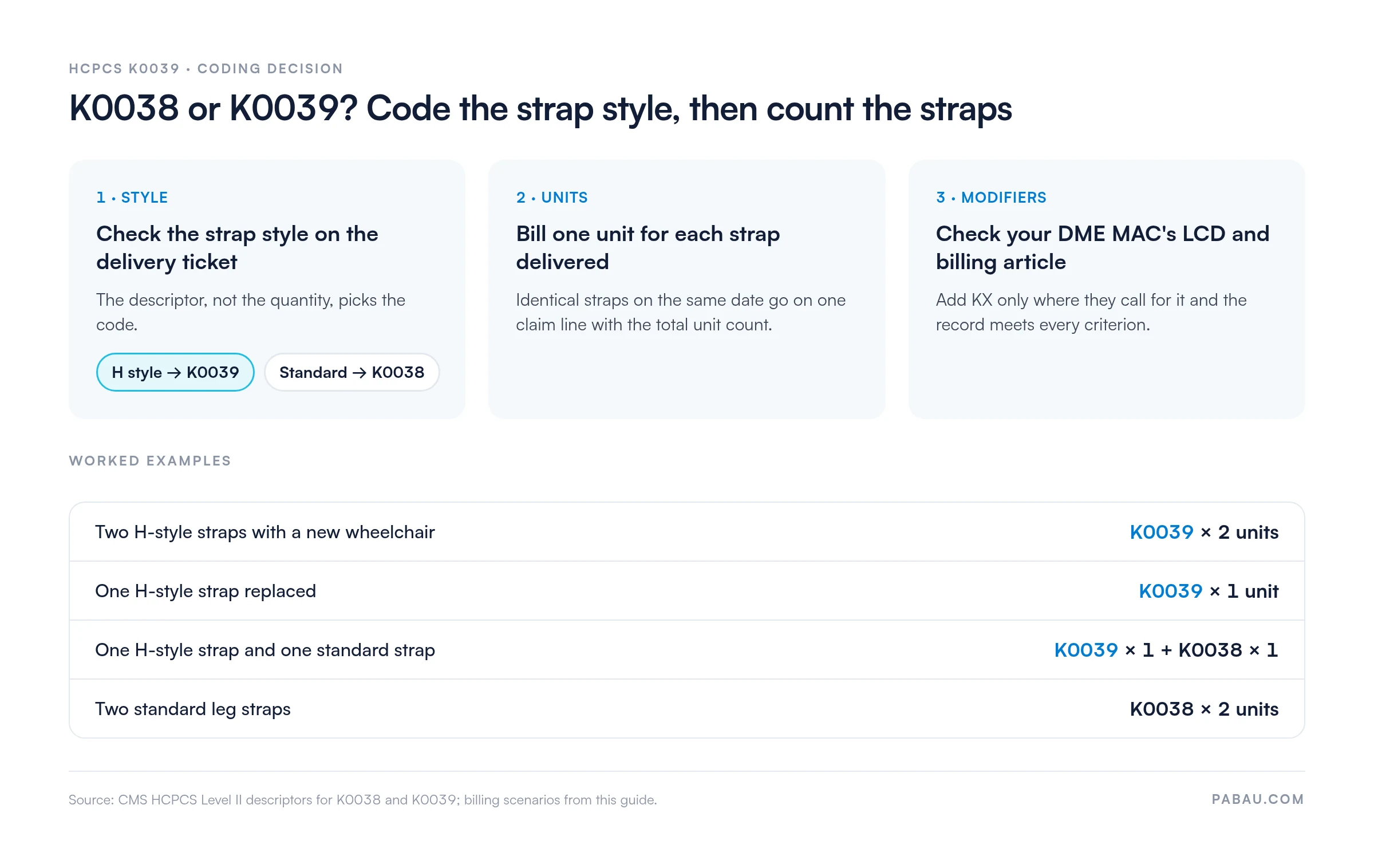
These common delivery scenarios show how style and count translate into codes and units.
K0039 sits within a broader family of wheelchair accessory K codes. Coders dispensing multiple accessories in a single encounter should verify that none overlap or bundle with K0039. Replacement swing-away footrests, for example, bill separately under K0052. Each neighboring descriptor can be checked in our HCPCS reference for coders.
Medicare Part B covers K0039 as a DME accessory when the item is medically necessary for the beneficiary’s condition. The treating practitioner must also document that need.
Coverage is governed by Local Coverage Determinations (LCDs) issued by the applicable Medicare Administrative Contractor (MAC). Noridian and CGS administer the DME MAC jurisdictions, and each publishes the wheelchair accessory LCDs for its regions. Always verify the LCD in effect for your jurisdiction before billing, as criteria are updated periodically.
General Medicare medical necessity criteria for wheelchair accessories such as K0039 typically include:
Ensuring DME billing compliance starts with verifying which MAC LCD applies to the claim before submission.
Before billing K0039, pull the wheelchair accessory LCD and its billing article from your DME MAC, Noridian or CGS. Match your documentation to the positioning language they use, and keep a jurisdiction-to-LCD reference chart in your billing workflow.
CMS and individual MACs require specific documentation to support a K0039 claim. Missing or incomplete records are a leading cause of denials and post-payment audits. The documentation set for submitting a clean claim for HCPCS code K0039 generally includes all of the following:
Retain all documentation for at least seven years. Recovery Audit Contractors (RACs) and Unified Program Integrity Contractors (UPICs) routinely target DME claims in post-payment audits. K0039 claims without contemporaneous physician orders are at high risk of recoupment.
As of the most recent CMS Prior Authorization for Certain DMEPOS Items list, K0039 is not among the accessories requiring mandatory prior authorization. However, this list changes and some payers impose prior authorization requirements independently of the CMS program. Always verify current PA requirements with the applicable MAC and any secondary or commercial payer before submission.
CMS publishes allowable amounts for K0039 in the DMEPOS fee schedule, which it updates at least once a year. Rates vary by state, by rural or non-rural area, and by whether the beneficiary lives in a competitive bidding area (CBA). No dollar rate is cited here because the allowable changes with each update.
To look up the current K0039 allowable:
Key rate distinctions to understand: The fee schedule rate is per unit, so two H-style straps pay at two units. Accessories generally follow the payment method of the wheelchair base, so confirm whether the claim is a purchase or a rental. Always check whether the beneficiary’s ZIP code falls within a CBA before applying a rate.
HCPCS code K0039 claims require specific modifiers to communicate coverage status, item condition, and acquisition method to Medicare and other payers. Using the wrong modifier, or omitting a required one, is a direct path to denial.
KX is required on K0039 when the applicable LCD or billing article says so. Verify the rule for your DME MAC jurisdiction before you bill. Where KX applies, add it only when the documentation supports every listed criterion. If the record falls short and you expect a denial, append GA instead, with a signed ABN on file before dispensing.
K0039 denials cluster around a handful of recurring issues. Tracking denial patterns through denial management strategies helps DMEPOS suppliers resolve the most frequent causes systematically rather than case by case.
Medicare provides a five-level appeal process for denied DMEPOS claims. Most documentation-based denials are resolved at Level 1 (Redetermination) or Level 2 (Reconsideration) when the right records are submitted.
For documentation-based denials, the most effective appeal includes a letter of medical necessity from the ordering physician. It should explicitly reference the LCD coverage criteria and sit alongside the original chart notes.
Track your K0039 appeal outcomes by denial reason. When the same CARC code shows up on several claims, the cause usually sits in your documentation or coding process. Fixing that process once saves appealing each claim separately. Pabau, the practice management platform we build, tracks denial codes across claims, so your team spots a repeat pattern early.
Medicaid coverage for K0039 varies by state Medicaid program. Each state sets its own coverage criteria, prior authorization thresholds, and allowable amounts for DME accessories independently of Medicare. Some states mirror Medicare’s LCD criteria, while others apply more restrictive or more permissive standards. Never assume Medicare coverage rules transfer to Medicaid.
Commercial payers, Medicare Advantage plans, and managed Medicaid MCOs apply their own coverage policies for wheelchair accessories. These policies may require prior authorization, impose quantity limits, or exclude the code entirely for certain plan types. Always verify each payer’s policy through its provider portal or provider services line before dispensing.
DMEPOS suppliers juggling multiple HCPCS codes across Medicare, Medicaid, and commercial payers need modifier requirements, documentation checklists, and claim status in one place. Pabau tracks each claim through its DME claims management software, from submission to payment. It also keeps audit-ready records for RAC and UPIC reviews.
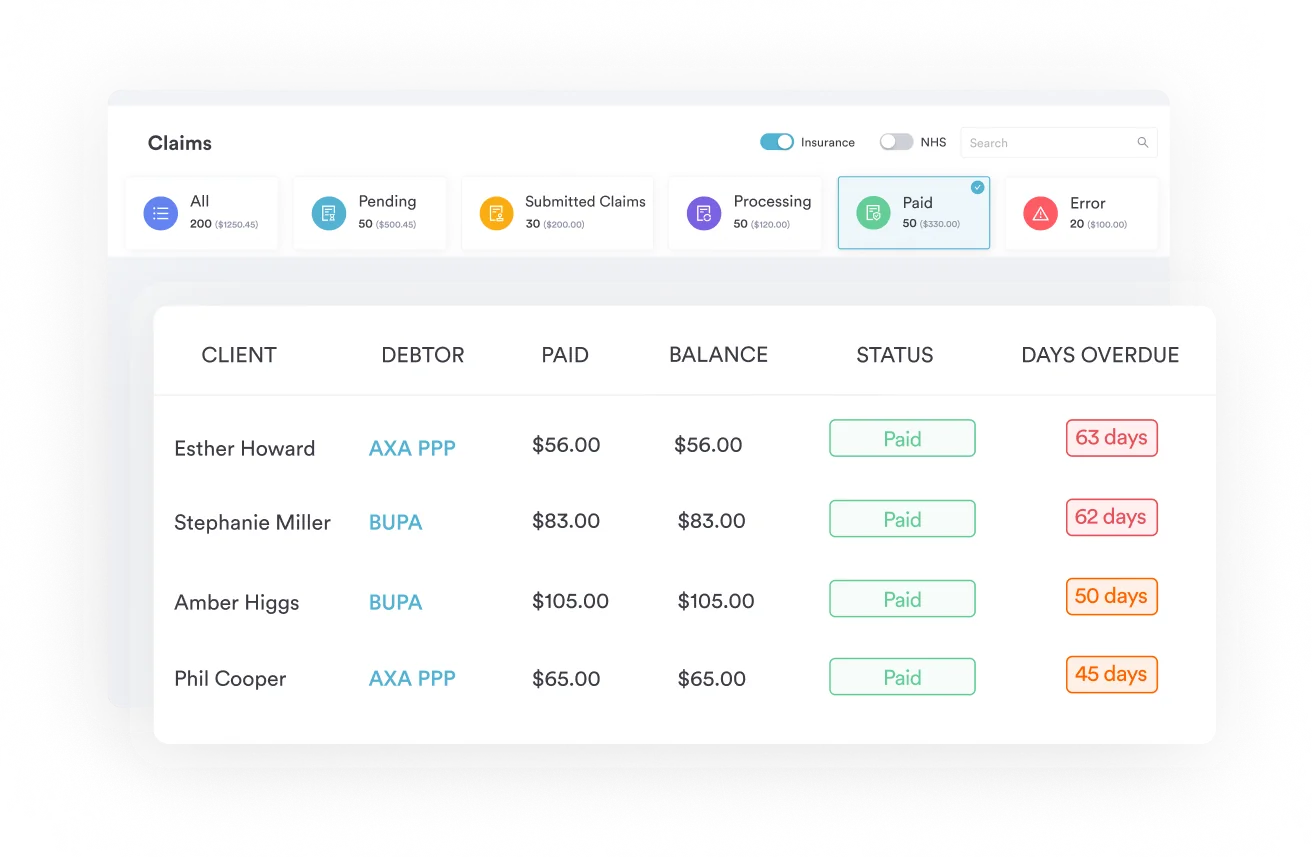
For K0039, that means the order, the proof of delivery, and the strap count stay attached to the claim. Your team can check style and units against them before the claim drops, rather than after a denial.

Pabau’s claims management software helps you track modifier requirements, documentation, and claim status, and keeps your DMEPOS records audit-ready. See how it fits your billing workflow.

The delivery ticket decides a K0039 claim. If it names an H-style strap and the count, the code and the units follow, and an auditor can see why. Build that step into intake so nobody codes a strap from memory.
Modifiers are the part that changes by jurisdiction. Check your DME MAC’s LCD and billing article once, record whether KX applies, and reuse that answer on every strap claim.
To keep strap style, units and supporting records attached to every claim, book a demo and see how Pabau handles DME billing.

Need a broader grounding in DME billing rules? Medical billing fundamentals covers the end-to-end claim cycle from code selection through payment posting.
Seeing repeat denials across your DMEPOS claims? Denial management strategies explains how to track denial patterns and fix upstream causes systematically.
Want to improve first-pass claim rates? Submitting a clean claim walks through the documentation and edit checks that prevent rejections before they reach the payer.
Dispensing a standard leg strap instead? HCPCS code K0038 covers the non-H-style strap, with its own units and documentation rules.
HCPCS code K0039 describes one H-style leg strap for a wheelchair, with the official descriptor Leg strap, H style, each. It’s a HCPCS Level II code in the K0001–K0195 wheelchair components and accessories range, and each strap is billed as one unit.
Both codes are billed per strap. K0038 is a standard leg strap, each, and K0039 is an H-style leg strap, each. Choose the code by the strap’s style, not the quantity. Two H-style straps are two units of K0039, and two standard straps are two units of K0038.
Yes, Medicare Part B covers K0039 as a DME accessory when medical necessity is documented. Add the KX modifier when the applicable LCD or billing article requires it, and verify that for your DME MAC jurisdiction. Coverage requires a written physician order and supporting chart documentation.
KX is required when the applicable LCD or billing article says so, so verify it for your DME MAC jurisdiction. NU indicates a new purchased strap, and RR applies when the wheelchair base and its accessories are rented. GA is used when an ABN is on file and coverage is uncertain. GY applies when the item is non-covered, and UE is used for pre-owned equipment.
K0039 is not currently on the CMS Prior Authorization for Certain DMEPOS Items list. However, prior authorization requirements vary by Medicare Advantage plan, Medicaid MCO, and commercial payer. Verify PA requirements with each payer before dispensing.
The allowable changes with each CMS DMEPOS fee schedule update and varies by state, rural or non-rural area, and competitive bidding area. It’s paid per unit, so each H-style strap is one unit. Look up the current rate in the CMS DMEPOS fee schedule file at cms.gov, using your state’s column.