CPT code 25628: Open treatment of carpal scaphoid fracture
CPT code 25628: definition and clinical description CPT code 25628 describes ope...

Last Updated: Oct 19, 2026
57461 is the CPT code for colposcopy of the cervix including upper/adjacent vagina; with loop electrode conization of the cervix. It covers a colposcopic exam and the removal of a cone-shaped specimen with an electrosurgical loop in the same session.
The cone specimen is what separates 57461 from its neighbors, 57460 for loop electrode biopsy and 57454 for biopsy with endocervical curettage. The code carries a 0-day global period on the 2026 Medicare Physician Fee Schedule.
Let Pabau's smart automation suggest the right codes, reduce claim denials, and keep your practice compliant—effortlessly.
Automate repetitive tasks and focus on what matters most—your patients.
Reduce coding errors and ensure compliance with the latest regulations.
Clean claims, fewer denials, and faster reimbursements.
Powerful insights and reporting to help your practice thrive.
HIPAA compliant SOC 2 certified GDPR-compliant Trusted by 4,000+ clinics worldwide

CPT code 57461 covers colposcopy plus LEEP conization in a single session, and the cone specimen, not a biopsy, is what defines it.
57461 is distinct from 57460 (loop biopsy) and 57454 (biopsy with ECC), and the right code depends on whether a cone specimen was removed.
The most common denial trigger is billing 57461 when the operative note records only biopsies, without a cone excision or specimen size.
57461 has a 0-day global period and pays about $349 in the office and $162 in a facility on the 2026 Medicare fee schedule.
Pabau’s claims software pre-fills the claim from the patient record and submits it through Claim.MD, while your biller confirms the code pairing.
The official descriptor for CPT code 57461 reads: Colposcopy of the cervix including upper/adjacent vagina; with loop electrode conization of the cervix. Report it when the surgeon examines the cervix under the colposcope and removes a cone-shaped specimen with a loop electrode in the same session. In addition, it sits in the cervix uteri endoscopy codes (57452-57461) of the Female Genital System section.
A LEEP conization removes a cone-shaped specimen from the cervical transformation zone using a loop electrode powered by electrosurgical current. In fact, this is a therapeutic excision, not a diagnostic biopsy, and that distinction is the core of coding 57461 correctly.
The operative sequence a coder should expect in the notes:
The usual reasons for 57461 are high-grade squamous intraepithelial lesion (HSIL), CIN 2 or CIN 3 confirmed on biopsy, and adenocarcinoma in situ. Also, an unsatisfactory colposcopy after a high-grade cytology result is another reason. Also, the procedure is usually done in an office or ambulatory surgical center (ASC) under local anesthesia.
CPT 57461 vs 57460 is the coding question that comes up most in this family. Indeed, what the surgeon removed decides it:
The operative note must record specimen size to support 57461. For example, a note that describes “loop excision” without a cone specimen, depth, and width looks the same as a loop biopsy at audit. In fact, payers now ask for pathology reports alongside 57461 claims. Also, a specimen described as a “punch biopsy” in pathology will contradict the code.
CPT 57461 is LEEP conization with colposcopy, and the colposcopy is part of its descriptor. CPT 57520 is cold-knife or laser conization, and CPT 57522 is loop electrode conization without colposcopy. In short, the technique and the recorded colposcopy decide which code is correct.
Because 57461 already includes the colposcopy, never add the base colposcopy code, 57452, to it. When the colposcope only guides the loop and no full exam is recorded, report 57522 instead. But when a surgeon performs a cold-knife conization and separately records colposcopy, payer policy decides whether both may be reported. So check your MAC’s LCD and NCCI edits, where one exists, before you submit both codes together.
The decision tree below puts the five codes side by side, so a coder can match the operative note to a code in two questions.
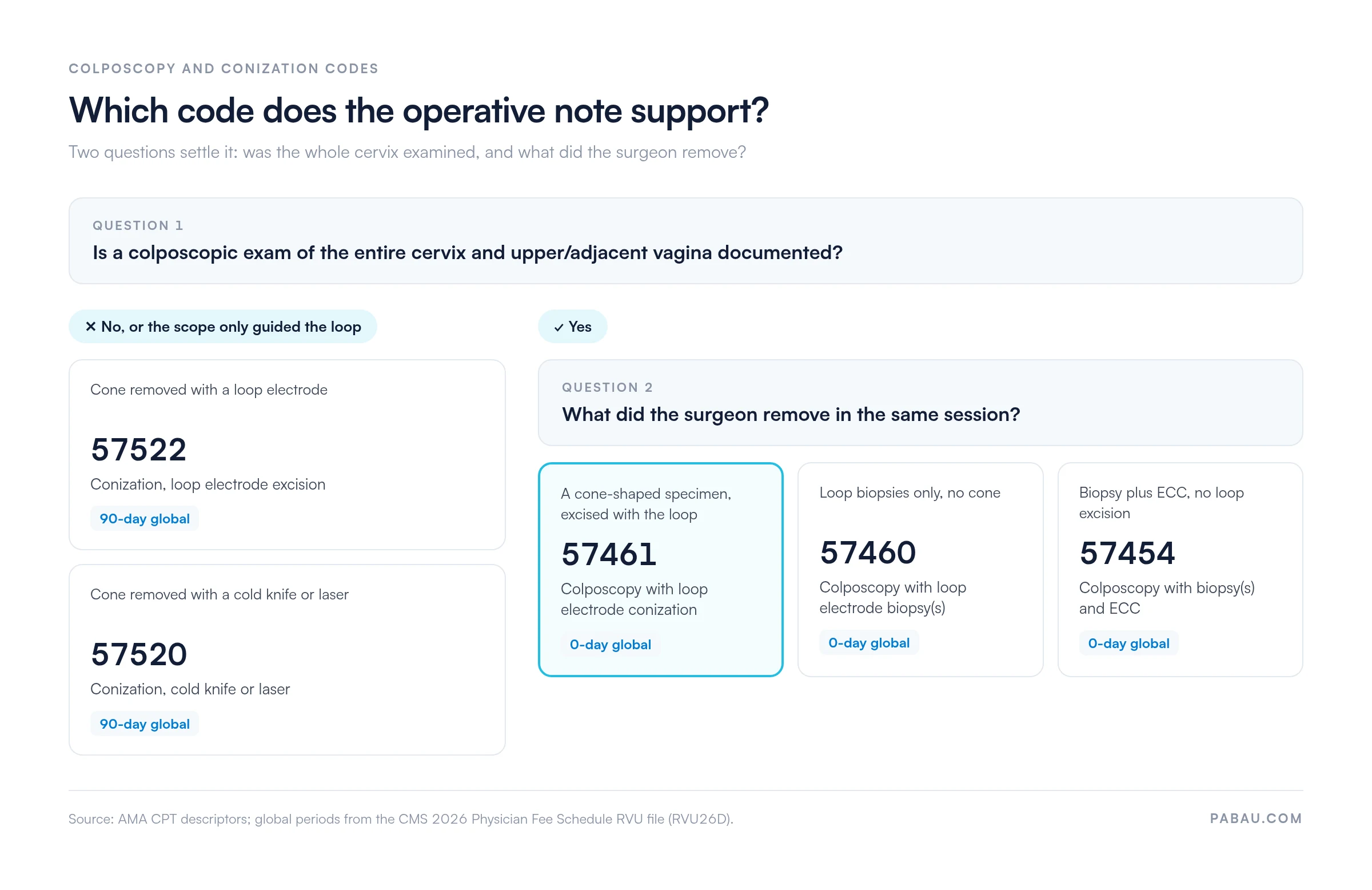
With CPT 57461, the colposcopy, any loop biopsy, and an ECC done with the cone are all bundled into the code. But the pathologist’s specimen analysis is the service reported on its own. In fact, ECC is not an add-on code. Instead, it is the standalone code 57456. CMS updates the National Correct Coding Initiative (NCCI) edits quarterly, so check the current table before reporting it on the same date.
Key bundling points for 57461:
For OB-GYN practices, Pabau’s claims management software pulls the patient record’s data into a pre-filled claim and submits and tracks it through Claim.MD. But your biller still checks each code combination against the current NCCI edits before it goes out.
Medical necessity for 57461 must be established by an ICD-10-CM diagnosis code that supports the clinical reason for LEEP conization. Indeed, payers review the diagnosis-to-procedure relationship, and a screening diagnosis code billed with a surgical code will draw a denial.
Code to the highest grade the pathology confirms: N87.1 for CIN 2, or D06.0 or D06.1 for carcinoma in situ by site. In addition, medical necessity rests with the payer’s coverage criteria, and MAC jurisdictions vary. Then review your MAC’s LCD and NCCI edits, where one exists, and confirm the code in the ICD-10-CM code set before submitting. Finally, a Z12.4 (cervical cancer screening) code is never appropriate as the primary diagnosis when a therapeutic procedure was done.
On the 2026 Medicare Physician Fee Schedule, CPT 57461 pays about $349 nationally in the office and about $162 in a facility. Both figures come from the CMS 2026 relative value file at the $33.4009 conversion factor, before locality (GPCI) adjustment. Qualifying APM participants are paid at the $33.5675 conversion factor instead. So check your locality rate with the CMS Physician Fee Schedule lookup tool.
Source: CMS, 2026 PFS relative value files (RVU26D, non-QP file).
The office payment is more than double the facility payment, because the practice carries the overhead. As a result, accurate place-of-service (POS) coding is critical. For example, POS 11 (office), POS 22 (outpatient hospital), and POS 24 (ASC) each produce different allowed amounts.
Run a quarterly audit on your 57461 claims, comparing the place-of-service code billed with the location logged in your scheduling system. A POS error on a LEEP conization can cut the national payment from about $349 to $162 without generating a denial. Instead, the claim simply pays at the facility rate. In short, catching this early is faster than chasing underpayments later.
In fact, the operative note is the make-or-break document for CPT 57461. A claim that lacks the elements below will either be denied outright or downgraded to 57460 on audit.
Required record elements for LEEP conization under colposcopic guidance:
A missing cone size is the records fault that most often turns a valid 57461 claim into a 57460 downgrade on later review. So train surgeons to dictate the width, depth, and appearance of the specimen before leaving the procedure suite.
CPT 57461 has a 0-day (000) global period under the Medicare Physician Fee Schedule, so no post-operative days are bundled. In other words, only care on the day of the procedure is included in the payment. A significant, separately identifiable E/M service on the same day needs modifier -25. But a follow-up visit on a later date can be billed as its own E/M service when it’s medically necessary.
Modifiers accepted with 57461:
Place-of-service codes for 57461: POS 11 (office) generates the non-facility rate. In contrast, POS 22 (outpatient hospital) and POS 24 (ASC) generate the facility rate. So before submitting, confirm the POS code in the practice management system matches where the procedure took place.
Denial prevention for CPT 57461 starts with knowing which payer rules trigger most often. The patterns below reflect the coder community’s documented experience and common payer audit findings for the colposcopy code family.
Most of these denials are cheaper to prevent than to appeal. For example, checking each claim against the clean claim criteria before submission catches the coding and POS errors in the table. For claims that still come back, a structured denial management process shortens the time from denial to resubmission.
A LEEP claim depends on records that often live in different places. The operative note sits in the EHR, the pathology report arrives later, and the claim gets keyed into a clearinghouse portal. As a result, each handoff is a chance for the cone size or the POS code to go missing.
Pabau keeps the treatment notes and the claim in the same system. The claim is pre-filled from the patient record, so the details your team already entered carry over without retyping. It then goes to the payer through Claim.MD, with real-time eligibility checks and claim status tracking.
But your biller still confirms the CPT and ICD-10 pairing and the NCCI edits. Instead, what changes is the time spent chasing records and rekeying data, which leaves more of the day for checking the codes themselves.

Pabau pre-fills claims from the patient record and submits them through Claim.MD, with eligibility checks and status tracking. See how OB-GYN practices keep notes and claims in one workflow.

CPT code 57461 turns on a single clinical fact: whether the loop removed a cone specimen or only biopsies. If the operative note records the cone’s width and depth, the code holds up at audit. Otherwise, expect a downgrade to 57460.
So the fix sits upstream of billing. Get surgeons dictating specimen size, and confirm the POS code before the claim is built. With a 0-day global, a same-day E/M service is the next item to check, because it needs modifier -25 to be paid.
Pabau keeps the clinical record, the claim data, and the clearinghouse submission in one workflow, while your biller verifies the codes. Book a demo to see how that workflow handles colposcopy and LEEP claims for your OB-GYN practice.

Need guidance on submitting clean claims through a clearinghouse? Our Claim.MD clearinghouse guide walks through how clearinghouse submission works for OB-GYN practices.
Trying to reduce the time from denial to resubmission? Denial codes in medical billing breaks down the most common CARC reason codes and the corrective actions that clear them fastest.
Want to understand how the full billing lifecycle connects? Revenue cycle management explained walks through every stage from patient registration to payment posting.
Billing a colposcopy without a LEEP? CPT code 57452 covers the base colposcopy exam of the cervix and upper vagina.
Was the cone excised without a colposcopy? CPT code 57522 covers loop electrode conization reported on its own.
CPT code 57461 is the procedure code for colposcopy of the cervix and upper/adjacent vagina with loop electrode conization, done in one session. Use it when the surgeon examines the cervix colposcopically and removes a cone-shaped specimen with an electrosurgical loop. It differs from loop biopsy codes because a cone specimen must be excised and sent to pathology.
Not for the same session, in most cases. In fact, ECC is the standalone code 57456, not an add-on code. Also, AMA CPT Assistant guidance treats ECC done with a conization as included in 57461. So check the current NCCI edits, and use modifier -59 or -XS only for a truly separate service where the edit permits it.
CPT 57461 has a 0-day (000) global period under the 2026 Medicare Physician Fee Schedule, so no post-operative days are bundled. A significant, separately identifiable E/M service on the same day needs modifier -25. But medically necessary follow-up visits on later dates are billed separately.
The most commonly paired ICD-10-CM codes are N87.1 (CIN 2), D06.0 (carcinoma in situ of endocervix), and D06.1 (carcinoma in situ of exocervix). In contrast, N87.0 (CIN 1) often does not meet medical necessity criteria for LEEP conization. So pair the most specific diagnosis the notes support, and check your MAC’s LCD where one exists.
The most common reason is an operative note that documents LEEP without a cone specimen or its size. In fact, at audit, that record looks the same as a loop biopsy. As a result, payers downgrade to 57460 when the notes do not confirm a cone-shaped excision sent to pathology with a measurable size.