

CCSD code G5100: Bypass of duodenum billing guide
CCSD code G5100 bills a bypass that leaves the duodenum in place CCSD code G5100...

Last Updated: Oct 16, 2026
Billable Code
57522 is the CPT code for loop electrode excision (LEEP) conization of the cervix, with or without fulguration, dilation and curettage, or repair. Those components are bundled into the code when they're performed in the same session.
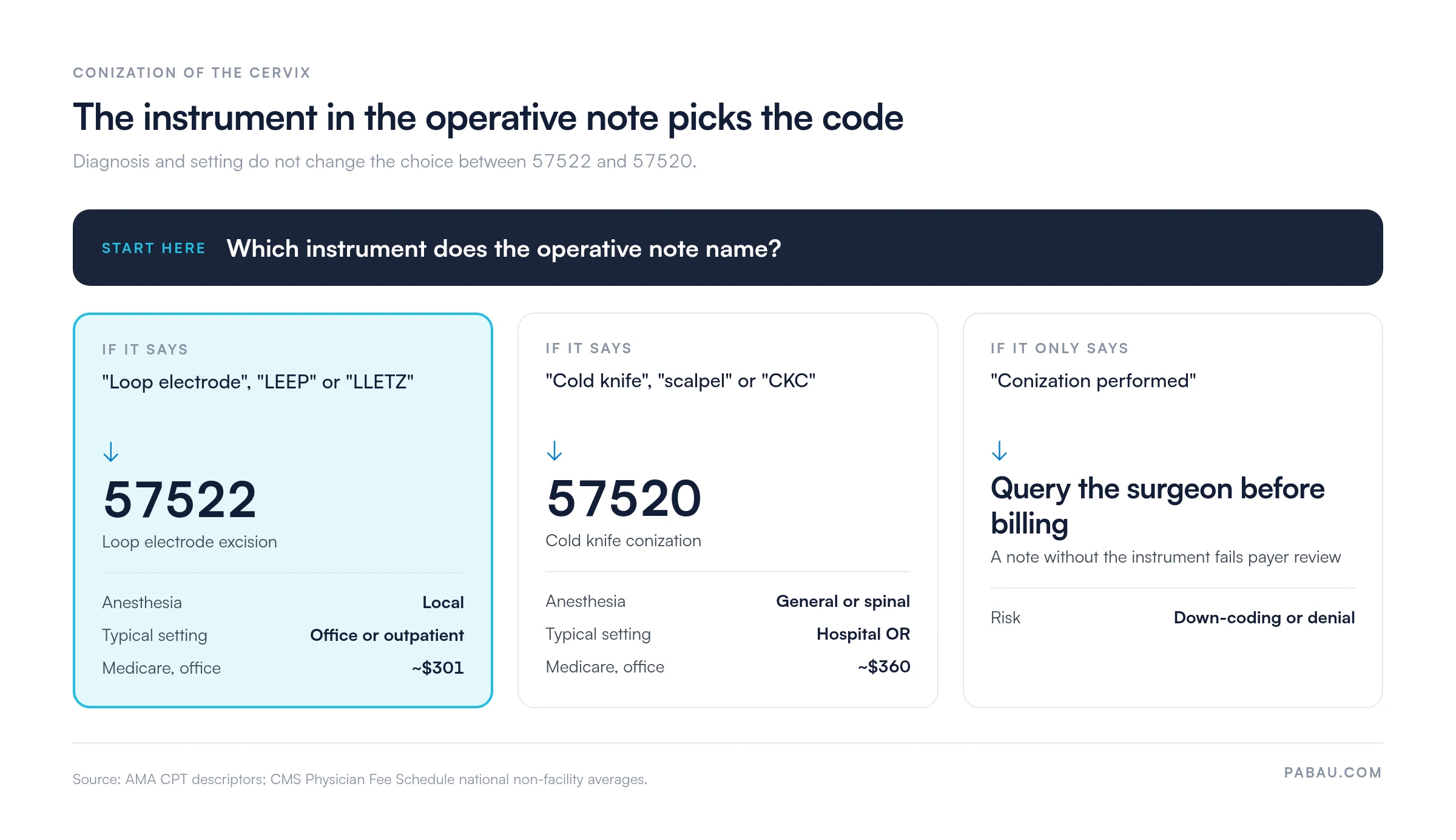
The instrument named in the operative note decides the code. A loop electrode means 57522, while a cold knife means its neighbor 57520. The procedure carries a 90-day global surgical period.
Let Pabau's smart automation suggest the right codes, reduce claim denials, and keep your practice compliant—effortlessly.
Automate repetitive tasks and focus on what matters most—your patients.
Reduce coding errors and ensure compliance with the latest regulations.
Clean claims, fewer denials, and faster reimbursements.
Powerful insights and reporting to help your practice thrive.
HIPAA compliant SOC 2 certified GDPR-compliant Trusted by 4,000+ clinics worldwide

CPT code 57522 covers loop electrode (LEEP) conization of the cervix. It differs from 57520 (cold knife) only by the instrument named in the operative note.
The code carries a 90-day global surgical period. An E/M service inside that window needs modifier 57 or modifier 24 to be billed separately.
NCCI edits bundle colposcopy codes 57454, 57460 and 57461 into 57522 on the same date. Billing them together without a valid modifier is a top denial trigger.
Medicare pays about $301 for 57522 in the office and about $231 in a facility. The place of service on the claim has to match the room.
Pabau’s claims management software flags NCCI edit conflicts and tracks 90-day global windows, which cuts avoidable OB-GYN claim denials.
CPT code 57522 is the procedure code for loop electrode excision (LEEP) conization of the cervix. Fulguration, curettage and repair done in the same session are bundled into it. It carries a 90-day global period and pays about $301 in the office under the Medicare fee schedule. Use the table below to confirm the code before you submit the claim.
Medicare rates shown are national non-geographic averages. Always verify against the CMS Physician Fee Schedule lookup for the applicable payment year and geographic locality. Commercial payer rates differ by contract and must be verified individually.
The AMA CPT code set gives 57522 a long official descriptor. It reads: “Conization of cervix, with or without fulguration, with or without dilation and curettage, with or without repair; loop electrode excision.” Each “with or without” clause names a component the code already pays for when it’s performed. None of them is ever billed as a separate line.
This bundled structure matters most for OB-GYN billing teams. Never list the fulguration or ECC as a separate line item. NCCI edits will catch it, and the resulting CO-97 denial is difficult to appeal.
LEEP conization is performed to treat cervical intraepithelial neoplasia (CIN), typically CIN II or CIN III, following a colposcopy that confirms high-grade disease. That colposcopy has its own code family, built on CPT code 57452 for an exam with no tissue sampling. Understanding the operative steps helps coders confirm whether the documented service matches 57522 or a different code.
Coders reading an operative note should look for the phrase “loop electrode” or “LEEP” and confirm the cervix was the operative site. If the note says “cold knife” or “scalpel,” the correct code is 57520, not 57522.
57522 (loop electrode) and 57520 (cold knife conization) share nearly identical clinical indications but differ entirely by surgical technique. Code selection follows the instrument documented in the operative note, not the physician’s preferred terminology or the diagnosis.
The practical decision rule is to open the operative note and find the instrument. If the surgeon used a wire loop energized by an electrosurgical unit, bill 57522. If the surgeon used a scalpel to cut the cone, bill 57520. The diagram below adds the third case, where the note names no instrument at all.
Several gynecologic codes are bundled into 57522 under NCCI edit pairs. None of them can be billed separately on the same date of service without a valid modifier. Billing them together without a modifier is the most common reason for CO-97 denials on LEEP claims.
NCCI edits are updated quarterly by CMS. Confirm the current edition for any specific edit pair before filing an appeal. The clean claim standards for 57522 require that no bundled code appears on the same claim without clear documentation of a distinct separate service.
Check whether the colposcopy was performed on a prior date versus the same date as the LEEP. A colposcopy done at a previous encounter, with its own visit, operative note and date of service, is not bundled into 57522. It can be billed separately. The NCCI bundling issue only applies to same-date services.
Medical necessity denials for 57522 are often triggered by unsupported or absent diagnosis codes. Payers expect a diagnosis that justifies cervical excisional treatment. That means CIN II, CIN III, or a high-grade squamous intraepithelial lesion confirmed by colposcopy and biopsy pathology.
Always verify against the payer’s Local Coverage Determination (LCD). Some Medicare Administrative Contractors have LCDs that explicitly restrict which ICD-10 codes support 57522. When a CO-50 denial (non-covered service) arrives, check the diagnosis against the LCD before assuming the procedure was miscoded.
Reimbursement for 57522 splits into two tracks depending on where the procedure is performed. The non-facility rate applies when the procedure is done in the office (POS 11). The facility rate applies in an outpatient hospital (POS 22) or ambulatory surgical center (POS 24). The office rate runs roughly $70-90 higher at national rates. CMS pays more there because the practice carries overhead that the facility absorbs in the other settings.
RVU figures above are national values from the CMS fee schedule, before geographic adjustment. Use the FastRVU lookup tool or the official CMS MPFS to retrieve current-year values with your geographic practice expense index applied. One common billing error is a claim submitted with POS 11 (office) for a procedure performed at an ASC. The claim then pays the non-facility rate for a facility service, and Medicare demands the difference back in a post-payment audit.
Practice management software like Pabau prevents this by setting the POS from the appointment location recorded at scheduling. The electronic claim sent through Claim.MD then carries that POS automatically.
CPT 57522 carries a 90-day global surgical period. A related service performed by the same surgeon within that 90-day window is included in the original payment. It cannot be billed separately. The exception is a service billed with a modifier that signals a distinct circumstance.
Use modifier 59 (distinct procedural service) only when the XS, XU, XE and XP modifiers don’t fit and the edit pair allows an override. Incorrect modifier 59 use on 57522 claim pairs is an OIG audit focus area for gynecologic procedure billing. The electronic remittance advice on a denied LEEP claim shows the reason code. Review it before deciding which modifier to append on the appeal.
Medicare generally does not require prior authorization (PA) for CPT 57522, but most commercial payers do. That’s especially true when the procedure is performed in an outpatient hospital or ASC rather than an office. PA requirements vary by plan and by state, so verify them before scheduling, not before submitting the claim.
Typical documentation payers request for a 57522 prior authorization:
Pabau’s insurance eligibility verification workflow can flag PA requirements at scheduling, so the front desk starts the authorization before the procedure date. A 57522 claim submitted without a required authorization number comes back as a CO-15 denial. CO-15 means the number is missing, invalid, or doesn’t apply to the billed service. It’s also one of the easiest denials to prevent.
After wrong-code selection, missing or incomplete operative documentation is the most common reason 57522 claims are recouped on audit. The operative note must contain specific language to support the code. Generic notes that say “conization performed” without specifying the instrument do not pass payer review.
The medical billing compliance standard for operative notes is simple. A trained coder who did not witness the procedure must be able to select the correct code from the note alone. If the coder has to phone the surgeon for clarification, the note is inadequate for billing.
Most 57522 denials fall into a handful of repeating patterns. Each one has a specific remittance advice code and a specific fix. Nearly all of them trace back to documentation or pre-submission checks, which the practice controls.
Of all the medical billing denial codes, CO-97 and CO-50 appear most often on 57522 remittance advices. Both are preventable with edits run before the claim is submitted.
In many OB-GYN practices, the coder meets a LEEP claim after the patient has gone home. They read the operative note for the instrument, check same-day colposcopy against the NCCI tables, and track the 90-day window in a spreadsheet.
With OB-GYN claims management software like Pabau, the procedure note fields are captured at the time of documentation. The claim is built from that same record. It goes out through Claim.MD, Pabau’s clearinghouse integration, which reaches thousands of US payers and runs NCCI edit checks before submission.
Catching a CO-97 bundling conflict at the clearinghouse takes seconds to fix, while appealing it after the denial takes weeks. Global period tracking works the same way. A follow-up visit inside the 90 days is flagged before it’s billed without its modifier.

Pabau’s claims management tools flag NCCI edit conflicts, track global period windows, and connect to Claim.MD for electronic claim submission across thousands of US payers. See how OB-GYN practices use Pabau to catch 57522 billing errors before they reach the payer.

Bill 57522 only when the operative note names the loop electrode, and leave same-day colposcopy off the claim. Make those two checks before submission and the costliest 57522 denials never reach the payer.
The trade-off worth remembering is the setting. An office LEEP pays roughly $70-90 more than the same procedure in a facility. That premium holds only while the POS on the claim matches the room the patient was in.
Book a demo to see how Pabau checks LEEP claims for bundling and global period conflicts before they reach the payer.

Need to verify related gynecologic CPT codes? IVF CPT codes covers the full reproductive medicine billing code set for practices that perform fertility procedures alongside cervical treatments.
Want a structured framework for clean claims? Clean claim standards outlines the documentation and submission requirements that prevent the most common denial patterns across surgical procedure codes.
Managing denials across a multi-provider OB-GYN practice? Denial management in healthcare covers how to build a denial tracking system, categorize root causes, and reduce write-offs at the practice level.
Choosing a clearinghouse for OB-GYN claims? Claim.MD clearinghouse review explains how its claim scrubbing and payer connections work before you commit.
Reading the remittance on a denied LEEP claim? Electronic remittance advice walks through the reason codes on an ERA and what each one asks you to fix.
CPT code 57522 covers loop electrode conization (LEEP) of the cervix, including any fulguration, dilation and curettage, or repair performed at the same operative session. All of those components are bundled into the single code and cannot be billed separately on the same date.
CPT 57522 uses a loop electrode (LEEP), while CPT 57520 uses a cold knife (scalpel). Code selection is determined entirely by the surgical instrument documented in the operative note, not by the diagnosis or the setting. If the note says “cold knife” or “CKC,” bill 57520; if it says “loop electrode” or “LEEP,” bill 57522.
The Medicare national average is approximately $301 in a non-facility setting (office) and approximately $231 in a facility setting (hospital or ASC). Rates vary by geographic locality and are updated annually. Always verify against the current CMS Physician Fee Schedule for the exact payment year and location.
Medicare generally does not require prior authorization for 57522, but most commercial payers do, particularly for outpatient hospital or ASC settings. Requirements vary by plan. Verify with the specific payer before scheduling, and document the authorization number before the claim is submitted.
No. Colposcopy codes 57454, 57460, and 57461 are bundled into 57522 by NCCI edits when performed on the same date. Colposcopy performed at a prior visit on a different date of service with its own operative report is not bundled and can be billed separately.
CPT 57522 carries a 90-day global surgical period. Related services performed by the same surgeon within those 90 days are included in the original payment. Use modifiers 78 (complication return), 79 (unrelated procedure), or 24 (unrelated E/M during global) to bill separately when those circumstances apply.



