HCPCS Code M0100: Intragastric hypothermia using gastric freezing
HCPCS code M0100: Definition and code attributes HCPCS Code M0100 is a HCPCS Lev...

Last Updated: Nov 5, 2026
HCPCS code L0472 is the Level II code for a prefabricated thoracic-lumbar-sacral orthosis (TLSO) with triplanar control and hyperextension. Its rigid anterior and lateral frame runs from the symphysis pubis to the sternal notch, with one pubic and one sternal component. Posterior and lateral pads with straps limit spinal flexion and restrict trunk motion in all three planes.
Medicare covers L0472 under Part B, and the code includes fitting, frame shaping and adjustment. Only PDAC-listed products can be billed with it. Three causes are among the most common reasons L0472 claims are denied. They are a product missing from the PDAC listing, a diagnosis that doesn't support an LCD indication, or missing order and delivery records.
Let Pabau's smart automation suggest the right codes, reduce claim denials, and keep your practice compliant—effortlessly.
Automate repetitive tasks and focus on what matters most—your patients.
Reduce coding errors and ensure compliance with the latest regulations.
Clean claims, fewer denials, and faster reimbursements.
Powerful insights and reporting to help your practice thrive.
HIPAA compliant SOC 2 certified GDPR-compliant Trusted by 4,000+ clinics worldwide

HCPCS code L0472 is a prefabricated hyperextension TLSO with triplanar control. It uses a rigid anterior and lateral frame with a pubic and a sternal component.
The code includes fitting, frame shaping and adjustment, so those services are never billed as separate lines.
L0472 is on the PDAC coding verification list, so bill it only for products the PDAC has listed under L0472.
Medicare covers L0472 for one of four indications in LCD L33790, and the medical record must show which one applies.
Pabau’s claims management software tracks order, delivery and coding records and flags incomplete documentation before claim submission.
HCPCS code L0472 describes a thoracic-lumbar-sacral orthosis (TLSO) with triplanar control that holds the spine in hyperextension.
The CMS HCPCS Level II file lists it as an orthotic L-code, added on January 1, 2003. The short descriptor reads “Tlso rigid frame hyperex pre”.
The design is a three-point frame rather than a shell. A rigid anterior and lateral frame runs from the symphysis pubis to the sternal notch, with one pubic and one sternal component. Posterior and lateral pads with straps and closures push back against the frame, which limits spinal flexion. Manufacturers often sell this design as a Jewett-style hyperextension brace.
“Prefabricated” means the frame is mass-produced, then shaped and fitted to the patient. The descriptor folds that fitting, frame shaping and adjustment into the code itself.
Coverage under L0472 is set by the CMS descriptor, the spinal orthosis LCD and its policy article. Coding a brace into L0472 when its construction points elsewhere is an audit risk in either direction.
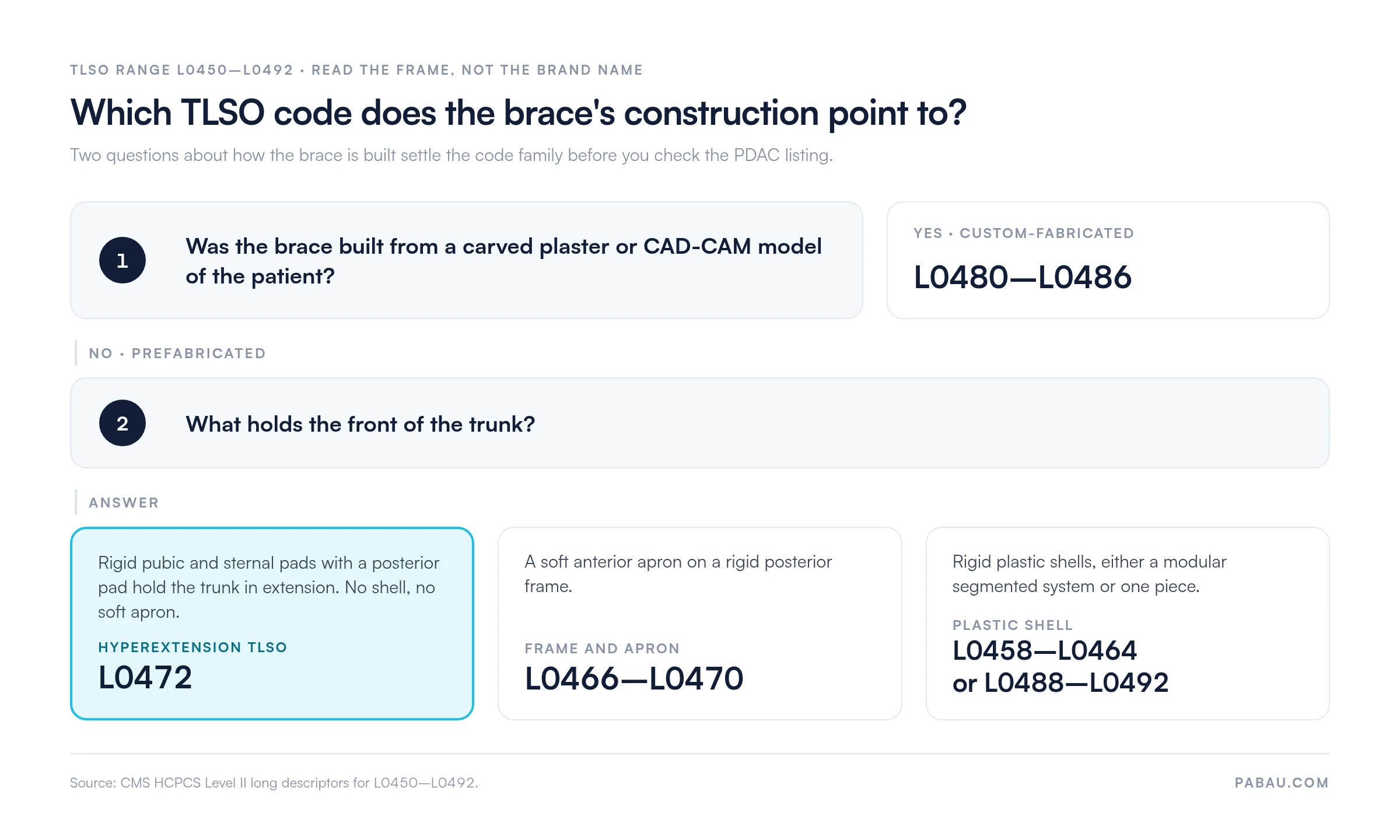
Every code in the L0450 to L0492 TLSO range describes a different construction. Read the device against the descriptor rather than the brand name. The comparison below uses the CMS long descriptors.
Practical rule: If a pubic pad, a sternal pad and a posterior pad hold the trunk in extension, L0472 is correct. That design has no shell and no soft apron.
A rigid back frame with a soft front apron points to L0466 to L0470. Of those, L0470 is the triplanar version and L0472’s closest neighbor. Plastic shells point to L0458 to L0464 or L0488 to L0492. A brace built from a model of the patient points to L0480 to L0486. The diagram below runs the same check as two questions.
Medicare covers L0472 under the Spinal Orthoses: TLSO and LSO LCD (L33790). The LCD covers a spinal orthosis when it is ordered for one of four indications. The order and the medical record have to show which indication applies to this patient.
What falls outside coverage: A brace supplied for comfort, posture or general prevention, with no indication documented, does not meet the LCD. Claims of that kind are denied as not reasonable and necessary.
Check the PDAC Product Classification List before you dispense. L0472 has required a coding verification review since July 1, 2010. A brace the PDAC hasn’t listed under L0472 is denied as incorrect coding, whatever its design.
The spinal orthosis policy article A52500 does not publish a list of covered ICD-10-CM codes for L0472. The diagnosis on the claim has to match the medical record and support one of the four LCD indications. The table below shows example codes and the indication each one can support when the chart documents it.
These are examples, not a coverage list. Always code to the highest specificity the record supports, and use the 7th character for the encounter type.
Spinal orthosis reviews can fail on records the supplier could have collected before billing. Each item below should be in the file before the claim goes out, not after a denial arrives.
Structured documentation workflows cut audit exposure. A medical billing compliance program sets which chart elements to check before claims reach the payer.
Traditional Medicare does not require prior authorization for L0472. It is not among the orthosis codes on CMS’s DMEPOS Required Prior Authorization List. Medicare Advantage and commercial plans set their own rules, though, and many review spinal orthoses before delivery.
When a plan asks for prior authorization, send the order, the treating practitioner’s notes, the diagnosis code and the brace’s make and model. Standard requests often take several business days, so request approval as soon as the order arrives.
Medicare pays L0472 from the CMS DMEPOS fee schedule, which CMS updates each year and sets by state. The beneficiary pays 20% coinsurance after the annual Part B deductible, which is $283 in 2026. Medicare pays the remaining 80% of the allowed amount.
Look up the current allowed amount for L0472 in the DMEPOS fee schedule file for the beneficiary’s state. Rates change each January 1, so check them before quoting a patient estimate or agreeing a contract rate.
Modifier errors cause avoidable L0472 denials. The Medicare spinal orthosis policy article sets no KX requirement for L0472, so the liability modifiers matter most. The table below covers the modifiers billers most often weigh for this code.
Rule of thumb: If the record supports an LCD indication and the product is PDAC-listed, L0472 goes out with no liability modifier. Add GA only when you expect a denial and hold a signed ABN.
L0472 is billed to the DME MAC on the CMS-1500 paper form or the 837P electronic transaction. The supplier must be enrolled with Medicare as a DMEPOS supplier before billing. The steps below follow standard DME MAC requirements.
The denial management workflow for L0472 follows predictable patterns. The table below maps frequent CARC codes to their root causes and fixes. Knowing the denial codes in medical billing helps billers resolve rejections faster and prevent repeats.
Appeal strategy for CO-50 denials: Send the treating practitioner’s notes, imaging reports and a letter that maps the patient’s condition to the LCD indication. Cite LCD L33790 in the appeal. Medicare allows 120 days from the initial determination to request a redetermination.
Run a monthly pre-submission audit on TLSO claims. Flag any L0472 line for a product the PDAC hasn’t listed under the code. Also flag M54.50 as a sole diagnosis, and any date of service that doesn’t match delivery. These three filters catch common preventable L0472 denials.
Orthotic paperwork often sits across email, scanned forms and a separate billing tool. That makes it easy to bill a brace before the order, the fitting record or the delivery signature is on file.
Pabau, the practice management platform we build, keeps those records on the patient file. Digital forms capture the delivery signature and fitting notes, and clinical notes hold the diagnosis and indication. Pabau’s audit-ready claims management then builds the claim from the same record.
That way, you can confirm the order, the fitting record and proof of delivery before an L0472 claim goes out. When a DME MAC review arrives, the audit trail is already in one place.

Pabau’s claims management tools help DME billing teams flag missing documentation, apply the correct modifiers, and reduce preventable denials for HCPCS orthotic L-code submissions.

L0472’s frame reaches the sternal notch and holds the trunk in extension, and that design drives every billing decision on the code. Match the brace to the descriptor before you dispense, then confirm its PDAC listing. Document the LCD indication it serves, and the claim stands up to review.
Pabau’s medical billing workflows help billing teams standardize documentation, apply modifiers correctly and track claims through adjudication. To see how Pabau supports orthotic billing, book a demo with the team.

Need a framework for reducing claim denials across your DME billing operation? Denial management in healthcare covers root-cause analysis and appeal workflows for common CARC codes.
Want to understand how the revenue cycle connects to L-code reimbursement? Revenue cycle management fundamentals explains the end-to-end billing process from eligibility through payment posting.
Billing a one-piece plastic shell instead of a frame? HCPCS code L0488 covers the prefabricated triplanar TLSO shell with an interface liner and its documentation rules.
Working with a modular, segmented TLSO? HCPCS code L0464 explains the prefabricated modular shell system and how it is billed.
HCPCS code L0472 covers a prefabricated TLSO with triplanar control that holds the spine in hyperextension. A rigid anterior and lateral frame runs from the symphysis pubis to the sternal notch, with pubic and sternal components and posterior pads. The code includes fitting, frame shaping and adjustment.
No. L0472 is a thoracic-lumbar-sacral orthosis, because its frame reaches the sternal notch. Braces that stop below the thoracic spine are billed with LSO codes instead.
Both are prefabricated triplanar TLSOs. L0470 uses a rigid posterior frame with a soft anterior apron and subclavicular extensions. L0472 uses a rigid anterior and lateral frame that holds the trunk in hyperextension and limits flexion.
Medicare’s spinal orthosis policy article publishes no list of covered ICD-10 codes. The diagnosis must match the record and support one of the four LCD indications. Thoracic or lumbar compression fracture codes, such as S22.080A, are common examples when the chart documents them.
Yes, when the brace is ordered for one of the four indications in LCD L33790 and the record supports it. The product must also be PDAC-listed under L0472. The beneficiary pays 20% coinsurance after the Part B deductible.
Traditional Medicare does not require prior authorization for L0472. Medicare Advantage plans and many commercial insurers do, so check with the plan before dispensing the brace.
Common causes are a product not PDAC-listed under L0472, a record that doesn’t support an LCD indication, or fitting billed on a separate line. Check the CARC code on the remittance advice, fix the root cause, then resubmit or appeal.