HCPCS Code L0472: Hyperextension TLSO billing guide
HCPCS code L0472: Official descriptor and device definition HCPCS code L0472 des...

Last Updated: Nov 5, 2026
M0100 is the HCPCS Level II code for intragastric hypothermia using gastric freezing.
Medicare does not cover M0100 under NCD 100.6, so claims carrying it are denied as non-covered. The procedure, a 1950s peptic ulcer treatment, is now obsolete, so an M0100 line usually means the service performed needs recoding.
Let Pabau's smart automation suggest the right codes, reduce claim denials, and keep your practice compliant—effortlessly.
Automate repetitive tasks and focus on what matters most—your patients.
Reduce coding errors and ensure compliance with the latest regulations.
Clean claims, fewer denials, and faster reimbursements.
Powerful insights and reporting to help your practice thrive.
HIPAA compliant SOC 2 certified GDPR-compliant Trusted by 4,000+ clinics worldwide

HCPCS Code M0100 describes intragastric hypothermia using gastric freezing, a peptic ulcer treatment largely abandoned by the early 1970s.
Medicare does not cover M0100 under NCD 100.6, which calls the procedure obsolete, and commercial payers typically take the same position.
Claims submitted with M0100 are almost always denied as a non-covered service, so the usual fix is recoding the service performed.
HCPCS Level II codes such as M0100 are public domain and need no AMA license, unlike CPT codes, which the AMA owns and licenses.
HCPCS Code M0100 is a HCPCS Level II code with the official descriptor Intragastric hypothermia using gastric freezing.
It sits in the M0000-M0301 range, which the Centers for Medicare & Medicaid Services (CMS) titles Medical services.
The table below summarizes the key attributes of M0100 as listed in the CMS HCPCS Level II code set.
M0100 stays in the code set for historical completeness and audit reference, and no current clinical use exists for the procedure it describes. It shares that position with other M-series codes for services Medicare does not cover, such as M0076 for prolotherapy and M0300 for IV chelation therapy.
Intragastric hypothermia using gastric freezing was a peptic ulcer treatment developed in the 1950s and 1960s. It cooled the stomach lining to suppress acid secretion. A balloon device was inserted into the stomach and filled with refrigerated fluid to lower gastric mucosal temperature, reducing parietal cell activity.
Clinical trials through the late 1960s showed no sustained benefit over standard medical management. Medicare’s NCD 100.6 cites a high complication rate and the procedure’s failure in double-blind studies. By the early 1970s, gastric freezing had largely disappeared from mainstream practice.
Three clinical features distinguish M0100 from other gastrointestinal procedure codes:
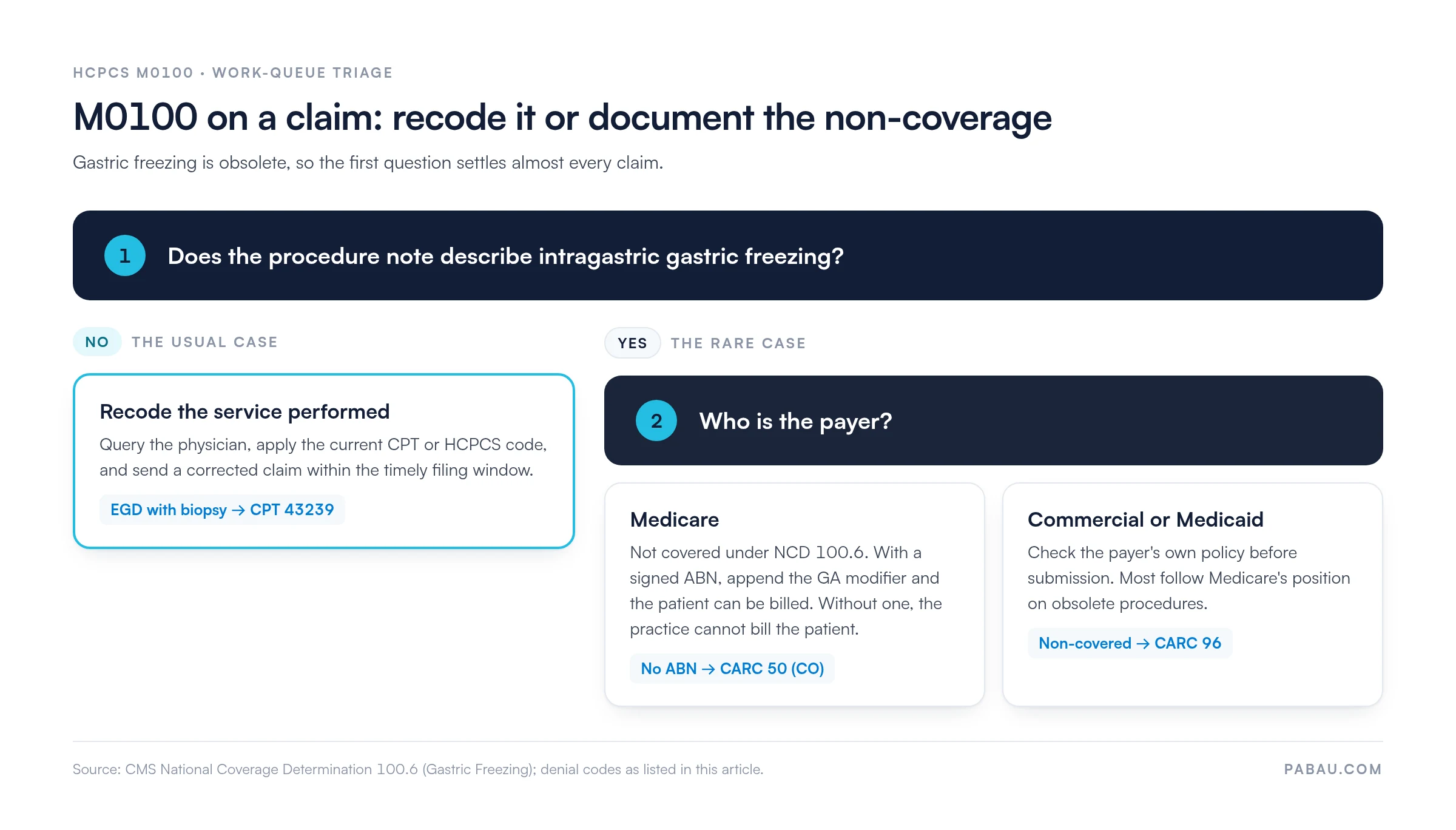
Coders who meet M0100 in a denial work queue today are usually dealing with a miscoded claim. The underlying service was likely a different gastric or endoscopic procedure with a current CPT or HCPCS code. The flow below shows how to work one.
No. Medicare does not cover HCPCS Code M0100. National Coverage Determination (NCD) 100.6, Gastric Freezing, states that the procedure is now considered obsolete and is therefore not covered.
When a claim carries M0100, Medicare Administrative Contractors (MACs) deny it because the service is not a covered Medicare benefit. The Claim Adjustment Reason Code (CARC) returned usually reflects a non-covered service rather than a documentation deficiency.
Verify coverage with any specific payer before submission. Payer policies change, and a small number of legacy contracts may list M0100 differently. Even so, approval is highly unlikely given the procedure’s obsolescence.
Before submitting any claim with HCPCS Code M0100, confirm the procedure note describes gastric freezing. For Medicare patients, NCD 100.6 already settles coverage, so the open question is whether a signed ABN is on file. For other payers, check the payer’s own policy, and recode the service performed if the note describes a different procedure.
Because HCPCS Code M0100 is non-covered, its documentation mostly supports an appeal or patient billing rather than payment. If a practice believes a submission is justified, the claim must include the following.
Understanding how medical billing works, from the clinical record to the claim, helps billing staff catch missing documentation before submission. A well-documented claim also shortens the appeal cycle if a denial does occur.
The M0100 denial pattern most often stems from a coding error. The coder applied M0100 when a current CPT or HCPCS code better describes the service performed. The table below compares M0100 with codes for related gastric or cooling procedures.
When a coder cannot identify the current code for a gastric procedure, the next step is a query to the treating physician. An upper endoscopy with biopsy, for example, belongs under CPT 43239. Using M0100 as a catch-all for unspecified gastric services generates predictable, preventable denials.
The AAPC HCPCS code lookup tool and the PGM Billing HCPCS search both confirm whether a code is active and matches the procedure performed.
Denials for HCPCS Code M0100 follow a consistent pattern, and each arrives with a CARC that names the reason. Our guide to medical billing denial codes explains each code family. For M0100, the best resolution is usually recoding rather than appealing.
Effective denial management for M0100 starts before the claim leaves the practice. A pre-submission coverage check and a physician query on coding accuracy prevent most M0100 denials from reaching the work queue.
Run a targeted audit of every claim coded with HCPCS Code M0100 from the past 24 months. Flag each one: did the note describe gastric freezing, or was a different gastric service miscoded? For every miscoded claim, decide whether a corrected claim or provider adjustment fits the payer rules and the timely filing window.
No. HCPCS Level II codes, including M0100, are maintained by CMS and are in the public domain, so using them needs no AMA license. The American Medical Association (AMA) owns CPT, which is HCPCS Level I, and licenses CPT codes and descriptors for commercial use.
That distinction matters when a claim mixes both code sets. CPT codes such as 43257, cited in the table above, fall under the AMA license, while M0100 does not. Good medical billing compliance includes confirming that every billing tool showing CPT descriptors holds a current AMA license.
For a quick check that a Level II code is valid, the NLM Clinical Tables HCPCS API offers a free programmatic lookup.
In many practices, an M0100 line goes out on the claim, the denial comes back weeks later, and a biller works it by hand. By then, the timely filing window for a corrected claim is already shrinking.
In Pabau’s claims management software, each claim opens pre-filled from the invoice and is checked for missing or invalid details before it reaches the clearinghouse. A rejected or flagged claim shows as Needs action, with a Fix link that opens the field to correct.
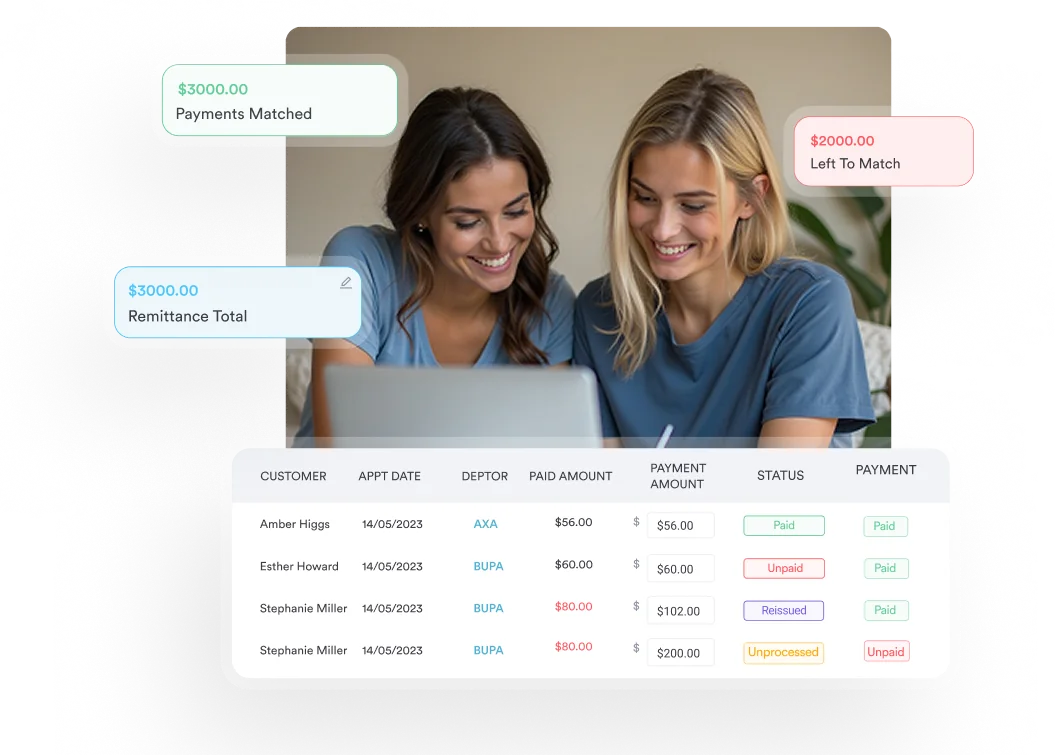
The claims dashboard then tracks every claim from Pending to Paid, with days overdue and filters by insurer. Billers can spot an M0100 denial early and recode it while the filing window is still open.

Pabau checks each claim for missing or invalid details before it reaches the clearinghouse, then tracks it from Pending to Paid.

An M0100 line on a claim today almost always points to a coding error. Treat it as a prompt to audit the encounter, since an appeal cannot overturn NCD 100.6.
Recode the service performed and send the corrected claim inside the timely filing window. Keep the ABN workflow ready for the rare note that does describe gastric freezing. A few minutes of physician query time costs far less than a denial that will not reverse.
Book a demo to see how Pabau flags rejected claims early, so your billing team can recode them before the filing window closes.

Need a broader grounding in HCPCS and medical billing? Understanding medical billing fundamentals explains how claims move from clinical encounter to paid remittance.
Dealing with a denial work queue? Denial management in healthcare covers root-cause analysis and appeal strategies for common payer rejections.
Concerned about billing compliance obligations? Medical billing compliance guidance outlines the regulatory and contractual requirements that govern accurate claim submission.
HCPCS Code M0100 is a Level II Healthcare Common Procedure Coding System code for intragastric hypothermia using gastric freezing. The stomach-cooling procedure was developed in the 1950s to treat peptic ulcer disease and was largely abandoned by the early 1970s. The code remains in the HCPCS set for historical reference, and no currently performed procedure maps to it.
Intragastric hypothermia using gastric freezing was a technique in which a balloon filled with refrigerated fluid was placed in the stomach to suppress acid production. Clinical evidence showed no sustained benefit over drug therapy. Medicare’s NCD 100.6 cites a high complication rate and failure in double-blind studies, and calls the procedure obsolete.
No. Medicare does not cover HCPCS Code M0100. National Coverage Determination (NCD) 100.6, Gastric Freezing, states that the procedure is now considered obsolete and is not covered. Medicare Administrative Contractors deny M0100 claims as a non-covered benefit.
M0100 remains the HCPCS code for intragastric hypothermia using gastric freezing, but Medicare does not cover it. If a claim carries M0100, audit the encounter and identify the service performed. Then apply the correct current CPT or HCPCS code for that service.
M0100 claims are denied most commonly as a non-covered service (CARC 96) or for missing medical necessity (CARC 50 or 167). Incorrect diagnosis code linkage (CARC 11 or 167) also triggers denials. For Medicare patients, a missing signed ABN means the practice cannot bill the patient for the non-covered service.
No. HCPCS Level II codes such as M0100 are maintained by CMS and are in the public domain, so they need no AMA license. The AMA license applies to CPT (HCPCS Level I) codes, which vendors must license to display CPT descriptors in billing software.