HCPCS Code L0472: Hyperextension TLSO billing guide
HCPCS code L0472: Official descriptor and device definition HCPCS code L0472 des...

Last Updated: Nov 5, 2026
L1910 is the HCPCS Level II code for ankle foot orthosis, posterior, single bar, clasp attachment to shoe counter, prefabricated, includes fitting and adjustment.
Most L1910 denials trace to three fixable mistakes. The first is coding it when the device qualifies as a custom-fabricated orthosis, which requires a different L-code. The others are a missing KX modifier on Medicare claims and records that never document the functional deficit behind the order.
Let Pabau's smart automation suggest the right codes, reduce claim denials, and keep your practice compliant—effortlessly.
Automate repetitive tasks and focus on what matters most—your patients.
Reduce coding errors and ensure compliance with the latest regulations.
Clean claims, fewer denials, and faster reimbursements.
Powerful insights and reporting to help your practice thrive.
HIPAA compliant SOC 2 certified GDPR-compliant Trusted by 4,000+ clinics worldwide

HCPCS Code L1910 covers a prefabricated ankle foot orthosis with a posterior single bar that clasps to the patient’s shoe counter.
The descriptor includes fitting and adjustment, so a device handed over without custom fitting is billed as L2999, not L1910.
L1910 differs from L1930 by design and material, and from L1960 because L1960 is custom fabricated.
Medicare requires the KX modifier when the LCD L33686 criteria are met, plus an RT or LT modifier on every line.
Pabau’s claims management software scrubs each claim for missing or invalid details before it reaches the payer.
HCPCS Code L1910 describes an ankle foot orthosis (AFO) with a posterior single bar that clasps to the counter of the patient’s shoe.
The device is prefabricated, and the code includes fitting and adjustment. The Centers for Medicare and Medicaid Services (CMS) maintains L1910 in the L-code series of HCPCS Level II.
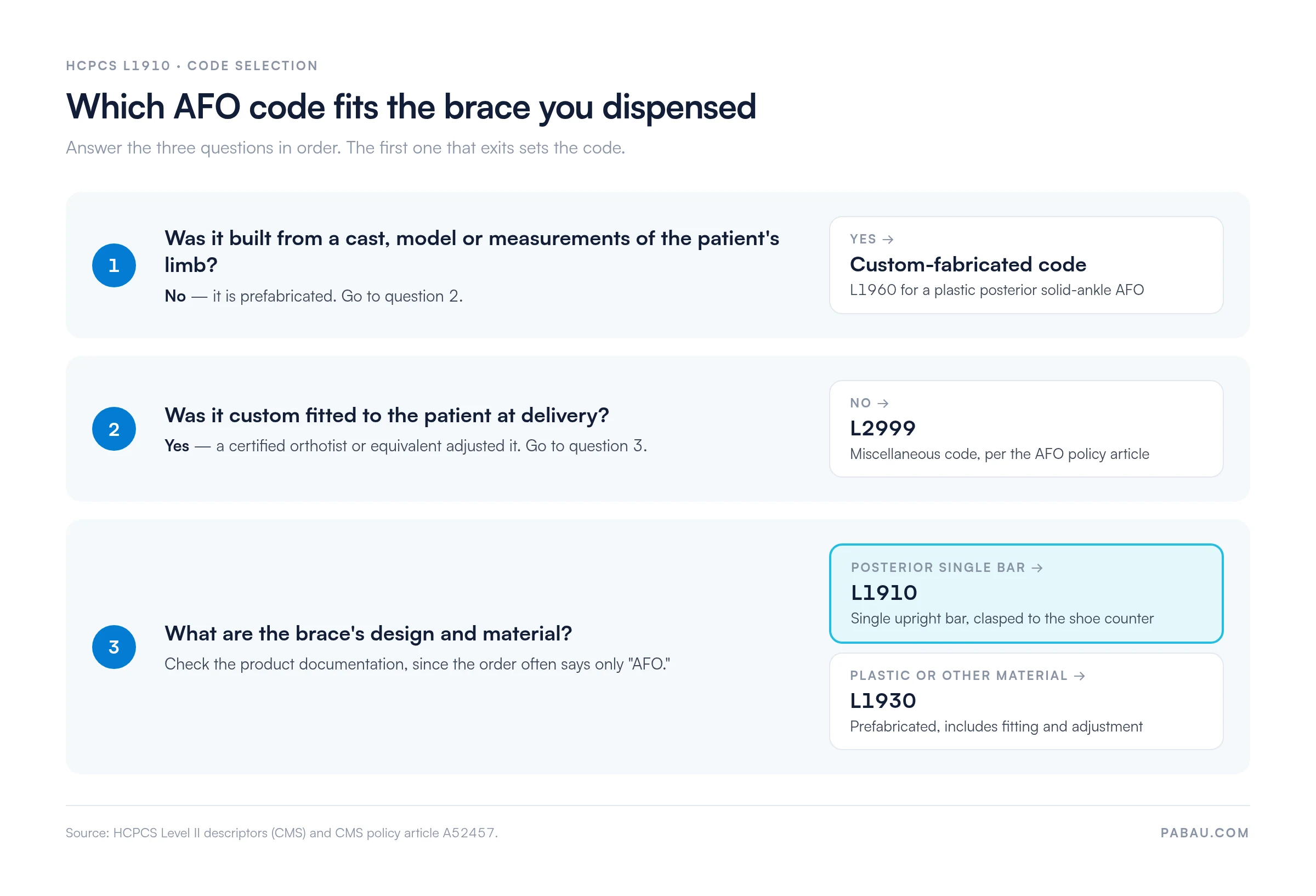
Two parts of the descriptor decide whether L1910 fits the device you dispensed. The first is the design: a single upright bar behind the leg, attached to the shoe by a clasp at the heel counter.
The second is the fabrication method. L1910 is prefabricated, so a brace built from a cast or measurements of the patient’s limb belongs under a custom-fabricated code.
The right code depends on two facts about the dispensed device: its design and material, and whether it was prefabricated or custom fabricated. L1910 and L1930 are both prefabricated and both include fitting and adjustment. L1960 is custom fabricated.
Coders most often swap L1910 and L1930 because both are prefabricated. Read the product documentation rather than the order wording. A molded plastic AFO is L1930, even if the order simply says “AFO.” Billing L1960 for a prefabricated device is a false claim risk, because L1960 requires custom fabrication.
One more rule catches suppliers out. CMS treats L1910 as a custom-fitted item, which means a certified orthotist or someone with equivalent training adjusts it to the patient at delivery. If the brace is handed over without that fitting, the AFO policy article directs suppliers to the miscellaneous code L2999 instead.
Taken in order, the fabrication method, the fitting and the design settle the code in three questions.
Medicare Part B covers L1910 for ambulatory beneficiaries with weakness or deformity of the foot and ankle. The patient must need stabilization for medical reasons and have the potential to benefit functionally. These criteria come from LCD L33686, Ankle-Foot/Knee-Ankle-Foot Orthosis.
The LCD reads the same in all four DME Medicare Administrative Contractor (MAC) jurisdictions. Noridian administers Jurisdictions A and D, and CGS administers Jurisdictions B and C.
Medicare’s requirements for an L1910 claim include the following conditions.
Custom-fabricated AFOs such as L1960 face stricter criteria in the same LCD. That is one more reason to code a prefabricated brace as L1910 or L1930 rather than reaching for a custom code. Commercial payers often follow similar standards but may publish their own policies, so verify prior authorization rules before dispensing.
Check the LCD and its policy article on the Medicare Coverage Database each quarter. The DME MACs revise them jointly, and a coding or documentation rule that applied last year may have changed. Each revision carries its own effective date.
Missing or incomplete documentation is the top reason L1910 claims fail on post-payment audit. Every required record should sit in the supplier’s file before the claim goes out. Sound billing compliance documentation practices capture each item at the point of dispensing. A delivery checklist that prompts staff for each record cuts audit exposure further.
Suppliers must keep these records for seven years from the date of service. Medicare can request them at any point in that window.
CMS runs a prior authorization program for selected DMEPOS items. At the time of writing, L1910 is not on the Required Prior Authorization List for that program. CMS updates the list periodically, so check the current version before each claim cycle.
Commercial payers set their own prior authorization rules. Some require approval for every orthotic L-code, while others set a cost threshold. A request for L1910 should include the order, the clinical notes, and the device make and model. Record the approval number on the claim.
An accredited DMEPOS supplier bills L1910 to the DME MAC on the CMS-1500 claim form or its electronic equivalent. Clean claim submission for L1910 depends on the elements below being correct on every line.
Most L1910 denials are preventable. The denial management strategies that work in DMEPOS billing start with the error behind the denial, not a straight resubmission. The medical billing denial codes on the remittance advice show which element failed. These are the most common L1910 denial triggers.
Medicare pays L1910 from the DMEPOS fee schedule, which CMS updates each year and revises quarterly. Fee schedule amounts vary by state. Check the current file for your state before quoting a patient’s share, rather than relying on a cached figure.
Commercial payer rates are negotiated separately. Many contracts express the rate as a percentage of the Medicare fee schedule, such as 110% of Medicare.
The ICD-10-CM code submitted with L1910 must reflect the weakness or deformity the records describe. Generic diagnoses such as ankle pain (M25.571/M25.572) rarely support the claim on their own. The codes below often appear on AFO claims, but the documentation still has to meet the LCD criteria.
Use the most specific ICD-10-CM code the record supports. M25.371 (other instability, right ankle) tells the reviewer more than M25.373 (unspecified ankle). Multiple sclerosis now needs a G35 subcode, because G35 alone stopped being valid on October 1, 2025.
Most L1910 errors start at the front desk or in the fitting room. A brace gets dispensed, the fitting goes unrecorded, and the claim leaves without a side modifier. The denial then arrives weeks later, long after anyone remembers the visit.
Pabau, the practice management platform we build, keeps the order, the clinical notes, and the signed delivery record on the patient’s file. Its software catches claim errors by scrubbing every claim for missing or invalid details before submission. US claims go out as CMS-1500s through Claim.MD, which also runs eligibility checks before the visit.
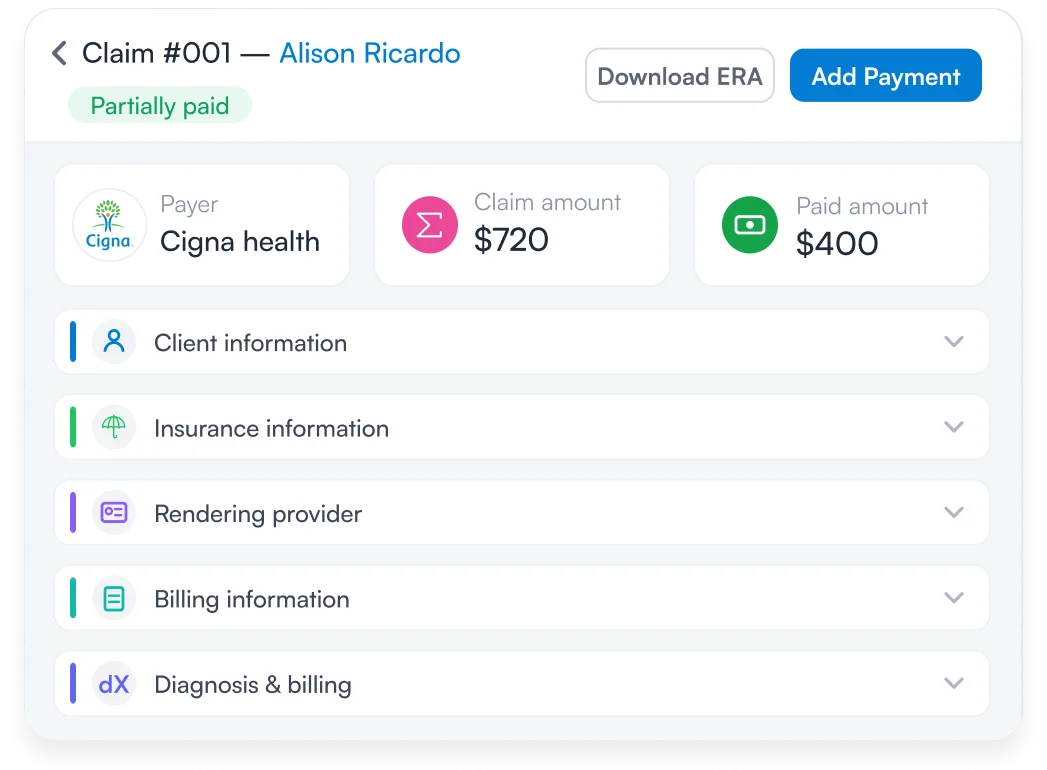
When a claim comes back rejected, Pabau flags it as Needs action, so the team fixes and resubmits it quickly. Payments settle straight from electronic remittance advice (ERA) files, which keeps the ledger accurate without manual posting.

Pabau’s claims management software scrubs each orthotic claim for missing or invalid details and flags rejected claims for action. Your team fixes errors before they turn into denials.

Let the device in hand decide the code, because the order wording rarely settles it. If the device is a stock posterior single-bar AFO that clasps to the shoe and was fitted at delivery, L1910 is right. A plastic stock AFO is L1930, a custom-built one is a custom code, and an unfitted one is L2999.
Once the code is right, the claim rests on the KX attestation and the records behind it. Suppliers that check the device, the fitting record, and the side modifier before submission avoid most rework. The trade-off is a few minutes at dispensing against weeks of appeals later.
Book a demo to see how Pabau keeps orthotic orders, fitting records, and claims in one place for your practice.

Need a denial management framework for DMEPOS? Denial management in healthcare covers root-cause analysis and appeal workflows for common payer rejections.
Want to understand how claims flow from submission to payment? Revenue cycle management explained breaks down each stage from coding through remittance.
Looking for DME billing compliance guidance? Medical billing compliance outlines the documentation standards that protect suppliers during audits.
Coding a molded plastic AFO instead? HCPCS code L1930 covers the prefabricated plastic AFO and the records that keep it off a denial list.
Was the brace built from a cast? HCPCS code L1960 explains the custom-fabricated posterior solid-ankle AFO and its stricter coverage criteria.
HCPCS Code L1910 covers a prefabricated ankle foot orthosis with a posterior single bar that clasps to the counter of the patient’s shoe. Fitting and adjustment are included, so neither is billed separately. Plastic or other-material prefabricated AFOs use L1930, and custom-fabricated AFOs such as L1960 use their own codes.
L1910 is a posterior single-bar AFO that clasps to the shoe counter, while L1930 is a prefabricated AFO made of plastic or other material. Both are prefabricated and include fitting and adjustment. The device’s design and material decide the code, so check the product documentation before billing.
Yes, Medicare Part B covers L1910 for ambulatory beneficiaries with weakness or deformity of the foot and ankle. The patient must need stabilization for medical reasons and be able to benefit functionally. The supplier adds the KX modifier only when the records meet every criterion in LCD L33686.
The supplier needs a standard written order, medical record notes that meet the LCD criteria, and a description of the device. It also needs a record of the custom fitting and signed proof of delivery. Medicare suppliers keep these records for seven years from the date of service.
The most common causes are a missing KX or RT/LT modifier and billing L1910 for a plastic or custom-fabricated AFO. Others include billing a brace that was never custom fitted, incomplete records, and lapsed accreditation or enrollment. The adjustment reason code on the remittance advice identifies the specific cause.
No, not for the same limb on the same date of service. L1910 is a prefabricated posterior single-bar AFO, and L1960 is a custom-fabricated plastic AFO with a posterior solid ankle. One limb receives one base AFO, so one base code applies. When each leg gets a different AFO, bill each on its own line with RT or LT.