57135 is the CPT code for excision of vaginal cyst or tumor. It covers complete surgical removal of a discrete cyst or benign mass from the vaginal wall, such as an inclusion cyst or Gartner duct cyst.
The code is easy to confuse with its neighbors. A post-biopsy closure, a Bartholin gland marsupialization and a vaginal septum resection can read alike in a brief operative note. Each takes a different CPT code. Mixing up 57135, 57130 and 57200 is a common source of billing errors.
Automate repetitive tasks and focus on what matters most—your patients.
Improve accuracy
Reduce coding errors and ensure compliance with the latest regulations.
Get paid faster
Clean claims, fewer denials, and faster reimbursements.
Grow with confidence
Powerful insights and reporting to help your practice thrive.
HIPAA compliant•SOC 2 certified•GDPR-compliant•Trusted by 4,000+ clinics worldwide
Key takeaways
CPT 57135 covers complete excision of a discrete cyst or benign tumor from the vaginal wall, not Bartholin gland procedures or septum resections.
The operative note must document the site, size, excision technique, completeness and specimen handling to support the code.
The codes most often confused with 57135 are 57130 (vaginal septum), 57200 (suture of a vaginal injury) and 57100 or 57105 (biopsy).
57135 carries a 10-day global period and 2026 Medicare total RVUs of 5.04 in a facility and 7.28 in an office.
Pabau’s claims management software pre-fills claims from the patient record, offers ICD-10-CM and CPT lookup libraries, and checks required claim fields before submission.
CPT code 57135 covers complete removal of a vaginal wall mass
CPT code 57135 is defined by the American Medical Association as “Excision of vaginal cyst or tumor.” You report it when the surgeon removes a discrete cyst or benign mass from the vaginal wall in its entirety.
It sits in the Vagina subsection (57000-57426) of the Female Genital System section, which spans codes 56405-58999.
CPT codes are the HIPAA-mandated standard for electronic claim transactions
The procedure itself is short. The surgeon identifies the mass, dissects it free from the surrounding tissue, removes it whole and closes the defect. Sending the specimen to pathology is common, but it isn’t a condition for reporting the code.
What 57135 includes, and the look-alikes it doesn’t
The descriptor says “cyst or tumor,” which takes in a range of benign vaginal wall masses. The boundary matters because each look-alike procedure has a code of its own.
Masses that belong under 57135
Vaginal inclusion cysts (most common, formed from entrapped epithelium during prior surgery or repair)
Gartner duct cysts (mesonephric duct remnants arising on the anterolateral vaginal wall)
Bartholin gland cysts or abscesses: These have their own codes. Use 56440 for marsupialization, 56420 for incision and drainage of a Bartholin abscess, and 56740 for excision of a Bartholin gland or cyst. Bartholin glands sit at the vaginal opening, so they’re coded in the vulva range.
Vaginal septum resection: Use CPT 57130 instead. A septum is a fibrous or fibromuscular band, not a discrete cyst or tumor.
Biopsy without excision: If the surgeon sampled tissue without removing the mass, use 57100 for a simple biopsy of vaginal mucosa. Use 57105 for an extensive biopsy requiring suture (including cyst). Don’t confuse either with 57106, which is a partial vaginectomy, the removal of part of the vaginal wall.
Colporrhaphy: Use CPT 57200 when the surgeon sutured a nonobstetrical vaginal injury. Closing a biopsy site is part of the biopsy, not an excision.
Cervical or vulvar cysts: Different anatomical sites take codes from their own subsections.
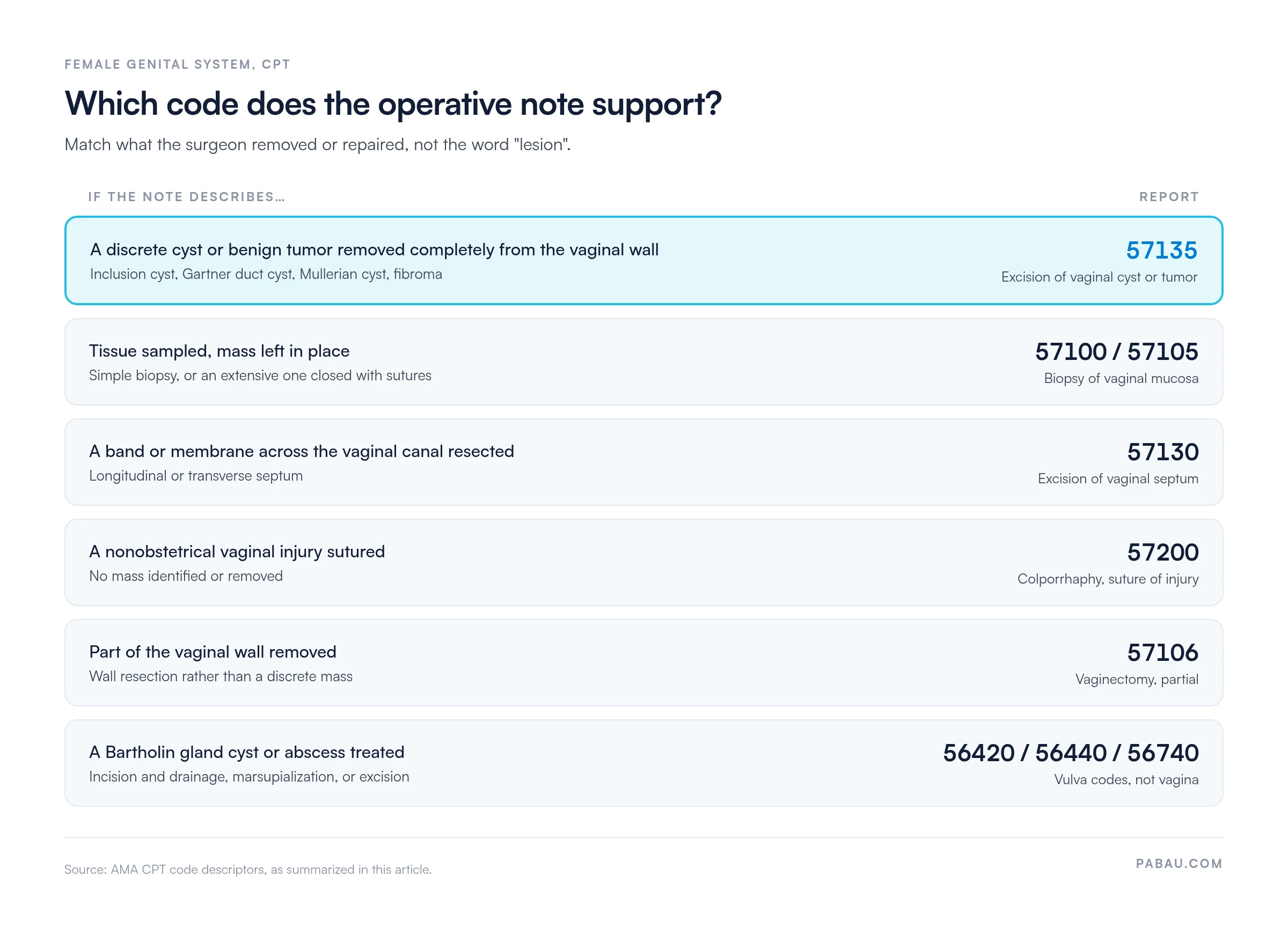
The quickest way to choose between them is to read what the note says was removed or repaired. The table below matches each finding to its code.
A note that only says “lesion removed” fits none of these rows, so query the surgeon before you code. Descriptors come from the AMA CPT code set.
The operative note has to prove a complete excision
Every 57135 claim rests on the operative note. Payers audit the code because the descriptor is broad, and a thin note leaves room to argue that another code applies. A clean claim submission for 57135 needs the note to confirm each of the following.
Preoperative diagnosis: The clinical reason for the procedure, such as a symptomatic vaginal cyst causing dyspareunia or urinary pressure. This establishes medical necessity and must pair with an appropriate ICD-10 code.
Anatomical location: The site on the vaginal wall (anterior, posterior, lateral) and its relation to nearby structures. Gartner duct cysts typically sit on the anterolateral wall, while inclusion cysts tend to form at sites of earlier surgery or repair.
Size of the cyst or tumor: Record the size in centimeters. Some payers use it to judge medical necessity.
Technique of excision: Describe the incision, dissection and removal. “Cyst was excised” on its own is too thin to support the code.
Completeness: Use wording such as “complete excision” or “cyst removed in its entirety.” If the cyst ruptured during removal, note that the wall was removed too.
Specimen handling: State whether the specimen went to pathology. When it did, the record should hold the matching pathology report.
Closure: Type of closure (absorbable suture, mucosa reapproximated, etc.).
Then pair the note with the ICD-10 code. Medical billing compliance requires the diagnosis to show why surgery was needed, not just that a mass was found.
How a 57135 claim moves from the procedure to payment
Once the note is right, the claim follows a predictable path. Here’s how it usually runs in an ob-gyn practice.
Before the procedure. The front desk checks eligibility and, where the plan requires it, obtains prior authorization for the planned excision.
Day of surgery. The surgeon documents the site, size, technique, completeness and specimen in the operative note.
Coding. The coder confirms a discrete mass was removed whole and assigns 57135 with the supporting ICD-10 code. Modifiers are added if another procedure was done in the same session.
Pathology. Many practices hold the claim until the pathology report is back. That way a confirmed benign tumor is coded as D28.1 rather than as a cyst.
Claim build. The claim goes out on the CMS-1500 or its electronic 837P equivalent. The place of service decides whether the facility or non-facility rate applies.
After payment. The 10-day global period covers the day of the procedure and the 10 days that follow. Routine follow-up visits in that window are part of the payment and aren’t billed separately.
ICD-10 codes that support medical necessity for 57135
The diagnosis code has to justify surgical excision. These are the codes most often paired with 57135.
ICD-10-CM Code
Description
Use with 57135 when
N89.8
Other specified noninflammatory disorders of vagina
Vaginal inclusion cyst, Gartner duct cyst, or other benign cyst not classified elsewhere
N89.9
Noninflammatory disorder of vagina, unspecified
The cyst type can’t be specified further. Use N89.8 when the type is documented.
Q52.4
Other congenital malformations of vagina
Gartner duct cyst with documented congenital origin (mesonephric duct remnant in a patient with no prior surgery)
D28.1
Benign neoplasm of vagina
The pathology report confirms a benign tumor (fibroma, hemangioma) rather than a cyst
N76.89
Other specified inflammation of vagina and vulva
An infected or inflamed vaginal cyst is excised rather than simply incised and drained
ICD-10-CM codes update every October 1. Check them against the version in effect on the date of service.
57135 vs. 57130: A septum is not a cyst
CPT 57130 is excision of a vaginal septum, a different structure entirely. A septum is a fibromuscular band or membrane that runs lengthwise or across the vaginal canal. A cyst is a discrete fluid-filled sac in the vaginal wall. Coders mix them up when the note says something vague like “vaginal lesion removed.”
Element
CPT 57135
CPT 57130
Structure removed
Discrete cyst or benign tumor from vaginal wall
Fibromuscular vaginal septum (longitudinal or transverse)
Typical indication
Symptomatic inclusion cyst, Gartner duct cyst, benign vaginal wall mass
Congenital or acquired vaginal septum causing obstruction or dyspareunia
Key operative note signal
“Cyst excised from anterior/posterior vaginal wall,” with a fluid-filled structure described
“Vaginal septum resected,” with a band-like or membrane structure described
Common ICD-10 pair
N89.8, D28.1
Q52.10-Q52.12 (doubling of vagina; transverse or longitudinal vaginal septum)
57135 vs. 57200: Colporrhaphy repairs an injury, not a mass
CPT 57200 is “Colporrhaphy, suture of injury of vagina (nonobstetrical).” The mix-up usually happens after a biopsy. The surgeon samples tissue and closes the site with sutures, and the claim goes out as 57135 even though no cyst or tumor was excised.
Element
CPT 57135
CPT 57200
Primary service
Complete excision of a cyst or tumor
Suture repair of a nonobstetrical vaginal injury
Requires discrete mass
Yes, a cyst or tumor must be identified and removed
No, the service is the repair of an injury
Post-biopsy suture
Incorrect. No mass was excised.
Incorrect. The closure belongs to the biopsy, and 57105 already includes suture.
Key operative note signal
“Cyst/tumor excised completely from the vaginal wall”
“Vaginal laceration repaired with interrupted sutures”
If the note shows a biopsy closed with sutures and nothing more, the biopsy code covers it. 57105 is the extensive biopsy that requires suture, so the closure isn’t billed on top.
Pro Tip
When reviewing an operative note for 57135, ask one question first: did the surgeon remove a pre-existing discrete mass from the vaginal wall? If yes, 57135 may apply. If the surgeon only sampled tissue, closed a wound, or resected a membrane, reach for a different code. That single question rules out most wrong-code choices before they become denials.
Unlisted code 58999 is the rare exception
CPT 58999 is the unlisted procedure code for the female genital system. Use it only when no CPT code describes the procedure and 57135 would misrepresent it.
Complex excision with reconstruction: Some defects need flap reconstruction or a graft that no specific repair code covers. Then 57135 alone may undercode the service.
New surgical technique: If the approach can’t be mapped to the existing descriptor, 58999 with detailed documentation is correct.
Not for a difficult excision: A large or adherent cyst is still 57135. Report the extra work with modifier -22 instead.
Billing CPT 58999 means sending a special report with the claim. It describes the nature, extent and need for the procedure, plus the time, effort and equipment involved. Without it, 58999 claims are routinely denied. Talk to a certified professional coder before swapping an unlisted code in for a named one.
Four modifiers you may need with 57135
Modifiers change how the payer reads a 57135 claim. Using the wrong one, or leaving one off when it’s needed, is a common denial trigger.
Modifier
When to use
Documentation required
-51 Multiple procedures
When 57135 is billed with another gynecologic procedure on the same day by the same surgeon
Each procedure must be separately documented in the operative note. Second and later procedures are paid at about 50% under Medicare’s multiple-procedure rule.
-22 Increased procedural services
When the excision was unusually complex due to cyst size, deep infiltration, or adherence to adjacent structures
The note must describe the specific factors that made the work harder than usual. Expect a payer audit.
-59 Distinct procedural service
When 57135 is billed alongside a procedure that NCCI edits would otherwise bundle, and the services were distinct
Document separate sites or separate indications. Use XS (separate structure) or another X modifier first where one fits.
-50 Bilateral procedure
Rarely. The vagina is a midline structure, so bilateral billing seldom fits 57135.
Check the payer’s bilateral indicator for 57135 before appending -50, and document both excision sites.
What Medicare pays for CPT 57135 in 2026
The CMS Physician Fee Schedule sets the Medicare RVUs for 57135. The figures below come from the 2026 Medicare Physician Fee Schedule. Check the current-year values in the CMS lookup before quoting them to a payer.
RVU Component
Value (2026 MPFS)
Work RVU
2.63
Practice expense RVU (facility)
1.95
Practice expense RVU (non-facility)
4.19
Malpractice RVU
0.46
Total RVU (facility)
5.04
Total RVU (non-facility)
7.28
Global surgery period
10 days
At the standard 2026 conversion factor of $33.4009, those totals come to about $168 in a facility and $243 in an office. Both are before geographic adjustment.
Use the FastRVU lookup tool to see the values with your locality’s adjustment applied. Commercial rates are set by each contract and can differ a lot from Medicare.
Six reasons 57135 claims get denied
Most 57135 denials trace back to the note, the diagnosis or the code choice, so they can be prevented. Strong denial management workflows start with knowing which documentation problems lead to which denial codes.
The ICD-10 code doesn’t support medical necessity. Using N89.9 (unspecified) when the note clearly identifies a Gartner duct cyst invites a medical necessity denial. N89.8 or Q52.4 with supporting clinical notes will hold up better.
The note documents a biopsy, not an excision. If it says “punch biopsy performed and site closed,” the service is 57100 or 57105, not 57135. When the note only says “lesion removed,” query the surgeon before choosing 57135.
The wrong neighbor code is selected. A post-biopsy suture billed as 57135 and a full excision billed as 57200 are both audit flags. Check the medical billing denial codes that come back on these pairs.
No pathology report on file. If the note says the specimen went to pathology, payers expect the report in the record. Without it, the payer may question whether the procedure was performed as documented.
A bundling edit without the right modifier. Billed with a procedure that NCCI edits bundle, 57135 comes back as CO-97. Only a supported distinct-service modifier, such as -59 or XS, prevents that. Modifier -51 on its own doesn’t bypass these edits.
Prior authorization is missing. Some commercial plans require prior authorization for planned outpatient surgery. Check the plan’s rules before scheduling.
Before you submit: A 57135 claim checklist
Run through these checks before the claim leaves the practice.
The note says the mass was removed completely and describes how.
The site and size are recorded.
The ICD-10 code matches the note and, where available, the pathology report.
The code is 57135, not 57100, 57105, 57130 or 57200.
Any modifier is backed by the note, with -59 or XS used only for a distinct site.
The place of service matches where the procedure happened.
A prior authorization number is on the claim if the plan required one.
No routine follow-up visit inside the 10-day global is billed separately.
How Pabau keeps 57135 claims complete before they go out
In many ob-gyn practices, the claim for a 57135 excision is still pieced together by hand. Someone copies the procedure from the schedule, looks up the diagnosis code and re-keys the insurance details. Each step is a chance for a missing field or a wrong code.
Pabau’s claims management software builds the claim from the patient record instead. The CPT code attached to the service lands on the charge line, and the ICD-10 slots are seeded from the recorded problem list. Built-in ICD-10-CM and CPT lookup libraries let your team confirm a code without leaving the claim.
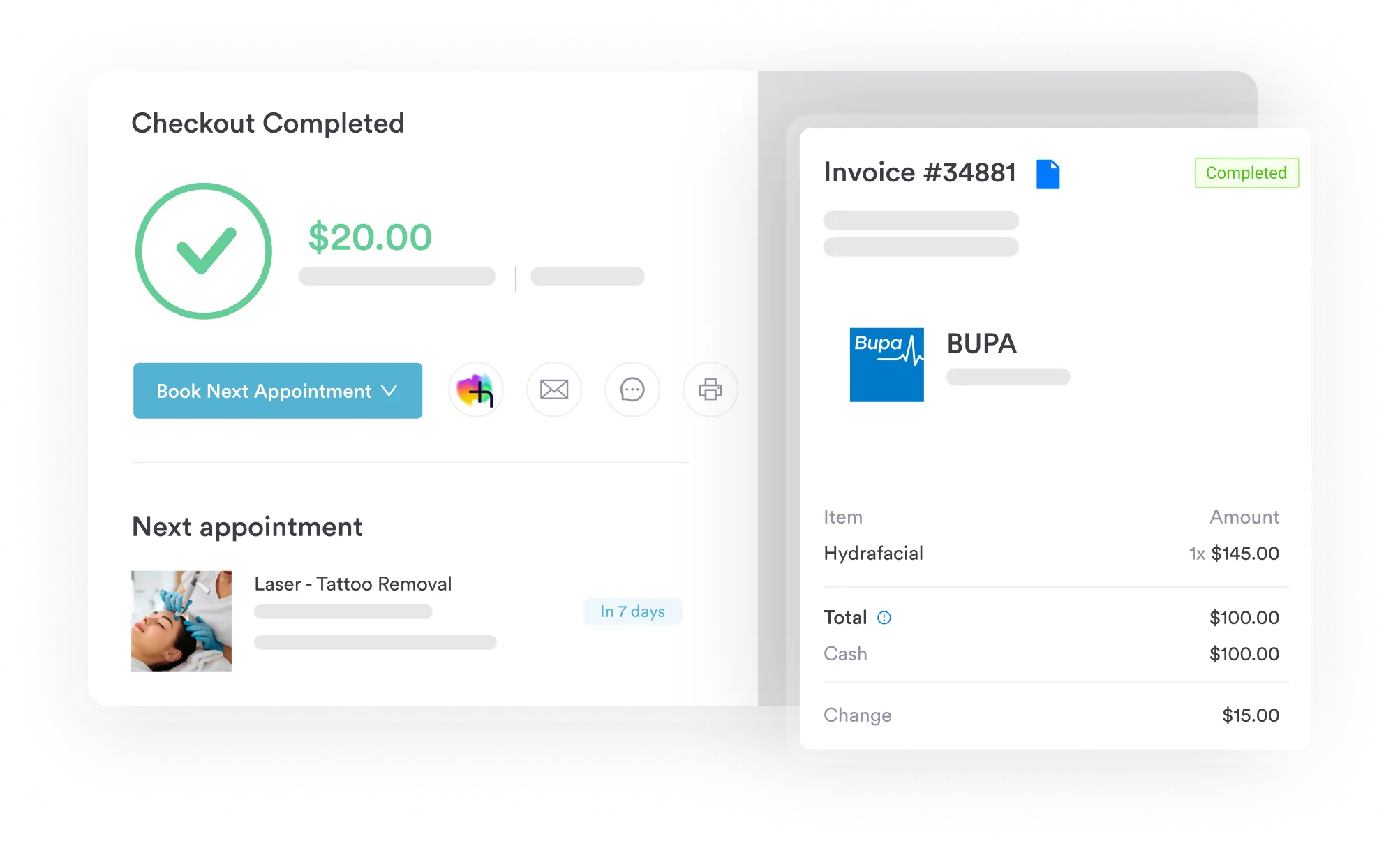
Pabau ties the completed invoice to the patient’s insurer at checkout, so the excision you billed is already on record when the claim is built.
Before the Send button unlocks, Pabau checks that required claim fields are complete, such as membership numbers and authorization codes. US claims then go through Claim.MD, with real-time eligibility checks, ERA posting and claim-status tracking.
Your billing team spends less time re-keying claims and chasing rejections for missing details. That leaves more time for the coding calls only a person can make.
Send cleaner ob-gyn claims the first time
Pabau pre-fills claims from the patient record, offers ICD-10-CM and CPT lookup libraries, and checks required fields before submission. US claims go through Claim.MD with eligibility checks and ERA posting.
CPT code 57135 rewards a simple habit. Code what the surgeon removed, and only when the note proves the mass came out whole. If it can’t show a complete excision of a discrete mass, 57135 is the wrong code, and no modifier will rescue the claim.
The best place to prevent a 57135 denial is the operative note template your surgeons use. When it prompts for site, size, technique and completeness, choosing between 57135, 57130, 57105 and 57200 becomes routine. Hold the claim for pathology when the diagnosis could change, and treat the 10-day global as part of the payment.
For a refresher on the wider revenue cycle, see how medical billing works from charge to payment. Book a demo to see how Pabau pre-fills and submits gynecology claims, so fewer come back for missing details.
Continue your research
Need to understand how clearinghouse submissions work for surgical codes?Medical claims clearinghouse guide explains how claims route from practice to payer and where errors are caught.
Want a reference for understanding 837P claim file structure?837 electronic claim file guide covers how EDI transactions carry CPT codes, modifiers, and diagnosis pairings to payers.
Reviewing what goes into a superbill for surgical procedures?Superbill guide outlines what elements a complete superbill must capture before a surgical claim is submitted.
Frequently asked questions
Is CPT 57135 covered by Medicare?
Yes, Medicare covers CPT 57135 when medical necessity is documented and a supporting ICD-10 code is on the claim. The 2026 Medicare Physician Fee Schedule assigns approximately 5.04 total RVUs in facility settings and 7.28 in non-facility settings. That is about $168 and $243 nationally before geographic adjustment.
What is the global period for CPT 57135?
CPT 57135 has a 10-day global period. It covers the day of the procedure and the 10 days after it, and routine follow-up visits in that window aren’t billed separately. An unrelated visit during the global period takes modifier -24.
Can you bill an office visit on the same day as 57135?
Only when the visit addresses a significant, separately identifiable problem. For a minor procedure like 57135, the evaluation that leads to the excision is part of the procedure payment. A separate visit is billed with modifier -25 and its own documentation.
What is the CPT code for Bartholin cyst removal?
Bartholin cysts aren’t coded with 57135. Use 56740 for excision of a Bartholin gland or cyst, 56440 for marsupialization, and 56420 for incision and drainage of a Bartholin abscess.
Who bills the pathology for a 57135 specimen?
The pathologist bills the specimen exam separately, under their own surgical pathology code. The surgeon reports only 57135. Coding from the final pathology report keeps both claims on the same diagnosis.