CPT code 34812: Open femoral artery exposure for endovascular repair
CPT code 34812: Official descriptor and procedure overview CPT code 34812 is off...

Last Updated: Nov 19, 2026
57200 is the CPT code for colporrhaphy, suture of injury of vagina (nonobstetrical). It covers the surgical repair of a vaginal laceration or wound that did not arise from childbirth.
The code sits in the Female Genital System section of CPT (56405-58999) and carries a 90-day global period. Payers often deny it when it is billed for vaginal cuff dehiscence, a postpartum laceration, or an injury that also involves the perineum.
Let Pabau's smart automation suggest the right codes, reduce claim denials, and keep your practice compliant—effortlessly.
Automate repetitive tasks and focus on what matters most—your patients.
Reduce coding errors and ensure compliance with the latest regulations.
Clean claims, fewer denials, and faster reimbursements.
Powerful insights and reporting to help your practice thrive.
HIPAA compliant SOC 2 certified GDPR-compliant Trusted by 4,000+ clinics worldwide

CPT code 57200 covers suture repair of a non-obstetric injury of the vagina, not cuff dehiscence or a postpartum laceration.
The code carries a 90-day global period under the CMS Physician Fee Schedule, with a work RVU of 4.31.
Once the injury involves the perineum, CPT 57210 describes the repair instead of 57200.
Vaginal cuff dehiscence is the most common misapplication. Use CPT 13160, with modifier -78 inside the hysterectomy global period.
Pabau’s claims management software tracks CPT 57200 submissions, modifiers, and denial reasons for OB/GYN practices.
CPT code 57200 reports colporrhaphy, the suture repair of a vaginal injury that did not arise from childbirth. FastRVU’s CPT 57200 listing of Medicare fee schedule data classes it as major surgery with a 90-day global period. The American Medical Association publishes the official descriptor: Colporrhaphy, suture of injury of vagina (nonobstetrical).
The word “nonobstetrical” decides code selection on every vaginal laceration claim. An injury from delivery belongs to the obstetric package, so 57200 applies only when the documentation rules childbirth out.
The procedure involves layered suture closure of the vaginal mucosa and submucosal tissues following a traumatic or non-obstetric surgical injury. It does not include an injury that also involves the perineum (see CPT 57210) or a dehisced wound. Anterior or posterior colporrhaphy with pelvic floor reconstruction has its own codes (see CPT 57240-57265).
Getting the scope right is where most 57200 denials originate. The code is narrow: It covers surgical suture repair of a vaginal injury that did not arise from obstetric delivery.
A clean claim for 57200 rests on three documentation pillars: The operative report, the diagnosis specificity, and the non-obstetric etiology statement. Submitting without all three invites payer scrutiny. For practices aiming at clean claim submission on the first pass, the operative note must address each element below.
The supporting ICD-10-CM diagnosis code must align with the etiology documented in the operative note. Mismatched codes between the op note and the claim form are among the top denial triggers for this procedure code.
CPT 57200 covers a non-obstetric injury of the vagina alone. CPT 57210 is colpoperineorrhaphy, the suture of an injury of the vagina and/or perineum, so it takes over once the perineum is involved. Confusing the two is the most common coding error in this range, and the table below maps the codes around them.
When one injury runs from the vaginal wall into the perineum, report 57210 alone, because its descriptor already covers both sites. Adding 57200 for the vaginal part of the same wound unbundles the repair. Confirm NCCI edits before billing 57200 with any other gynecologic procedure, as bundling edits are updated quarterly.
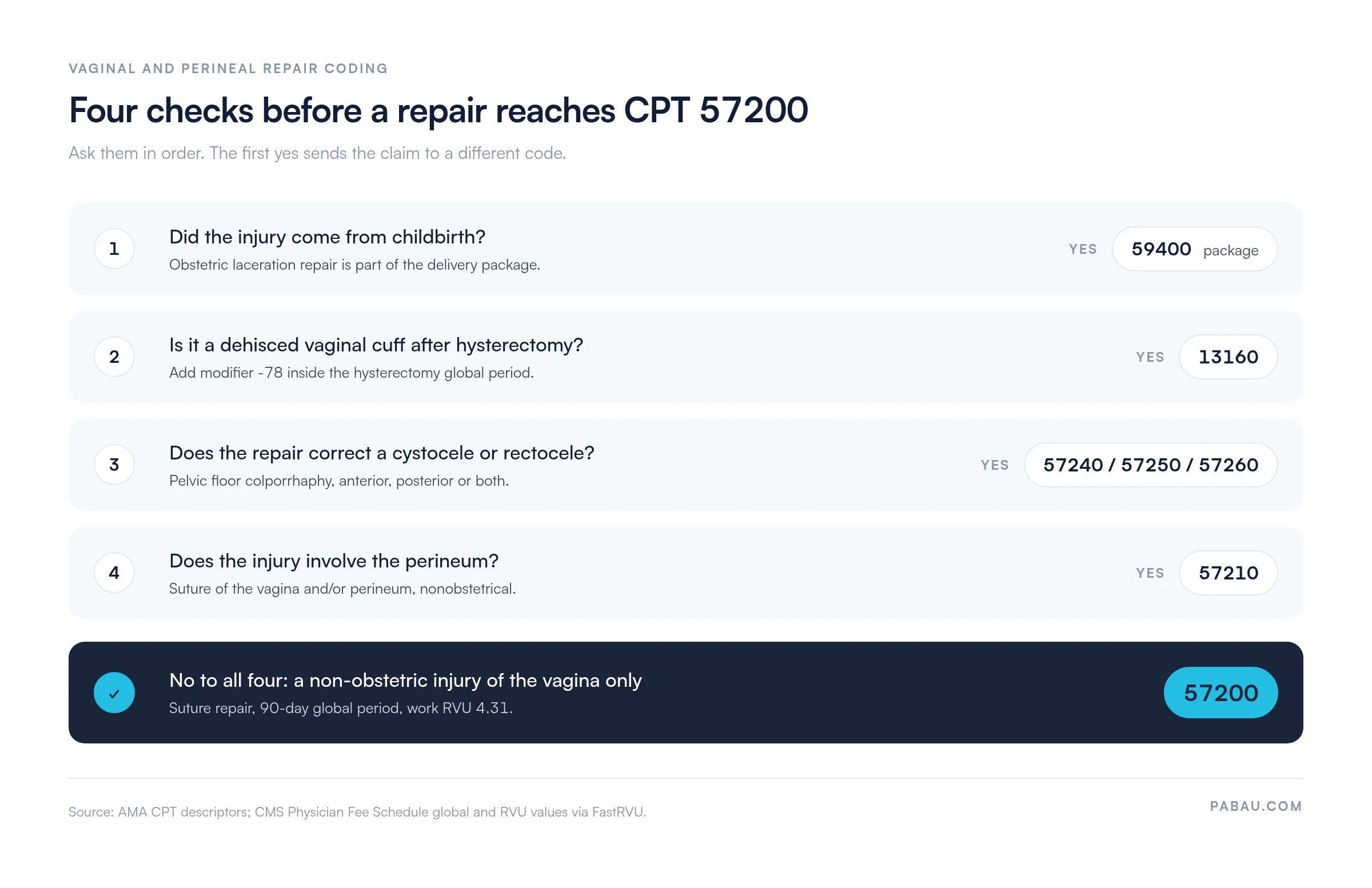
The chart below runs the checks in the order a coder should ask them, from delivery-related injury down to a repair of the vagina alone.
CPT 57200 carries a 90-day global period under the CMS Physician Fee Schedule, the indicator 090 used for major surgery. The surgical payment bundles the preoperative visit the day before and routine follow-up care for 90 days after the procedure.
The obstetric global package needs specific attention. 59400 bundles antepartum care, the vaginal delivery, and routine postpartum care into one payment. A clinician may still perform a 57200 repair in that postpartum window for a distinct non-obstetric injury. The operative note must then establish that the injury is unrelated to the delivery.
Modifier -79 (unrelated procedure or service by the same physician during the postoperative period) is typically required to bypass the bundling edit. A grounding in medical billing fundamentals like global packages helps billing staff spot these risks before submission.
Modifier selection for 57200 depends on the clinical context, particularly whether the procedure falls within another code’s global period.
Modifier -78 is the most commonly misapplied modifier in this code range. It applies when 57200 is a return to the operating room for a complication of a prior surgery. That prior surgery must still be within its global period. It does not apply when the vaginal injury is entirely unrelated to any prior surgery.
Every CPT 57200 claim needs a supporting ICD-10-CM code that reflects a non-obstetric vaginal injury. The superbill documentation generated at the time of service should capture this diagnosis with the specificity payers require.
Vague codes like “vaginal disorder, unspecified” increase denial risk, so use the most specific code that matches the operative note. Reserve N89.8 for a vaginal injury no laceration or complication code describes.
Payers reject ICD-10 codes associated with obstetric or postpartum conditions when paired with 57200. Codes in the O-chapter (Pregnancy, childbirth and the puerperium) will typically trigger an automatic denial because they contradict the nonobstetric qualifier in the CPT descriptor.
Before submitting a CPT 57200 claim, run a quick diagnostic: does the ICD-10 code you have selected appear anywhere in the O-chapter? If yes, stop and document why the injury is unrelated to any concurrent or recent delivery. Flag the claim for pre-submission review rather than reprocessing after denial.
Medicare reimbursement for CPT 57200 is calculated from the CMS Physician Fee Schedule (PFS), which is updated each January. The figures below are 2026 PFS values as published by FastRVU.
Verify current-year rates with the CMS Physician Fee Schedule lookup tool before using them for payer negotiations or productivity calculations.
Use the FastRVU lookup tool to calculate the Medicare national payment amount with the current conversion factor and your locality’s geographic practice cost index (GPCI).
Medicaid rates, where applicable, are set by each state and are typically a percentage of the Medicare rate. Always confirm with the state Medicaid fee schedule.
Prior authorization for CPT 57200 varies by payer and clinical context. Emergency traumatic vaginal lacerations are rarely subject to prior authorization requirements, as they present as acute injuries requiring immediate surgical intervention.
Elective colporrhaphy performed on a scheduled basis is more likely to require pre-authorization, particularly from managed care plans and Medicare Advantage programs.
Never assume prior authorization is waived based on code category alone. Document every authorization reference number in the patient record and reference it on the CMS-1500 claim form in Box 23.
Denials on CPT 57200 cluster around five patterns, and each has a known fix. The guide to medical billing denial codes maps the CARC codes payers attach to them. A wider denial management process catches repeat patterns before resubmission.
Run a quarterly denial audit specifically for CPT 57200 and CPT 13160. Look for 57200 denials on patients who had a hysterectomy in the prior 90 days. That cluster means the team is coding cuff dehiscence repairs under the wrong code. A single code map correction eliminates the pattern.
Most 57200 denials start with a mismatch: the operative note says one thing and the claim says another. A billing team that re-keys codes from a typed note into a separate billing tool repeats that risk on every claim.
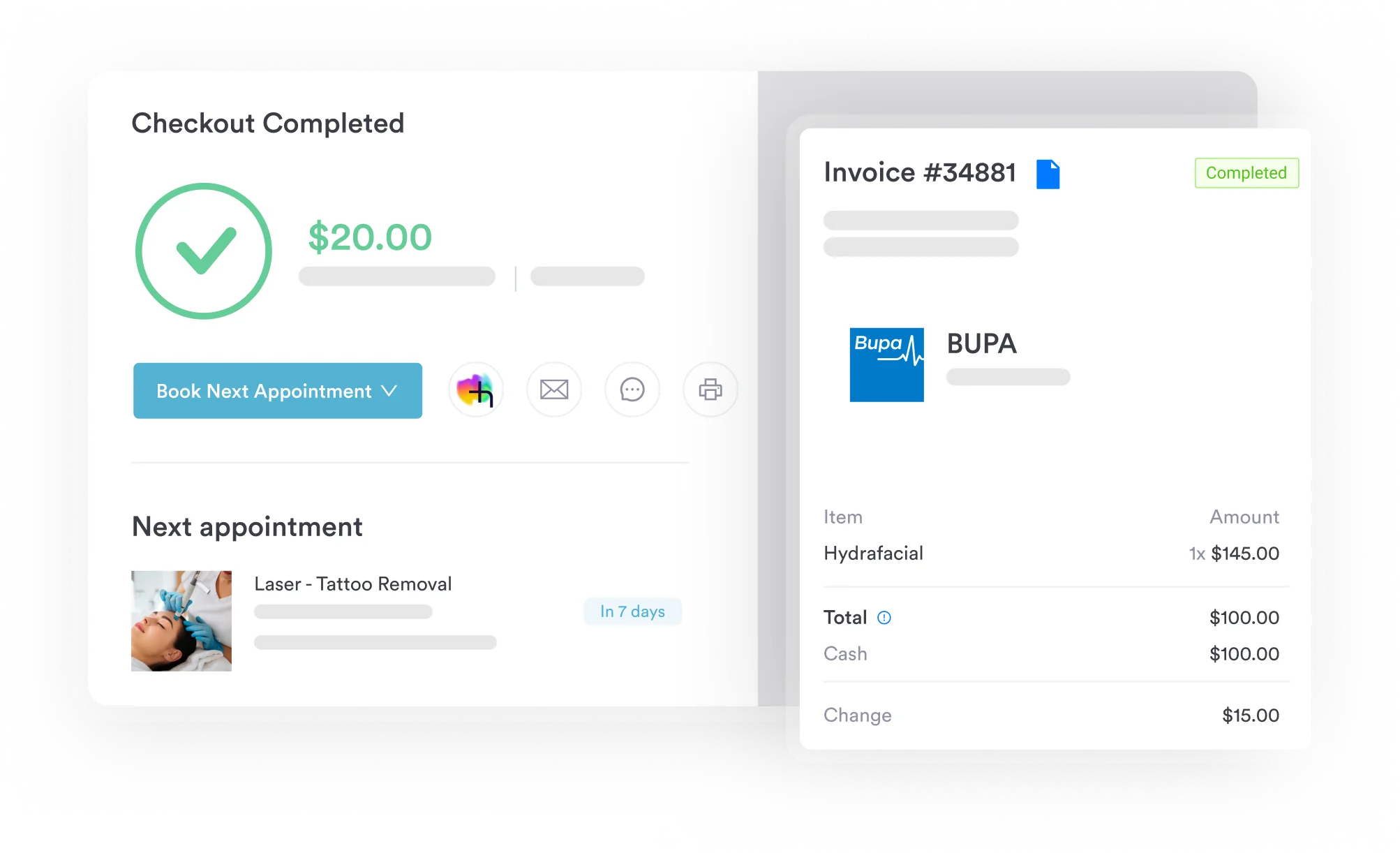
Pabau, a practice management and billing platform, keeps the note and the claim in one record. Its claims management software tracks denial reason codes by procedure code and supports corrected claim submission. A team can then spot a recurring 57200 pattern instead of treating each denial alone.
Claims go out through the Claim.MD clearinghouse, which connects to thousands of US payers, Medicare included. Eligibility responses, claim status, and remittance advice come back against the same patient record.

Pabau ties the operative note, the code, and the claim together, then tracks denial reasons by procedure code. See how OB/GYN practices use it to catch coding errors before submission.

A 57200 claim turns on two facts: where the injury came from and what it touched. A non-obstetric injury of the vagina alone is 57200. Childbirth, a dehisced cuff, pelvic floor repair, or perineal involvement each send the claim to another code.
Write both facts into the operative note before anyone codes the claim, and most of the denials above have nothing to attach to. The 90-day global period raises the stakes, because a wrong first claim also shapes how every follow-up visit is billed.
Book a demo to see how Pabau keeps the operative note, the code, and the claim in one workflow for gynecologic billing.

Want to understand how clearinghouse submissions work? Medical claims clearinghouse guide explains how payer connectivity, 837P formatting, and ERA remittances connect to your billing workflow.
CPT code 57200 covers colporrhaphy, the suture repair of a non-obstetric vaginal injury. It applies when a clinician surgically repairs a vaginal laceration or wound that did not arise from childbirth. The repair uses layered suture closure of the vaginal mucosa and submucosal tissues.
CPT 57200 covers suture repair of a non-obstetric injury of the vagina only. CPT 57210 is colpoperineorrhaphy, the suture of a non-obstetric injury of the vagina and/or perineum. Once the perineum is involved, 57210 is the code.
No. Vaginal cuff dehiscence following hysterectomy should be coded as CPT 13160 (secondary closure of surgical wound), not 57200. If the repair is performed as a return to the operating room within the hysterectomy’s global period, append modifier -78 to CPT 13160.
Yes, but only when the vaginal repair is for a non-obstetric injury that is clinically distinct from any delivery-related care. Append modifier -79 (unrelated procedure) and document in the operative note that the injury is unrelated to the concurrent or recent obstetric delivery. Without the modifier, the claim will bundle into CPT 59400.
Medicare rates for CPT 57200 are set annually in the CMS Physician Fee Schedule and vary by geographic locality. The work RVU is 4.31 and the total RVU is 9.12, which gives a 2026 national payment of $304.62 before GPCI adjustment. The locality’s GPCI then moves that figure up or down. Use the CMS PFS lookup tool or FastRVU to verify current-year rates for your specific location.
The operative note must document the anatomical site, wound length and depth, and the suture technique and materials used. It must also state that the injury is non-obstetric and that the repair addressed a distinct injury. A matching non-obstetric ICD-10-CM diagnosis code must accompany the claim.
Prior authorization requirements for CPT 57200 vary by payer. Emergency traumatic repairs rarely require prior authorization. Elective colporrhaphy under managed care or Medicare Advantage plans may require pre-authorization. Always verify with the specific payer before the procedure and document any authorization reference number on the claim form.