HCPCS Code Q4185: Cellesta flowable amnion billing guide
HCPCS Code Q4185: definition and official descriptor HCPCS Code Q4185 is the Lev...

Last Updated: Nov 20, 2026
57100 is the CPT code for biopsy of vaginal mucosa; simple (separate procedure). It reports a superficial vaginal biopsy where bleeding is controlled without sutures.
It sits in a three-code family with 57105 and 57106, and the choice between 57100 and 57105 turns on whether the clinician placed sutures. Practices that bill vaginal procedures most often see claims denied for miscoding between 57100 and 57105, a mismatched ICD-10 diagnosis, or missing pathology documentation. All three errors are preventable, and each is covered below.
Let Pabau's smart automation suggest the right codes, reduce claim denials, and keep your practice compliant—effortlessly.
Automate repetitive tasks and focus on what matters most—your patients.
Reduce coding errors and ensure compliance with the latest regulations.
Clean claims, fewer denials, and faster reimbursements.
Powerful insights and reporting to help your practice thrive.
HIPAA compliant SOC 2 certified GDPR-compliant Trusted by 4,000+ clinics worldwide

CPT Code 57100 covers a simple vaginal mucosa biopsy closed without sutures. If the site needed a suture, the claim takes 57105 instead.
Every 57100 claim needs an ICD-10-CM diagnosis that establishes medical necessity for a vaginal biopsy. A mismatched diagnosis is the leading denial trigger.
Medicare pays 57100 at different rates in facility and non-facility settings, so check current values in the CMS Physician Fee Schedule before billing.
A vaginal biopsy taken during colposcopy is reported with 57421, not with 57100.
Pabau, a practice management platform with built-in claims management, submits claims through Claim.MD and checks eligibility before the claim goes out.
CPT Code 57100 is the code for a simple biopsy of vaginal mucosa, where the clinician removes superficial tissue for pathology and places no sutures.
Its official descriptor in the AMA’s CPT code set reads: Biopsy of vaginal mucosa; simple (separate procedure). “Separate procedure” means it is not ordinarily reported alongside a more comprehensive vaginal surgery at the same session.
An OB/GYN or gynecologic oncologist usually performs it in an office or outpatient setting. Abnormal cytology, a visible lesion, or another clinical finding prompts the need for histologic confirmation.
A punch or cup biopsy instrument removes a small tissue core from the vaginal wall mucosa. The clinician confirms hemostasis and sends the specimen to pathology.
No suture is placed, and that detail is what separates 57100 from 57105. Keeping it clear in the note prevents the most common miscoding in this procedure family.
The code covers a narrow slice of vaginal biopsy work, so its scope boundaries guard against both undercoding and upcoding. Verify what is and isn’t within scope using the PGM Billing CPT lookup before submitting.
A coder’s practical rule: if the operative note mentions sutures, the claim cannot use 57100. The pathology examination of the specimen is billed separately and is never bundled into 57100 itself.
An operative note that only says “vaginal biopsy performed” gives the payer nothing to audit and puts the claim at risk. The note must establish medical necessity and confirm each element that justifies 57100 specifically. Sound medical billing practice treats the operative note as the claim’s primary evidence.
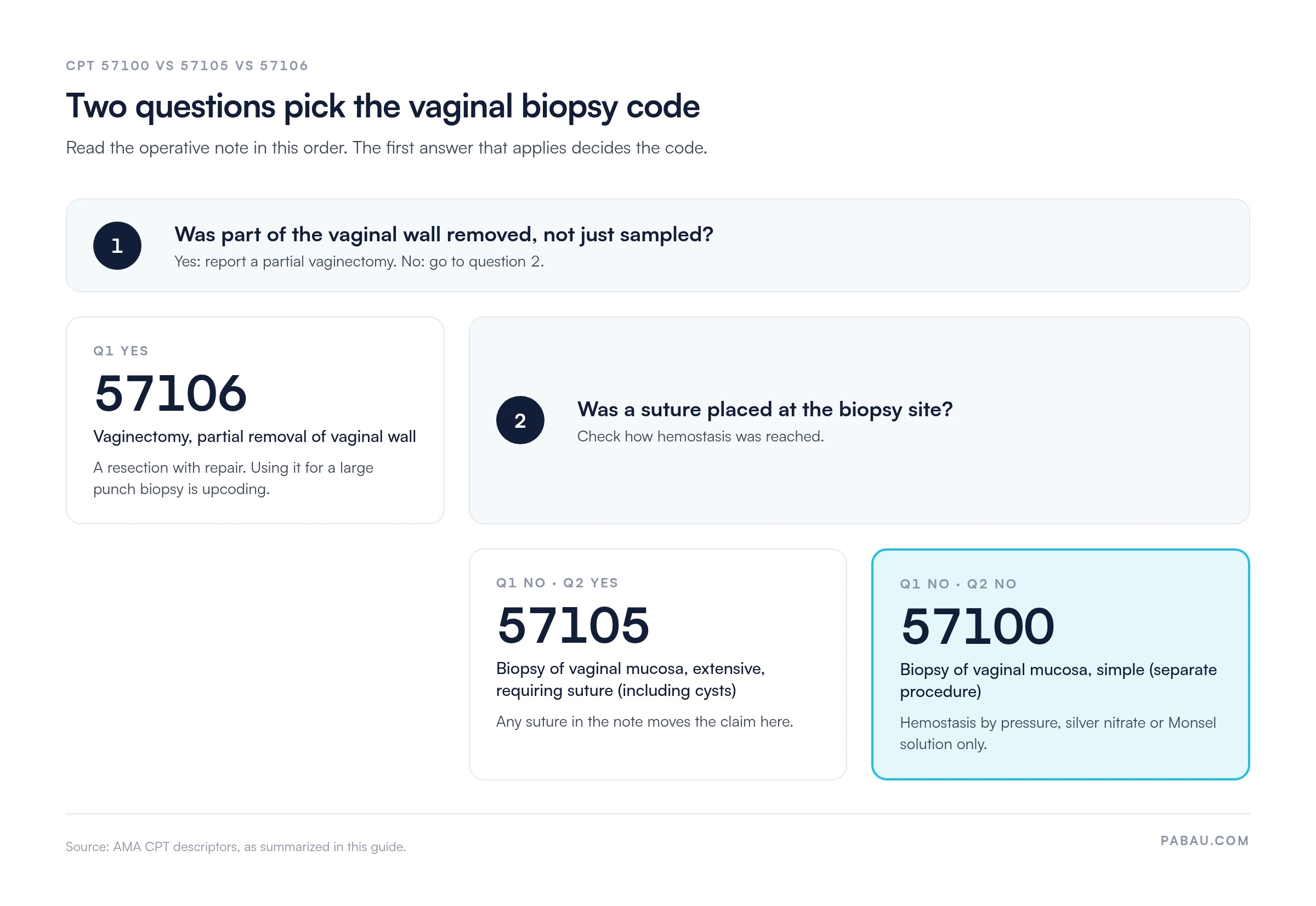
These three codes form a complexity ladder, and choosing the wrong rung is a common error in vaginal biopsy billing. Check the descriptor language in the AAPC Codify CPT lookup before submission.
The 57106 descriptor reflects a far more involved procedure than a biopsy. If you’re unsure whether the operative findings cross into vaginectomy territory, check the current AMA descriptor before coding. Using 57106 for a large punch biopsy is upcoding, so the order of the two questions below matters.
The National Correct Coding Initiative (NCCI), maintained by the Centers for Medicare and Medicaid Services (CMS), governs what can be billed alongside CPT Code 57100. NCCI edit tables are updated quarterly, so verify active edit pairs before submitting. Three bundling scenarios come up most often:
Run an NCCI edit check before submitting any claim that pairs 57100 with a same-day E/M, hysteroscopy, or colposcopy. NCCI tables update every quarter, so an edit pair that allowed separate billing last year may bundle this year. Build a quarterly audit into your coding workflow to stay current.
Every CPT Code 57100 claim needs a diagnosis code that establishes medical necessity for the vaginal biopsy. Payers, including Medicare, check the ICD-10-CM code against their local coverage determinations (LCDs).
A mismatch between procedure and diagnosis is the most common denial trigger for this code family. A visible vaginal lesion that fits no more specific category is coded N89.8.
Coverage determinations vary by payer and Medicare Administrative Contractor (MAC). A diagnosis that satisfies one payer’s LCD may not satisfy another’s. Map the diagnosis code to the specific payer’s published coverage policy before billing. Never assign a code that overstates the documented clinical finding to gain coverage.
Medicare reimburses CPT Code 57100 through the Medicare Physician Fee Schedule (MPFS), which the CMS Physician Fee Schedule lookup tool updates annually.
Reimbursement differs depending on where the procedure is performed. Use the FastRVU 2026 RVU lookup to retrieve current work, practice expense, and malpractice RVU values by locality.
The global surgical period for 57100 is typically 0 days under the CMS MPFS, so postoperative follow-up is not bundled into the procedure fee. Confirm the global period for the current year in the MPFS database before billing post-procedure visits separately.
Commercial payers generally follow Medicare’s coverage framework, but prior authorization requirements vary. Many commercial plans don’t require prior authorization for 57100, so check the payer-specific portal before the procedure date.
HIPAA mandates standardized code sets for covered transactions, so CPT is required for all commercial and government payer submissions in the United States.
Most 57100 denials are preventable. Consistent pre-submission checks and a steady denial management workflow stop most of them before the claim reaches the payer.
When a 57100 claim does come back denied, the remittance carries a reason code that points to one of the rows above. Our guide to claim denial codes explains what each one means.
This checklist covers the documentation elements that set a CPT Code 57100 claim apart from generic biopsy coding. Run it as a pre-submission review to catch the common denial triggers before the claim reaches the clearinghouse. The goal is a clean claim on the first submission.
Build this checklist into your billing workflow as a pre-claim review step. Flag any encounter where the operative note does not state that no sutures were placed. That single element is the most frequent source of upcoding audit findings for vaginal biopsy claims.
Most 57100 denials start with a detail the operative note recorded but the claim lost: the hemostasis method, the vaginal site, or the pathology requisition. When the note and the claim sit in separate systems, a biller has to re-key each of those by hand.
Pabau, a practice management platform with built-in OB/GYN claims management, keeps the clinical note and the claim in one patient record. The billing team codes from the note itself, so a documented suture or a missing pathology order is visible before the claim goes out.
Claims route out through the Claim.MD clearinghouse as 837P files, with eligibility checked before submission. Claim status updates and electronic remittance advice come back against the same patient record.

Pabau connects your clinical notes to your billing workflow. CPT codes, diagnosis pairings, and claim submissions stay accurate from the first note to the final ERA.

CPT Code 57100 rewards one habit above the rest: write the hemostasis method into every vaginal biopsy note. A note that says “pressure and silver nitrate, no sutures” defends the code in an audit. A note that says nothing about closure leaves the payer free to question it.
The diagnosis is the other half. Pick the most specific vaginal finding the record supports, then check it against the payer’s LCD before the claim goes out. Get those two lines right and most 57100 denials never happen. Book a demo to see how Pabau links the operative note to the claim for gynecologic procedures.

Want to understand how claim denials are managed systematically? What is revenue cycle management explains the end-to-end billing pipeline from encounter to payment posting.
Coding a suspected or confirmed vaginal cancer? ICD-10 code C52 covers malignant neoplasm of the vagina, the diagnosis to pair with that biopsy.
CPT Code 57100 covers a simple biopsy of the vaginal mucosa performed without suture closure. The code includes superficial tissue removal, hemostasis by pressure or topical agent, and submission of the specimen to pathology. It does not include wound closure by suture, endometrial sampling, or cervical biopsy.
The difference is suture closure. CPT 57100 is used when hemostasis at the biopsy site is reached without sutures. CPT 57105 is used when the biopsy needs a suture to close the defect or control bleeding. Any documentation of sutures in the operative note rules out 57100 and requires 57105.
Yes, Medicare reimburses CPT Code 57100 through the Medicare Physician Fee Schedule, with separate rates for facility and non-facility settings. The non-facility rate is higher because it reflects office overhead. Verify the current year’s payment amount using the CMS Physician Fee Schedule lookup tool, as rates change annually.
Yes, a same-day E/M may be billed with CPT 57100 when it represents a separately identifiable service. Append modifier 25 to the E/M code and document the distinct clinical issue addressed during the visit. Without modifier 25, most payers will bundle the E/M payment into the procedure fee.
Possibly, with caution. NCCI may bundle 57100 as a component of 58558 (hysteroscopy with biopsy) when performed in the same encounter. If the vaginal biopsy was performed at a distinct anatomical site with a separate indication, modifier 59 on 57100 may allow separate billing. Verify the active NCCI edit pair before submitting, and make sure the documentation clearly supports a distinct service.
The global surgical period for CPT 57100 is typically 0 days under the CMS Physician Fee Schedule. That means routine postoperative follow-up is not bundled into the procedure payment. Confirm the current-year global period in the MPFS database, because CMS may update it.