ICD-10 Code R63.4: Abnormal weight loss
ICD-10 Code R63.4: Definition, billability, and code structure ICD-10 code R63.4...

Last Updated: Nov 13, 2026
Billable Code Specific Code
N89.8 is the billable ICD-10-CM code for other specified noninflammatory disorders of vagina. It covers a named vaginal condition with no more precise N89 code. Examples include leukorrhea NOS, a vaginal cyst, an old vaginal laceration and a pessary ulcer.
The code sits in category N89 of Chapter 14. A named condition separates it from N89.9, and a note that rules out inflammation or infection keeps it clear of N76.-.
Let Pabau's smart automation suggest the right codes, reduce claim denials, and keep your practice compliant—effortlessly.
Automate repetitive tasks and focus on what matters most—your patients.
Reduce coding errors and ensure compliance with the latest regulations.
Clean claims, fewer denials, and faster reimbursements.
Powerful insights and reporting to help your practice thrive.
HIPAA compliant SOC 2 certified GDPR-compliant Trusted by 4,000+ clinics worldwide

N89.8 is a billable ICD-10-CM code valid for FY2027, covering other specified noninflammatory vaginal disorders not captured by sibling codes.
Use N89.8 when documentation names a specific noninflammatory condition; use N89.9 only when the condition is truly unspecified.
Inflammation of the vagina (N76.-) is an Excludes1 condition for N89, so coding it alongside N89.8 triggers a claim edit.
Pabau’s claims management software carries the diagnosis code onto the claim and sends US claims to payers via Claim.MD.
ICD-10 Code N89.8 sits in the N89 block of Chapter 14 of ICD-10-CM, covering noninflammatory disorders of the female genital tract.
The table below confirms the core reference data coders need before building a claim.
Verify the current-year tabular listing in the CDC/NCHS ICD-10-CM web tool before submitting any claim. Annual CMS updates occasionally revise code descriptors or add sibling codes to an existing block.
N89.8 captures the clinical presentations in the N89 family that have a known, documented etiology but do not map to a more specific code. The noninflammatory qualifier decides the code. If the physician’s note describes inflammation, infection, or an organism, N89.8 is the wrong code.
Conditions commonly indexed to N89.8 in the ICD-10-CM alphabetic index include:
The phrase “other specified” signals that the physician has named the condition but the ICD-10-CM tabular does not offer a dedicated code for it. When documentation is too vague to name the condition, N89.9 (noninflammatory disorder of vagina, unspecified) applies instead.
Knowing where N89.8 sits within the N89 block helps prevent code-selection errors. Each sibling code has a distinct qualifier. Choosing a less specific code than the documentation supports is a coding error that payers may audit.
Severe vaginal dysplasia (VAIN III) is not in N89. It codes to D07.2, carcinoma in situ of vagina.
The CMS ICD-10-CM annual update files publish any descriptor or hierarchy changes each October. Check the FY2027 release for any N89 block revisions before the new fiscal year begins.
Excludes notes govern which codes may and may not appear alongside N89.8 on the same claim. Violating an Excludes1 rule is one of the fastest paths to a denial.
Excludes1 (never coded together): The tabular places Excludes1 notes at two levels. A condition in either group takes the code shown, never N89.8.
N89 category:
N89.8 itself:
Excludes2 (not included here, but may coexist): The N89 category’s Excludes2 note lists senile (atrophic) vaginitis (N95.2). That condition is not part of N89, so N95.2 may be reported alongside N89.8 when both are documented. Excludes2 allows both codes together. It does not list other genitourinary conditions.
The practical test: If the physician’s note mentions infection, inflammation, or an organism, look for a more specific code before defaulting to N89.8. Acute vaginitis, for example, codes to N76.0. Only the physician can document that a condition is noninflammatory, so query the provider when the note is silent. A saline or KOH wet mount run to rule out infection bills to commercial payers as 87210. N89.8 stays the pointer when the smear is non-specific.
The codes most frequently confused with N89.8 share overlapping clinical presentations. This comparison table covers the decision rule for each.
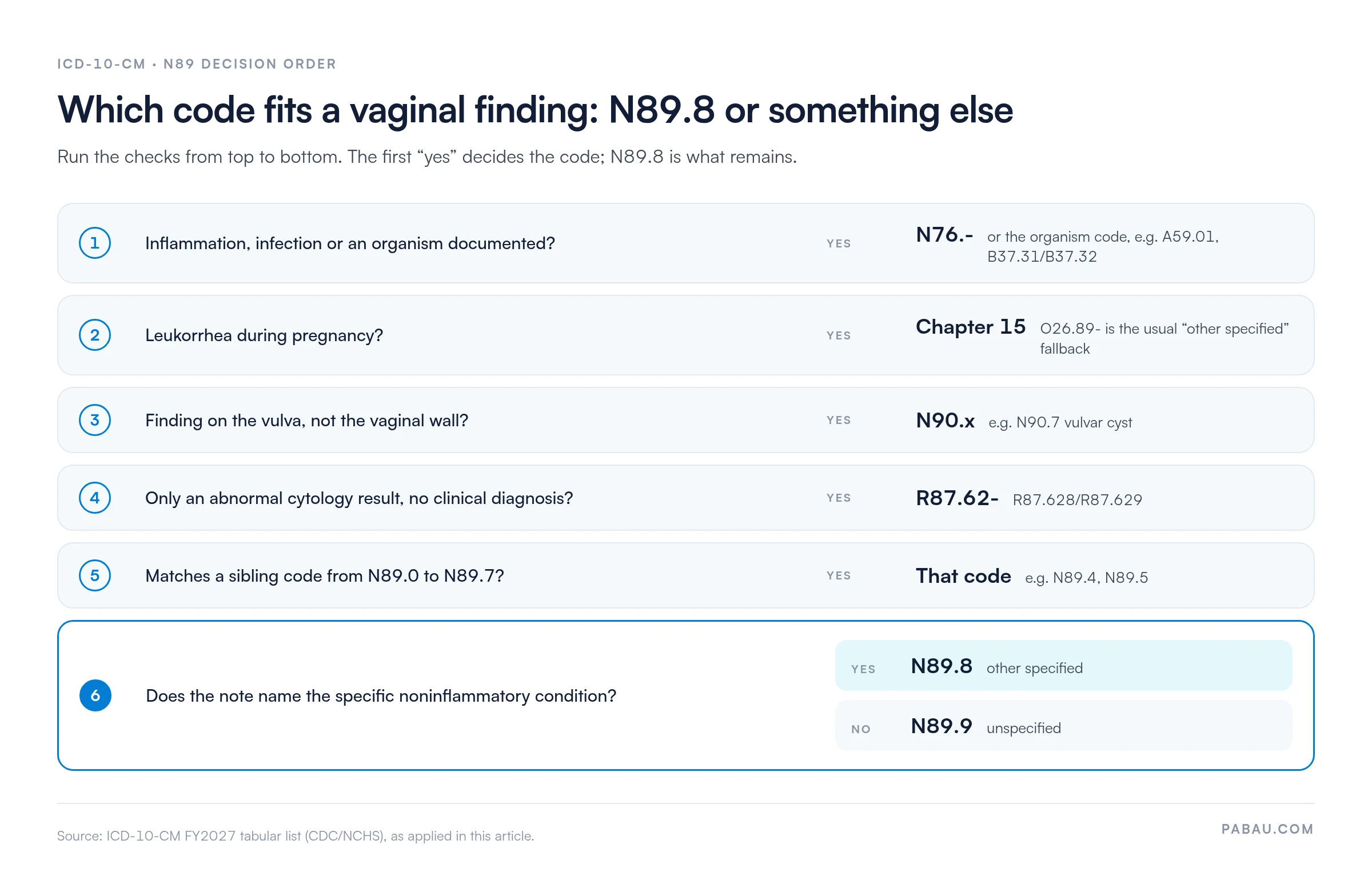
The checks run in a fixed order, and the first one that applies decides the code. The decision order below sets them out for a single encounter.
A claim built on N89.8 is only as defensible as the physician’s note behind it. Payers auditing gynecology claims look for four specific documentation elements before accepting N89.8 as a supported diagnosis.
When documentation is incomplete, the coder’s first step is a physician query. Assign N89.9 as a placeholder if needed, then amend once the clarification is received. Aligning with billing compliance requirements protects the practice during payer audits.
Before assigning N89.8, run a quick noninflammatory check: scan the note for the words ‘vaginitis’, ‘inflammation’, ‘infection’, ‘organism’, ‘culture positive’, or any organism name. If any appear, stop and query the physician before proceeding. One missed inflammatory keyword is enough to trigger an Excludes1 denial.
N89.8 serves as the supporting diagnosis code when procedure claims require a gynecological diagnosis to establish medical necessity. The table below lists CPT codes most frequently billed alongside N89.8 and the medical necessity linkage for each.
Each CPT line on the claim points to the diagnosis that justifies it. For a new patient visit billed as 99203, that pointer is N89.8 when the vaginal condition drove the visit.
Coverage for each procedure code varies by payer and clinical indication. Confirm that the procedure’s medical necessity is explicitly supported by N89.8 documentation before submission. Use the AAPC Codify ICD-10-CM lookup to verify crosswalk relationships between N89.8 and specific CPT codes.
No national coverage determination (NCD) exists that specifically governs N89.8 as a standalone diagnosis. Coverage is therefore determined at the Local Coverage Determination (LCD) level by Medicare Administrative Contractors (MACs), and by individual payer policy for commercial insurers.
Key payer considerations for gynecology billing teams using N89.8:
Before submitting, verify eligibility and policy rules for each payer. Submitting a clean claim on the first attempt cuts adjudication delays on N89.8 encounters.
N89.8 claims fail for a small set of repeating reasons, and each one has a known fix.
A structured denial management workflow helps gynecology billing teams catch these patterns before they compound. Cross-reference your practice’s denial history against common denial codes to identify whether N89.8 is a recurring source of rejected claims.
Run a quarterly claim audit on N89.8 encounters. Filter your EHR for N89.8 as the primary diagnosis, then check those claims for an N76.- code. The check surfaces Excludes1 violations before payers find them in an audit.
N89.8 remains a valid, billable code for FY2027, effective October 1, 2026. No descriptor change, deactivation, or replacement has been announced for N89.8 in the CMS FY2027 annual tabular update. The code has been active and billable since ICD-10-CM replaced ICD-9-CM in October 2015 and has not been revised during that period.
The N89 block as a whole also remains structurally unchanged for FY2027. No new sibling codes have been added between N89.8 and N89.9, and the block boundaries (N89.0 through N89.9) are unchanged. CMS publishes the FY2027 update files on its ICD-10 codes page. The CDC/NCHS tabular list carries the official code text.
Confirm the code’s status before each October 1 fiscal year change. The CDC ICD-10-CM tabular and index are the authoritative sources for US coding.
Many gynecology teams read the physician’s note in one system and build the claim in another. Each handoff is a chance to drop the named condition or pair N89.8 with an excluded N76.- code.
Pabau, the practice platform we build for clinical and billing teams, keeps the diagnosis code on the patient record beside its supporting note. Its claims management software carries that code onto the CMS-1500/837P claim. Claims then go to US payers via Claim.MD, including eligibility checks.
Payer responses come back as ERA remittances on the same record. Your billing team sees the payer’s answer next to the note and the code it questioned, so the correction starts from the documentation.

Pabau links each diagnosis code to the note behind it and sends US claims via Claim.MD, so N89.8 encounters reach payers clean.

N89.8 is safe to bill when the note holds two facts: a named noninflammatory condition and no sign of infection or inflammation. If either is missing, query the physician or fall back to N89.9 instead of stretching the code.
The excluded N76.- pairing is the error worth guarding against, because claim editors flag it automatically. A pre-submission check for that pairing is quicker than working the denial afterward. Book a demo to see how Pabau ties each diagnosis code to its documentation before the claim goes out.

Need a denial resolution framework for gynecology claims? Denial management in healthcare outlines a step-by-step workflow for tracking, categorizing, and appealing rejected claims.
Looking for the full list of denial codes that affect gynecology billing? Common denial codes in medical billing covers CARC and RARC codes most frequently returned on women’s health claims.
Want to understand how claims flow from diagnosis to payment? Revenue cycle management fundamentals explains the end-to-end process for outpatient gynecology practices.
Coding an inflammatory vaginal condition instead? ICD-10 code N76.0 covers acute vaginitis, one of the inflammatory codes that N89.8 excludes.
ICD-10 Code N89.8 is the billable ICD-10-CM diagnosis code for other specified noninflammatory disorders of vagina. It covers conditions such as leukorrhea NOS, vaginal cysts, old vaginal lacerations and pessary ulcers. It also takes other named noninflammatory vaginal findings with no more precise code in the N89 block. The code is valid for FY2027 and has been active since ICD-10-CM implementation in October 2015.
Yes, N89.8 is a fully billable ICD-10-CM code for FY2027. It can go on a CMS-1500 or 837P claim as a primary or secondary diagnosis. The physician’s documentation must name the specific noninflammatory vaginal condition and rule out an inflammatory or infectious cause.
N89.8 applies when the physician has documented a specific noninflammatory vaginal condition by name. N89.9 applies when a noninflammatory vaginal disorder is present but its type is unspecified. Using N89.8 when documentation only supports N89.9 is a coding error that payers may flag on audit. Always confirm the physician has named the condition before assigning N89.8.
Leukorrhea not elsewhere classified maps to N89.8 when it is documented as noninflammatory and not attributable to a coded organism or structural cause. Leukorrhea during pregnancy is a pregnancy-related condition, so code it from Chapter 15 rather than N89.8. O26.89- (other specified pregnancy-related conditions) is the usual fallback. Vaginal discharge with an identified inflammatory cause codes to the specific inflammatory condition (e.g., N76.0 for acute vaginitis).
Use N89.8 when the physician has named a noninflammatory vaginal condition but no more specific ICD-10-CM code exists for that condition within the N89 block. First check N89.0 through N89.7 for a matching descriptor. If the condition is leukoplakia, it maps to N89.4; if it is vaginal stricture, it maps to N89.5. N89.8 is the residual “other specified” slot when those sibling codes do not fit.
No additional documentation is mandated beyond standard ICD-10-CM requirements. The physician’s note must still name the specific noninflammatory condition and rule out an inflammatory cause, explicitly or implicitly. When N89.8 supports a procedure such as colposcopy (57420), payers may apply LCD-based criteria. Those criteria require a documented abnormal vaginal finding that justifies the procedure, so the clinical rationale must be explicit in the note.