

CCSD Code D1010: Radical mastoidectomy including meatoplasty
CCSD Code D1010: Definition and clinical scope CCSD Code D1010 is the UK private...

Last Updated: Nov 25, 2026
56700 is the CPT code for partial hymenectomy or revision of the hymenal ring. It covers removing part of the hymen, or reshaping its ring, when a structural problem such as an imperforate hymen makes surgery medically necessary.
It sits in the Vulva, Perineum, and Introitus subsection of the Female Genital System surgery codes. Assignment turns on excision. A simple incision of the hymen is hymenotomy, reported with 56442 instead.
Let Pabau's smart automation suggest the right codes, reduce claim denials, and keep your practice compliant—effortlessly.
Automate repetitive tasks and focus on what matters most—your patients.
Reduce coding errors and ensure compliance with the latest regulations.
Clean claims, fewer denials, and faster reimbursements.
Powerful insights and reporting to help your practice thrive.
HIPAA compliant SOC 2 certified GDPR-compliant Trusted by 4,000+ clinics worldwide

CPT code 56700 covers partial hymenectomy or revision of the hymenal ring. Hymenotomy, a simple incision, is reported with 56442 instead.
Payers deny 56700 as cosmetic unless a structural diagnosis such as imperforate hymen (ICD-10 Q52.3) or tight hymenal ring (N89.6) leads the claim.
The code carries a 10-day global period. A same-day E/M service needs Modifier 25 on the E/M code, never on 56700.
Pabau’s claims management software supports gynecology practices with clean claim submission, eligibility verification, and denial tracking across payers.
CPT code 56700 is defined as “Partial hymenectomy or revision of hymenal ring.” The NASPAG gynecology coding sheet lists it as the procedure code for imperforate hymen, with 2.84 work RVUs and a 10-day global period.
It sits in the Vulva, Perineum, and Introitus subsection (56405 to 56821) of the Female Genital System surgery codes. The code covers excision or revision of hymenal tissue. A simple incision of the hymen is hymenotomy, which is reported with 56442 instead.
The hymen is a thin membrane at the vaginal introitus. CPT code 56700 covers two related surgical acts: partial excision of the hymenal membrane, and revision of the hymenal ring. For either one, the coder needs the operative report to state which was performed and why.
Common indications in operative reports include imperforate hymen causing hematocolpos, microperforate hymen causing recurrent infections, and symptomatic hymenal tags. Post-surgical revision of a prior hymenectomy site also qualifies.
The coder must tell excision, where tissue is removed, from incision, where tissue is cut but not removed. Incision alone is hymenotomy, a different procedure reported with 56442.
Medical necessity for hymenectomy is the primary battleground for CPT code 56700 denials. Payers will approve the procedure when a structural or symptomatic diagnosis is documented. They will deny it, usually under cosmetic exclusion clauses, when documentation suggests the procedure was performed for cultural, religious, or elective non-medical reasons.
Imperforate hymen often presents at puberty with hematocolpos, so many of these patients are minors. Coders should flag a pediatric record for additional consent and documentation requirements. These vary by state and institution, and the billing team should not make scope-of-practice calls on its own.
The diagnosis code tells the payer why the surgery was needed. A symptom-only code, used when a structural code is available, is a common trigger for medical necessity denials.
Use the most specific structural code available. In the CDC ICD-10-CM coding tool, Q52.3 is the code for imperforate hymen. It is the strongest single code to pair with 56700 for a medically indicated procedure.
Read together, the procedure code and the lead diagnosis come down to two questions about the operative note.
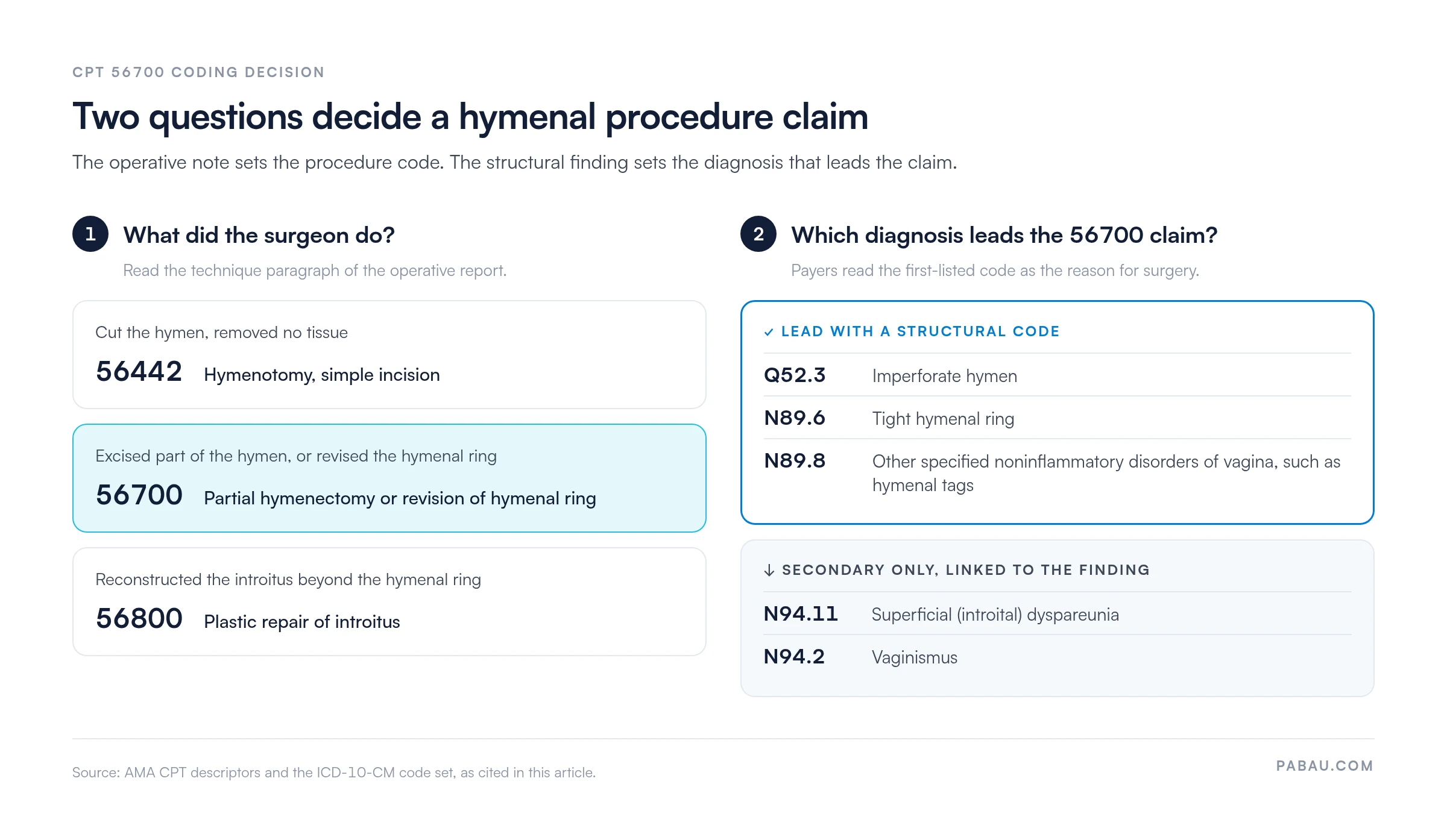
The codes most often confused with 56700 sit in the same subsection or describe adjacent procedures. The wrong choice usually ends in a down-coded payment or a medical necessity denial.
Check the operative report for the exact term used by the surgeon. ‘Hymenotomy’ (incision only, no tissue removed) is reported with 56442, not 56700. If the report says ‘incision of the hymen’ without excision language, ask the physician to clarify before submitting.
Coverage for CPT code 56700 depends on the indication, whatever the payer. Medicare covers medically necessary hymenectomy when supported by an appropriate structural diagnosis and documentation.
Commercial payers typically follow a similar framework but apply cosmetic-exclusion language more aggressively. Run insurance eligibility verification before the procedure date to confirm plan-level coverage and prior authorization rules.
CPT code 56700 reimbursement under Medicare is calculated using the Resource-Based Relative Value Scale (RBRVS). The table below shows indicative RVU components based on current CMS Physician Fee Schedule data.
Payment amounts vary by locality and are updated annually. Verify the current conversion factor and geographic adjustment in the CMS MPFS lookup or the FastRVU 2026 RVU lookup tool.
A well-documented operative report decides whether a 56700 claim clears medical review. Payers audit these claims for specific elements. Building a documentation checklist into your pre-submission workflow supports clean claim submission and reduces the need for retrospective appeals.
CPT code 56700 denials cluster into five categories, and each one has a fix that works before submission. Track recurring patterns with a structured denial management workflow.
When an appeal starts from a remittance, the medical billing denial codes reference decodes each CARC and RARC the payer sent.
Modifiers on a 56700 claim do two jobs. They signal complexity beyond the typical procedure, and they separate 56700 from other same-session codes under NCCI bundling edits. Applying a modifier without the documentation to support it is itself an audit trigger.
CPT code 56700 carries a 10-day global surgical package under CMS. Confirm the current-year value in the CMS MPFS database, since global periods can change. For how global periods fit the wider claim cycle, see our medical billing fundamentals guide.
Many 56700 denials are set up before the claim is built. The operative note names a symptom instead of the structural finding, or nobody requests the prior authorization.
Pabau, a practice management platform, keeps the operative note and the claim in the same patient record. Its claims management software flags a missing post-operative diagnosis before the claim leaves the queue. Catching the missing diagnosis at submission costs far less than rebuilding an appeal packet after a denial.
Claims route through the Claim.MD clearinghouse, with eligibility checks run before the procedure date. Remittances come back as 835 files and post against the patient record, so the billing team sees a denial the day it arrives.

Pabau supports OB-GYN and women’s health practices with integrated claims management, eligibility verification, and denial tracking. Submit cleaner 56700 claims and spend less time on appeals.

A 56700 claim stands or falls on one link in the operative note. The note has to tie the structural finding to the excision or revision that treated it. Write both in plain words, and put Q52.3, N89.6 or N89.8 first on the claim.
The work sits at the front end. Checking the note and the prior authorization before surgery takes less effort than answering a cosmetic-exclusion denial afterward. Book a demo to see how Pabau carries a gynecology operative note through to a clean claim.

Coding the obstruction behind the surgery? ICD-10 code Q52.3 covers imperforate hymen, the strongest diagnosis to pair with 56700.
Need a denial management reference for gynecology billing? Medical billing denial codes provides a full CARC/RARC reference for navigating payer rejection reasons.
Want a broader overview of how medical billing works? What is revenue cycle management covers the full billing lifecycle from eligibility to payment posting.
CPT code 56700 covers partial hymenectomy, which removes part of the hymen, or revision of the hymenal ring. It does not cover hymenotomy, a simple incision reported with 56442, or hymenoplasty (restoration). Payers expect a medically necessary indication such as imperforate hymen or introital obstruction.
A partial hymenectomy (CPT 56700) removes a portion of the hymenal membrane or revises the ring. A complete hymenectomy removes the entire membrane, and the AMA CPT code set publishes no separate code for it. Check the code choice with a certified coder or the AAPC Codify CPT lookup, since the 56700 descriptor specifies partial removal.
Medicare covers CPT code 56700 when the procedure is medically necessary and supported by a structural diagnosis such as Q52.3 (Imperforate hymen). The operative report must be complete. Coverage depends on your MAC’s local coverage determination and the documentation submitted. Cosmetic or elective procedures without a documented structural diagnosis will be denied.
CPT code 56700 carries a 10-day global surgical package. Routine post-operative visits in the 10 days after the procedure are included in the payment and cannot be billed separately. Verify the current-year value in the CMS Physician Fee Schedule, since CMS can update global periods. A complication that needs a return to the OR during the global period is billed with Modifier 78 on the new procedure code.
Prior authorization requirements for CPT code 56700 vary by payer and plan. Most commercial payers require it for elective surgical procedures in the Female Genital System category. Medicare does not use a standard PA process for surgical codes but may apply prepayment review. Confirm each plan’s requirement at eligibility verification, before the procedure is scheduled.
Yes, CPT 56700 can be billed with a same-day E/M code when the E/M is a significant, separately identifiable service. Apply Modifier 25 to the E/M code, not to 56700. The E/M note must record work beyond the decision to operate. A standard surgical consent discussion alone does not meet the threshold.




