

HCPCS code J2690: Procainamide units and billing guide
What HCPCS code J2690 covers, and what it does not HCPCS code J2690 reports R...

Last Updated: Oct 30, 2026
52352 is the CPT code for cystourethroscopy, with ureteroscopy and/or pyeloscopy, with removal or manipulation of calculus. Ureteral catheterization is included in the code.
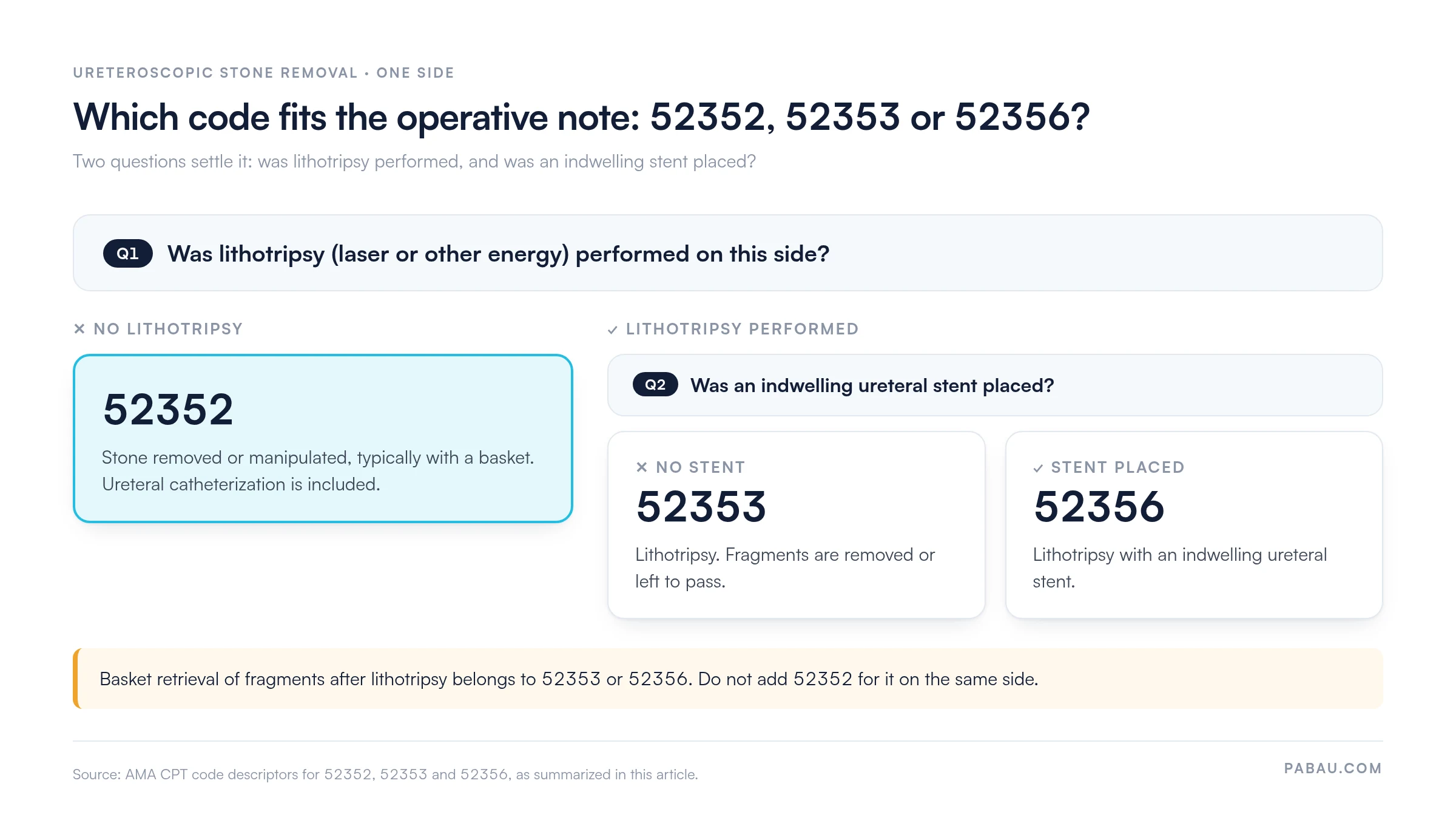
It applies when a stone in the ureter or renal pelvis is removed or repositioned, typically with a basket, and no lithotripsy is performed. Basket retrieval of fragments after lithotripsy on the same side is reported with 52353, or with 52356 when an indwelling stent is placed.
Let Pabau's smart automation suggest the right codes, reduce claim denials, and keep your practice compliant—effortlessly.
Automate repetitive tasks and focus on what matters most—your patients.
Reduce coding errors and ensure compliance with the latest regulations.
Clean claims, fewer denials, and faster reimbursements.
Powerful insights and reporting to help your practice thrive.
HIPAA compliant SOC 2 certified GDPR-compliant Trusted by 4,000+ clinics worldwide

CPT Code 52352 covers ureteroscopic removal or manipulation of a stone without lithotripsy, typically with a basket.
Basket retrieval of fragments after lithotripsy belongs to 52353, or 52356 when a stent is placed, so 52352 is not added on the same side.
Before billing 52352 with stent placement code 52332, check the current NCCI edit and its modifier indicator.
CPT 52352 carries a 0-day global period, so visits from the next day onward are billed separately.
Pabau, the practice software we build, turns invoices into electronic claims and flags denied claims for rework.
CPT Code 52352 describes cystourethroscopy with ureteroscopy and/or pyeloscopy; with removal or manipulation of calculus (ureteral catheterization is included). That wording follows the AMA CPT codebook descriptor.
The surgeon passes a flexible or semi-rigid ureteroscope through the urethra into the ureter or renal pelvis and localizes the stone. The stone is then removed or manipulated, typically with a retrieval basket. No lithotripsy is performed. That distinction separates 52352 from the lithotripsy codes 52353 and 52356.
The parenthetical in the descriptor also confirms that ureteral catheterization is bundled into 52352. Billing it separately is an unbundling error, whether the catheter was placed for access or dilation.
The correct code depends on what the operative report says the surgeon did. CPT 52353 covers ureteroscopy with lithotripsy, and 52356 covers lithotripsy with an indwelling ureteral stent. Applying 52352 when lithotripsy was performed is a frequent code-selection error in urology endoscopy billing.
Critical rule for fragment removal: When a surgeon fragments a stone with lithotripsy and then baskets the pieces out, that retrieval is part of 52353. It is part of 52356 when an indwelling stent is also placed. CPT Code 52352 is not reported for fragment retrieval after lithotripsy on the same side.
The diagram below walks through the two questions a coder asks of the op note.
52352 can still sit on the same claim as a lithotripsy code when a separate stone on the other side was removed without lithotripsy. That claim needs modifier XS or laterality modifiers, plus an op note that describes each side separately.
Stent placement after stone removal is reported with CPT 52332. Billed with 52352 on the same date, it can trigger a National Correct Coding Initiative (NCCI) procedure-to-procedure edit.
Check the current NCCI PTP edit table for the 52352/52332 pair and its modifier indicator before billing. An indicator of 1 means a modifier may bypass the edit, while 0 means no modifier will. NCCI edits update quarterly, so recheck the pair each quarter.
The operative report must explicitly state why the stent placement was a distinct, separately identifiable service. Payer reviewers look for this justification first when a modifier is present.
The correct modifier prevents automatic denials and holds the claim up under audit. Each modifier has a narrow indication in ureteroscopy billing.
Coders often ask whether XS works when only one stone was removed. XS signals a separate structure, so a second stone in the same ureter does not qualify. Using XS to unbundle 52332 from CPT Code 52352 in the same ureter is modifier misuse and will not hold up in a payer audit.
The operative report is the claim’s foundation, and vague documentation is behind most 52352 denials. For urology claims management, the operative note must contain these elements:
Auditors reviewing a 52352 claim look for confirmation that no lithotripsy was performed. If the note mentions “laser” or “lithotripsy” without making the technique clear, expect a query, reclassification to 52353, or a denial. Clean claim submission depends on an op note that settles this point before the claim leaves the practice.
Run a pre-submission documentation check before billing CPT Code 52352. Confirm the operative report states how the stone was removed or manipulated, and that no lithotripsy was performed. A single ambiguous phrase can trigger a medical review request or reclassification to 52353.
Every claim for CPT Code 52352 needs an ICD-10-CM diagnosis code that establishes medical necessity. An unspecified stone code used when the site is documented raises denial risk, because the payer cannot match the diagnosis to an endoscopic stone procedure.
The N20 codes carry no laterality, so record the side through modifier LT/RT or the claim narrative when the payer asks for it. Code the confirmed diagnosis from the operative or pathology report rather than a presumptive working diagnosis.
Medicare pays about $312 nationally for CPT Code 52352 in 2026, in a hospital outpatient department, an ambulatory surgery center (ASC) or an office. The facility and non-facility total RVUs are both 9.33, so the setting does not change the physician payment.
Local payment still varies with the geographic practice cost index (GPCI), so treat the national figure as a baseline.
These figures use the 2026 Medicare Physician Fee Schedule and its $33.4009 conversion factor. Pull current rates from the CMS Physician Fee Schedule lookup or the FastRVU RVU lookup tool, because the conversion factor changes every calendar year.
CPT 52352 carries a 0-day (000) global surgical period under the CMS Medicare Physician Fee Schedule. The global period ends on the day of the procedure, so no postoperative visits are bundled into the surgical payment.
The 0-day global is standard for endoscopic ureteroscopy codes in the 52320-52356 range. Confirm the current assignment in the CMS MPFS data file before billing, as global period values can change with major CPT updates.
Most 52352 denials are preventable. Effective denial management for urology practices starts by recognizing which error category triggered the rejection.
Matching the CARC reason codes on the remittance against a list of denial codes shows which denial type occurred. That makes each appeal more targeted.
When appealing a 52352 denial for wrong-code selection, attach the operative report and highlight the phrase that confirms no lithotripsy was performed. Payers rarely reverse without documentary evidence. Track lithotripsy-versus-52352 appeals separately in your denial log to spot coding patterns that need surgeon education.
Electronic remittance advice (ERA) files returned after 52352 adjudication carry a CARC reason code and a RARC remark code. They also show the paid or denied amount per line. CO-4 points to a missing or inconsistent modifier, and CO-97 to a service bundled into another payment.
Mapping these codes to the denial categories above turns each remittance into a coaching tool for the billing team. The AAPC Codify CPT lookup shows modifier requirements and NCCI edits next to the descriptor. Billers can use it to check whether a resubmission with a modifier is supportable before sending.
Tracking denials by code, and not only by payer, shows when one documentation habit keeps failing. If 52352 denials keep returning the same CARC, an op-note template change fixes more claims than appealing each one.
Many urology practices still re-key each ureteroscopy claim into a clearinghouse portal, then chase remittances in a separate inbox. Pabau, the practice management platform we build, generates the claim from the invoice the practice already raises.
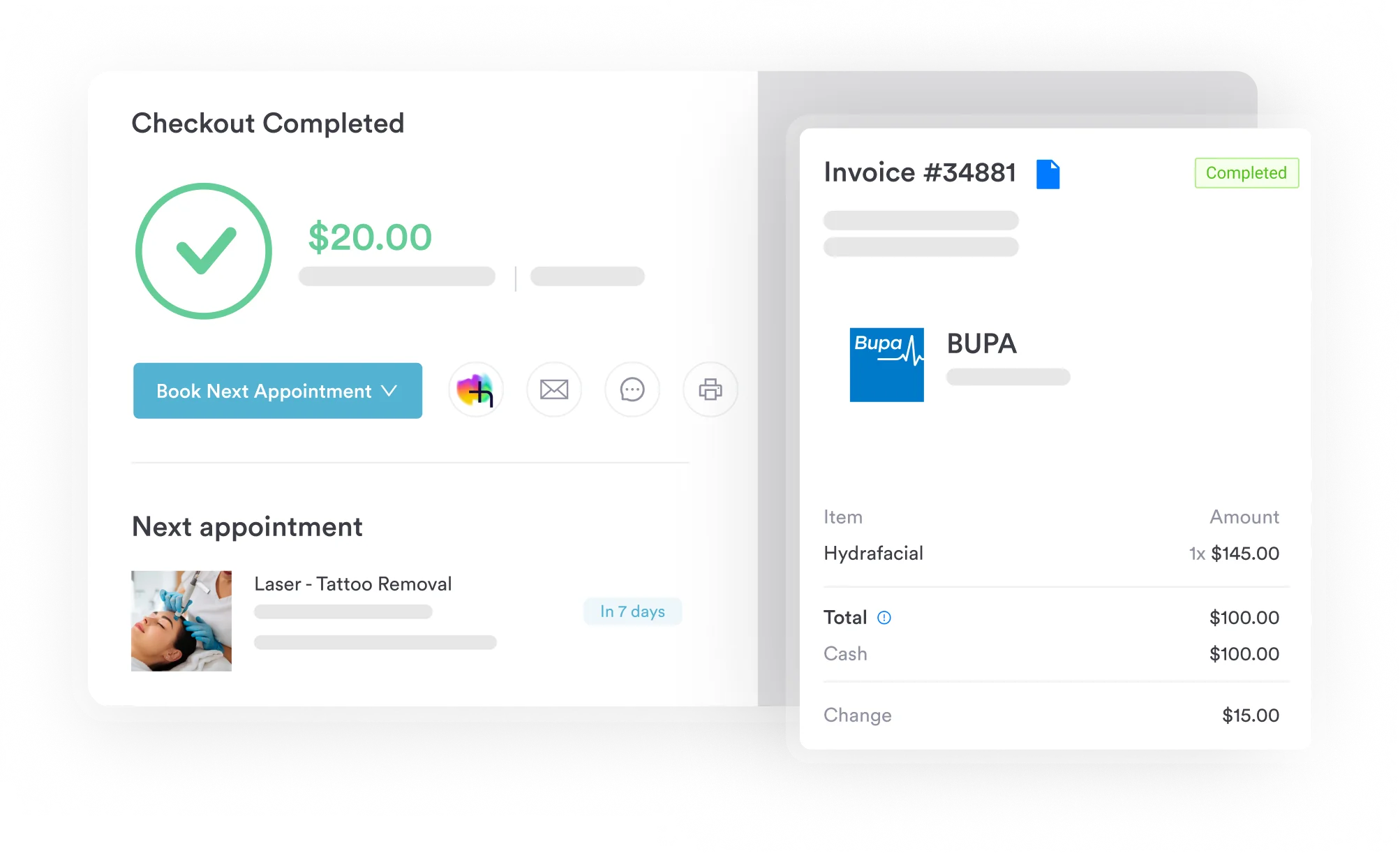
Through the Claim.MD integration, Pabau sends electronic CMS-1500 claims to thousands of US payers and runs real-time eligibility checks before treatment. Practices connect their own Claim.MD account to use it.
Claim statuses and ERAs flow back into Pabau’s claims dashboard and are matched to the claims they settle. Denied claims are flagged for rework, so a 52352 denial reaches the coder while the op note is still fresh.

Pabau turns your invoices into CMS-1500 claims, sends them to thousands of US payers through Claim.MD, and flags denied claims for rework.

CPT 52352 is the right code only when the op note shows a stone removed or manipulated without lithotripsy. Once lithotripsy is performed on that side, the case belongs to 52353, or to 52356 if a stent goes in.
The most useful fix sits upstream of billing. An op-note template that records technique, side and stent indication answers most auditor questions, and it settles the 52332 decision before the claim is built. The trade-off is a few extra fields for the surgeon, against fewer queries and appeals later.
Book a demo to see how Pabau takes a urology claim from invoice to remittance in one system.

Need to understand how claims move through a clearinghouse? Medical claims clearinghouse explained covers how 837P files are validated and transmitted to payers.
Want to reduce your urology practice’s claim rejection rate? Revenue cycle management overview walks through the end-to-end RCM workflow from scheduling to payment posting.
Looking for coding guidance on superbill design for endoscopy cases? Superbill guide explains what fields must appear on a urology superbill for clean claim submission.
CPT Code 52352 is the code for cystourethroscopy with ureteroscopy and/or pyeloscopy, with removal or manipulation of calculus. Ureteral catheterization is included. It is used when the stone is removed or repositioned, typically with a basket, and no lithotripsy is performed.
No. Basket retrieval of fragments after lithotripsy is part of CPT 52353, or 52356 when an indwelling stent is placed. Reporting 52352 for that retrieval on the same side is an unbundling error and a common audit trigger.
Modifier 50 applies when ureteroscopy with stone removal is performed on both ureters in the same session. Some payers prefer modifiers LT and RT on two separate claim lines instead. Check the payer’s preference before billing. The operative report must document the procedure in both the left and right ureter.
Sometimes. Check the current NCCI procedure-to-procedure edit table for the 52352/52332 pair and its modifier indicator before billing. Where a modifier is allowed, 59 or XS applies only when the op note shows the stent placement was a distinct service. Edits update quarterly, so recheck the pair each quarter.
Use CPT 52353 when lithotripsy was performed and no indwelling stent was placed, whether the fragments were basketed out or left to pass. If a stent was also placed, 52356 applies instead. CPT Code 52352 applies only when the stone was removed or manipulated without lithotripsy.
The 2026 Medicare national payment for CPT Code 52352 is about $312 in both facility and non-facility settings. It comes from a work RVU of 6.58, total RVUs of 9.33 and the $33.4009 conversion factor. Actual payment varies by geographic adjustment (GPCI), so verify current rates in the CMS Physician Fee Schedule lookup.


