

HCPCS Code Q4175: Billing, coverage, and documentation guide
HCPCS Code Q4175: Code Description and Product Identity HCPCS Code Q4175 is the ...

Last Updated: Nov 20, 2026
54360 is the CPT code for plastic operation on penis to correct angulation. It covers corporoplasty that straightens penile curvature from Peyronie's disease, congenital curvature, or trauma, whether the surgeon uses plication or incision with grafting.
Some payers and Medicare Administrative Contractors classify penile curvature correction as cosmetic, so the operative report must document functional impairment and medical necessity.
Let Pabau's smart automation suggest the right codes, reduce claim denials, and keep your practice compliant—effortlessly.
Automate repetitive tasks and focus on what matters most—your patients.
Reduce coding errors and ensure compliance with the latest regulations.
Clean claims, fewer denials, and faster reimbursements.
Powerful insights and reporting to help your practice thrive.
HIPAA compliant SOC 2 certified GDPR-compliant Trusted by 4,000+ clinics worldwide

CPT Code 54360 describes plastic operation on the penis to correct angulation, within the Penis heading (54000-54450) of the AMA Male Genital System subsection.
N48.6 (induration penis plastica) supports the code for Peyronie’s disease, while Q55.61 (curvature of penis, lateral) or Q54.4 (congenital chordee) supports congenital cases.
Some payers classify penile curvature correction as cosmetic, so check each payer’s LCD or medical policy and secure prior authorization before surgery.
Pabau’s claims management software records prior authorization codes on the patient’s case and sends 837P claims through the Claim.MD clearinghouse.
CPT Code 54360 is officially described as “Plastic operation on penis to correct angulation.” The American Medical Association places it in the AMA’s CPT code set under the Male Genital System subsection of the Surgery chapter. It sits within the Penis heading, which spans codes 54000 through 54450. That heading also holds the circumcision codes, including CPT 54163 for the repair of an incomplete circumcision. The same heading lists CPT 54160 for surgical circumcision in a newborn. The procedure corrects penile curvature through corporoplasty techniques applied to the tunica albuginea.
The descriptor does not specify technique. Plication-based approaches (such as the Nesbit procedure) and incision-with-grafting approaches both fall within 54360 when the documented purpose is angulation correction. A grasp of medical billing fundamentals also explains the global period. It bundles routine follow-up care into the base payment for 90 days after the procedure.
CPT 54360 applies when a urologist or plastic surgeon performs corporoplasty specifically to correct penile angulation severe enough to impair sexual function. Two clinical categories drive the majority of cases.
Payers require documented functional impairment, not just measured angulation. Curvature above 30 degrees is commonly cited in prior authorization criteria, but the threshold varies by payer. A structured intake that captures conservative treatment history (vacuum erection devices, intralesional injections, oral therapies) strengthens both the clinical record and the prior auth submission.
The operative report is the billing anchor for CPT Code 54360. Coders cannot select this code from the chart alone. The report must establish five things.
Clean claim submission for surgical codes like 54360 depends on spotting missing documentation before the claim leaves the practice. A missing operative technique description is a common cause of documentation denials.
Several Male Genital System codes cover penile procedures and are frequently confused with 54360. The key differentiator in every case is the specific clinical purpose documented in the operative report.
Confusion between 54300 and 54360 is a frequent source of coding queries. If the operative report describes skin flaps or a skin graft used to straighten chordee, 54304 may be more accurate than CPT Code 54360. When in doubt, query the surgeon before submitting.
Read the operative report for its stated purpose, then match that purpose to a code in the guide below.
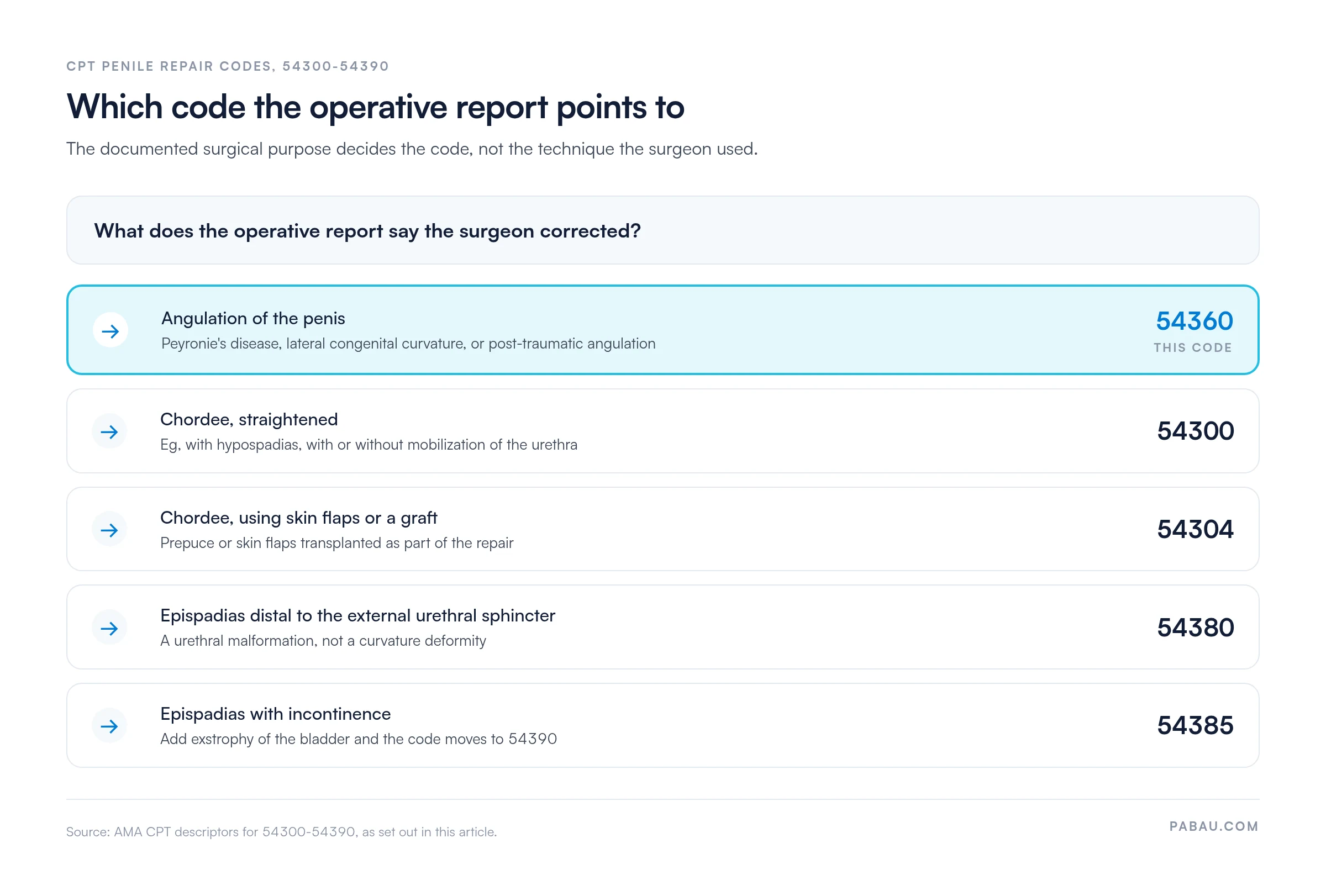
Medical necessity for CPT Code 54360 is established by pairing the procedure code with the correct ICD-10-CM diagnosis. A missing diagnosis code is a common cause of non-covered denials for this procedure. So is a code that the payer’s local coverage determination excludes.
Always verify ICD-10-CM codes against the current edition published by the CDC’s National Center for Health Statistics. Code descriptions and validity statuses update annually on October 1. Using a retired or non-billable code generates an automatic claim edit failure before the claim reaches a human reviewer.
Medicare reimbursement for CPT Code 54360 comes from the Medicare Physician Fee Schedule (MPFS), which applies relative value units (RVUs) to derive a payment amount. The figures below represent CMS published values and change annually. Verify the current year’s MPFS through the CMS Physician Fee Schedule lookup tool before quoting rates to patients or payers.
Use the FastRVU 2026 RVU lookup tool to retrieve the current work, practice expense, and malpractice RVU components for CPT Code 54360 by geographic location. Payment amounts vary by Medicare Administrative Contractor (MAC) region based on the geographic practice cost index (GPCI).
Before submitting CPT Code 54360 to Medicare, pull the applicable Local Coverage Determination (LCD) from the CMS Coverage Database. Some Medicare Administrative Contractors publish LCDs for penile procedures that list covered diagnoses. For a commercial payer, or where no LCD exists, request the payer’s medical policy in writing before scheduling the procedure.
Prior authorization for CPT Code 54360 is required by most major commercial payers and many Medicare Advantage plans. The authorization request must demonstrate that the curvature is functionally limiting, not merely cosmetic, and that conservative management has been attempted.
Authorization denials for CPT Code 54360 are frequently overturned on appeal when the first request was simply incomplete. Tracking each request through a defined prior authorization process reduces the risk of scheduling a procedure without confirmed coverage.
CPT Code 54360 claims face a narrow set of denial patterns that repeat across payers. Each is preventable with the right documentation protocol and pre-submission workflow.
Structured denial management workflows reduce the time from denial to corrected resubmission. For CPT Code 54360 specifically, tracking denial reasons by payer allows a practice to build payer-specific documentation templates that front-load the evidence those payers require. Review the medical billing denial codes to map each CARC to the correct appeal pathway.
NCCI (National Correct Coding Initiative) edits govern how CPT Code 54360 interacts with other codes billed on the same claim. They matter most when the surgeon performs a second penile or urethral procedure in the same session.
CMS publishes NCCI edit pairs that define which code combinations require a modifier and which are never separately billable. For CPT 54360, the following situations arise most frequently.
Verify specific NCCI edit pairs for CPT 54360 using the CMS NCCI Policy Manual and the online NCCI Edit Inquiry Tool on the CMS website. NCCI edit tables are updated quarterly, so a bundling rule that was not present in a prior year may appear on a current claim. Proper medical billing compliance for surgical urology codes requires verifying NCCI edits at the time of billing, not at the time of procedure scheduling.
Run a pre-submission NCCI edit check for every CPT Code 54360 claim that includes a secondary penile or urethral procedure. When modifier 59 is applied, retain the operative report section that documents the distinct procedure in the claim file. Payers auditing modifier 59 usage on genital surgery codes request this documentation routinely.
Surgical urology claims for CPT Code 54360 carry a 90-day global period. They also bring prior authorization, NCCI edit exposure, and cosmetic-exclusion risk into the same claim cycle. Each of those steps costs revenue when a billing team tracks it by hand.
Pabau, the practice management platform we build, handles US insurance billing through the Claim.MD clearinghouse. Its claims management software checks patient eligibility and sends 837P claims electronically. Electronic remittance advice (835 files) comes back into Pabau, so billing staff see the payer’s CARC codes against the claim without reading raw ERA files.
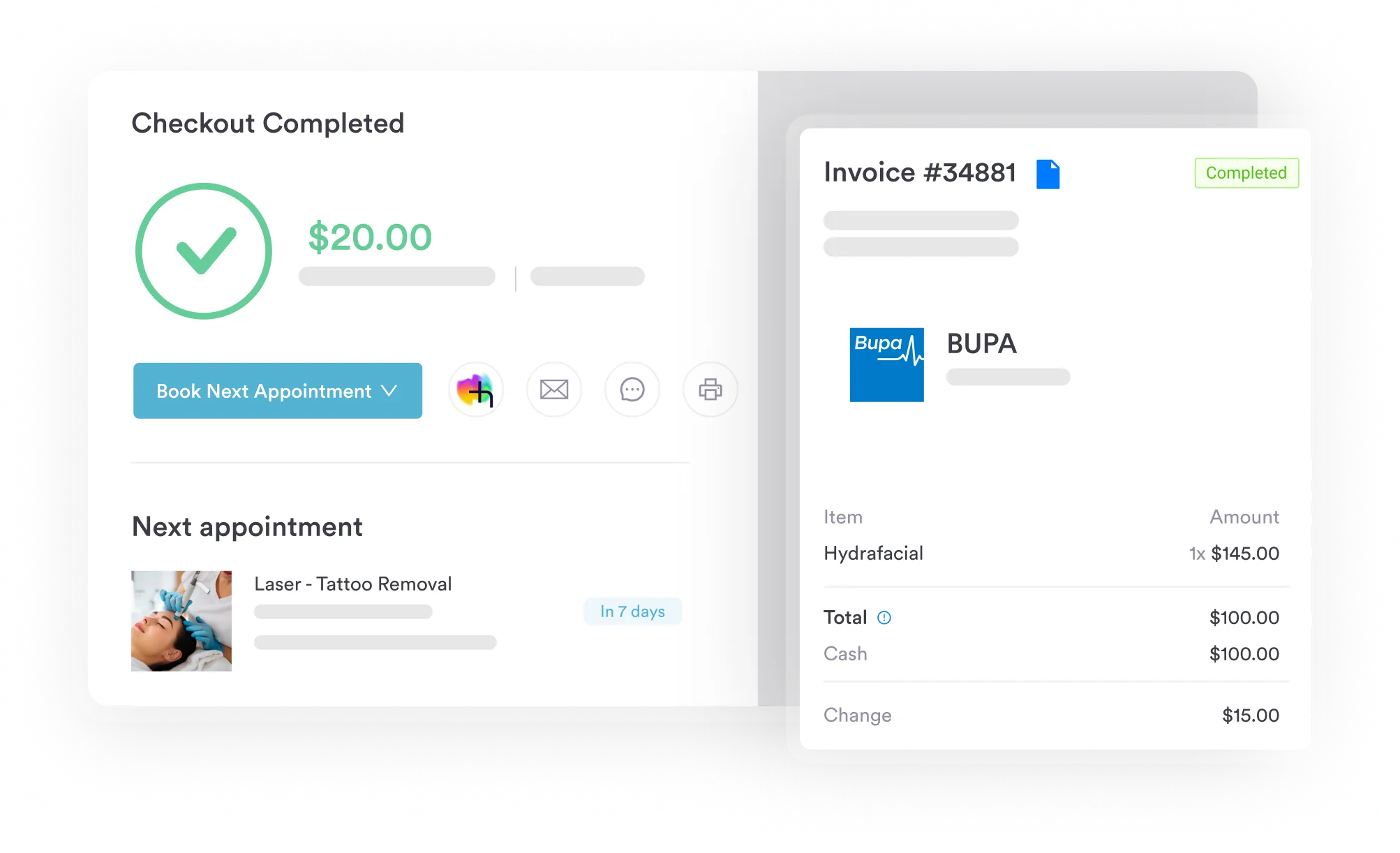
Prior authorization sits on the patient’s case, with the auth code, dates and sessions recorded and a warning when one is missing. For a code that most commercial payers authorize first, that warning flags the missing auth number before a CO-15 denial does.

Pabau records prior authorization codes on the patient’s case, checks eligibility, and sends CPT claims through Claim.MD. Your team fixes errors before they become denials.

CPT Code 54360 pays on first submission when the operative report makes the case for it. Name the technique, the degree of angulation and the functional impairment. Then choose 54360 only when angulation correction is the documented purpose.
The price is work before surgery. Pull the payer’s LCD or medical policy, secure the authorization number, and check NCCI edits for any second procedure before the date is booked. At that stage, a missing document costs a phone call rather than an appeal.
Keeping eligibility, authorization and denials in one system makes that routine repeatable, which is the point of revenue cycle management. Book a demo to see how Pabau tracks authorizations and claims for urology procedures like CPT 54360.

Billing a penile prosthesis in the same session? CPT 54405 covers insertion of a multi-component inflatable penile prosthesis.
Struggling with claim denials across your practice? How Pabau’s Claim.MD clearinghouse works explains eligibility checks and ERA processing for surgical codes.
Want to understand the 837 file format for surgical claims? 837 file guide covers the HIPAA-compliant claim transaction format used for CPT submissions.
Looking for insurance eligibility verification guidance? Insurance eligibility verification outlines how to confirm coverage before surgical procedures.
Need to read the RVU figures for a surgical code? What is an RVU breaks down the work, practice expense and malpractice components.
CPT Code 54360 covers plastic operation on the penis to correct angulation. Urologists or plastic surgeons perform this corporoplasty to straighten penile curvature caused by Peyronie’s disease, congenital curvature, or trauma. The code covers both plication-based and incision-with-grafting techniques, provided the documented surgical purpose is angulation correction.
CPT 54360 covers angulation correction (corporoplasty for curvature), while CPT 54380 covers plastic operation on the penis for epispadias. Epispadias is a congenital condition in which the urethral opening sits on the dorsal penile surface. The two codes address different anatomical problems and are never interchangeable. Use 54360 when the operative note documents curvature correction, and 54380 when it documents epispadias repair.
Yes, Peyronie’s disease (ICD-10-CM N48.6) is the primary covered indication for CPT Code 54360 among payers that cover the procedure at all. Coverage is not universal. Some payers and Medicare Administrative Contractors classify penile curvature correction as cosmetic and exclude it. Check the applicable Local Coverage Determination before submitting, and document functional impairment explicitly in the operative report.
Yes, most major commercial payers and many Medicare Advantage plans require prior authorization for CPT Code 54360. Requests typically need documented functional impairment and failed conservative treatment. Most payers also want Peyronie’s disease stable for at least 12 months, and some ask for penile Doppler imaging. Submitting without a required authorization number results in a CO-15 denial that is difficult to overturn retrospectively.
The work RVU for CPT Code 54360 is approximately 10.00 to 12.00 in the facility setting, based on CMS MPFS data. RVU values are updated annually, and payment varies by Medicare Administrative Contractor region. Check the current year’s wRVU and total facility RVU in the CMS Physician Fee Schedule lookup tool or FastRVU before relying on them.
Common denial reasons for CPT Code 54360 include cosmetic exclusion, missing prior authorization, and an ICD-10-CM diagnosis code that does not support the procedure. Insufficient operative documentation is also a common cause of documentation denials. When the report omits the technique, the degree of angulation corrected, or the functional indication, reviewers deny on documentation grounds.





