CPT Code 19361: Latissimus dorsi flap breast reconstruction
CPT code 19361: Official descriptor and payment basics CPT code 19361 is the Cat...

Last Updated: Nov 18, 2026
S0400 is the HCPCS Level II code for a global fee for extracorporeal shock wave lithotripsy treatment of kidney stone(s).
It reports a whole ESWL episode as one bundled charge, in place of separate professional, facility, and equipment lines. As a temporary national S-code for private payers, S0400 is never paid by Medicare, which takes CPT 50590 for the same procedure. Each payer contract sets what the fee includes and who bills it.
Let Pabau's smart automation suggest the right codes, reduce claim denials, and keep your practice compliant—effortlessly.
Automate repetitive tasks and focus on what matters most—your patients.
Reduce coding errors and ensure compliance with the latest regulations.
Clean claims, fewer denials, and faster reimbursements.
Powerful insights and reporting to help your practice thrive.
HIPAA compliant SOC 2 certified GDPR-compliant Trusted by 4,000+ clinics worldwide

HCPCS code S0400 is a single global fee for one episode of shock wave lithotripsy (ESWL) on kidney stones.
S0400 is a temporary national S-code for private payers, and Medicare does not accept it in any setting.
The payer contract defines what the global fee bundles, so read it before you add any other line for the same episode.
Medicare and most payers without a global ESWL contract take CPT 50590 for the same procedure instead.
Pabau, the practice software we build, keeps the treatment note, the authorization, and the claim on one patient record.
HCPCS code S0400 is the Level II code for a global fee for extracorporeal shock wave lithotripsy (ESWL) treatment of kidney stones.
CMS’s quarterly HCPCS file lists it with the short descriptor “Global eswl kidney” and a coverage code that marks it not payable by Medicare. It reports the whole lithotripsy episode as one charge, not as separate professional, facility, and equipment lines.
S0400 sits in the S-code series of temporary national codes. Chapter 23 of the Medicare Claims Processing Manual reserves that series for the Blue Cross Blue Shield Association and other private insurers. Medicare pays the same procedure through CPT 50590 instead.
A global ESWL fee pays one rate for the whole lithotripsy episode. Without it, the same session usually reaches the payer as several claims. The urologist bills the procedure, the facility bills its fee, and a mobile lithotripsy vendor may bill the machine and technician.
Payers that contract a global rate fold those pieces into one S0400 line. The contract also names who submits the claim, often the lithotripsy provider or the physician group that holds the agreement. Everyone else in the episode is then paid by that entity, not by the payer. The chart below sets the two claim shapes side by side.
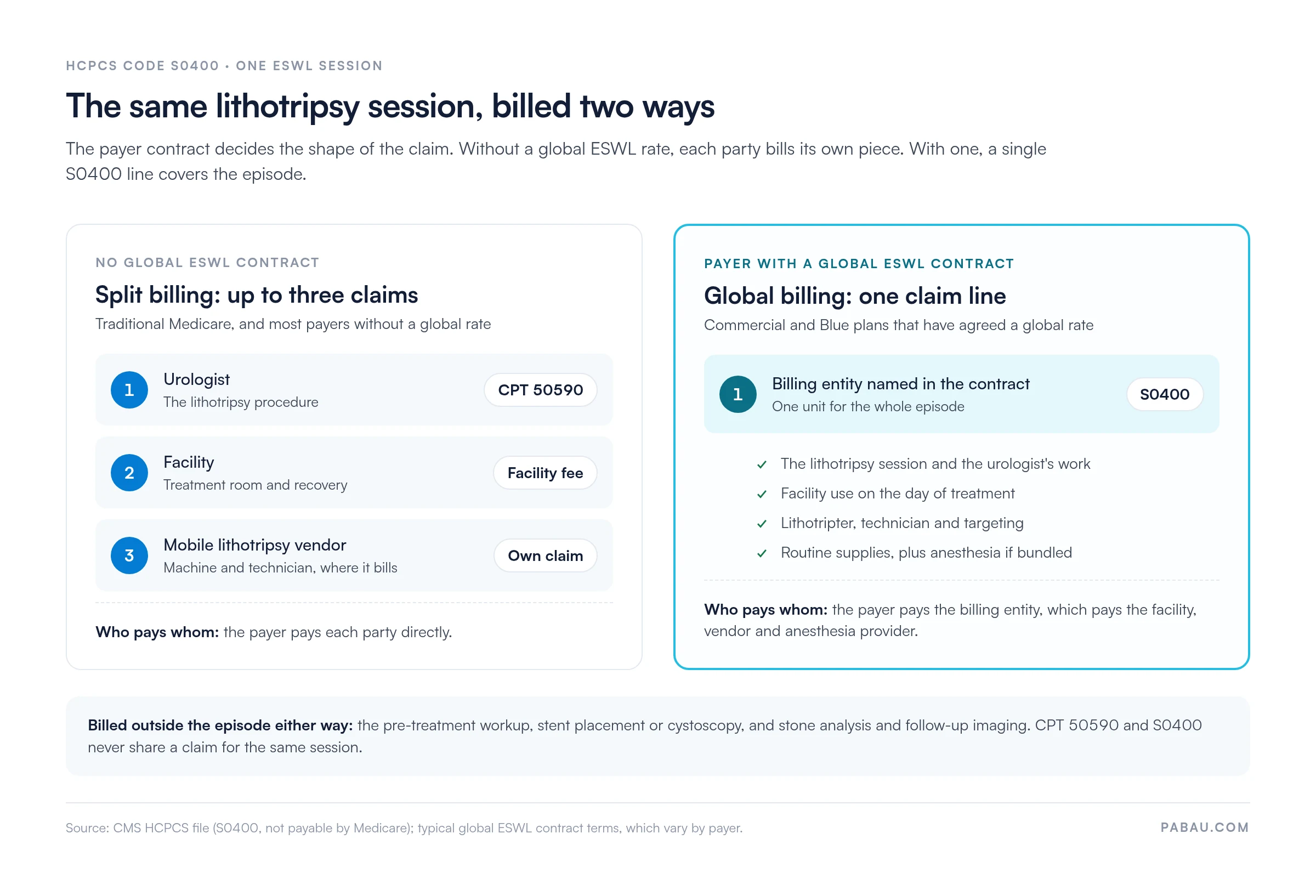
Ask the payer for the global ESWL contract exhibit before the first case. It lists the bundled components, the billing entity, and the claim form, which together decide whether S0400 or CPT 50590 goes on the claim.
The exact package comes from each contract, but most global ESWL agreements follow the same outline. Use the lists below as a starting checklist, then confirm each item against the payer’s terms.
Some contracts also limit how many sessions per kidney fit inside a single global period. A second session on the same stone may then pay at a reduced rate, or not at all.
Only a payer that has agreed a global ESWL rate pays S0400. Acceptance of S-codes in general is not enough, because the code describes a bundled arrangement, not a single service.
The pre-op history and physical code, S0260, raises a similar question, since many payers fold that visit into the surgical global package. Check the contract or the payer’s provider manual before the patient is scheduled.
Where no global contract exists, the episode goes back to the usual split. The urologist bills CPT 50590, and the facility bills its own fee.
Most S0400 problems start before the session, when nobody checks whether the payer pays a global fee at all. Treat the first three steps below as part of scheduling, not billing. Medical billing works the same way for any code: the front desk decides more claims than the coder does.
The diagnosis has to show a kidney stone that ESWL can treat. Use the most specific code the imaging report supports.
The S0400 descriptor names kidney stones, so a stone outside the kidney can fall outside the contract. Check the contract before you bill S0400 for a ureteral stone alone.
S-codes have no national modifier rules, so each payer decides which modifiers it reads on S0400. The table lists the ones payers ask for most often on lithotripsy claims.
A global fee pays for the whole episode, so the record has to show the whole episode. Submitting a clean claim starts with a note that answers every question the payer’s reviewer will ask. Keep these items in the patient record before the claim goes out:
Your medical billing compliance program should keep the internal split of the global payment on file too. Payers can audit how the fee was shared, and the record has to match the contract.
Most S0400 denials trace back to the wrong payer or to a bundled line billed twice. Our guide to denial codes in medical billing explains each reason code in more detail.
A CO-18 on S0400 often means a partner billed the session too. Agree in writing who submits each claim before the first patient, and the duplicates stop. A wider denial management workflow helps you spot the pattern early.
S0400 is one way to report ESWL, and the payer decides which way applies. The table sets S0400 beside the codes coders most often mistake for it.
The main confusion is between S0400 and CPT 50590. Both describe ESWL, but they never sit on the same claim for the same session. Under a global contract, S0400 replaces 50590 and the facility fee. Without one, 50590 and the facility fee replace S0400.
Ureteroscopy and percutaneous codes describe different procedures and fall outside the S0400 descriptor. If the urologist switches from ESWL to ureteroscopy, the claim carries the ureteroscopy code that matches the operative note.
Global ESWL billing involves several parties and one claim. The authorization sits in one inbox, the treatment note in another system, and the vendor invoice in a spreadsheet. Each handoff is a chance to bill 50590 when the contract pays S0400, or both together.
In Pabau, the treatment note, the authorization, and the invoice live on the same patient record. Your billing team codes from the documented session, not from a retyped summary. Pabau’s automated claims management then submits the claim, checks eligibility, and tracks its status.
When a denial arrives, it shows against that patient record with the original note beside it. A CO-97 or CO-18 gets worked while the session details are still fresh.

Pabau links the treatment note, the authorization, and the claim, so your ESWL claims go to each payer in the format its contract expects. See how it works for your practice.

S0400 is a contract code more than a clinical one. The session is the same ESWL that CPT 50590 describes. What changes is who gets paid, and in how many pieces.
So settle the contract question before the patient is booked. A payer with a global ESWL rate takes one S0400 line, and nobody else bills that session. A payer without one, including traditional Medicare, takes 50590 and a separate facility fee.
Get that choice right at scheduling, and an S0400 claim seldom needs an appeal. Book a demo to see how Pabau keeps the treatment note, the authorization, and the claim on one patient record.

Seeing repeated rejections on bundled claims? Denial codes in medical billing covers the most common CARC and RARC codes and how to resolve them.
HCPCS code S0400 is the Level II code for a global fee for extracorporeal shock wave lithotripsy treatment of kidney stones. It reports the whole ESWL episode as one charge. It is a temporary national S-code that private payers use, and Medicare does not accept it.
No. S-codes are not valid for Medicare, and CMS lists S0400 as not payable. Medicare pays ESWL through CPT 50590, with the facility billing its own fee. Do not appeal a Medicare denial on S0400; rebill under CPT 50590 instead.
The payer contract decides. Most global ESWL agreements bundle the lithotripsy session, the urologist’s work, facility use, and the lithotripter with its technician. Pre-treatment visits, imaging, and stent placement usually fall outside it.
No, not for the same session. S0400 already includes the professional work that 50590 describes. Billing both usually triggers a CO-97 denial for a service included in another payment.
The entity named in the payer’s global ESWL contract submits it. That is often the lithotripsy provider or the urology group. The facility, vendor, and any anesthesia provider are then paid by that entity.
Kidney stone codes support it, most often N20.0 for a kidney stone or N20.2 for kidney and ureteral stones together. N13.2 can be added when the stone causes obstruction. Check the contract before billing S0400 for a ureteral stone alone.