

CCSD code G5100: Bypass of duodenum billing guide
CCSD code G5100 bills a bypass that leaves the duodenum in place CCSD code G5100...

Last Updated: Oct 16, 2026
52353 is the CPT code for cystourethroscopy, with ureteroscopy and/or pyeloscopy; with lithotripsy (ureteral catheterization is included).
Two adjacent codes, 52356 and 52332, cover overlapping work, so picking the wrong one generates NCCI bundling denials. Three questions settle almost every 52353 claim. Was a ureteral stent placed, was the procedure bilateral, and does the operative report carry each element the code requires?
Let Pabau's smart automation suggest the right codes, reduce claim denials, and keep your practice compliant—effortlessly.
Automate repetitive tasks and focus on what matters most—your patients.
Reduce coding errors and ensure compliance with the latest regulations.
Clean claims, fewer denials, and faster reimbursements.
Powerful insights and reporting to help your practice thrive.
HIPAA compliant SOC 2 certified GDPR-compliant Trusted by 4,000+ clinics worldwide

CPT 52353 covers ureteroscopic or pyeloscopic lithotripsy. Ureteral catheterization is bundled in and cannot be billed separately.
When a ureteral stent is placed in the same ureter at the same session, bill 52356 instead of 52353 + 52332.
NCCI edits bundle 52332 into 52353 for the same side. Modifier 59 or XS applies only to a contralateral stent.
At the CY2026 conversion factor, 52353 pays about $345 and 52356 about $367 before locality adjustment.
Pabau’s claims management software flags NCCI bundling conflicts before submission, reducing denial rates for urology practices.
CPT code 52353 is the American Medical Association-maintained code for “Cystourethroscopy, with ureteroscopy and/or pyeloscopy; with lithotripsy (ureteral catheterization is included).” A urologist passes a scope from the urethra up to the stone, then fragments it with energy, most often a holmium laser.
The parenthetical on ureteral catheterization carries a bundling rule. Billing 52005 separately alongside 52353 triggers an NCCI edit and a denial every time.
The AMA CPT Knowledge Base confirms that laser lithotripsy falls under 52353 and that ureteral catheterization is included. The holmium (Ho:YAG) laser is the dominant energy source for ureteroscopic lithotripsy. Coders sometimes ask whether the laser changes code selection. It does not, because 52353 covers lithotripsy whatever the energy modality.
The most common coding error on ureteroscopy claims is billing 52353 + 52332 when a stent goes into the same ureter. 52356 already includes both the lithotripsy and the stent placement.
Adding 52332 alongside 52353 bills the stent twice. When the urologist fragments a stone and stents that same ureter at one session, 52356 is the only correct code. Two questions settle the line item, and the payment follows from the answers.
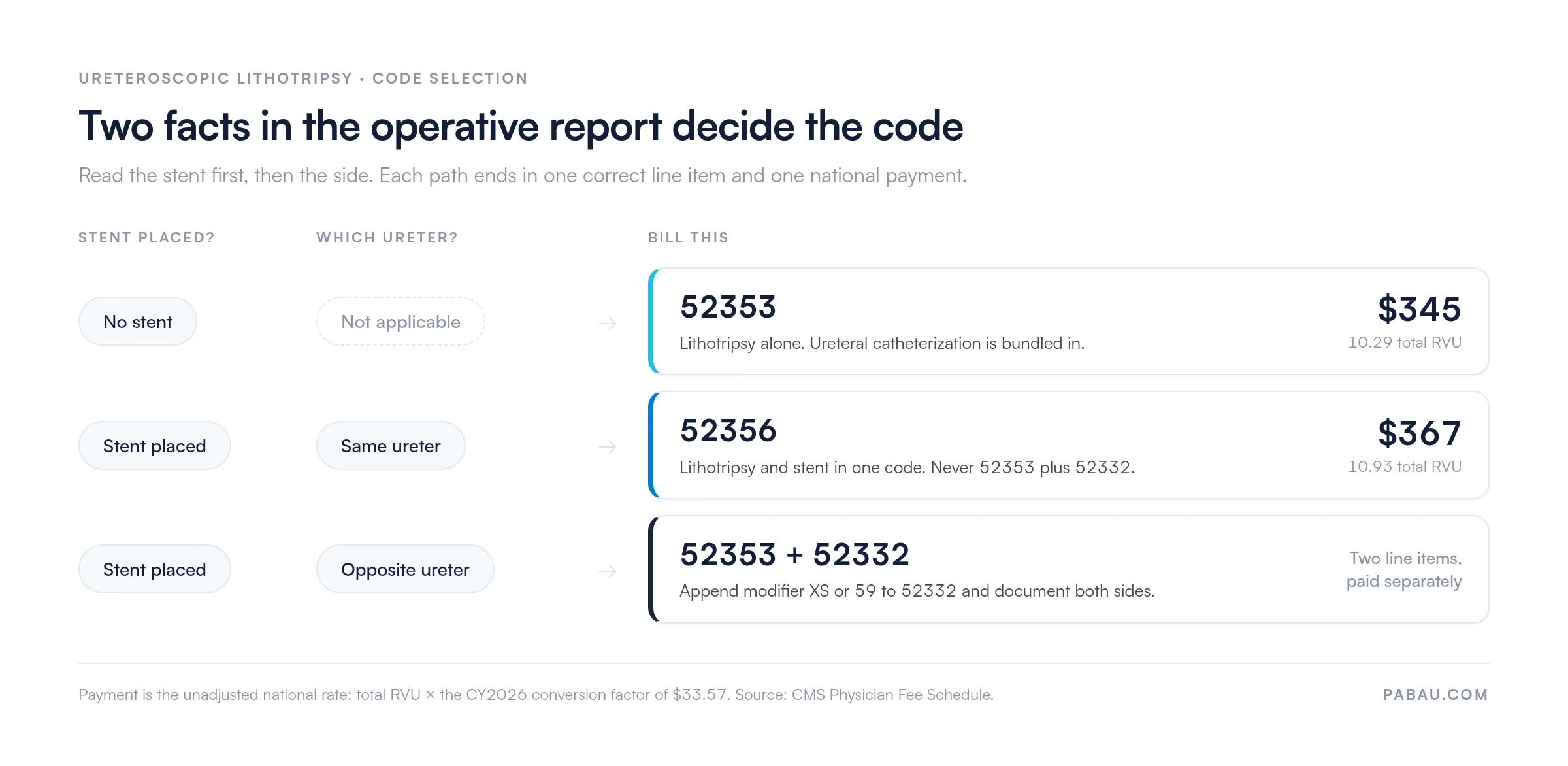
CPT 52332 covers cystourethroscopy with insertion of an indwelling ureteral stent. NCCI edits bundle it into 52353 when both are billed for the same ureter at the same session. The edit exists because 52356 is the designated combined code. Overriding the bundle takes a clinical distinction, not just an appended modifier.
Modifier 59 applies when the stent and the lithotripsy are performed on different sides. The X-modifiers are preferred where a payer accepts them: XS for a separate structure, XU for an unusual non-overlapping service.
The operative report has to state the laterality of each procedure. A note reading only “bilateral” does not say which ureter received which service, so it will not support the modifier. Stent placement on the same side as the lithotripsy is never separately reportable, which is the whole reason 52356 exists.
Check three data points in the op note before you code. Which ureter was treated, whether a stent was placed, and in which ureter. Then confirm whether the procedure was bilateral. Those three answers set the code combination.
The 52000-series runs from basic cystoscopy through to complex stone management. Knowing where 52353 sits in that family prevents both under-coding and over-coding. The safest habit is to code from the operative findings rather than from the number your practice bills most often.
CPT 50590 covers extracorporeal shock wave lithotripsy, a different approach from ureteroscopic lithotripsy. The treatment modality documented in the operative report drives code selection, and stone location alone does not. A ureteral stone treated with ESWL is 50590. The same stone fragmented under direct ureteroscopic vision is 52353.
Once the stone sits in the bladder, the service is litholapaxy rather than ureteroscopic lithotripsy. A simple bladder stone under 2.5 cm is CPT 52317, and a larger one moves to 52318.
According to the CMS Physician Fee Schedule lookup tool, CPT 52353 carries a work RVU of 7.31 and a total RVU of 10.29. The total is the same in facility and non-facility settings, so the site of service does not change the Medicare allowance for this code.
Multiply the total RVU by the annual conversion factor to get the national allowance. CMS set the CY2026 conversion factor at $33.57 for qualifying APM participants and $33.40 for everyone else. That puts 52353 at roughly $345 and 52356 at roughly $367 before any locality adjustment.
Note: RVU values come from the CY2026 Medicare Physician Fee Schedule. Verify locality-adjusted rates in the CMS lookup tool before you submit, because figures differ by MAC jurisdiction. CMS updates them each January.
A clean claim for CPT 52353 depends on what the operative report captures. Auditors and payers look for five documentation elements when they review 52353 claims. Missing any one of them is grounds for denial or down-coding.
A urology superbill built around these five elements makes coder review faster and cuts the number of queries sent back to the surgeon. Mapping structured operative-note fields straight to CPT line items removes the manual transcription step where documentation errors enter the claim.
Medicare does not routinely require prior authorization for 52353, but Medicare Advantage plans and many commercial insurers do. The clinical criteria usually include imaging confirmation of the stone and a stone size above roughly 5 to 6 mm.
Plans also want evidence that conservative management failed or was contraindicated. Checking eligibility before scheduling confirms what each patient’s plan requires.
Compliance turns on two small habits. Record the authorization number on the claim, and make sure the authorized code matches what was actually performed.
If the patient needed 52356 but authorization covered 52353, obtain a revised authorization or the claim denies on code mismatch. Payer policies vary, so confirm the parameters with each plan.
The AAPC and CMS NCCI guidance identify six recurring denial patterns for 52353. Each has a specific correction path, and working through them in order is faster than appealing blind.
Tracking denial codes at the code level across 52353 claims shows where the process actually fails, whether in scheduling, documentation or coding. A monthly denial review by CPT code surfaces those patterns early.
The ICD-10-CM diagnosis code paired with 52353 is what establishes medical necessity. The primary diagnosis should reflect the stone location and laterality documented in the operative report. The CDC/NCHS ICD-10-CM tool lists the N20 category, which covers calculus of kidney and ureter by location.
Code to the highest level of specificity the operative report supports. N20.1 (calculus of ureter) beats N20.9 (urinary calculus, unspecified) for medical necessity. Where the report states laterality, add the site-specific code.
Most urology billing teams catch a 52353 bundling error after the remittance comes back. The coder reads the op note and builds the claim. The NCCI edit then surfaces weeks later as a denial that has to be reworked.
Practice management software like Pabau moves that check to the point of claim build. Our claims management software runs the NCCI pairs as the line items go on. A 52332 sitting beside 52353 on the same ureter raises a flag before the claim leaves the practice.
The same check covers modifier requirements and the ICD-10 pairing, and every Pabau subscription includes it. Coders keep the judgment calls that need a clinician’s read, and the edit logic catches the pairs that get missed at volume.

Pabau’s claims management software checks NCCI edits, modifier requirements, and ICD-10 pairing before 52353 claims leave your practice. Fewer denials, faster reimbursement.

Three decisions carry most of the denial risk on a 52353 claim. Whether a stent was placed, which ureter it went into, and whether the op note actually says so. Settle those three before the claim is built and the rest of the code set falls into place.
The allowance difference between 52353 and 52356 is only about $22. The rework is the expensive part. A denied claim costs staff time and delays payment, and some age past the filing window.
If your urology claims keep coming back on NCCI edits, the fix belongs upstream of the clearinghouse. Book a demo to see how Pabau checks 52353 claims before they are submitted.

Need to understand how medical claims move from practice to payer? Medical claims clearinghouse overview explains the submission pathway and how clearinghouse edits catch errors before adjudication.
Want a reference for denial code meanings on 52353 remits? Claim.MD clearinghouse guide covers CARC denial reason codes and how to read ERA remittance detail.
Looking to improve first-pass claim rates across your urology practice? Best medical billing software for US practices reviews the tools urology billing teams use to reduce rework.
CPT code 52353 is the billing code for cystourethroscopy with ureteroscopy and/or pyeloscopy, with lithotripsy. The urologist advances a scope through the urethra to the stone and fragments it, most often with a holmium laser. Ureteral catheterization is bundled into the code and cannot be billed separately.
Yes. The AMA CPT descriptor states that ureteral catheterization is included in CPT 52353. Billing CPT 52005 alongside 52353 triggers an NCCI bundling edit and will result in denial. There is no modifier that overrides this bundling rule.
They can be billed together only when the stent goes into a different ureter from the one treated with lithotripsy. Modifier 59 or XS must be appended to 52332 to override the NCCI edit. When both happen in the same ureter at one session, the correct code is 52356 alone.
CPT 52353 covers ureteroscopic or pyeloscopic lithotripsy with no ureteral stent. CPT 52356 covers the same procedure plus insertion of a stent in that ureter at the same session. If the stent is ipsilateral, 52356 is the single correct code. Billing 52353 + 52332 in that case double-bills the stent, and NCCI edits deny it.
Six patterns account for most 52353 denials. The first is an NCCI bundling conflict from billing 52332 on the same side without a valid modifier. The second is unbundled ureteral catheterization, where 52005 is added alongside 52353. The third is a missing prior authorization from a commercial or Medicare Advantage plan. The fourth is an operative report that omits scope type, lithotripsy confirmation or laterality. The fifth is a global period conflict from a prior major urology procedure. The last is an ICD-10 code that does not support medical necessity.
The most common pairings are N20.1 (calculus of ureter), N20.0 (calculus of kidney) and N20.2 (calculus of kidney with calculus of ureter). N20.9 (urinary calculus, unspecified) is a last resort, used only when the location is not documented. N13.2 (hydronephrosis with renal and ureteral calculous obstruction) is added as a secondary code when the stone is obstructing.



