

HCPCS Code L0472: Hyperextension TLSO billing guide
HCPCS code L0472: Official descriptor and device definition HCPCS code L0472 des...

Last Updated: Nov 5, 2026
44145 is the CPT code for colectomy, partial; with coloproctostomy (low pelvic anastomosis). It describes an open low anterior resection. The surgeon removes part of the colon, usually the sigmoid with the upper rectum. The remaining colon is then joined to the rectum deep in the pelvis. Bowel continuity is restored in the same operation, and no colostomy is created.
This reference covers the official descriptor and how 44145 differs from 44140 to 44147 and laparoscopic 44207. It also covers ICD-10-CM pairings, modifiers, Medicare reimbursement, denial reasons and documentation requirements.
Let Pabau's smart automation suggest the right codes, reduce claim denials, and keep your practice compliant—effortlessly.
Automate repetitive tasks and focus on what matters most—your patients.
Reduce coding errors and ensure compliance with the latest regulations.
Clean claims, fewer denials, and faster reimbursements.
Powerful insights and reporting to help your practice thrive.
HIPAA compliant SOC 2 certified GDPR-compliant Trusted by 4,000+ clinics worldwide

CPT 44145 is an open partial colectomy with coloproctostomy, a low anterior resection that reconnects the remaining colon to the rectum.
No stoma belongs to 44145. Adding a colostomy makes it 44146, and closing the rectal stump with an end colostomy makes it 44143.
The laparoscopic counterpart is 44207, not 44204, which is the laparoscopic version of 44140.
The operative note must state the open approach, the segment removed, and an anastomosis to the rectum low in the pelvis.
Report add-on 44139 with 44145 when the surgeon documents splenic flexure mobilization.
CPT code 44145 reports an open partial colectomy in which the surgeon removes part of the colon and reconnects the remaining colon to the rectum. The American Medical Association publishes it in the CPT code set. The official descriptor reads: Colectomy, partial; with coloproctostomy (low pelvic anastomosis).
Surgeons and coders usually call this operation a low anterior resection. The coloproctostomy is the defining element. The surgeon joins the colon to the rectum deep in the pelvis, which restores bowel continuity in the same operation. The descriptor includes no colostomy.
Typical indications include sigmoid and rectosigmoid cancer, upper and mid rectal cancer, and complicated diverticular disease of the sigmoid colon. Large benign rectal polyps that can’t be removed endoscopically are another. The open approach separates 44145 from its laparoscopic counterpart, 44207.
A low anterior resection coded under 44145 follows a defined operative sequence. Each step should appear in the operative note to support the code.
The critical distinction is that continuity is restored and no colostomy is made. If the surgeon also creates a colostomy, the correct code is 44146. If the rectal stump is closed and an end colostomy is brought out, the operation is a Hartmann procedure, coded 44143.
Surgeons often protect a low anastomosis with a temporary loop ileostomy. The 44145 descriptor does not describe one. Check current NCCI edits and the payer’s policy before reporting an ileostomy code on the same claim.
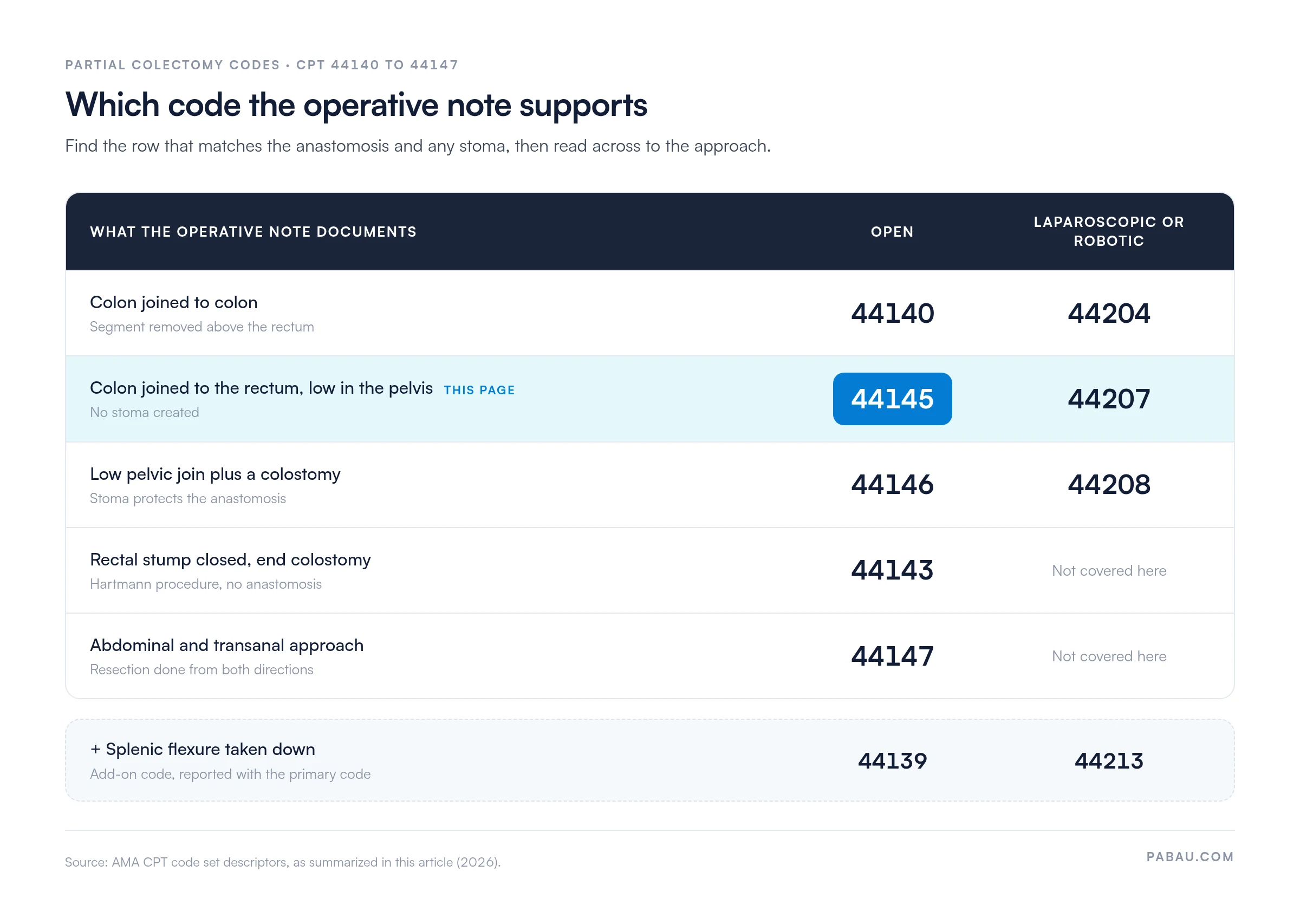
The 44140 to 44147 family covers open partial colectomy. Two questions separate the codes. Where was the colon joined, if at all? And was a stoma created?
Read the table from the anastomosis column first. A join to the rectum points to 44145, 44146 or 44147, and a stoma then decides between 44145 and 44146.
CPT 44207 is the laparoscopic counterpart of 44145. Its descriptor reads: Laparoscopy, surgical; colectomy, partial, with anastomosis, with coloproctostomy (low pelvic anastomosis). Robotic-assisted cases are coded as laparoscopic, so they map to 44207 as well.
A common error is reaching for 44204 on a laparoscopic low anterior resection. CPT 44204 is the laparoscopic version of 44140, which describes a colon-to-colon anastomosis.
When a laparoscopic case converts to open, report the open code, 44145, and do not report the laparoscopic attempt. If the conversion added substantial work, some payers accept modifier 22 with operative note support.
A low anastomosis often needs the splenic flexure taken down so the colon reaches the pelvis without tension. Report add-on code 44139 with 44145 when the operative note documents that mobilization.
In a laparoscopic case, the matching add-on is 44213 with 44207. The matrix below puts the open and laparoscopic codes side by side, add-ons included.
Every 44145 claim needs at least one ICD-10-CM code that establishes medical necessity for the resection and the low pelvic anastomosis. The diagnosis must appear in the operative note, not only in the admission record.
Use the most specific ICD-10-CM code available. For colorectal malignancy, report the primary tumor site, so a tumor at the rectosigmoid junction takes C19 rather than C20.
Payers with local coverage determinations (LCDs) cross-reference the diagnosis against covered indications. A non-covered code paired with 44145 can deny however well the operative note is written. The CrossCoder CPT-to-ICD-10 crosswalk tool helps verify which diagnosis codes support 44145 under payer-specific LCDs.
Before submitting a 44145 claim, check the diagnosis code against the payer’s LCD for colorectal surgery. CMS and most commercial payers maintain covered-diagnosis lists for these procedures. A claim with an unlisted ICD-10-CM code denies even when the operative note is complete.
For clean claim submission on a 44145, the operative note must document every element the descriptor requires. Missing any of the following creates an audit vulnerability.
Per AHIMA guidelines, the coder should query the surgeon when the note is unclear about the anastomosis or a stoma. Coding from an ambiguous note without a query is a compliance risk.
Several modifiers apply to CPT 44145, depending on the operative circumstances and billing scenario. Each carries specific documentation requirements.
CPT 44145 carries a 90-day global surgical period under Medicare as a major surgical procedure. Routine post-operative visits within that window are included in the global payment. A return to the operating room for a complication is billed with modifier 78, and an unrelated procedure with modifier 79.
CPT 44145 carries high relative value units, reflecting the operative time and complexity of an open pelvic resection and anastomosis. Pabau, the practice management platform we build, sends professional claims through Claim.MD, its US clearinghouse integration. It supports CMS-1500 and 837P submission.
Medicare updates the Physician Fee Schedule every January 1. Always verify current RVU values and payment rates with the CMS MPFS look-up tool rather than cached figures from prior years. The FastRVU 2026 RVU lookup gives a quick reference for the work, practice expense, and malpractice components.
Professional payment is separate from the facility DRG payment the hospital receives for the inpatient stay. Keep the two apart when estimating practice revenue.
The superbill documentation for 44145 should capture the procedure date, the surgeon’s NPI, and the place of service code. It should also list every applicable ICD-10-CM code before the claim is generated.
Prior authorization norms for 44145 vary by payer type and urgency.
When authorization is required, the package typically includes the diagnosis with supporting imaging and the surgeon’s attestation of medical necessity. It also covers non-surgical management that was tried or contraindicated, and the proposed code, 44145, with the planned date of service.
Most denials on 44145 claims fall into seven categories. Each one traces back to the operative note, the diagnosis, or a missing authorization.
When a 44145 claim is denied, check the denial codes on the ERA before appealing. CARC 4 (procedure code inconsistent with the modifier) and CARC 97 (payment included in another service) are common surgical denials. Coders can often resolve both with documentation or rebilling.
Accurate 44145 coding starts with a line-by-line read of the operative report. Use the AAPC CPT code lookup to cross-check the descriptor and adjacent parenthetical notes before finalizing the code.
Without claims software, a coder checks each 44145 claim by hand against the op note. They confirm the approach, the anastomosis level and the stoma status, then key the claim into a separate clearinghouse portal. A missing authorization number often surfaces only when the denial arrives.
Pabau runs those checks inside its claims management software. Claim validation scrubs each claim for missing or invalid details before submission and flags any claim missing an authorization code. In the US, eligibility checks run through Claim.MD, and ERA files can be settled when the payer responds.
Your coder still decides between 44145, 44146 and 44207. What changes is that an incomplete claim stops before submission, so it gets fixed before the payer sees it.

Pabau checks each claim for missing or invalid details before submission, and US eligibility checks run through Claim.MD. Fewer avoidable denials reach your billing team.

Accurate coding of CPT 44145 rests on one operative fact. The surgeon removed part of the colon and joined what remained to the rectum, without a colostomy.
That fact separates 44145 from a Hartmann procedure (44143) and from a resection protected by a colostomy (44146). The approach then separates it from laparoscopic 44207. Build a pre-submission check around those three questions, and add 44139 whenever the note documents splenic flexure mobilization.
Book a demo to see how Pabau flags incomplete surgical claims before they reach the payer.

Need to understand how clearinghouse edits catch errors before submission? Our Claim.MD clearinghouse guide explains how real-time eligibility checks and claim edits work for surgical procedures.
Looking for guidance on denial codes and how to respond? Understanding electronic remittance advice covers how to read CARC and RARC codes on ERAs from surgical claim submissions.
Want a step-by-step breakdown of the medical billing cycle for surgical practices? What is revenue cycle management walks through each stage from charge capture through payment posting.
Coding a laparoscopic colon-to-colon resection instead? CPT code 44204 covers the laparoscopic partial colectomy with anastomosis that coders often confuse with 44207.
CPT code 44145 describes an open partial colectomy with coloproctostomy, also called a low anterior resection. The surgeon removes part of the colon and joins the remaining colon to the rectum low in the pelvis. No colostomy is created.
CPT 44145 restores bowel continuity by joining the colon to the rectum. CPT 44143 is the Hartmann procedure, where the rectal stump is closed and an end colostomy is created. If no anastomosis was made, 44145 is the wrong code.
Both describe a partial colectomy with a low pelvic coloproctostomy. CPT 44146 adds a colostomy, often made to protect the anastomosis while it heals. If the surgeon created a colostomy, report 44146 rather than 44145 plus a separate stoma code.
The laparoscopic counterpart of 44145 is CPT 44207. CPT 44204 is often chosen by mistake, but it is the laparoscopic version of 44140, a colon-to-colon anastomosis. Robotic-assisted cases are also reported with 44207.
Common pairings are C18.7 (sigmoid colon cancer), C19 (rectosigmoid junction), C20 (rectum), and D12.7 or D12.8 for large benign neoplasms. Diverticular indications include K57.32, K57.20 and N32.1 for a colovesical fistula. The diagnosis must be documented in the operative note.
Yes. Add-on code 44139 reports splenic flexure mobilization performed with a partial colectomy, including 44145. The operative note must document the take-down. In a laparoscopic case the add-on is 44213, reported with 44207.
The most common are modifier 22 for substantially increased work, 51 for multiple procedures, 62 for co-surgery and 80 for an assistant surgeon. Each needs specific support in the operative note. Payers may deny modifier 22 without a supporting letter.
Medicare pays CPT 44145 at its total RVUs times the annual conversion factor, adjusted for your locality. The Physician Fee Schedule updates every January 1, so check the current rate in the CMS MPFS look-up tool. Professional payment is separate from the hospital’s DRG payment.
The most common reasons are a Hartmann procedure billed as 44145 and a colostomy case billed as 44145 instead of 44146. Others include a laparoscopic case billed as open and an undocumented anastomosis level. Diagnosis, prior authorization and modifier 22 problems complete the list.



