

HCPCS Code Q4175: Billing, coverage, and documentation guide
HCPCS Code Q4175: Code Description and Product Identity HCPCS Code Q4175 is the ...

Last Updated: Nov 20, 2026
44144 is the CPT code for colectomy, partial; with resection, with colostomy or ileostomy and creation of mucofistula. It covers an open resection where the proximal end becomes a stoma and the distal end is brought to the skin as a mucous fistula.
Coders most often confuse it with 44143, where the distal stump is closed and left in the abdomen (Hartmann procedure). The other common mix-up is 44140, where the ends are rejoined without a stoma. The operative note's account of the distal end decides which code applies.
Let Pabau's smart automation suggest the right codes, reduce claim denials, and keep your practice compliant—effortlessly.
Automate repetitive tasks and focus on what matters most—your patients.
Reduce coding errors and ensure compliance with the latest regulations.
Clean claims, fewer denials, and faster reimbursements.
Powerful insights and reporting to help your practice thrive.
HIPAA compliant SOC 2 certified GDPR-compliant Trusted by 4,000+ clinics worldwide

CPT code 44144 covers an open partial colectomy with a proximal stoma and a distal mucous fistula. It is neither the Hartmann procedure (44143) nor a primary anastomosis (44140).
The mucous fistula separates 44144 from 44143. The distal bowel end is brought out as a skin-level opening instead of being oversewn and left in the abdomen.
There is no laparoscopic code for this procedure, so a case completed laparoscopically is reported with unlisted code 44238.
RVU and Medicare payment figures change with each annual CMS Physician Fee Schedule update, so check the current year’s values before you submit.
Pabau, a practice management platform with built-in claims, submits CMS-1500/837P claims through Claim.MD, runs eligibility checks and tracks ERA remittances.
CPT code 44144 describes an open partial colectomy with resection, a proximal stoma (colostomy or ileostomy), and a distal mucous fistula. The AMA’s CPT code set gives the full descriptor as Colectomy, partial; with resection, with colostomy or ileostomy and creation of mucofistula.
Three parts must all be present, and all three must be documented in the operative report:
The code sits in the open colectomy family (44140 through 44160). However, choosing the right one depends on what the surgeon did with both ends of the divided bowel.
A 44144 procedure runs in four steps, and the operative note must document each one.
The key distinction from the Hartmann procedure (CPT 44143) is what happens to the distal stump. Under 44143, the distal bowel is oversewn and left inside the abdomen. In contrast, under 44144, it is exteriorized. Surgeons create a mucous fistula when the distal stump is too inflamed to close safely. It also suits cases where early reversal is planned, because an exteriorized end is easier to take down. A laparoscopic case that rejoins the bowel low in the pelvis and also brings out a colostomy takes a different code, CPT 44208.
Read the operative note in two passes: first whether the ends were rejoined, then what was done with the distal end. Next, the map below follows that order across the open colectomy codes.
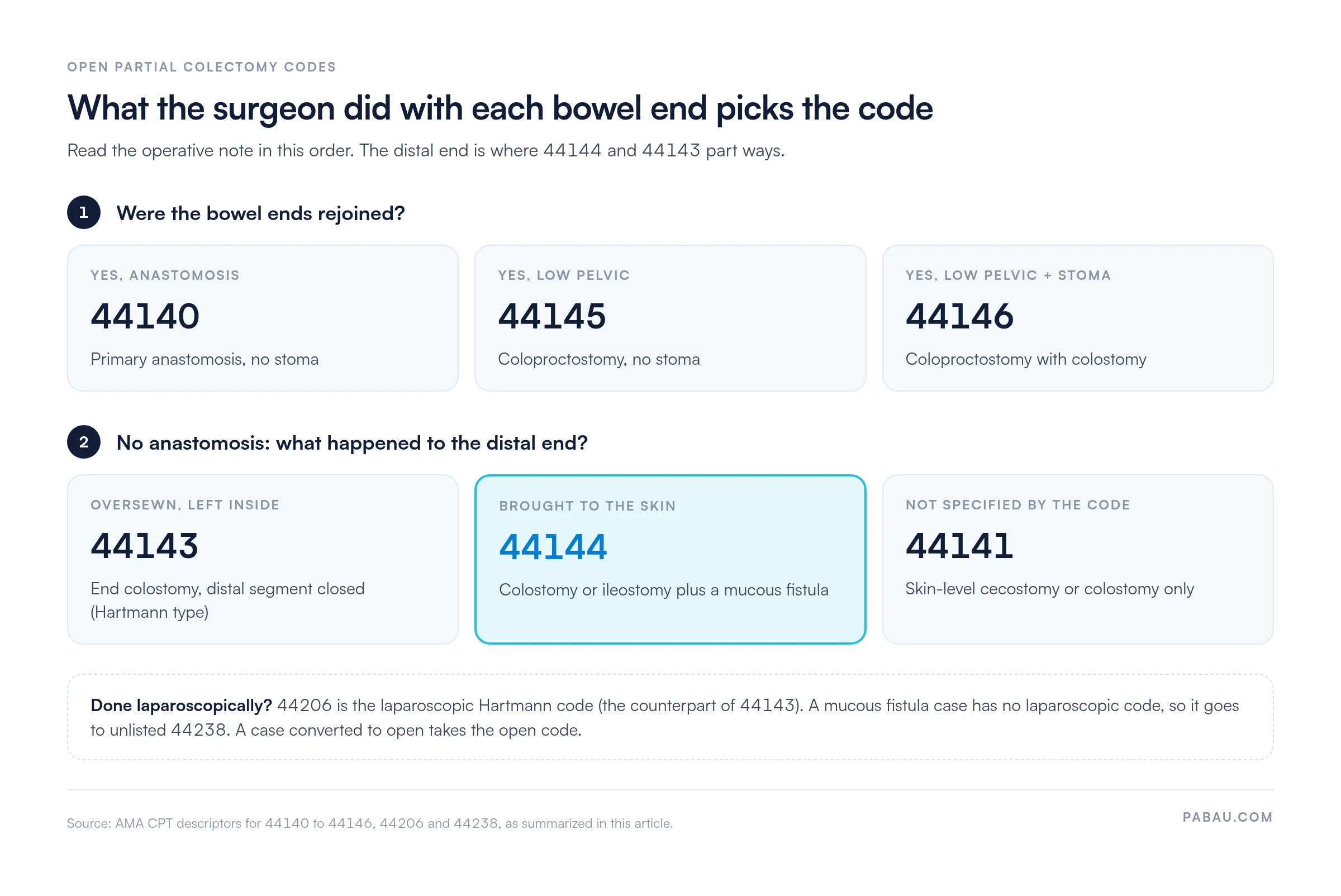
Check the operative report for the words ‘mucous fistula’ or ‘mucofistula’ and confirm a separate skin opening for the distal end. If the report says ‘oversewn’ or ‘stapled closed’ for the distal stump, the correct code is 44143 (Hartmann), not 44144.
The 44140 family covers open partial colectomies differentiated by what is done at both ends of the resected bowel. However, no single element decides the code. The combination of proximal and distal management does.
For example, a laparoscopic case converted to open for adhesions, perforation, or technical difficulty is coded as the open procedure. If both ends were exteriorized, that is 44144, with the conversion and its clinical reason documented. No laparoscopic version of 44144 exists, so a case completed laparoscopically goes to unlisted code 44238. Similarly, the neighboring low pelvic code, 44145, follows the same open-versus-laparoscopic split.
Medical necessity for CPT code 44144 must be supported by an ICD-10-CM diagnosis code that shows the clinical reason for bowel resection without primary anastomosis. Because payers cross-check the CPT and ICD-10 pair, a conflict can lead to a denial.
In addition, ICD-10-CM codes update each October 1. Verify the current-year code descriptors via the CDC/NCHS ICD-10-CM web tool before you submit, particularly for the K57 diverticular disease category.
Medicare reimbursement for CPT code 44144 comes from the CMS Physician Fee Schedule (MPFS). First, the RBRVS formula multiplies the total RVU by the annual conversion factor. Medicare publishes separate facility and non-facility rates, but open colectomy is a hospital procedure, so the facility rate applies.
The CMS Physician Fee Schedule lookup tool is the authoritative source for current RVU values. The table below shows the RBRVS component structure. Check it against the current-year MPFS database before billing.
Use the FastRVU 2026 RVU lookup to retrieve the current wRVU, PE RVU, MP RVU, and Medicare payment rate for 44144 by locality. The 90-day global period bundles the preoperative visit on the day before surgery and routine postoperative care for 90 days into the payment. Therefore, bill the surgical code only, not follow-up E/M visits inside the global window.
Once the code is assigned, Pabau’s claims management software submits the CMS-1500/837P claim through the Claim.MD clearinghouse. It runs eligibility checks and tracks ERA remittances, so your team sees when a 44144 claim pays or denies.
For example, an operative report that uses the word “colostomy” without specifying the distal bowel management is insufficient to support 44144. In addition, payers conducting post-payment audits look for clear documentation of the mucous fistula creation, not just the proximal stoma.
The following checklist shows what a coder reviewing the operative report needs to confirm before assigning 44144. Submitting a clean claim for a complex surgical code requires every item documented before you submit, not flagged for follow-up after the denial.
Superbill generation for surgical cases benefits from structured fields that prompt coders to confirm each documentation element before the encounter is closed. When the operative note does not say what was done with the distal stump, query the surgeon before coding. Do not default to 44143.
Modifier selection for CPT code 44144 follows standard surgical coding rules. Also, apply only modifiers supported by the operative and clinical documentation.
Most CPT code 44144 denials have three causes. These are the wrong code (usually 44143), an incomplete operative report, or an ICD-10 code that does not support a staged procedure. Therefore, tracking those patterns in your denial management workflows shortens delays.
When a denial arrives, the remittance denial codes on the ERA (835 transaction) identify the payer’s reason. Moreover, pairing that tracking with the documentation checklist above speeds appeals and builds a correction loop into pre-submission.
Run a quarterly audit of all 44143 and 44144 claims. A 44143 claim from a surgeon who often creates mucous fistulas is worth a second look. The operative report may support 44144, and a corrected claim can recover the undercoding within the payer’s timely filing window.
A colectomy claim often passes through three hands. The coder reads the operative note, the biller keys the claim into a clearinghouse portal, and someone else watches for remittances in a separate inbox.
Instead, in Pabau, the claim is built from the patient record and submitted as a CMS-1500/837P through Claim.MD. Eligibility checks run before the admission, and ERA remittances and secondary claims come back to the same record.
However, code selection stays with your coders. What changes is visibility. A denied 44144 claim shows up against the patient and the date of surgery, so the corrected claim goes out inside the filing window.

Pabau submits CMS-1500/837P claims through Claim.MD, runs eligibility checks and tracks ERA remittances. Your billing team sees each colectomy claim’s status on the patient record.

CPT code 44144 and its nearest neighbor, 44143, split on one surgical decision. Either the distal bowel end is oversewn and left in the abdomen, or it is brought to the skin as a mucous fistula.
Make that question a fixed step in your operative-note review, and query the surgeon whenever the note is silent on it. The claim then holds up against both undercoding and a post-payment audit.
Once the code is right, Pabau submits the claim through Claim.MD, checks eligibility and tracks the ERA remittance until the claim pays. Book a demo to see that workflow on a colectomy case.

Comparing against the Hartmann code? CPT code 44143 covers the open colectomy where the distal stump is closed and left inside the abdomen.
Using Claim.MD for surgical claims? Claim.MD clearinghouse overview explains how the clearinghouse checks and routes claims before they reach the payer.
Confused by 837 transaction requirements for surgical claims? Understanding the 837 file format covers the electronic claim structure for professional and institutional billing.
Want to see how payments post back? Electronic remittance advice (ERA) explained shows how 835 remittances feed denial tracking and payment posting.
CPT code 44144 is an open partial colectomy with resection, a proximal stoma (colostomy or ileostomy) and a distal mucous fistula, per the AMA descriptor. All three parts must appear in the operative report to support this code. There is no laparoscopic code for this procedure; a laparoscopic approach is reported with unlisted code 44238.
CPT 44143 (Hartmann procedure) closes the distal bowel stump and leaves it inside the abdomen. CPT 44144 exteriorizes the distal stump as a mucous fistula at the skin surface. If the operative report says the distal end was “oversewn” or “stapled closed,” use 44143. If it describes a separate skin opening for the distal bowel, use 44144.
A mucous fistula is a skin-level opening created from the distal (downstream) end of the divided bowel after resection. Unlike the proximal stoma, it passes only mucus secreted by the remaining bowel lining. It keeps the distal segment accessible for future reversal surgery without a laparotomy to find an oversewn stump. Its presence is the key differentiator between CPT 44144 and CPT 44143.
Three causes lead the list. The first is billing 44143 when a mucous fistula was created. The others are an operative report that omits the fistula and a diagnosis code that does not support staged surgery. NCCI bundling conflicts and global period billing errors are secondary causes. Most denials are appealable with the corrected operative documentation.





