HCPCS Code Q4175: Billing, coverage, and documentation guide
HCPCS Code Q4175: Code Description and Product Identity HCPCS Code Q4175 is the ...

Last Updated: Nov 20, 2026
44213 is the CPT add-on code for laparoscopic mobilization of the splenic flexure performed with a partial colectomy. It is reported in addition to the primary procedure, never on its own.
Medicare pays 44213 only alongside one of five laparoscopic partial colectomy codes, 44204 through 44208. The operative report must describe the mobilization as a distinct step and state why it was needed.
Let Pabau's smart automation suggest the right codes, reduce claim denials, and keep your practice compliant—effortlessly.
Automate repetitive tasks and focus on what matters most—your patients.
Reduce coding errors and ensure compliance with the latest regulations.
Clean claims, fewer denials, and faster reimbursements.
Powerful insights and reporting to help your practice thrive.
HIPAA compliant SOC 2 certified GDPR-compliant Trusted by 4,000+ clinics worldwide

CPT code 44213 describes laparoscopic mobilization of the splenic flexure performed with a partial colectomy, and it is an add-on code (+44213).
44213 is never billed alone. It needs one of five primary laparoscopic partial colectomy codes, 44204 through 44208, on the same claim.
Total colectomy codes 44210 through 44212 are not on the primary code list, so 44213 does not pair with them.
The operative report must describe the splenic flexure mobilization as its own step and state why it was medically necessary.
Most 44213 denials trace back to a missing or wrong primary code, or to an operative note that mentions the mobilization in passing.
CPT code 44213 is the add-on code for laparoscopic mobilization of the splenic flexure during a partial colectomy. It is never billed on its own.
CMS’s add-on code edits list it as a Type 1 add-on code with five primary codes, 44204 through 44208. Medicare pays it only when one of those primary codes is paid to the same practitioner for the same patient and date.
The AMA CPT code set descriptor reads: Laparoscopic mobilization of splenic flexure performed in conjunction with partial colectomy (List separately in addition to primary procedure). The plus symbol (+44213) in the CPT codebook marks its add-on status.
Add-on codes exist because some surgical steps add significant work that the primary code’s relative value units do not capture. Splenic flexure mobilization is one of those steps. When the surgeon performs it during a laparoscopic partial colectomy, billing 44213 alongside the primary code reflects that extra operative work. A grasp of medical billing fundamentals for add-on codes helps practices avoid the most common submission errors.
Add-on codes follow billing rules that differ from standalone procedure codes. CPT 44213 must be reported on the same claim as its primary procedure, never on a separate date of service. It carries no global surgical period of its own. It inherits the primary code’s period, which for a major laparoscopic colectomy is typically 90 days.
The CMS add-on code edits name the primary codes that may accompany 44213. All five are laparoscopic partial colectomies. Report 44213 only with one of the following:
Reporting 44213 without one of these codes on the same claim brings an automatic denial. Payer systems cannot process an add-on code without its parent, so the claim rejects at the edit level before a reviewer sees it. The laparoscopic total colectomy codes, 44210 through 44212, are not on the list either.
Laparoscopic mobilization of the splenic flexure frees the left colon at its fixed attachment near the spleen. The surgeon does it to gain bowel length for a tension-free anastomosis. The step involves dividing the splenocolic and phrenocolic ligaments, dissecting in the lesser sac, and sometimes entering the left mesocolon. Its risks include splenic capsule injury, left ureter damage, and inadvertent entry into the tail of the pancreas.
Splenic flexure mobilization is medically necessary when bowel reach is insufficient for a tension-free anastomosis. The most common clinical settings include:
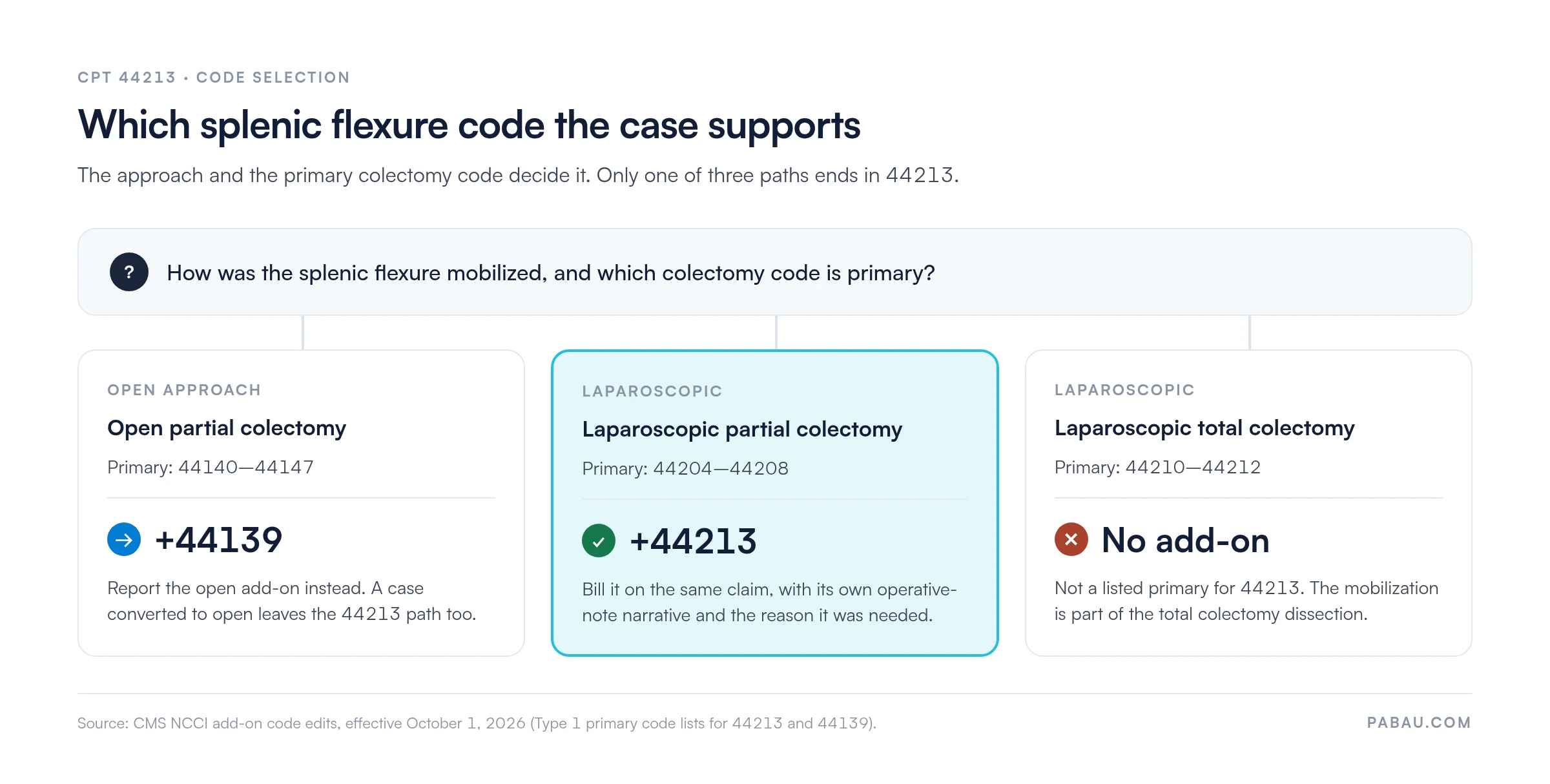
During a total colectomy, the splenic flexure is freed as part of the full colonic dissection. That work belongs to 44210, 44211, or 44212 and is not reported with 44213.
Not every laparoscopic left colectomy requires splenic flexure mobilization. The surgeon decides during the operation, based on bowel reach and mesenteric mobility. That decision, and the reason for it, must appear in the operative note to support the 44213 charge.
The operative report is the billing record for CPT 44213. Without adequate documentation, the claim will not survive a payer audit. A clean claim submission depends on getting this right before anyone enters the charge. The operative note must contain each of the following:
A short phrase appended at the end of the operative note (“splenic flexure was mobilized”) is rarely sufficient. Coders and auditors look for a detailed description that could stand alone as documentation of a separately performed service.
Before submitting a CPT 44213 claim, have the coder check the operative report. It should hold a standalone paragraph on the mobilization, with a medical necessity statement. A single mention at the end of the note is the most common documentation deficiency behind denials on this code.
The National Correct Coding Initiative (NCCI) maintains bundling edits that decide whether two codes may be reported together. Because 44213 is an add-on code, its pairing with primary codes is governed by the CMS add-on code edits. The procedure-to-procedure edit tables then cover the other codes on the claim.
Coders should check the current CMS NCCI tables every quarter, since CMS updates the edits four times a year. The key bundling considerations for CPT 44213 claims include:
Consult the current quarter’s CMS NCCI Policy Manual for Medicare Services before deciding that a modifier resolves a specific edit pair. Applying a modifier to bypass an edit without supporting documentation is a compliance risk.
CPT 44213 sits at the end of the laparoscopic colectomy code range. The codes just before it and the open surgical analogue are often confused. Among its primaries, 44204 covers a partial colectomy with anastomosis, and 44207 adds a low pelvic coloproctostomy. Its last primary, 44208, keeps that low pelvic join and adds a colostomy. The comparison below shows when 44213 applies versus its neighbors:
The most consequential distinction involves the total colectomy codes 44210, 44211, and 44212. The splenic flexure is mobilized as part of that total dissection, and CMS does not list those codes as primaries for 44213. A claim pairing them fails the add-on edit. The decision comes down to two questions: which approach the surgeon used, and which colectomy code is primary.
Medicare pays for CPT code 44213 through the Medicare Physician Fee Schedule (MPFS), administered by the Centers for Medicare and Medicaid Services (CMS). The CMS Physician Fee Schedule lookup tool gives current payment rates, relative value units (RVUs), and facility versus non-facility differentials by locality.
Key reimbursement characteristics for CPT 44213 under Medicare:
Effective revenue cycle management for colorectal surgery depends on catching pairing errors before submission. Otherwise they surface as remittance denials weeks later.
Medicare does not require prior authorization for CPT 44213 as a standard rule, but commercial payers vary widely. Some Blue Cross Blue Shield plans and regional Medicare Advantage plans require authorization for laparoscopic colectomy and its add-on codes as a package. Verify payer-specific requirements before the procedure. Payer policies change without public notice, so a policy verified six months ago may no longer be current.
CPT 44213 denials follow predictable patterns, so each one has a clear fix. Strong denial management workflows for colorectal surgery coding should address all six of these before claims leave the practice:
Review denial codes in medical billing for the CARC and RARC reason codes payers return on 44213 rejections. They map directly back to the denial categories above.
A denied 44213 claim is recoverable in most cases, provided the documentation supports it. Follow these steps:
Appeals for CPT 44213 succeed most often when the surgeon’s addendum addresses the specific denial reason instead of restating the operative note. If the denial cited insufficient medical necessity, the addendum should describe the intraoperative bowel reach and why the anastomosis needed the mobilization.
In many surgical practices, the 44213 pairing gets checked by hand, if at all. The operative note is often read only after a denial arrives, and appeals are tracked in a spreadsheet. Each step depends on one coder remembering the add-on rules.
Pabau, a practice management platform with built-in claims management software, keeps that work in one place. US claims go out as CMS-1500 and 837P files through Claim.MD, with eligibility checks before the date of surgery. ERA remittances come back into Pabau, so a denied 44213 line shows its reason code next to the claim.
Prior authorization codes, dates, and sessions sit on the patient’s case, with a warning when one is missing. Your billing team can work a denial the day it posts instead of finding it weeks later in an aging report.

Pabau sends US claims through Claim.MD and brings ERA remittances back to the claim, so 44213 denials surface with their reason codes. See how surgical practices work denials faster with Pabau.

Treat 44213 as a claim that is won or lost in the operating room. If the surgeon dictates a separate mobilization paragraph with its reason, and the primary code is 44204 through 44208, the add-on pays.
The trade-off worth remembering is time. A coder spending two minutes on the operative note before submission saves weeks of appeal work. Build that check into the charge entry routine for every laparoscopic left-sided resection.
Want 44213 denials to surface with their reason codes the day they post? Book a demo to see how Pabau handles colorectal surgery claims.

Billing the primary procedure with an ileocolostomy? CPT code 44205 covers laparoscopic partial colectomy with removal of the terminal ileum, one of the five primaries for 44213.
Submitting colorectal surgery claims to Medicare? Medicare billing walks through the claim rules and payment process that apply to surgical add-on codes.
Looking for a complete overview of the claims lifecycle for surgical practices? Revenue cycle management explained covers each stage from charge capture through payment posting.
Working a backlog of denied surgical claims? Denial management in healthcare sets out a workflow for preventing, tracking, and appealing denials.
CPT code 44213 is an add-on code for laparoscopic mobilization of the splenic flexure, performed with a partial colectomy. The plus (+) symbol in the CPT codebook marks it as an add-on, so it is never billed alone. It must accompany a primary laparoscopic partial colectomy code.
Yes, CPT 44213 is an add-on code, listed by CMS as a Type 1 add-on. It must be reported on the same claim as one of its primary codes: 44204, 44205, 44206, 44207, or 44208. Submitting 44213 without one of them brings an automated denial at the payer’s edit level.
The primary codes for CPT 44213 are 44204 through 44208, which cover laparoscopic partial colectomy procedures. The code is not reported with total colectomy codes 44210 through 44212 or with open colectomy codes. The open analogue for splenic flexure mobilization is 44139.
Yes, CPT 44213 may be billed with 44204 (laparoscopic partial colectomy with anastomosis). The operative report must describe the splenic flexure mobilization as a separate step from the anastomosis. It must also give the medical reason, typically insufficient bowel reach for a tension-free anastomosis.
CPT 44212 is a primary code for laparoscopic total colectomy with proctectomy and ileostomy. Splenic flexure mobilization is included in that procedure and not separately billable. CPT 44213 is the add-on for a separately performed mobilization during a partial colectomy, so the two codes are never interchangeable.
Yes. CMS updates NCCI bundling edits every quarter, and they may affect code pairs that include 44213. Lysis of adhesions performed during the splenic flexure dissection generally bundles and is not billed separately. Check the current quarter’s CMS NCCI tables before applying a modifier to bypass a bundle.