

HCPCS Code L0472: Hyperextension TLSO billing guide
HCPCS code L0472: Official descriptor and device definition HCPCS code L0472 des...

Last Updated: Nov 5, 2026
44143 is the CPT code for colectomy, partial; with end colostomy and closure of distal segment (Hartmann type procedure). It covers an open resection of part of the colon, with the proximal end brought out as an end colostomy and the distal segment closed.
Coders most often see it after a sigmoid resection for perforated diverticulitis or an obstructing tumor. The surgeon leaves a closed rectal stump instead of an anastomosis. The colostomy is part of the code and is never billed separately. A laparoscopic Hartmann procedure is reported with 44206 instead.
Let Pabau's smart automation suggest the right codes, reduce claim denials, and keep your practice compliant—effortlessly.
Automate repetitive tasks and focus on what matters most—your patients.
Reduce coding errors and ensure compliance with the latest regulations.
Clean claims, fewer denials, and faster reimbursements.
Powerful insights and reporting to help your practice thrive.
HIPAA compliant SOC 2 certified GDPR-compliant Trusted by 4,000+ clinics worldwide

CPT 44143 describes an open partial colectomy with end colostomy and closure of the distal segment, the Hartmann type procedure.
The laparoscopic version of the same operation is reported with CPT 44206, so 44143 applies only to an open approach.
Colostomy creation is bundled into 44143 under NCCI edits, and billing it separately is the most common denial trigger for this code.
A 90-day global period applies, so related post-op visits in that window are part of the surgical payment.
Pabau, the practice management platform we build, checks CPT and ICD-10 pairings and flags NCCI conflicts before a 44143 claim reaches the payer.
CPT code 44143 covers an open partial colectomy with an end colostomy and closure of the distal bowel segment. The surgeon removes a segment of the colon, brings the proximal end out as a colostomy, and staples or oversews the distal end.
The American Medical Association’s CPT code set places 44143 in the Surgery/Digestive System section, alongside colectomy codes 44140 through 44147. Within that range, CPT 44145 is the open resection that joins the colon to the rectum low in the pelvis.
No anastomosis is created, and the closed distal segment usually stays in the pelvis as a rectal stump. That pairing of an ostomy and a closed stump separates 44143 from 44140, which reconnects the bowel. It also separates it from 44144, where a colostomy or ileostomy is created along with a mucofistula.
Code selection in this family depends entirely on what was created at the distal end of the bowel and whether an ostomy was formed. These are the codes coders confuse most often, and a wrong pick leads to a denial or a post-payment audit.
The operative report is the deciding document, and the diagram below maps each outcome to its code. If the surgeon creates an end colostomy and leaves the distal segment as a closed stump without anastomosis, 44143 is correct.
If a colostomy or ileostomy is created with a mucofistula, use 44144 instead. If the bowel is reconnected end-to-end or end-to-side, use 44140.
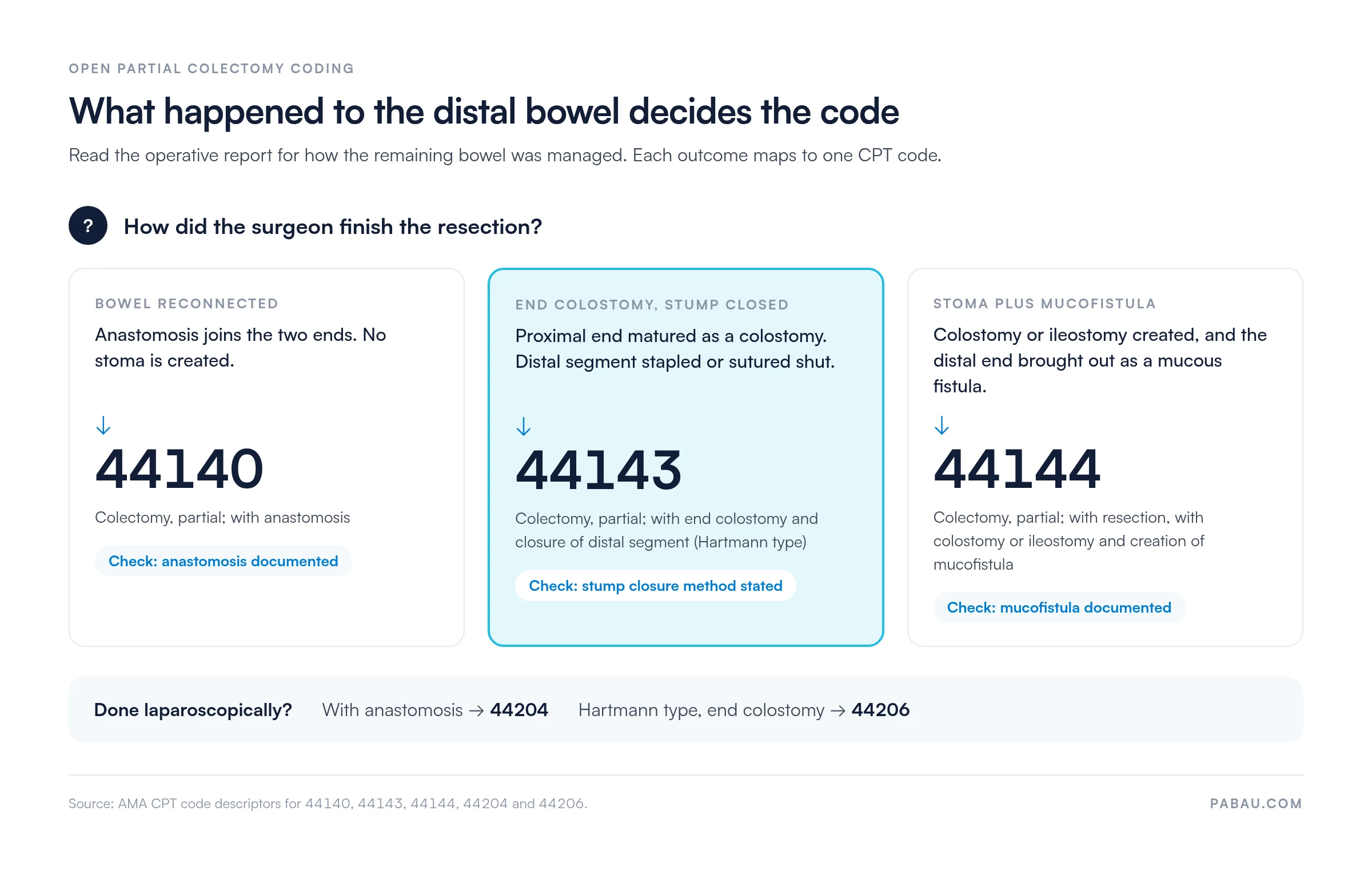
CPT code 44143 is open-only. A laparoscopic colectomy with end colostomy and closure of the distal segment is reported with CPT 44206. A laparoscopic colostomy made without removing any colon is a separate service, billed as CPT 44188. When a case starts laparoscopically and converts to open, report the open code (44143) and document the reason for conversion.
Add modifier -22 only when the note shows substantially increased work. Never report both the laparoscopic and open codes for the same session.
The Hartmann procedure is the textbook case for CPT code 44143. Surgeons choose it for perforated diverticulitis, obstructing sigmoid cancer, and emergencies where an anastomosis would risk a leak.
Coders working a Hartmann operative report should verify four elements before assigning 44143:
Auditors focus on the rectal stump documentation. The operative report must state explicitly how the distal segment was managed. “Stump oversewn with 3-0 Vicryl and left in the pelvis” satisfies payer requirements.
A report that describes the resection and colostomy but never mentions the distal segment is incomplete for 44143. Expect a documentation request or a denial.
Hartmann reversal, which reconnects the colon to the rectal stump, is a separate encounter. It is coded to 44626 or 44625, depending on the technique. Reversal codes never go on the original 44143 claim.
Diagnosis-procedure mismatch is a frequent cause of 44143 denials. Every claim needs at least one ICD-10-CM code that supports medical necessity for a partial colectomy with colostomy. The diagnoses below are the usual indications for a Hartmann type resection, in line with AAPC coding guidance.
Code to the highest level of specificity the documentation supports. A diagnosis of “diverticulitis” with no perforation, abscess or bleeding maps to K57.32. Without the complication documented, payers may question why a colostomy was needed. When a nontraumatic perforation without diverticular disease drove the surgery, K63.1 carries the medical necessity.
Modifier selection errors are a fast path to denial or post-payment recovery for 44143. Each modifier requires specific operative documentation to survive a payer audit.
Modifier -22 draws more payer scrutiny than any other modifier on colorectal surgery claims. Payers expect a letter of medical necessity with measurable factors. Typical evidence is operative time well above the usual for the code, a documented BMI where obesity is cited, or radiology confirming prior pelvic radiation. Appending -22 to every complex colectomy without that support invites post-payment audits.
Before billing modifier -62 on CPT code 44143, check its co-surgeon indicator in the CMS Physician Fee Schedule lookup. Some payers restrict co-surgeon billing on colectomy procedures, so confirm approval before the claim goes out.
CPT code 44143 carries a high work relative value unit (RVU) assignment, reflecting open colorectal surgery with ostomy creation. Use the CMS Medicare Physician Fee Schedule lookup tool to find the current-year total RVU and national unadjusted payment for 44143. CMS updates these values every year, and geographic adjustment factors (GPCI) change the final payment by locality.
The reimbursement figure consists of three RVU components:
Underpayment on this code usually comes from a mismatched place-of-service code, which moves the claim onto the wrong rate. A medical claims clearinghouse such as Claim.MD should flag that mismatch before the claim reaches Medicare.
CMS assigns a 90-day global period to CPT 44143. Under Medicare’s global surgery package, the surgical payment covers related pre-operative services from the day before surgery.
It also covers routine post-operative care for 90 days after. An evaluation and management visit in that window for a problem related to the surgery is denied if billed separately.
These services stay separately billable within the global period:
Stoma care education from a registered nurse is not billable under the physician’s global package. Depending on the payer, it may be billable under nursing or outpatient facility rules.
Accurate coding for CPT code 44143 starts with a complete operative report. Missing elements lead to downcoding to 44140 or to an outright denial on post-payment audit. Every op report for 44143 must document:
A clean claim for a complex surgical code answers the reviewer’s questions before they request the medical record. A structured dictation template for colectomy makes a missing stump note or approach easy to spot before submission. Check your medical billing compliance protocols to confirm operative note standards meet current payer requirements.
The National Correct Coding Initiative (NCCI) bundles several related procedure codes into CPT 44143. Billing these codes separately without a valid modifier is a certain denial and, if done repeatedly, a compliance risk. Pabau’s claims management software flags NCCI edit conflicts before the claim reaches the payer.
Unbundling a code that NCCI would otherwise bundle takes modifier -59 (distinct procedural service) or an X{EPSU} modifier. The documentation must show a different session, procedure, site or indication. Modifier -59 without that support is one of the most audited modifier patterns in colorectal surgery.
Most 44143 denials trace back to the six causes in the table below, each with its fix. Denial management workflows catch them before the claim goes out. Knowing the medical billing denial codes attached to each cause helps billing staff write targeted appeals.
Emergency colorectal surgery often skips the standard prior authorization workflow. Many commercial payers expect notification within 24 to 48 hours of an emergency admission. Missing that window turns a payable claim into a technical denial that has nothing to do with the coding, and it needs its own appeal.
A 44143 claim usually passes through three sets of hands. The surgeon dictates, a coder reads the op note, and a biller keys the codes into a clearinghouse portal. Each handoff is another chance to miss the stump closure or add a bundled colostomy code.
In Pabau, the CPT code, ICD-10 diagnoses and modifiers sit on the patient record, and claims go out through the Claim.MD integration. Pabau checks CPT and ICD-10 pairings and flags NCCI conflicts before the claim leaves the practice.
The result is fewer rejected colectomy claims and less time spent appealing a 90-day global payment that should have paid the first time.

Pabau integrates with Claim.MD to validate CPT-ICD-10 pairings, flag NCCI conflicts, and submit clean surgical claims electronically. See how it works for colorectal surgery billing teams.

For 44143, the claim turns on what the operative report says about the distal bowel. Get surgeons to document the open approach, the end colostomy and the stump closure every time. That removes the causes behind most denials on this code.
Start with a dictation template that asks for those three facts, then run every colectomy claim through an NCCI check before it goes out. A few extra minutes per case costs far less than a large surgical payment stuck in appeal. Book a demo to see how Pabau catches 44143 coding conflicts before your claims reach the payer.

Navigating the 837P file format for surgical claims? 837 file guide covers the EDI transaction structure used to submit professional claims electronically.
Want to understand ERA remittances after a 44143 claim pays or denies? Electronic remittance advice explained walks through 835 transaction reading and CARC denial code interpretation.
CPT code 44143 covers an open partial colectomy with end colostomy creation and closure of the distal bowel segment, the Hartmann type procedure. Bowel resection, colostomy maturation and rectal stump closure are all billed as this single code, with no separate colostomy code.
CPT 44143 is a partial colectomy with an end colostomy and a closed distal segment. CPT 44144 covers a partial colectomy with a colostomy or ileostomy plus the creation of a mucofistula. If the distal end was closed as a stump, use 44143; if it was brought out as a mucofistula, use 44144.
The global period for CPT 44143 is 90 days, which makes it a major surgical procedure under CMS rules. Routine post-operative care related to the surgery is included in the global payment for those 90 days. Services for unrelated conditions in that window need modifier -24 (E&M) or -79 (procedure) to be billed separately.
CPT 44143 is for open colectomy only. A laparoscopic partial colectomy with end colostomy and closure of the distal segment is reported with CPT 44206. When a laparoscopic case converts to open, report the open code (44143) and document the reason for conversion.
Modifiers used with CPT 44143 include -22 (increased complexity), -51 (multiple procedures), -62 (two surgeons), -80 (assistant surgeon, MD) and -AS (PA or NP assistant). Modifier -22 gets the most scrutiny and needs a letter of medical necessity with measurable complicating factors.
Five ICD-10-CM codes come up most often with CPT 44143. They are K57.20 (perforated diverticulitis with abscess), C18.7 (sigmoid colon malignancy), K63.1 (intestinal perforation), K56.2 (volvulus) and K56.609 (intestinal obstruction). Code to the highest specificity the operative and pathology notes support, because unspecified codes invite medical necessity denials.
The most common causes are billing 44140 when a colostomy was created, and billing the colostomy separately despite NCCI bundling. Missing prior authorization, diagnosis-procedure mismatch, an op report with no stump documentation and an unsupported modifier -22 follow. A pre-submission NCCI check and a structured dictation template prevent most of them.
Medicare reimbursement for CPT 44143 varies by location, based on the CMS Physician Fee Schedule and local Geographic Practice Cost Indices (GPCI). Look up the current-year total RVUs and national unadjusted payment in the CMS PFS lookup tool. Rates change every year, so no fixed figure stays accurate for long.



