CPT code 21011: Excision of soft tissue tumor of the face
CPT code 21011: Official descriptor and procedure overview CPT code 21011, as pu...

Last Updated: Oct 8, 2026
CPT code 44625 reports the open closure of an intestinal stoma when the surgeon also removes a segment of bowel and rejoins the ends. The join must not run from colon to rectum. Its neighbors look almost identical on a claim. CPT 44620 covers closure without resection, and 44626 covers a colorectal join, such as a Hartmann's reversal.
One statement in the operative note decides which code survives review: that bowel was excised. Without it, expect the payer to downcode to 44620. The sections below follow a 44625 claim from operative note to payment, with the checks that keep it there.
Let Pabau's smart automation suggest the right codes, reduce claim denials, and keep your practice compliant—effortlessly.
Automate repetitive tasks and focus on what matters most—your patients.
Reduce coding errors and ensure compliance with the latest regulations.
Clean claims, fewer denials, and faster reimbursements.
Powerful insights and reporting to help your practice thrive.
HIPAA compliant SOC 2 certified GDPR-compliant Trusted by 4,000+ clinics worldwide

CPT code 44625 needs both a bowel resection and an anastomosis. A closure without resection maps to 44620 instead.
The phrase “other than colorectal” is binding. A colon-to-rectum join, such as a Hartmann’s reversal, is billed as 44626.
A frequent denial trigger is an operative report that never confirms the resection, so payers downcode the claim to 44620.
Medicare keeps 44625 on its inpatient-only list for CY2026, so an outpatient or ASC place of service gets the claim rejected.
Pabau’s claims management software pre-fills the claim from the record, validates required fields and submits through Claim.MD.
CPT code 44625 reports an open enterostomy closure that includes a bowel resection and a non-colorectal anastomosis. The American Medical Association descriptor reads: Closure of enterostomy, large or small intestine; with resection and anastomosis other than colorectal.
The code sits in the Repair group of the Intestines (Except Rectum) codes, within the CPT Surgery chapter. All three elements must appear in the same operation. Remove any one of them, and a different code applies.
An enterostomy takedown with resection follows a predictable sequence. First, the surgeon mobilizes the stoma from the abdominal wall and frees the bowel from adhesions. Next, the segment bearing the stoma is resected, along with any compromised bowel nearby. Finally, an anastomosis restores continuity.
Resection is the step that separates 44625 from a simpler closure. In some takedowns, the surgeon freshens the stoma edges and closes the bowel in place. That approach maps to CPT 44620. Surgeons usually resect because of scarring at the stoma, ischemic or narrowed bowel ends, or a diseased segment.
Stoma type changes the picture too. A loop ileostomy with healthy edges may close without resection, so coding 44625 by default is an error. An end colostomy reversed after a Hartmann’s procedure usually needs a colorectal join, which points to 44626.
The open enterostomy closure codes form a tight family. Two questions sort them. Was bowel resected, and is the anastomosis colorectal?
Coders often confuse 44620 and 44625. The operative report must state that resection was performed. If it only records a “takedown” or “reversal,” payers default to 44620.
Approach comes before both questions. A laparoscopic closure with resection and anastomosis is reported with 44227, never with the open codes. The decision tree below puts all three checks in order.
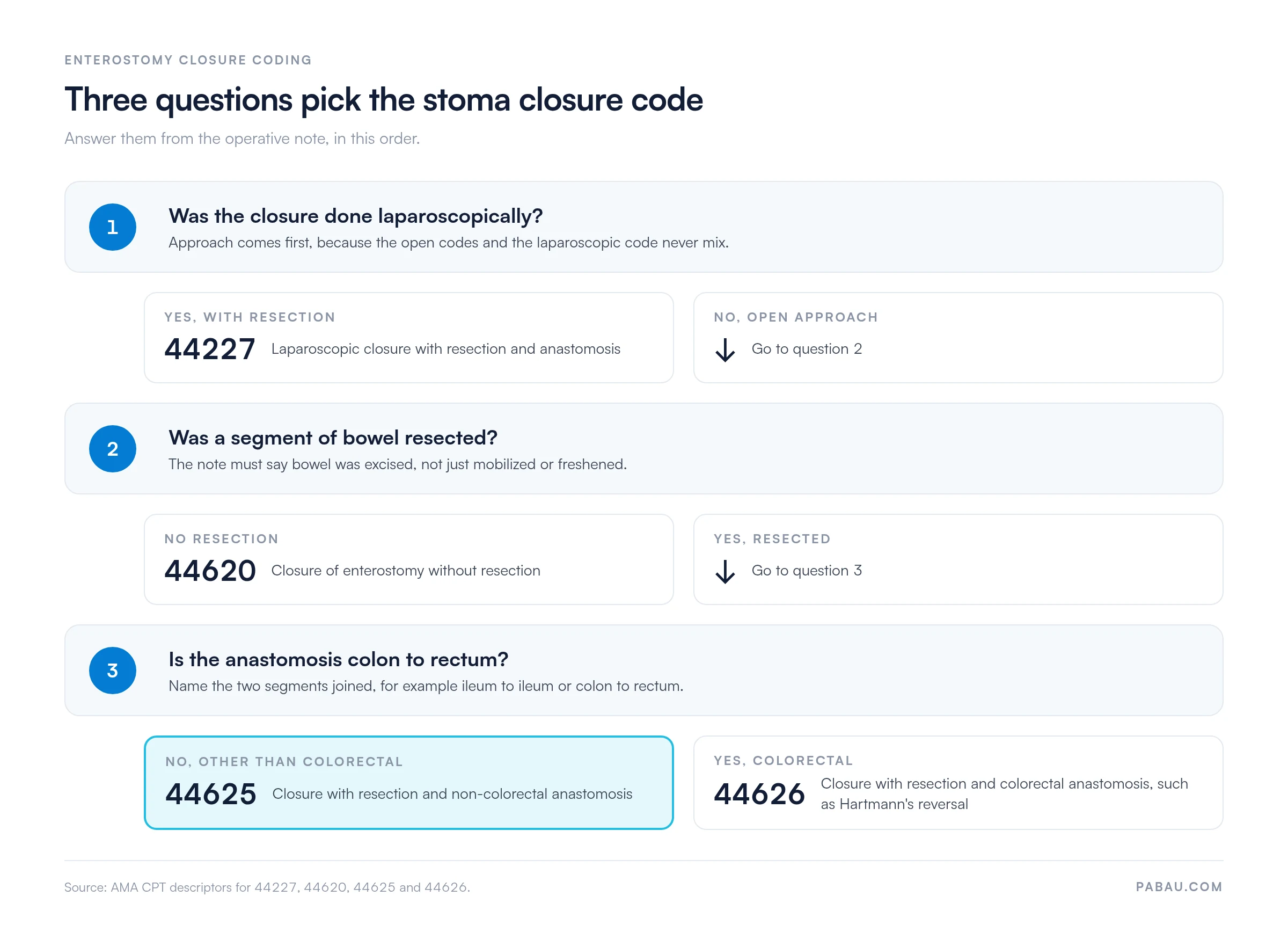
The operative report must support all three elements of CPT code 44625. A clean claim starts with documentation specific enough to survive payer review without a records request.
Check the note for these five elements before coding:
If the note describes a colorectal reconnection, code 44626 instead. Auditors spot a 44625 claim that contradicts the note on record review.
CPT 44625 is on the CMS inpatient-only (IPO) list. Medicare won’t pay it when the claim shows an outpatient or ambulatory surgical center (ASC) place of service.
CMS updates the list annually in the Outpatient Prospective Payment System (OPPS) final rule, typically released in early November. CMS has also finalized a three-year phase-out of the IPO list, starting in CY2026. Code 44625 remains listed for CY2026, so check each new rule before you bill.
Practical checks for billing teams:
CPT code 44625 carries a 90-day global surgical period, so routine post-op care is bundled into the surgical fee. Modifiers flag the exceptions and report services outside that package.
Medicare pays CPT code 44625 under the Medicare Physician Fee Schedule (MPFS), using relative value units (RVUs). Because the code is inpatient-only, the facility rate applies. That’s the surgeon’s fee for work in a hospital, not the office-based non-facility rate.
RVUs and the conversion factor change each January 1. The CMS Physician Fee Schedule lookup tool gives national rates. Your geographic practice cost index (GPCI) then adjusts them for your locality. The FastRVU 2026 RVU lookup estimates payment with GPCI adjustments for your Medicare Administrative Contractor region.
Commercial rates for 44625 vary by contract and often run above Medicare. Check the payer contract before you estimate reimbursement on a specific claim.
CPT code 44625 claims fail in five recurring ways, and each one is preventable. A steady denial management workflow cuts resubmission costs and protects cash flow. Our denial code guide decodes the reason codes payers send back.
Hold any claim that fails a check until the surgeon adds an addendum. A resubmission costs more time than the review.
Original Medicare doesn’t require prior authorization for CPT code 44625. It does require medical necessity, supported by the clinical record, the diagnosis codes and the operative report.
Medicare Advantage plans and most commercial insurers handle 44625 differently. Requirements vary by plan. They may include surgeon notes, imaging of the original indication and evidence the patient is fit for reversal. A clear prior authorization process prevents same-day cancellations caused by missing approvals.
CPT code 44625 carries a 90-day global period. Routine post-op care from the day after surgery through day 90 is bundled into the surgical fee. Payers deny bundled visits billed separately, and a pattern of them can draw audit attention.
These services can still be billed separately during the global period:
Diagnosis codes show why the closure is clinically appropriate, which heads off medical necessity denials. The closure encounter is coded as attention to the stoma, not as stoma status.
Pair Z43.2 or Z43.3 with the condition code that explains why the stoma was created. Z93.2 and Z93.3 are status codes for other encounters. An Excludes1 note on Z93 bars them when the stoma itself needs attention. Verify pairings in the CDC ICD-10-CM coding tool and the annual ICD-10-CM Official Guidelines for Coding and Reporting.
Many surgical billing teams still build each 44625 claim by hand. They copy codes from the operative note, retype patient details and chase the claim through payer portals.
Pabau, the practice management platform we build, handles that stretch with claims management that pre-fills each claim from the patient record. Coders pick CPT and ICD-10 codes from built-in lookup libraries. Required-field validation then flags a missing entry before the claim leaves.
Pabau integrates with the Claim.MD clearinghouse for electronic claim submission to CMS and US payers. Eligibility checks, claim-status tracking and ERA posting run through the same connection, so your team works from one screen.
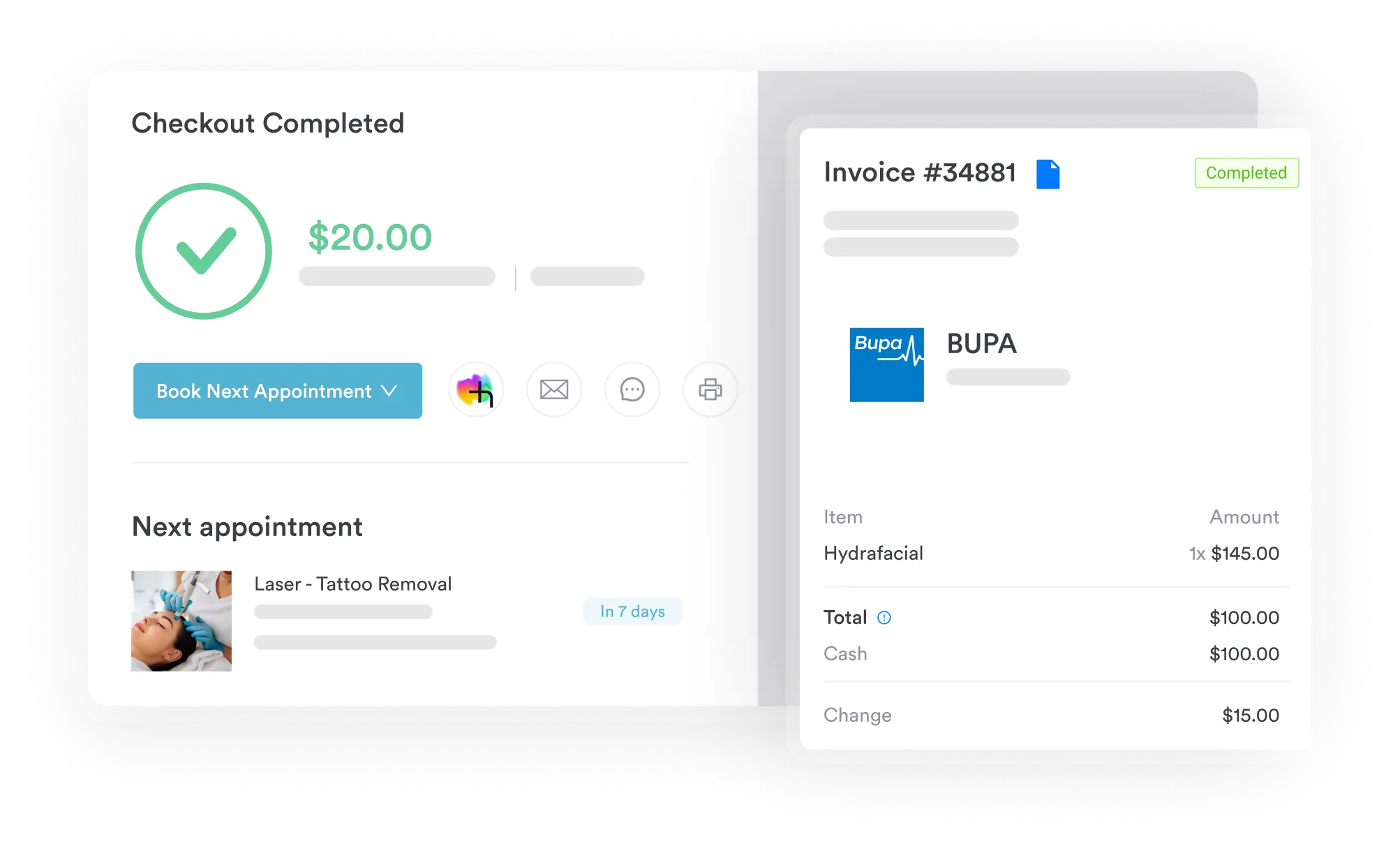

Pabau pre-fills surgical claims from the patient record, checks CPT and ICD-10 codes against built-in libraries and validates required fields. Claims, eligibility checks and ERAs then run through Claim.MD.

CPT code 44625 stands or falls on one documented fact. The surgeon resected bowel and joined it somewhere other than colon to rectum. Get that into every operative note, and most 44625 denials never happen.
The trade-off is a few minutes up front. A coder who reads the note before coding catches a 44620 or 44626 case early. That beats appealing a downcode months later.
Pabau tracks claim status and posts ERAs through Claim.MD, so a downcoded 44625 claim shows up as soon as the payer responds. Book a demo to see how Pabau moves surgical claims from operative note to payment.

Need guidance on medical billing compliance for surgical procedures? Medical billing compliance covers the documentation and regulatory requirements that protect surgical practices from audit risk.
Want to understand how clearinghouse claims work end-to-end? 837 file submission explains the electronic transaction format used for inpatient surgical claim filing, including field-level requirements.
Looking for clean claim best practices beyond documentation? Superbill creation covers how to structure the charge capture document that feeds accurate CPT and ICD-10 codes into your claim.
Often around three months after the first operation, once the patient has recovered. Many surgeons order a contrast study first to confirm the bowel downstream has healed. Ongoing chemotherapy or slow recovery can push the date back.
Usually not. CMS NCCI policy treats a hernia repair at the incision site of an abdominal procedure as part of that procedure. A hernia repaired at a separate site can be reported when it’s medically necessary and documented.
Yes. Medicare won’t pay 44625 with an outpatient or ASC place of service. CMS updates the inpatient-only list annually in the OPPS final rule, typically released in early November. CMS finalized a three-year phase-out of the list starting in CY2026, and 44625 remains listed for CY2026.
Use CPT 44227 when a closure with resection and anastomosis is done laparoscopically, including robotic-assisted cases. The open codes 44620, 44625 and 44626 don’t apply to a laparoscopic approach.
Yes, when it’s medically necessary. Part A covers the inpatient hospital stay, and Part B covers the surgeon’s fee, billed under a code such as 44625. Deductibles and coinsurance still apply.